AMERICAN HONEY

american-honey-2

The film, American Honey, came onto my radar screen recently because of the buzz it seemed to be getting in the media. I saw the trailer and became intrigued. I vowed to see the movie. Several things about this movie caught my attention. The name for one, American Honey. Thought provoking and provocative. It stirred visions of a sweet young thing standing up in an open car with the wind rushing through her hair without a care in the world. When I learned it was a road trip movie about a teen aged girl in a magazine crew I was hooked. When I was 16 I was a member of a traveling magazine crew too.  It was my first actual paying job that I ever had where I got a weekly paycheck. My teachers and my parents hated it. My teachers thought it was a distraction and my parents didn’t like the exposure I got to the seamier side of life. I loved it for the same reasons. I learned more about life from that one experience than almost anything else I have ever done. Like the characters in the film, I came of age.

So I went to see it. Here is my report. Despite the name this film is actually British. It was directed by British filmmaker, Andrea Arnold. Shooting locations included: Muskogee, Oklahoma, and parts of Kansas, Nebraska, Missouri, Iowa, and North Dakota. I am not going to say anything bad about Muskogee. I lived there for seven years and it is full of colorful characters. But I will say this: it is a good place to run away from.

It is always interesting to me to see America depicted through the lens of a foreign born director. Such as the likes of Michelangelo Antonioni and Wim Wenders, and now Andrea Arnold. Their perspectives are just a little bit different. But that difference is instructive. Arnold has previously won an Oscar for Wasp (2005), Best Short Film, Live Action.

The lead actor is played by newcomer Sasha Lane. This is her first movie role. She was literally discovered on the beach on spring break in Panama City, Florida. She has great energy and is a natural in her role as Star, the teenager from Muskogee who takes a chance on getting out of there and joins the magazine crew that is passing through. Shia LaBeouf plays top salesman Jake who tries to show the independent minded Star the ropes. He succeeds in more ways than one. Riley Keough, Elvis Presley’s granddaughter, plays the crew leader.

americanhoney_clip_motel

A couple of things that put me off at first were the aspect ratio and the length of the film. Aspect ratio was 4:3 which was damned near a square on the screen. I must confess that I did not like this format much when I first saw it, but after a while I got used to it. This is a format that the director must like as she uses it frequently. Running time is two hours and 43 minutes. Quite long. But, I must say I didn’t notice it much until the movie was over and I went outside and noticed that the weather had changed and the light was decidedly different. Man, that was a long film, I told myself. But, as I said, during the watching of the film I really didn’t notice. I believe that it took that much time for the story, such as it was, to unfold. The movie was not filmed in a conventional story line with a classic beginning, middle, and end, but rather more like a slice of life. It put me in mind of cinema verite, which I love.

american-honey-crew

The movie was supposed to be about a subculture of millennials making their way and coming of age. The ensemble acting was quite good with lots of energy and engagement. Everyone had their own back story they were running away from. I didn’t find them to be that different from the teenagers I hung out with when I was selling magazines door to door. They are millennials and I am a boomer. But hey! We were all young once. Great movie! Highly recommend.

LACOMBE, LUCIEN

lacombe-lucien

While film noir remains my favorite film genre, emanating mainly from the 1940’s and ‘50’s as it were, it seems to me that film (now mainly digital) hit its high water mark, like so many other things in the culture, in the 1970’s. I just haven’t seen anything as good at the movies as those produced during that time frame.

lucien-w-gun

Lacombe Lucien falls into that category. Released in 1974, it was directed by French filmmaker Louis Malle. Screenwriting credits go to Louis Malle and Patrick Modiano. Modiano won the Nobel Prize for literature in 2014.

malle-lucien1

The movie takes place during WWII in Nazi occupied France. Eighteen year old Lucien lives in the rural southwest of the country with his peasant family on a farm. His father is a POW and his mother helps to operate the farm. Lucien, who has no particular political leanings, is bored and looking for something to do beside mop the floors at the local nursing home. We see a little bit into his nature as we observe a series of troubling behaviors that would indicate his propensity for violence and brutality. First he sling shoots a song bird for target practice, then he shoots a rabbit, then he knocks the head off a chicken in real time.

lucien-and-france

Lucien tries to join the French Resistance but he is turned down because of his age. On his way home he makes a chance encounter with some collaborators and the German Gestapo. They welcome him with open arms. They bring him into their fold, ply him with alcohol, food, a place to stay, and other comforts. He is given a gun and becomes an enforcer for the German police. This gives Lucien a chance to belong to something bigger than himself and gain a little power. It is not hard to make the leap from this disaffected youth in 1944 to the disaffected youth of today who join ISIS.

He is taken to a rich Jewish tailor who is in hiding by the name of Horn to have a suit of clothes made. Horn becomes a father figure to the boy and an awkward relationship begins between the two. Horn has a beautiful daughter whose name just happens to be, France. Lucien falls for her hard.

Things became complicated as the Horns are part of the persecuted minority and Lucien inadvertently is responsible for Horn’s imprisonment and being sent to a concentration camp. When the roundup comes for France and her grandmother, Lucien is conflicted but opts to help them out. They run off together and hideout in the countryside. Fast on their heels are the French Resistance and the Gestapo. The war comes to an end and Lucien meets with an unhappy fate.

There are many things going on here not the least of which is the depiction of the banality of evil as demonstrated by the French collaborators. It is a unique character study of Lucien Lacombe who is a confused, naive, bully. Also, the movie shows that there were perhaps more collaborators that the French would like to admit. All in all a great movie and an early masterpiece for Louis Malle.


CAFE SOCIETY

Cafe_Society

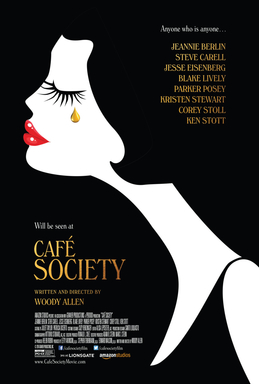
I caught a matinee today oh boy! It was Café Society, Woody Allen’s latest. It was just the thing I needed to lift my spirits. It had me smiling all the way through. I thought the acting was very good. Even Steve Carell, who I never really cared for, is starting to grow on me a little bit. Kristen Stewart, who is everywhere, was believable as the love interest. Blake Lively was lively as Veronica, the other love interest. And Jessie Eisenberg sure plays a mean Woody Allen. But the real star of the show was the cinematography. And the cities. It was essentially a tale of two cities. Los Angeles and New York in the 1930’s. Guess who won? New York. Complete with that iconic shot of Manhattan from the Brooklyn side framed lovingly by the Brooklyn Bridge. Not since Manhattan have we been graced by such a beautiful image.

It was photographed by acclaimed cinematographer Vittorio Storaro, favored cinematographer of Bernardo Burtolucci, for whom he photographed Last Tango in Paris. Mr. Storaro has won Oscars for Apocalypse Now, Reds, and The Last Emperor. This was Woody’s first foray into the digital world.

The plot was pretty standard stuff. Jewish boy goes to Los Angeles to work with his uncle in the movie business, falls in love with a secretary, things don’t work out; he goes back to New York and gets into the nightclub business. Falls in love another beautiful girl by the same name.  Complications ensue. What sets this material apart is the scintillating dialogue which is by turns clever, funny, and hilarious. Music to my ears. Oh, and speaking of music, the sound track is a master compilation of some of the best music from the era, Just wonderful.

Here is an example of some of the tete-e-tete between the characters and or other funny lines.

Bobby: What are you doing later?

Veronica: There is no later. It’s 1:30 am. I am usually in pajamas by 2.

Bobby: I like pajamas. What kind of beds do you like?

The narrator, who is the Woodman himself, occasionally muses: Socrates said the unexamined life is not worth living. The examined live is no bargain either. Or how about this one:  Life is a comedy written by a sadistic comedy writer.

Bobby’s big brother Ben is a gangster who gets convicted of murder and is sentenced to be executed in the electric chair. While in prison he converts to Christianity because there is no afterlife in the Jewish tradition. Ben’s mother is lamenting this fact when she says to her husband, “Ben is going to be executed in the electric chair and he has converted to Christianity and I don’t know what’s worse!” Pure genius!

In the last scene Bobby, is celebrating New Year’s Eve at his club while Vonnie and Phil are at a Hollywood party. Bobby and Vonnie in are in New York. Bobby in New York and Vonnie in LA are staring wistfully into the middle distance. More people die of unrequited love each year than of tuberculosis.

Ex Machina

Ex Machina

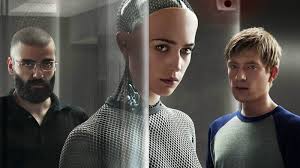
Ex Machina is a very slick science fiction thriller shot in Norway. A young programmer is hired under mysterious circumstances by the owner and CEO of a large Techno Firm to test the AI (artificial intelligence) of a beautiful fem-bot he has created. If this story sounds familiar it is because it is the latest iteration of a literary trope starting with Frankenstein. Only this is one of the better varieties and makes you think about the problems of creationism, robots, artificial intelligence, and the dangers and  pitfalls associated with falling in love with a lifelike beautiful robot.

The film starts slow then builds  in suspense and pays off in the final denouement which makes it worth the wait. Intelligently written with many turns and twists which will keep the viewers rapt attention. Beautifully photographed in the Norwegian Wood featuring a gorgeous subterranean abode and laboratory  which makes exciting use of its natural surrounding with breathtaking waterfalls, rock formations, and spectacular vistas of mountain tops and streams.

Domhnall Gleeson plays the nebbish computer programmer who is whisked to the hidden fortress of the mad scientist by Deus ex machina (helicopter). Oscar Isaac  plays the CEO and owner of the techno company where Caleb works. He is also the creator of Ava, the beautiful robot that Caleb is intended to test. Ava is played with remarkable conviction by Alicia Vikander. The movie is written and directed by Alex Garland.

This is the best movie I have seen this year and has reawakened my interest in robots and science fiction. The best example of of which Isaac Asimov’s,  “I Robot” and Philip K. Dick’s, “Do Androids Dream of Electric Sheep,” which was made into the science fiction movie classic, “Blade Runner.” I give this movie a rating of 8 out of 10. Highly recommend.

Unbroken

The movie Unbroken, directed by Angelina Jolie, proves that Miss Jolie is not only a movie star of the first magnitude, but a first rate director as well. There have been a lot of snarky comments about Angelina lately in the press, but I don’t know why there should be so much hate out there for the beautiful and talented Miss Jolie. Jealousy is the only thing I can see. I think credit is due for this masterful piece of work.
The film was beautifully photographed by Roger Deakins, also known for his work on The Shawshank Redemption, No Country for Old Men and, Skyfall. Writing credits go to Joel and Ethan Coen. The film was based on the best-selling book of the same name written by Laura Hillenbrand.
I was somewhat taken aback by some of the critics who called the movie boring and the hero unheroic. Nothing could be further from the truth. I was mesmerized for the entire running time of 2 hours and 17 minutes.  This film was about the triumph of the human spirit. It was not about super human deeds on the battlefield.
The movie was a faithful rendition of the book on which it was based. It told in a straight forward way with flashbacks throughout to flesh out the back story and give the audience understanding of what gave Louie Zamperini the strength of character to remain unbroken throughout the many ordeals he faced during WWII. He first survived a plane crash in the ocean, then survived 45 days at sea on a rubber raft with very little food and water. When he was picked up by the Japanese he was incarcerated in a prison camp and braved harsh conditions, mistreatment, and torture at the hands of a sadistic camp commander known as, “The Bird.”
In my view this is an inspirational film of epic proportion that shows us that the human spirit can triumph over evil. We need more films like this one. I see Oscar buzz and a possible nomination for best picture. It has my vote. Bravo Angelina Jolie!

Naming Blogs

The name Ghost Dog is in reference to the Jim Jarmusch film of the same name. I love this movie and the name Ghost Dog is the perfect trope evoking for me several levels of meaning, the first of which is my love for movies. Followed closely by my love for books, stories, photography and music. The movie contains all these elements and more. Including an eccentric character acting alone following his own code as expostulated in the book The Hagekure: The Way of the Samurai. Another element of my life very important to me is my interest and devotion to Eastern Philosophy. The way of the Samurai has long fascinated me. Two of my favorite passages from the book and included in the film are as follows:
“The Way of the Samurai is found in death. Meditation on inevitable death should be performed daily. Every day when one’s body and mind are at peace, one should meditate upon being ripped apart by arrows, rifles, spears, and swords. Being carried away by surging waves. Being thrown into the midst of a great fire. Being struck by lightning, being shaken to death by a great earthquake. Falling from thousand-foot cliffs, dying of disease, or committing seppuku at the death of one’s master. And every day, without fail, one should consider himself as dead. This is the substance of the Way of the Samurai.”
“There is something to be learned from a rainstorm. When meeting with a sudden shower, you try not to get wet and run quickly along the road. But doing such things as passing under the eaves of houses, you still get wet. When you are resolved from the beginning, you will not be perplexed, though you still get the same soaking. This understanding extends to everything.”
My tagline: Notes from the Underground with pictures says two things. First it is another literary reference about a disaffected character communicating with a wider audience from the vantage point of his underground location actually a “mouse hole.” This could be any blogger typing away on his computer keyboard in some dimly lit lonely basement,a  cheap hotel with neon lights blinking outside, or lonely apartment on Santa Monica Blvd. or other such accommodation. I see Tom Waits, Charles Bukowski, or Nelsen Algren.
The picture thing has to do with my love of photography, visual images, and the stories they tell. I will be illustrating my posts with my own work for the most part, but on occasion, when the moment is right, I might snag an image off the internet.
Well, that about explains it. I would be interested in hearing what you have to say, so drop me a line or leave  a comment. As my friend Timi says, keep the conversation going.

Allow Me to Introduce Myself

Hello readers. I am posting today an introduction. I am doing so as part of a Blogging 101 exercise but also as a way of actually introducing myself and getting to know you better. I am new to blogging but have always been interested in writing.

I am here because I love to write and I seek an audience. I want to improve my writing and hone my blogging skills. I will be writing about a variety of topics that interest me and I hope will interest you too.

I will be writing about culture, both pop and otherwise, art, photography, books, movies, current events, politics, philosophy and religion. I am particularly interested in Eastern Religions such as Buddhism.  Over time I may narrow my focus or create separate blogs, but for now I will contain everything  in one place.

I want to connect with people of like minded interests who have exciting ideas to share. I hope to find an audience and a readership that will continue to grow. I have already posted a number if pieces and I invite you to take a look at them. Feedback and comments are welcome.

Movie Review: Divergent

Andrew O’Hehir writes in his Salon piece that “The Hunger Games,” and “Divergent” are propaganda. Then he says they are not propaganda in the usual sense of the word but rather propaganda in the service of “individualism.” Individualism, according to O’Hehir, is the central idea behind consumer capitalism and is the bogey man we are all to fear. This is rubbish.
I would suggest that going from a young woman’s view of present day society as a glorified high school drama about not fitting as is the case with “Divergent” to political agitprop is a dangerous leap and a bit of a stretch.
O’hehir goes on to say that we must accept the premise that all imagined worlds of the future must be about the present; a dubious conjecture at best. Where, he asks, are the fascist forces demanding conformity? Where is the segregation of society to be found? Where is the regimentation that we see depicted these movies? Is he serious? One just has to open one’s eyes and look around to see plenty. Look at the paramilitary swat teams that have grown up in so many cities across America. Look at the spying on citizens that goes on by the NSA, Facebook, and Google. The pressure to conform has never been greater. Society is most certainly segmented into strata and classes. From the highest to the lowest, by race and by gender. And let’s not forget about the struggles of the LBGT community. In the workplace, if you don’t conform you are out.
I would argue that the oppressive societies shown in the “Hunger Games” and “Divergent” are in fact allegorical to our present day times. They are cautionary tales as to what the future may hold. The central message presented by “Divergent” is to beware of labeling or “pigeon holing” people based on personality traits or some form of arbitrary and rigid caste system that offers no upward or lateral mobility.
The place where I would agree with O’Hehir is that “Divergent,” while entertaining, was unsophisticated and simplistic. But what do you expect? It was based on the first of a series of novels written by a young woman geared for a young adult audience. I was willing to suspend my disbelief for a well- intentioned, well made, good effort that had much to offer including a strong female lead that was empowering to her and presented a good role model for other girls to follow. This, I think, is a good trend.
If you want to see real capitalist agitprop, check out Howard Roark’s speech in The Fountain Head, a movie based on the Ayn Rand novel of the same name. In this speech you can catch a glimpse the ideology of the individual versus the collective that O’Hehir is so agitated about.

http://voices.yahoo.com/movie-review-divergent-12592032.html?cat=40