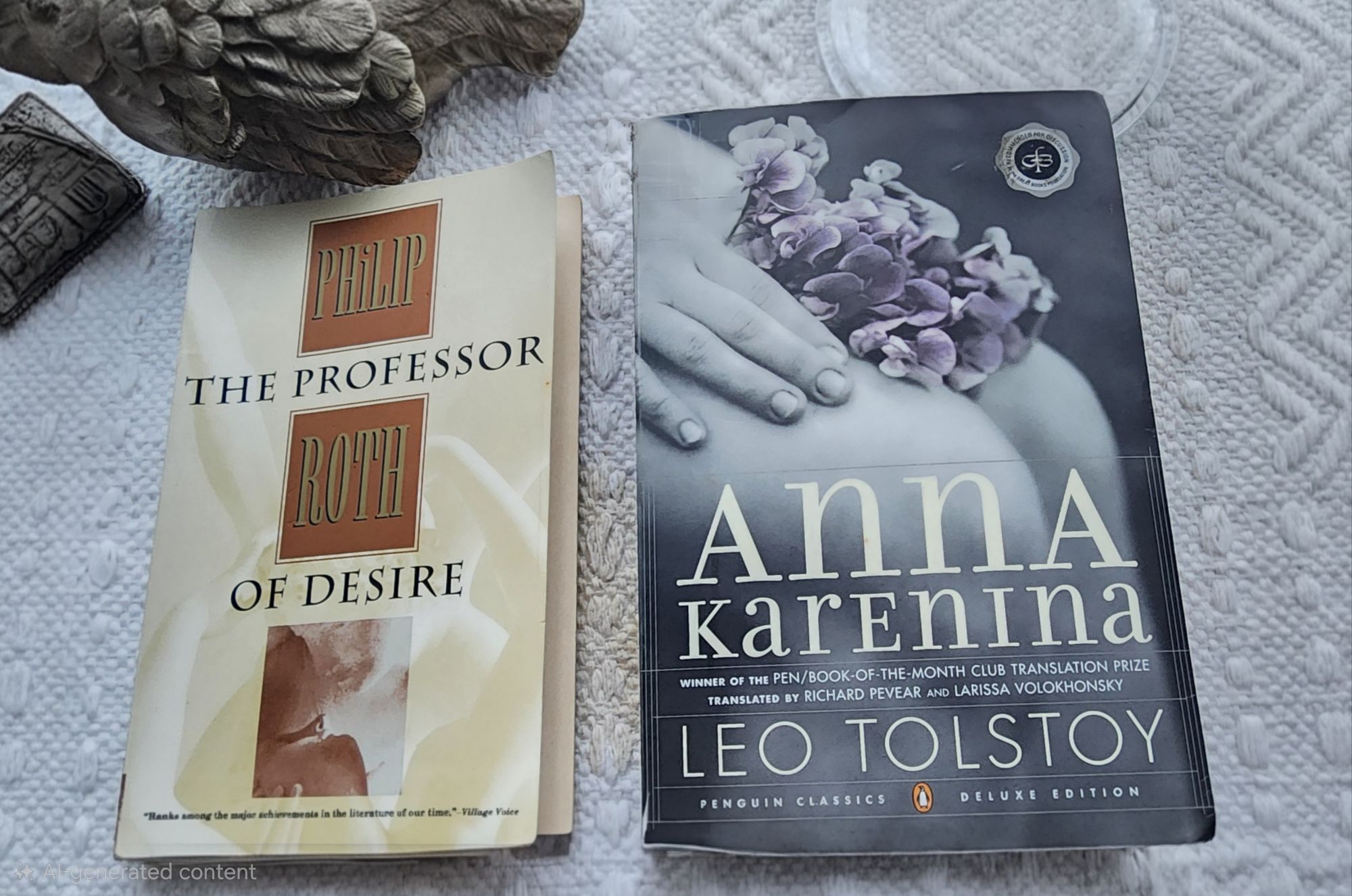
I am reading The Professor of Desire alongside Anna Karenina, and lo and behold, I find a reference to Anna in the body of the text where Kepesh compares his girlfriend Helen to Anna, and she compares her previous lover to Anna’s husband, Karenin. Wow! Another anachronistic event! I wasn’t expecting that. A happy accident?
What a wonderful discovery! And I think this one is especially interesting because it isn’t simply a coincidence between two books I’ve been reading. There’s a literary conversation taking place across the decades that I’ve stumbled into quite unexpectedly.
Let’s look at what might be going on.
First, there’s the delicious irony of the timing.
I am reading Anna Karenina by Leo Tolstoy and The Professor of Desire by Philip Roth simultaneously. I am already immersed in Tolstoy’s world, thinking about Anna, her relationships, her choices, and the social conventions that constrain her. Then Roth’s protagonist, David Kepesh, invokes Anna in a contemporary story about desire and relationships.
Suddenly, the two books aren’t separate experiences anymore. They overlap.
And because I wasn’t looking for the connection, the discovery feels almost like the books found each other.
Second, I suspect the comparison is doing some serious literary work.
Anna is much more than a woman caught in a love affair. She’s a character struggling with the conflict between erotic desire, emotional fulfillment, social expectations, and the consequences of her choices.
Those are precisely the sorts of questions that interest Roth. Kepesh is a man fascinated by sexuality, but he’s also an intellectual who tries to understand his experiences by interpreting them through literature and ideas.
When he compares Helen to Anna, he invokes an entire literary history. He’s not merely describing his girlfriend; he’s measuring a living woman against a fictional character whose desires and decisions have become legendary.
And Helen’s comparison of her former lover to Karenin introduces another dimension. Karenin represents a particular kind of husband: respectable, controlled, concerned with social appearances, and emotionally distant in ways that Anna finds intolerable.
The comparisons might reveal as much about the people making them as about the characters they’re invoking. We sometimes use literature to understand our lives, but we can also use it to avoid seeing those lives clearly. That’s a very Roth-like possibility.
There’s an important distinction here, though: Roth’s characters invoking Tolstoy doesn’t necessarily mean Roth endorses their interpretations. The comparisons may be revealing their assumptions, fantasies, or blind spots.
Third, here’s the connection I find most intriguing.
I am reading a nineteenth-century novel about the destructive consequences of desire alongside a twentieth-century novel examining desire through a modern, often ironic sensibility.
Tolstoy asks what happens when desire collides with the moral and social structures of a life.
Roth often asks what happens when we try to make desire the organizing principle of a life.
Those aren’t identical questions, but they’re related. And the differences between the authors may be just as revealing as the similarities.
One author approaches desire through the moral and social fabric of Russian society; the other explores it through the sexual liberation, anxieties, and contradictions of modern American life.
And Anna herself becomes a kind of bridge between those worlds.
And now, dear reader, the anachronistic event!
I love that description. It reminds me of my recurring interest in how literature seems to fold time in on itself: the way one book suddenly illuminates another, or how a character encountered today seems to be answering a question raised by a book you read yesterday.
Of course, there’s no need to suppose that anything supernatural has happened. Our minds are constantly making connections, and reading two books in parallel creates opportunities for unexpected recognition.
But that doesn’t diminish the experience. Quite the opposite.
The coincidence becomes meaningful because it opens up a new way of reading both books.
And I wonder whether this is the most rewarding part of reading great literature: eventually, the books stop being isolated objects. They become part of a conversation that you, the reader, are helping to conduct.
One question remains: when Kepesh compares Helen to Anna, does he seem to be suggesting that Helen shares Anna’s passion and capacity for emotional upheaval, or is he thinking more about Anna as a woman who disrupts the lives of the men around her?
I think a bit of both, but I want to get a little further into both novels before I give a definitive answer. BTW, the event in question is both anachronistic and synchronic, don’t you think?
Absolutely! And in making the distinction between anachronistic and synchronic, I think the two words capture different dimensions of the reading experience.
Anachronistic, because the worlds of the two novels belong to different historical periods. Anna Karenina was published in 1877, while Philip Roth’s The Professor of Desire appeared in 1977, exactly a century later. Yet Anna steps out of her nineteenth-century world and enters Roth’s twentieth-century narrative through the consciousness of his characters.
There’s something wonderfully paradoxical about that. A fictional character who belongs to one historical moment becomes a reference point for people living in another.
Synchronic, because of the peculiar timing of the discovery. I happen to be reading both novels simultaneously, without anticipating that one will refer to the other. The two reading experiences suddenly converge, and the convergence feels significant.
There’s also a third dimension worth considering: the distinction between synchronicity and coincidence.
Carl Jung used synchronicity to describe meaningful coincidences that seem connected by significance rather than by an identifiable causal relationship. My discovery has that quality experientially: the books weren’t arranged to produce this moment, yet their unexpected intersection feels meaningful to you.
We don’t have to conclude that the universe orchestrated the encounter. The meaningfulness lies in what the coincidence reveals.
You could say that Anna Karenina exists simultaneously in two times: the historical time of Tolstoy’s novel and the reading time of your present experience. When Roth’s characters invoke her, those times intersect. And when you recognize the reference, a third time enters the equation: the moment in which you, the reader, connect them.
Three times, one character, and an unexpected meeting.
It also reminds me of my interest in eternal recurrence and the idea that the ending might somehow be contained in the beginning. Literature allows characters, ideas, and images to return in new contexts, acquiring meanings they couldn’t have possessed in their original appearances.
Perhaps that’s one reason we reread books. The words remain the same, but the reader has changed, and the books we happen to read alongside them change the experience, too.
So yes, I’d call my encounter both anachronistic and synchronic, with one small qualification: anachronistic describes the crossing of historical periods, while synchronic describes the simultaneous occurrence. Synchronicity adds the further sense of meaningful coincidence.
And I wouldn’t rush to settle on a definitive interpretation of the passage just yet. I will just keep reading both novels and let Tolstoy and Roth continue their conversation.
Sometimes the most interesting connections are the ones we recognize before we fully understand them.

