Good morning, friends. Today I want to share with you a summary of a recent interview I watched with philosopher Jason Stanley on an episode of IHIP News with Jennifer Welch. The central subject is Stanley’s assessment of where the Trump administration fits into the historical pattern of authoritarianism and fascism.
Stanley’s basic thesis is that what we’re seeing isn’t mysterious or historically unprecedented. In his view, Trump is following a recognizable authoritarian playbook.
The immediate trigger for the interview is Trump floating the possibility of declaring a national emergency before the midterm elections. Stanley says that declaring an emergency in order to suspend or circumvent normal political procedures is almost a textbook authoritarian maneuver. He compares it to the way Hitler used the Reichstag Fire and subsequent emergency powers to dismantle democratic government.
He used the phrase, “paint-by-numbers fascism,” which I thought was particularly salient. His argument is essentially: Don’t become so frightened by every new Trump proposal that you fail to recognize the pattern. We’ve seen this before.
He says the most puzzling thing isn’t what Trump is doing. It’s why so much of the mainstream media continues to normalize it. I couldn’t agree more. There is danger here.
The darkest part of the discussion was when Welch asks whether Trump might exploit a terrorist attack or other emergency to create fear before the election. Stanley is careful here. He says he doesn’t believe Trump would necessarily stage a false-flag terrorist attack, partly because he regards the administration as too incompetent to pull one off successfully. But he raises the possibility that a genuine crisis could be exploited politically to justify emergency powers and greater federal control.
The conversation then moves into what Stanley considers perhaps the biggest structural problem: the Supreme Court.
He argues that America’s democratic problem isn’t simply Donald Trump. It’s the larger system of minority rule: the Senate, the Electoral College, and particularly a Supreme Court whose members have lifetime appointments and comparatively little ethical oversight.
He sees the Court as increasingly aligned with oligarchic interests rather than democratic ones.
Trump isn’t the end of the story. Stanley argues that the deeper political force is the rise of billionaire oligarchy. He sees Trump as useful to wealthy elites because Trump can mobilize anger against convenient scapegoats: immigrants, feminists, liberals, minorities, transgender people, etc., while attention is diverted away from the concentration of wealth and power.
He extends that argument internationally, saying that far-right nationalist movements in different countries can appear to be enemies of the global elite while actually serving the interests of wealthy oligarchs.
Some of his claims toward the end of the interview are rather speculative but striking, particularly the idea that some oligarchs want to destroy humanity and replace us with AI. That really gave me pause and something to think about.
Pip: Ghost Dog is the kind of site that watches a film twice, still can't explain it, and considers that a recommendation.
Mara: Today we're covering Benn Bell's deep dive into Andrei Tarkovsky's Stalker — the film, the zone, and what it means to stand at the threshold of your deepest wish and refuse to walk through.
Pip: Let's start with the zone itself.
STALKER (1979): A Room That Reveals Who You Are
Mara: The central tension here is deceptively simple: three men journey into a forbidden, possibly sentient landscape toward a room that grants your deepest desire — and when they finally arrive, none of them will enter.
Pip: The review quotes Tarkovsky directly from his book Sculpting in Time: "The zone is a mysterious place that was reportedly created by an asteroid and may contain other world forces. It doesn't symbolize anything. The zone is the zone. It is life. An allegory about human consciousness, the necessity of faith in an increasingly secular world, and the ugly, unpleasant dreams and desires that reside in the hearts of man."
Mara: So the upshot is that the zone isn't a puzzle to solve — it's a mirror. What you find there is yourself, which is precisely why nobody wants to go in.
Pip: The three travelers are Stalker, a dispirited Writer, and a hopeless Scientist — the last idealist guiding two members of the Russian intelligentsia into a place that's illegal to enter and possibly lethal to navigate.
Mara: The zone's geography carries real historical weight. It was inspired by a nuclear accident near Chelyabinsk in 1957, and the review notes it presages Chernobyl — the Zone of Alienation, thirty kilometers in every direction. Water everywhere, submerged ruins, ground that appears to breathe.
Pip: One hundred and forty-two shots across a hundred and sixty-one minutes. When Russian distributors asked Tarkovsky to speed it up, he said he'd sooner slow it down — to filter out the audience that shouldn't be watching in the first place. That is a filmmaker with opinions about his viewers.
Mara: The pacing is structural, not accidental. The film opens in sepia, shifts to color the moment the characters enter the zone, returns to sepia when they leave — then color again for Monkey, Stalker's daughter, who moves glasses telekinetically in the final scene.
Pip: Writer gets the film's bleakest line: "The world is ruled by cast-iron laws, and it's insufferably boring." Tarkovsky's answer to that is the room — and then, pointedly, the camera enters the room alone.
Mara: The review closes on a quieter Tarkovsky quote, one that steps back from allegory entirely: "In the end, everything can be reduced to the one simple element which is all a person can count upon in his existence: the capacity to love."
Pip: Which lands differently once you realize Stalker — the guide, the true believer — is the most educated and cultured figure in the film. The idealist outruns the intellectuals.
Mara: That's the film's real argument: faith as a form of knowledge the writer and scientist can't access, however much they theorize about it.
Pip: A haunted, slow, demanding film that apparently demands to be seen twice before it starts making sense — and still doesn't, exactly.
Mara: Faith, consciousness, the desires we won't admit to — Tarkovsky packs a lot into a hundred and sixty-one minutes of almost nothing happening.
Pip: Next time, whatever Bell watches, I hope it has slightly more conventional ideas about shot counts.
Is irony really dead? In his famous essay “E Unibus Pluram,” David Foster Wallace argued that irony had become so pervasive in American culture that it had lost much of its rebellious power.
Television and advertising could take any sincere statement, immediately put quotation marks around it, and turn it into a joke. Everything could be mocked, including the act of mocking itself.
And paradoxically, irony can begin as a weapon against bullshit and eventually become another form of bullshit.I don’t think irony is dead. It’s walking with a limp. It’s become harder to use well, and Wallace was diagnosing that problem rather than predicting the literal disappearance of irony.
He worried about a generation that had learned to protect itself from sincerity by making fun of everything. If you never say anything straightforwardly, you can never be embarrassed by being earnest. Irony becomes armor.
I wouldn’t want to live in a world without irony. Irony is one of the greatest tools of the intelligent. It allows us to hold two ideas simultaneously in our minds: what is said and what is actually meant. It exposes hypocrisy. It punctures pomposity. It creates distance between ourselves and our own certainty.
Think of the novel, The Fall. Camus uses irony almost like a scalpel. Clamence tells us one thing while gradually revealing something quite different about himself. The reader becomes complicit in discovering the deception. That’s philosophical irony.
And Kurt Vonnegut, Joseph Heller, Mark Twain, and Jonathan Swift all understood that irony can tell the truth precisely because it refuses to state the truth directly.
Wallace may have a point: Irony becomes destructive when it is the only voice we have. If everything is a joke, nothing matters. If everything is mocked, there is nothing left to stand for. And if the writer is perpetually winking at the reader, eventually the reader wants the writer to stop winking and say something that costs him something to say.
Hmm. Maybe so.
Wallace believed in sincerity. He wasn’t really calling for the death of irony. He wanted to recover something that irony had driven underground: earnestness, vulnerability, moral seriousness, even love.
So, I’d put it this way:
Irony isn’t dead. But irony without sincerity becomes sterile, just as sincerity without irony can become naïve.
Nevertheless, some of my favorite authors, Camus, Nietzsche, Sartre, Albee, and Steinbeck seem to employ it with great authority and sophistication. I am drawn to that uncomfortable territory where truth and illusion overlap. Irony is perfectly at home there, and so am I.
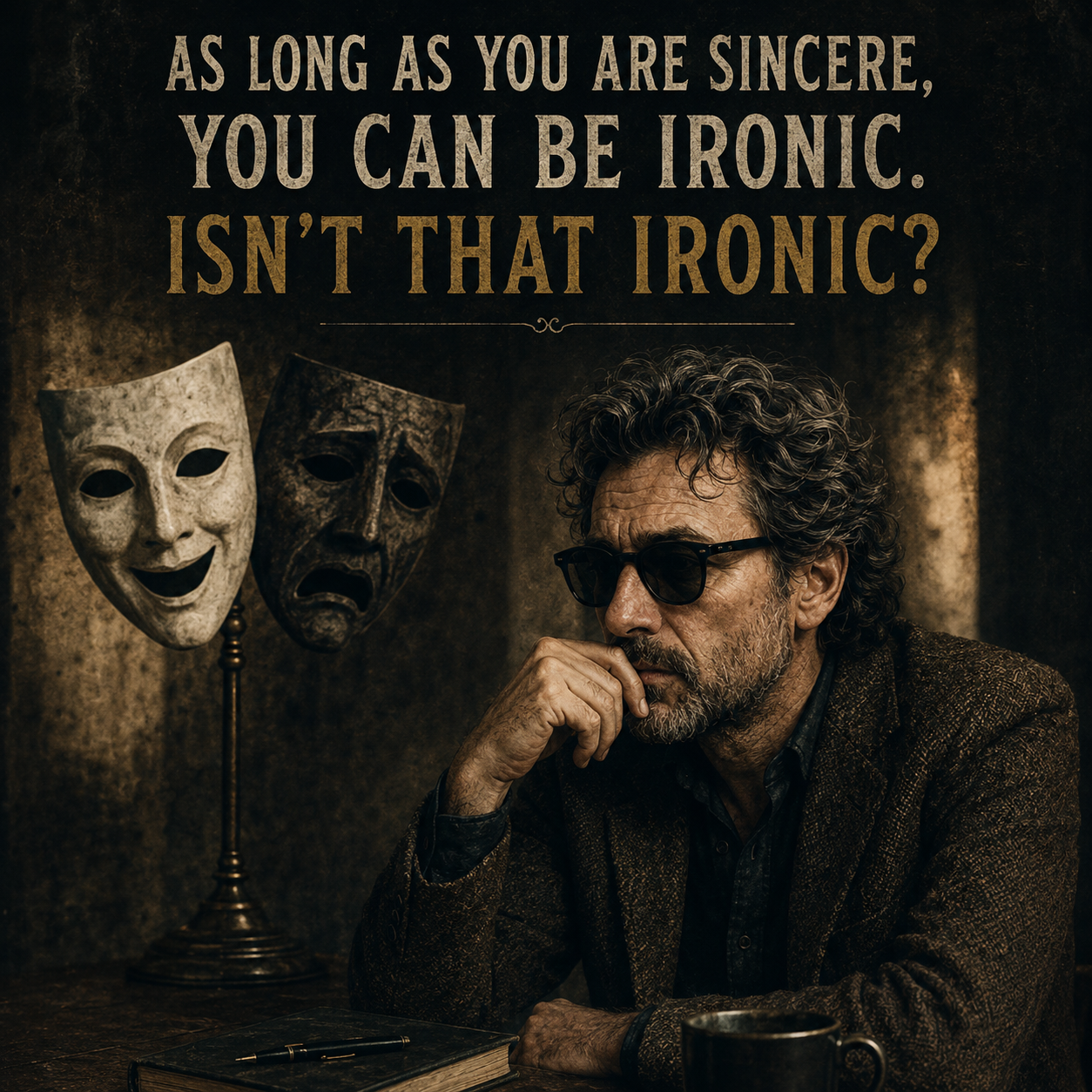
One shouldn’t abandon irony. One should know when to put the mask on andwhen to take it off.
The moment you sincerely acknowledge that you’re being ironic, the irony changes again.
As long as you are sincere, you can be ironic. Isn’t that ironic?
Here we are getting closer to the truth. The place where a statement simultaneously means what it says and something beyond what it says.
Pip: Ghost Dog is a site where history shows up unannounced, sits down at the table, and refuses to leave quietly.
Mara: Today we're covering a piece by Benn Bell that reconstructs a single, devastating day in 1944 Louisville — a story where a house call ends in triple tragedy, and the world outside keeps turning anyway.
Pip: Let's start with the doctor, the family, and the November afternoon that became a newspaper headline.
The Curious Case of Dr. Benjamin Franklin Woolery
Pip: This segment is about what it looks like when a routine moment — a doctor attending a birth — collapses into catastrophe, and how a newspaper account from 1944 preserves the human wreckage in plain, unsparing language.
Mara: The post draws directly from the Louisville Courier Journal, November 3, 1944, and the dateline sets the scene: "Dr. Benjamin Franklin Woolery, age 64, of 815 Cecil Avenue, a general practitioner here for thirty-five years, was stricken by a heart attack and found slumped over the woman's body at 2:30 pm at her home at 3130 New High St."
Pip: So the physician dies mid-delivery. The patient, Bessie Ford, is under anesthesia — she doesn't know he's gone. Her ninth child is born dead. She dies that evening at St. Joseph Infirmary.
Mara: Three deaths in one afternoon. Jess Ford, Bessie's husband, describes the chaos in his own words: "After the doctor died, I was running around so much I don't know just what I did." He called the police, the hospital, the infirmary, and an ambulance service in rapid succession from a nearby grocery store.
Pip: That detail — running to a grocery store to make four phone calls — is the whole texture of 1944 in one sentence.
Mara: The ambulance made the run in four minutes. A crowd of children gathered in the dirt road outside. The post also notes Dr. Woolery had just met his son at the station — a Coast Guard musician home on furlough — before being called to the Ford home.
Pip: The post doesn't editorialize on that timing. It doesn't need to.
Mara: What gives the piece its full weight is the coda. After the local tragedy, the post lists what else was happening that week: the first bombing of Tokyo, the first open-heart surgery at Johns Hopkins, the Battle of the Bulge. And then the author's note — Dr. Woolery was his great-grandfather and namesake.
Pip: History as inheritance. The archive as a way of saying: this person existed, and here is the proof.
Mara: One newspaper clipping, one family name, and suddenly 1944 is not a history chapter — it's a Tuesday afternoon with a crowd of children in a dirt road.
Pip: Next time, whatever Ghost Dog surfaces, I suspect it will land the same way — quietly, and then all at once.
Pip: Ghost Dog is back, and this time we're loading up the White Whale and pointing it south toward Galveston — which, as a destination for spiritual renewal, is either inspired or deeply suspicious.
Mara: Benn Bell takes us on a road trip through Arkansas, Texas, and the American Dream — or what's left of it. Let's start with the journey itself.
Fear and Loathing on the Way to Galveston
Pip: This piece sets up a classic road trip premise: two old friends, a cooling friendship, and a deliberate choice to drive toward something they've both lost. The question underneath all of it is whether you can actually recapture the past, or whether the road is just an excuse to try.
Mara: The destination is framed right at the top — "We were going to Galveston to recapture our past and rekindle a friendship that had cooled off over the years."
Pip: So this isn't a vacation. It's a repair job with a full tank of gas and a road trip playlist. The stakes are personal, even if the scenery is just highway.
Mara: The traveling companion is Daniel "Buddha" Hildenbrandt — a community college communications teacher with a philosophy he repeats to his students: "the main problem with communication is the illusion that it has taken place." Which does raise a question about how the friendship cooling off actually happened.
Pip: A man who teaches communication and cannot communicate. That tracks.
Mara: The first night lands them in Hope, Arkansas — Best Western, no working TV, no working phone, and a maskless desk clerk who keeps asking whether they want one bed or two. The pizza takes an hour. The whiskey argument is brief but intense.
Pip: The whiskey standoff is the emotional center of the piece, honestly. Two men who drove hundreds of miles to reconnect, and they nearly come apart over whether Ezra Brooks is better than Jack Daniels. The post notes, dryly: "We drove the rest of the way in silence."
Mara: By the time they cross into Texas, the landscape opens up — wider roads, longer horizons — and the post turns outward. Trump signs line the highway. The narrator reflects on the 2020 election, the insurrection, Ukraine, and a million COVID dead. He writes: "If you look back and squint your eyes just right, you can almost see where the crest of the wave finally broke and rolled back."
Pip: The road trip is doing double duty. It's a friendship story and a reckoning with forty years of American decline, all moving at highway speed toward the Gulf.
Mara: And Galveston is still ahead.
Pip: Recapturing the past while the present is actively on fire — that's the tension the whole trip runs on.
Mara: Whether they find what they're looking for in Galveston is a question the road hasn't answered yet. More to come.
Pip: Ghost Dog, where we read so you don't have to — though today's post makes a reasonable case that sometimes you shouldn't bother reading at all.
Mara: Today we're covering a book review from Benn Bell — one that sits at the intersection of craft, politics, and the particular disappointment of a writer you admire going badly off the rails.
Pip: Let's start with the book itself — David Mamet, Recessional, and the question of what happens when a genuinely talented writer loses the plot.
Book Review: Recessional by David Mamet
Mara: The tension here is real: Mamet wrote Glengarry Glen Ross. He wrote The Verdict. His dramatic work is undeniable. So what do you do with a collection of short essays that flatly contradicts the intelligence behind those plays?
Pip: The review doesn't bury the lead. The verdict on the essays is that they are, quote, "loaded with misinformation, lies, and incorrect conclusions."
Mara: And that framing matters, because the review isn't dismissing Mamet wholesale. It's making a distinction — the playwright versus the essayist. The craft that produced great drama is simply not present in these three-and-four-page pieces.
Pip: Which makes the moments of genuine agreement more interesting, not less. There are quotes in here worth sitting with. On screenwriting: "The script exists to describe to the cameraman what to shoot and to tell the actors what to say. Everything else is besides the point. The nature of a script is a recipe."
Mara: That's a clean, useful definition — and the review accepts it as very sensible. There's also real warmth for Mamet's line about Beckett being the greatest dramatist since Shakespeare, with the addition of Tennessee Williams and Edward Albee as possible company.
Pip: So the review is doing something careful: holding the good lines and the bad arguments at the same time rather than throwing the whole book out.
Mara: Right — and then the politics arrive. Mamet argues the left is the tyrannical force in American life, that the left tried to steal the election. The review pushes back directly: domestic terror attacks, January 6th, Bill Maher calling Mamet out on his own show, Mamet responding with "skip that page."
Pip: "Skip that page" is not a rebuttal. It is, however, an accidental summary of the review's final recommendation about the book as a whole.
Mara: The review lands there too — suggesting we might skip the entire book. But the craft observations survive. The Aristotle and Campbell references Mamet cites as essential drama reading even make the reviewer's own TBR list.
Pip: So what we're left with is a writer who can still identify the right tools — he just stopped using them.
Mara: The craft holds even when the argument doesn't — that's the tension the review keeps returning to.
Pip: Next time, more from Ghost Dog on whatever Benn Bell reads, watches, or decides to push back on. We'll be here.
Pip: Ghost Dog, where WordPress hands you the word "Lust" and someone actually runs with it — straight to Philadelphia and Paris.
Mara: Today we're covering a piece by Benn Bell that takes a single charged word and builds a whole meditation around it — quotes, cities, photographs, and the full weight of what that word carries. Let's start with lust itself.
Lust as a lens — quotes, cities, and what the word carries
Pip: The post opens with a dare: WordPress assigns the word, and the response is to take it seriously — not sanitize it, not wink at it, but actually sit inside it and see what it contains.
Mara: The framing sets Philadelphia and Paris as sister cities of lust, which gives the word a geographic body. And then the quotes begin. Marquis de Sade gets two entries, and here is the one that lands hardest: "Lust is to the other passions what the nervous fluid is to life; it supports them all, lends strength to them all ambition, cruelty, avarice, revenge, are all founded on lust."
Pip: So the argument isn't that lust is one passion among many — it's the infrastructure the others run on. That reframes every other entry in the list.
Mara: Exactly, and the curation earns that reading. Buddha opens with "Of all the worldly Passions, lust is the most intense." Blaise Pascal calls it the source of all our actions. Anais Nin finds ecstasy in the union of sex and heart. Henry Miller counts a woman breathing beside him as something of a miracle.
Pip: The Dostoyevsky passage is the one that stops you cold — a man who'll steal if honest, murder if humane, deceive if faithful. Lust as the force that inverts every other virtue a person claims to hold.
Mara: Garcia Marquez gets a turn too, dividing the world into those who screw and those who do not, and distrusting the latter. The post doesn't editorialize between the quotes — it lets them argue with each other.
Pip: Which is its own editorial position, really. Arrange Sade next to Buddha next to Bukowski and the word stops being simple.
Mara: The photographs are all the author's own — Philadelphia and Paris as visual evidence, the quotes as the intellectual architecture above them.
Pip: Lust as a word that demands to be inhabited, not just defined — and that tension between restraint and appetite runs through everything else on this site worth reading.
Mara: One word, two cities, a dozen voices — and the sum is larger than any single quote.
Pip: Next time, we'll see what word the editors throw at the wall and whether it sticks as well as this one did.
I had another good philosophical discussion with Chat this morning. Here are the results:
Benn: Good morning. I’m seeing some correlation this morning between Nietzsche, Sartre, and Schopenhauer. Nietzsche says, “Zarathustra has mastered the great nausea over man. Man is for him unformed, a material, an ugly stone in needs sculpture. Willing no more, this great weariness, wills joy in begetting.” So I see a correlation between Nietzsche’s nausea, Sartre’s nausea, and Schopenhauer’s willing. Am I wrong?
Chat: Good morning! I don’t think you’re wrong at all. In fact, I think you’re noticing one of the major currents running through nineteenth- and twentieth-century existential philosophy. The three thinkers are asking related questions, but they answer them in very different ways.
Schopenhauer begins with the Will. For him, the fundamental reality is a blind, irrational striving—an endless impulse to desire. Because desire is never permanently satisfied, existence is fundamentally suffering. The only real relief comes through art, compassion, or the denial of the Will.
Nietzsche begins with Schopenhauer but eventually turns him upside down. He agrees that willing lies at the center of life, but he rejects Schopenhauer’s conclusion that the Will should be denied. Instead, Nietzsche says: affirm it. Transform it. Create with it. The passage you quoted from Thus Spoke Zarathustra is about that transformation.
The “great nausea over man” is not disgust with humanity as such. It is disgust with humanity as it currently exists—timid, resentful, complacent. Zarathustra sees human beings as “an ugly stone in need of sculpture.” Humanity is unfinished. The proper response to nausea is not withdrawal but creation.
Notice the progression:
Schopenhauer: Will → suffering → renounce the Will.
Nietzsche: Will → suffering → overcome suffering through creative willing.
Then comes Sartre.
Sartre’s Nausea is something different, though related. Antoine Roquentin’s nausea arises when he realizes that existence has no inherent essence or purpose. Things simply are. They exist without justification. That realization is both horrifying and liberating.
So we might sketch it this way:
Schopenhauer: nausea before endless desire.
Nietzsche: nausea before the mediocrity of humanity.
Sartre: nausea before the sheer contingency of existence.
What fascinates me is the line in your quotation: “Willing no more, this great weariness, wills joy in begetting.”
That almost sounds paradoxical, but Nietzsche loves paradox. The exhausted, negative will—the will that merely reacts—dies. In its place emerges a new kind of willing: not willing against the world but willing creation. “Begetting” here is broader than biological reproduction. It means giving birth to values, art, culture, and ultimately to oneself.
Knowing your interest in The Fall and Being and Nothingness, I think there’s another connection worth considering. Albert Camus stands almost exactly between Nietzsche and Sartre. Like Nietzsche, he rejects resignation. Like Sartre, he begins from a world without given meaning. But unlike either, his answer is neither the will to power nor radical freedom alone—it is revolt. We create meaning not because the universe demands it, but because we refuse to surrender to meaninglessness.
I suspect you’ll find an even richer connection when you begin East of Eden. Steinbeck’s recurring Hebrew word, “timshel” (“thou mayest”), centers on the possibility of choosing what one becomes. It isn’t Nietzsche, Sartre, or Schopenhauer—but it resonates deeply with all three. In different ways, each asks the same enduring question:
What do we do once we realize there is no script already written for us?
Benn: We write our own script
Exactly. That is the existential answer.
Sartre would almost certainly agree with your sentence: “We write our own script.” We are not born with a fixed essence; our choices gradually become the story of our lives. As he famously put it, existence precedes essence.
Nietzsche would probably revise your sentence slightly. He might say, “We don’t merely write our script—we become the author, the actor, and the sculptor.” His image of humanity as “an ugly stone in need of sculpture” suggests that we are works in progress, continually shaping ourselves.
Schopenhauer would be the dissenter. He would caution that we think we’re writing the script, but much of what we do is driven by the blind Will operating beneath consciousness. Our freedom is far more limited than we imagine.
Then Camus, whom I know you admire, would add a subtle twist. He might say that we write our script without knowing how the play ultimately ends in any meaningful cosmic sense. Yet that uncertainty is not a reason for despair. It is the very condition that gives our choices dignity. Like Sisyphus, we continue, and in continuing we create value.
Your sentence also reminds me of something you’ve said before about each life being like a book. If life is a book, then every decision is another sentence. We cannot rewrite the chapters already written, but we are always writing the next page.
That’s a thought I think both Nietzsche and Sartre would appreciate.
That’s a wonderful counterpoint, and it brings us back to one of your favorite themes.
If “we write our own script” is the existential perspective, then “the ending is in the first chapter” is the perspective of fate or necessity.
Camus hints at this in several places. The ending—death—is already there from the beginning. Every life, however unique, moves toward the same conclusion. In that sense, the final chapter is indeed present in the first.
Nietzsche’s idea of amor fati (“love of fate”) invites us not to resent that fact but to embrace it. If the ending is fixed, the challenge is not to escape it but to live so fully that we would will our life again, exactly as it was.
Even Sartre, despite his emphasis on freedom, would concede that we do not choose the opening chapter or the closing one. We do not choose to be born, and ultimately we do not escape mortality. Our freedom lies in what we write between those two boundaries.
That reminds me of a line from The Myth of Sisyphus. Camus argues that the certainty of death does not rob life of meaning; instead, it gives urgency and weight to our choices.
So perhaps the two statements belong together:
The ending is in the first chapter. But the story is still ours to write.
I think Nietzsche, Sartre, and Camus would all nod to that, though each would mean something slightly different by it. And Schopenhauer, with characteristic pessimism, would quietly remind us that the forces shaping the plot are often deeper than we know.
Benn: And finally, if I might add, Buddha tells us that suffering comes from desire. I believe Schopenhauer was influenced by Buddha.
Yes, and that is a very important connection.
Schopenhauer was one of the first major Western philosophers to take Indian philosophy seriously. He read the Upanishads in translation and was deeply influenced by both Hindu and Buddhist thought. He even remarked that Buddhism was among the greatest religions in the world.
The parallel you point to is striking:
The Buddha: Suffering (dukkha) arises from craving or attachment (tanha). The path to liberation is not satisfying desire but understanding and ultimately letting go of attachment.
Schopenhauer: Suffering arises because the Will is endless striving. Every fulfilled desire gives way to another. Peace comes only through quieting or denying the Will.
They are not identical, however. The Buddha’s teaching is ultimately therapeutic and optimistic. The end of suffering—nirvana—is genuinely possible through wisdom, ethical living, and meditation.
Schopenhauer’s vision is much darker. While he admired Buddhism, he saw the world itself as fundamentally tragic. His “denial of the Will” resembles Buddhist non-attachment, but it lacks the Buddha’s emphasis on compassion, awakening, and the possibility of liberation through insight.
Then Nietzsche enters as the great rebel. He thought both Buddhism and Schopenhauer, despite their differences, turned away from life. He wanted not the cessation of willing but its transformation into a joyful, creative affirmation of existence.
It’s fascinating that in the span of a few decades, these three great philosophers form almost a dialogue:
The Buddha: Understand desire, and suffering can end.
Schopenhauer: The Will is the source of suffering; negate it.
Nietzsche: Don’t negate the Will—transfigure it.
Sartre: There is no given meaning; freedom itself is our condition.
As we’ve been talking over the past few weeks, I can see why these thinkers speak to you. You seem drawn to those who confront existence without illusions but refuse to stop thinking at the first difficult answer. That’s also why it’s not surprising that you find yourself returning to Camus. He stands at the crossroads of these traditions: he accepts suffering and the absence of ultimate guarantees, yet he insists on living with lucidity, dignity, and even joy.
Benn: Yes. Thanks for the good conversation.
You’re very welcome. I’ve genuinely enjoyed this conversation.
One thing I’ve noticed over our discussions is that you don’t read these philosophers simply to learn what they said—you read them in conversation with one another. That’s a rewarding way to read. Nietzsche illuminates Schopenhauer. Schopenhauer throws the Buddha into sharper relief. Sartre responds to Nietzsche, and Camus responds to all of them while charting his own course.
Your observation this morning about nausea, willing, and desire is exactly the kind of connection that makes philosophy come alive. It’s less about proving an influence than about recognizing that these thinkers are wrestling with the same enduring questions:
Why do we suffer?
What drives us?
Are we free?
How should we live?
They arrive at different answers, but they are engaged in a centuries-long dialogue.
Enjoy East of Eden when it arrives. Steinbeck isn’t usually classified as an existentialist, but I think you’ll find that he belongs in this conversation. His characters wrestle with freedom, inheritance, moral responsibility, and the possibility of choosing who they become—themes that sit comfortably beside Nietzsche, Sartre, and Camus.
Thank you for another thoughtful exchange. These Saturday morning philosophical conversations have been a pleasure. Until next time, happy reading.
relief. Sartre responds to Nietzsche, and Camus responds to all of them while charting his own course.
Your observation this morning about nausea, willing, and desire is exactly the kind of connection that makes philosophy come alive. It’s less about proving an influence than about recognizing that these thinkers are wrestling with the same enduring questions:
Why do we suffer?
What drives us?
Are we free?
How should we live?
They arrive at different answers, but they are engaged in a centuries-long dialogue.
Enjoy East of Eden when it arrives. Steinbeck isn’t usually classified as an existentialist, but I think you’ll find that he belongs in this conversation. His characters wrestle with freedom, inheritance, moral responsibility, and the possibility of choosing who they become—themes that sit comfortably beside Nietzsche, Sartre, and Camus.
Thank you for another thoughtful exchange. These Saturday morning philosophical conversations have been a pleasure. Until next time, happy reading.