A film by Michelangelo Antonioni.
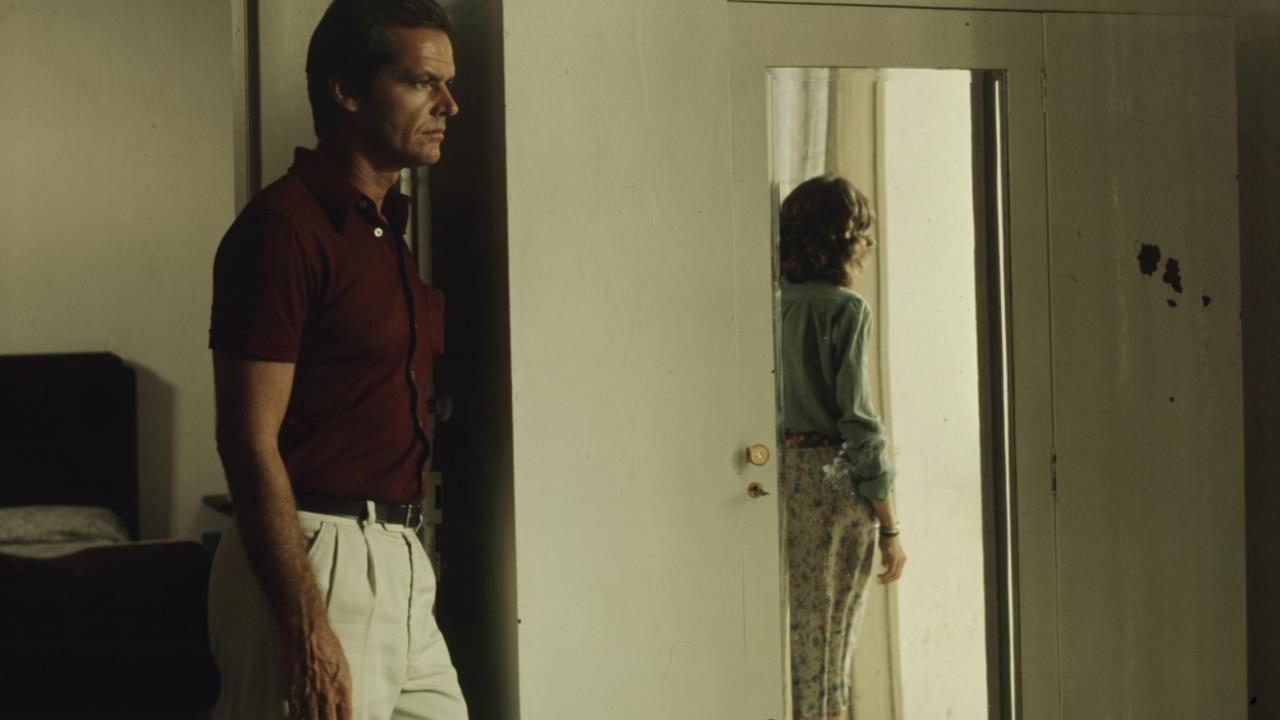
I have been wanting to watch this movie again ever since I saw it the first time back in 1975. It has just now become available. I was not disappointed, but I still don’t quite understand it. The outstanding things for me, aside from Jack Nicholson and Maria Schneider, were the visuals and the camera work, credit to Antonioni and cinematographer Luciano Tovoli. One might say style over substance, but that is not always a bad thing. The last shot is worth the wait. A long tracking shot moves outside the hotel window into the square; cars appear, then disappear; the people looking for him enter the square and move around, then the camera, in a still unbroken shot, re-enters the hotel room. I have never seen anything like it, and that is what remained etched in my memory for 50 years. It reminded me of a scene in The Stranger where Meursault looks out of a window in the afternoon, and as the day falls into night, the scene in front of him slowly changes as people move in and out of the frame and the light gradually fades. I wouldn’t be surprised if one didn’t inform the other.
The Passenger is exactly the kind of movie that can haunt you for decades without ever becoming entirely decipherable. And I think the movie’s visual experience may be more important than solving its plot.
The basic story is simple enough. Nicholson’s David Locke, a journalist who has become alienated from his own life, discovers that a dead man in the hotel room next door looks enough like him to allow him to assume the man’s identity. He effectively abandons Locke and assumes Robertson’s identity. But changing his identity doesn’t change himself.
He thinks he can escape the burden of being Locke by becoming somebody else. Yet wherever he goes, Locke, whatever is left of Locke, goes with him. The journey becomes less about where he is going than about whether a person can escape himself.
I see a comparison with Meursault in Camus’ The Stranger.
In The Stranger, Meursault is frequently an observer rather than an actor. He watches the world: sunlight, streets, people, heat, the changing afternoon. There is an extraordinary passage when he is in his apartment and looks through the window as the day changes. The ordinary world continues moving while Meursault remains strangely detached from it.
Antonioni does something remarkably similar, but with a camera.
Locke is increasingly a passenger in his own existence. He observes rather than participates. And Antonioni’s camera adopts that same detached consciousness. It doesn’t simply show us what Locke sees; it seems to think like Locke.
The ending is the key to the entire movie.
Locke is lying dead in the hotel room. The camera slowly moves toward the window, passes through the bars, goes outside into the plaza, wanders through the life of the town, and eventually returns to the room.
Cars move. People walk. The police arrive. Life goes on. The camera itself seems to abandon Locke, just as Locke tried to abandon his own identity.
And there’s something very Camus-like about that.
The universe doesn’t provide a dramatic answer. There is no grand revelation. There is simply the world continuing.
The resemblance to The Stranger is striking. I don’t know if there is a direct influence or not, but the resemblance is both synchronous and uncanny. Both works are fascinated by alienation, observation, identity, mortality, and the indifferent continuity of the physical world.
Meursault looks through the window at a world that continues without him. Locke disappears through the window into a world that continues without him.
With Antonioni, style is the substance. The camera movement, empty spaces, architecture, landscapes, silence, and duration aren’t decoration around the story. They are the story.


As someone who loves watching movies based on the visual appeal this felt like a recommendation.
LikeLiked by 2 people