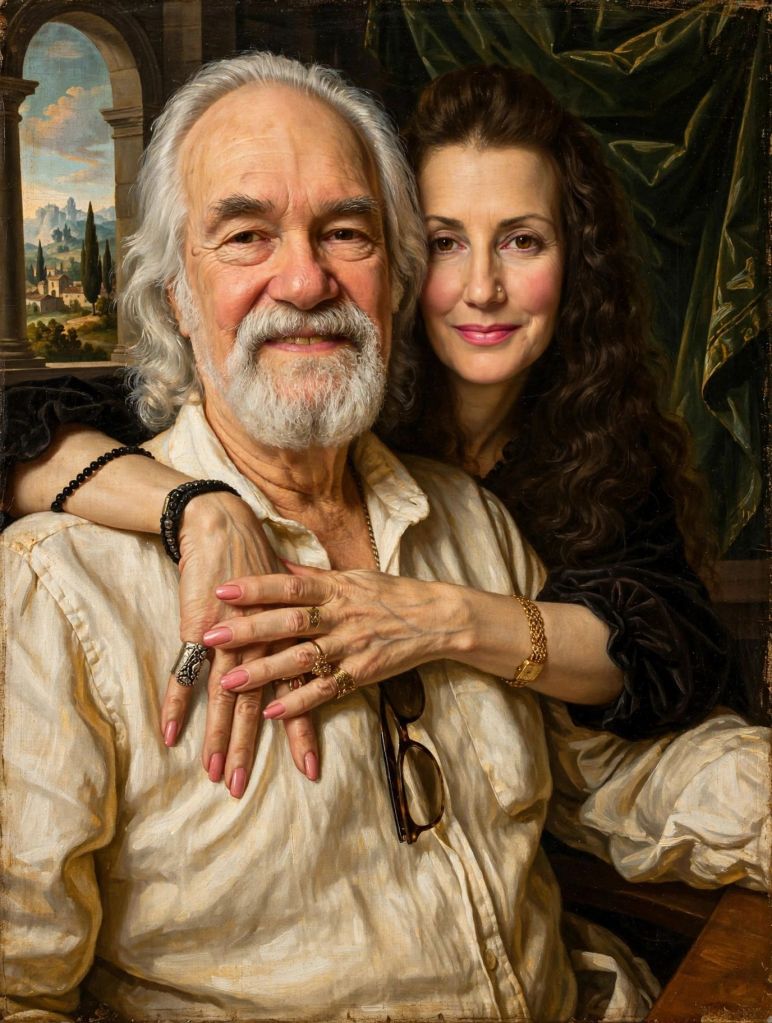
My last afternoon in New York was a quiet one, or so I intended. The Frick Art Gallery, tucked into Henry Clay Frick’s mansion on Fifth Avenue, is a sanctuary from the city, and I had come to see the Vermeers. But as often happens in great museums, my feet led me away from the popular rooms toward a smaller, dimly lit alcove dedicated to works of attribution.
The piece itself was small, a single panel, but the quality was undeniable. It was clearly Italian, perhaps Florentine, circa 1505. The texture of the paint, the specific sfumato effect on the skin tones, and the deep, rich pigments—that distinct Renaissance blue and the vibrant velvet—spoke of a master. Yet the brass plaque beneath it read: Unknown Painter.
When I raised my eyes to the composition, it was as if the room had suddenly shifted. It wasn’t just a shock; it was a physical sensation of disorientation.
I stood before a double portrait. The figures, captured in that precise moment of the 16th century, were seated closely. One was a figure with long, flowing silver hair and a full, neatly kept beard, wearing a cream-colored doublet. The other, a woman with voluminous, dark cascading curls, was dressed in a sumptuous velvet robe. Her arm was draped around his neck, and her hands rested over his chest, adorned with a collection of rings and an ornate, decorative chain bracelet that the artist had captured in meticulous detail.
I knew those faces. I knew the specific lines around the man’s smile, the gentle but direct gaze in the woman’s brown eyes, and even the unique curvature of her nose. I knew them with an intimacy that a history textbook or even a photo gallery couldn’t provide. I pulled my smartphone from my pocket and navigated to my photo roll.
I scrolling through recent images and selected a picture from the image_0.png file—the portrait of me and Robin.
There was no mistake. It was beyond likeness. The artist, painting five hundred years ago, had rendered the identical, specific features of our faces. The contours, the proportions, and the subtle, individual expressions had been painted with such precision that it defied mere coincidence. I looked back and forth, from the image_0.png file in my palm to the painting on the Frick’s wall.
The sensation was not just uncanny; it was time-altering. To see our own visages, so familiar and immediate, rendered as a priceless, centuries-old masterwork, felt like having a dream of someone and then meeting them in an ancient, sun-dappled courtyard. Robin would never believe me. The painting was not a mirror; it was a revelation of continuity I wasn’t prepared to receive. I snapped a photo of the unknown Renaissance double portrait, the Frick plaque below it, and my own hand holding the reference photo from image_0.png next to the canvas. I would need every bit of proof.