
“Things separate from their stories have no meaning. They are only shapes.”
― Cormac McCarthy, The Crossing
“Things separate from their stories have no meaning. They are only shapes.”
― Cormac McCarthy, The Crossing

The continuous development of art is bound up with the Apollonian and Dionysian duality; Just as procreation depends on the duality of the sexes, involving perpetual strife with only periodically intervening reconciliations.
 The path of the righteous man is beset on all sides by the iniquities of the selfish and the tyranny of evil men. Blessed is he, who in the name of charity and good will, shepherds the weak through the valley of darkness, for he is truly his brother’s keeper and the finder of lost children. And I will strike down upon thee with great vengeance and furious anger those who would attempt to poison and destroy my brothers. And you will know my name is the Lord when I lay my vengeance upon thee.

1.
Here’s looking at you kid.
2.
Blessed be he whose blood and judgement is so well commingled that he is not a pipe for fortune’s fingers to play what stop she pleases.
3.
May the devil cut off the toes of our foes that we may know them by their limping.
4.
Here’s to plain speaking and clear understanding.
5.
He who has dined with his friends but once knows what it’s like to be Caesar!
6.
To the constitution of the United States and confusion to its enemies.
7.
Here’s to wives and girl friends. May they never meet!
8.
She was only a grave digger’s daughter but you should have seen her under the sod.
9.
May you be in Heaven fifteen minutes before the devil knows you are dead.
10.
Cheers! Down the hatch mate!

Once upon a time in a land far away
In the country of New Jersey
I endeavored to to take my Jersey wife to the ballet.
We also took along my mother-in-law for the ride
Whom I deemed Mother Nature
And we crossed the river to the Philly side.
And there for one brief shining moment
There were two ball busters at the Nutcracker.

Snow Queen

Sleeping Beauty
It was a fairy tale romance…..

I had the opportunity to watch the wonderful Fannie and Alexander (1981), written and directed by Ingmar Bergman, last night at the Speed Art Museum Cinema here in Louisville, Kentucky. This is the first time I’ve seen it on the big screen since it first came out in 1981. It is a sheer joy to behold. It is perhaps Bergman’s greatest film, The Seventh Seal not withstanding. This is the most autobiographical of all of Bergman’s films and pretty well sums up his life and work.
Scrumptiously and lovingly photographed by Sven Nykvist, every frame is a visual masterpiece of beauty and composition for which he won an Oscar for Best Cinematography. The film also garnered three other Oscars nods including for Best Art Direction, Best Foreign Language Film, and Best Costume Design. Bergman was nominated for Best Screenplay and Best Director.
According to the film notes the movie turned out to be extremely expensive and difficult to make. In terms of scale Fanny and Alexander became Bergman’s largest ever production with a cast of 50 actors. He shot over 25 hours of film. A made for TV version was pared down to five hours in length then he set to work putting together the feature film. Bergman’s first attempt came in at four hours. He tried again and got it down to 3 hours and eight minutes. Still long but manageable. The film is shown with an intermission which we did not take at the Speed Cinema.
Bergman said in his autobiography that after Fanny and Alexander there will be no more feature films for him. Feature films are a job for young people, both physically and psychologically.
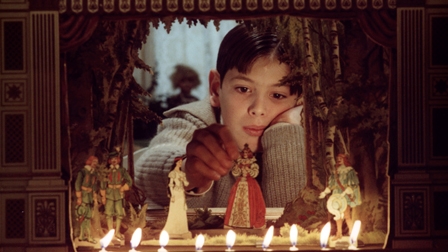
According to Bergman the film had two inspirations. One was a picture from the Nutcracker depicting two children huddling together on Christmas Eve waiting for the candles to be lit on the Christmas tree. The other was Charles Dickens. The bishop in his austere and pure house and the Jew in his antique store filled with old furniture and magical incantations and creatures. The Children are depicted as victims.
Fanny and Alexander are brother and sister in a bourgeois Swedish theatrical family. The film starts off on a snowy Christmas eve and is perhaps the most lavish and beautifully filmed Christmas celebration ever. The movie takes place in Swedish provincial town in the early years of the 20th century. The two children, Fanny and Alexander, are growing up in the bosom of a large, happy, extended family. Their father, who is the stage manager of the theatre the family owns, dies unexpectedly. Later, their mother remarries a stern, authoritarian clergyman. The juxtaposition of the vivacious theatre family with that of the dour, cold, and authoritarian bishop’s family could not be more stark and has its roots in Bergman’s own history. His father was a clergyman.
There are ghosts in the film which only Alexander can see. He is also prone to telling the most outlandish and imaginative lies for which he is severely punished at one point by his stepfather. Alexander is also the master of the magic lantern with which he enchants his sister on Christmas Eve. It is not too far a leap to see the budding genius of Ingmar Bergman taking shape in the form of the young Alexander.
The movie is divided into three parts as in a three act play. We might remember Ingmar Bergman is as well known as a theatrical director (at least in Sweden) as a film director. In a scene in the third section, Emily says to Helena. “I am reading a new play by Strindberg called A Dream Play and there is a perfect part in it for you.” Oh, no,” says Helena, not that misogynist!” “Oh but this part is perfect for you…” and off they go to talk about their next project and adventure.
I remember reading in Bergman’s autobiography how he struggled with A Dream Play when he directed it. He went on at length about the difficulty he had in staging a certain scene. When he finally found the key to his conundrum he was relieved but he also extolled the virtues of meeting the challenge. When I watched the above described scene I had to smile remembering that passage from his autobiography. I am most certain that no one else got the reference but me but for me it was another piece of the puzzle fitting together nicely and another dot connected.
Everything is here: Love, Sex, God, and Death. Now we know where Woody Allen gets it from. Actually, we knew all along that Ingmar Bergman has been a major influence on the films of Woody Allen.
This is the film against which I judge all others, a bench mark if you will, and most others pale by comparison. That is why I am mostly disappointed with the current crop of films coming out of Hollywood these days.
Speed continues to bring to Louisville the best of the best movies and I couldn’t be happier.

Allied is an entertaining piece of fluff that has arrived just in time for the holidays. We have seen it all before with better actors and better writing. Casablanca comes to mind. As a matter of fact the film begins in Casablanca and makes continuous reference to it throughout.
Of course Brad Pitt and Marion Cotillard are movie stars of the first rank and are beautiful to behold. I have a theory that movie stars are our demigods of today and provide for us what the demigods of old provided for the ancient Greeks, which is not a bad thing, and in fact is a lot of fun.
Director Robert Zemeckis has provide us with a well structured film with a good story that is beautiful to look at. Marvelous piece of escapism. Highly recommend!

Nietzsche in the morning Buddha at night
They kinda counteract each other but keep me upright
One thing they both seek to do is to find the truth
The will to truth is the will to power
When you sit sit when you stand stand
Above all you mustn’t wobble.

Man in his pajama at China Star in Louisville, Kentucky

I recently attended an exhibition at the Cincinnati Art Museum entitled Van Gogh: Into the Undergrowth. Turns out there is a whole sub-genre of painting called sous-bois, which means undergrowth, that explores the significance of the interior of the forest. Hmmm. I have been exploring the interior of the forest for years now. Here is my latest entry into this genre.

