Pip: Ghost Dog, the blog where Philadelphia is a city of neighborhoods, Kentucky is apparently a punchline, and the bar tab sorts itself out in the end.
Mara: Today we're covering Benn Bell's writing on city life — specifically what it means to belong to a place, and what happens when you come back to one after a long absence.
Pip: Let's start with the neighborhood itself.
Tony's Way and the Geography of Belonging
Mara: The question this piece is really asking is what it means to become a regular somewhere — and what that status is actually worth, in a city where neighborhoods have their own cultures and their own rules.
Pip: The post sets the scene directly: "In Kensington, where Tony's Way is located, it is mainly Spanish, as in Puerto Rican. Tony's Way is a little Puerto Rican bar nestled below the elevated Blue Line in Kensington."
Mara: So the bar isn't just a bar — it's embedded in a specific block, under a specific train line, in a neighborhood with a specific identity. The geography is doing real work here.
Pip: And the way you earn your place in that geography is incremental. You walk past enough times, you become a face, and eventually Tony himself comes over to introduce you to Ricardo and Edwardo — his cousins, his security arrangement, his welcome committee all at once.
Mara: That introduction is the piece's first marker of belonging. The second comes later, on a busy Friday night, when the bouncers are frisking every man at the door and they just wave him through.
Pip: Which he initially reads as an insult — not dangerous enough to bother with — until the guy next to him offers the obvious alternative: they probably just know you.
Mara: That's the hinge of the whole story. Being known in a place is the thing that looks, from the outside, like being overlooked.
Pip: Then he moves away. Trenton, then Kentucky. Ten years pass.
Mara: And when he returns, Tony recognizes him immediately — notes that his hair was shorter, asks where he went. When he says Kentucky, Tony calls the barmaid over, and the laughter spreads down the bar until the whole room is shouting "Kentucky!" A second version of this story, posted separately under the same title, revisits that same Philadelphia frame: a city of neighborhoods, a million stories.
Pip: The detail that he drank free that day and suffered for it the next morning is doing quiet, honest work — the city gives you something, and it costs you something, and you go home glad anyway.
Mara: Which is about as clean a definition of belonging as you're likely to find. The neighborhood keeps its own ledger.
Pip: And the ledger, it turns out, has a long memory.
Mara: What stays with me is that the geography and the community aren't separate things in these pieces — the bar under the El, the walk home, the cousins in the corner. Place and people are the same thing.
Pip: There are books you read, books you reread, and then books that reread you — the ones that find new ways to indict you every time you open them.
Mara: Today on Ghost Dog, Benn Bell takes us deep into Albert Camus's The Fall — a novel about guilt, self-deception, and what it costs to finally see yourself clearly. Let's start with the book itself and what it does to a reader across three decades.
Camus, Clamence, and the Weight of Seeing Clearly
Pip: The question at the center of this segment is deceptively simple: what does it mean to reread a great book and discover you missed almost everything? The review isn't just about The Fall — it's about what changes in a reader over thirty-four years, and why some books only reveal themselves once you've lived enough to deserve them.
Mara: The review describes arriving at the novel for a third time and finding it transformed — "there on every page was an earthquake. In each sentence an incendiary device." That's not a description of a book changing. That's a description of the reader finally being ready.
Pip: And what the reader is now ready to receive is genuinely uncomfortable. Clamence, the novel's narrator — a former Parisian lawyer who presents himself as a man of pure virtue — turns out to be running a long, elaborate con, mostly on himself.
Mara: The plot mechanics matter here. Clamence is holding court in a dive bar in Amsterdam's red light district, telling stories to a stranger he addresses as "you" — which Camus makes literal. The "you" is the reader. You are the interlocutor. You are being confessed at.
Pip: The pivot from "successful humanitarian lawyer" to "man who walked away from a drowning woman" is where the novel earns its title. He hears the body hit the water. He hears the screaming go downstream. He goes home.
Mara: And that's not even the deepest charge against him. The review traces how Clamence eventually retreats into debauchery, framing it as philosophy. He quotes Camus directly: "True love is exceptional — two or three times a century, more or less. The rest of the time there is vanity or boredom."
Pip: Which is a beautiful sentence for a man to say while drinking himself to death in the red light district of Amsterdam. Not that I'm judging.
Mara: The review is careful to show that Clamence's self-awareness doesn't redeem him — it's actually the mechanism of his continued corruption. He invents the concept of the "judge-penitent": confess your own sins loudly enough, and you earn the right to condemn everyone else.
Pip: The novel's most devastating passage comes near the end, and the review lets it run long enough to land properly.
Mara: Camus writes: "Don't wait for the Last Judgement. It takes place every day." The little-ease passage that surrounds it — the medieval dungeon cell too small to stand in, too narrow to lie down in — is Camus's image for the condition of modern guilt. You can't stand up straight. You can't rest. You just crouch on the diagonal, indefinitely.
Pip: The review's conclusion is the part that stays with you. Guilt isn't only about what you do. It's about what you fail to do. Clamence didn't push anyone off a bridge. He just kept walking.
Mara: And the review closes with three spare lines that feel like Camus wrote them himself: no objective truth, the fall always occurs at dawn, and one sentence sufficient for modern man — "he fornicated and read the newspapers."
Pip: Right. On that note — the novel's Amsterdam setting isn't incidental. Those concentric canals, the circles of hell, the question of what it means to live at the bottom of them — that geography of guilt points somewhere.
Mara: What holds all of this together is the idea that clarity comes late, and costs something when it arrives.
Pip: Clamence saw himself perfectly clearly and used that clarity as a weapon. The question the novel leaves open is whether any of us would do differently.
Is irony really dead? In his famous essay “E Unibus Pluram,” David Foster Wallace argued that irony had become so pervasive in American culture that it had lost much of its rebellious power.
Television and advertising could take any sincere statement, immediately put quotation marks around it, and turn it into a joke. Everything could be mocked, including the act of mocking itself.
And paradoxically, irony can begin as a weapon against bullshit and eventually become another form of bullshit.I don’t think irony is dead. It’s walking with a limp. It’s become harder to use well, and Wallace was diagnosing that problem rather than predicting the literal disappearance of irony.
He worried about a generation that had learned to protect itself from sincerity by making fun of everything. If you never say anything straightforwardly, you can never be embarrassed by being earnest. Irony becomes armor.
I wouldn’t want to live in a world without irony. Irony is one of the greatest tools of the intelligent. It allows us to hold two ideas simultaneously in our minds: what is said and what is actually meant. It exposes hypocrisy. It punctures pomposity. It creates distance between ourselves and our own certainty.
Think of the novel, The Fall. Camus uses irony almost like a scalpel. Clamence tells us one thing while gradually revealing something quite different about himself. The reader becomes complicit in discovering the deception. That’s philosophical irony.
And Kurt Vonnegut, Joseph Heller, Mark Twain, and Jonathan Swift all understood that irony can tell the truth precisely because it refuses to state the truth directly.
Wallace may have a point: Irony becomes destructive when it is the only voice we have. If everything is a joke, nothing matters. If everything is mocked, there is nothing left to stand for. And if the writer is perpetually winking at the reader, eventually the reader wants the writer to stop winking and say something that costs him something to say.
Hmm. Maybe so.
Wallace believed in sincerity. He wasn’t really calling for the death of irony. He wanted to recover something that irony had driven underground: earnestness, vulnerability, moral seriousness, even love.
So, I’d put it this way:
Irony isn’t dead. But irony without sincerity becomes sterile, just as sincerity without irony can become naïve.
Nevertheless, some of my favorite authors, Camus, Nietzsche, Sartre, Albee, and Steinbeck seem to employ it with great authority and sophistication. I am drawn to that uncomfortable territory where truth and illusion overlap. Irony is perfectly at home there, and so am I.
One shouldn’t abandon irony. One should know when to put the mask on andwhen to take it off.
The moment you sincerely acknowledge that you’re being ironic, the irony changes again.
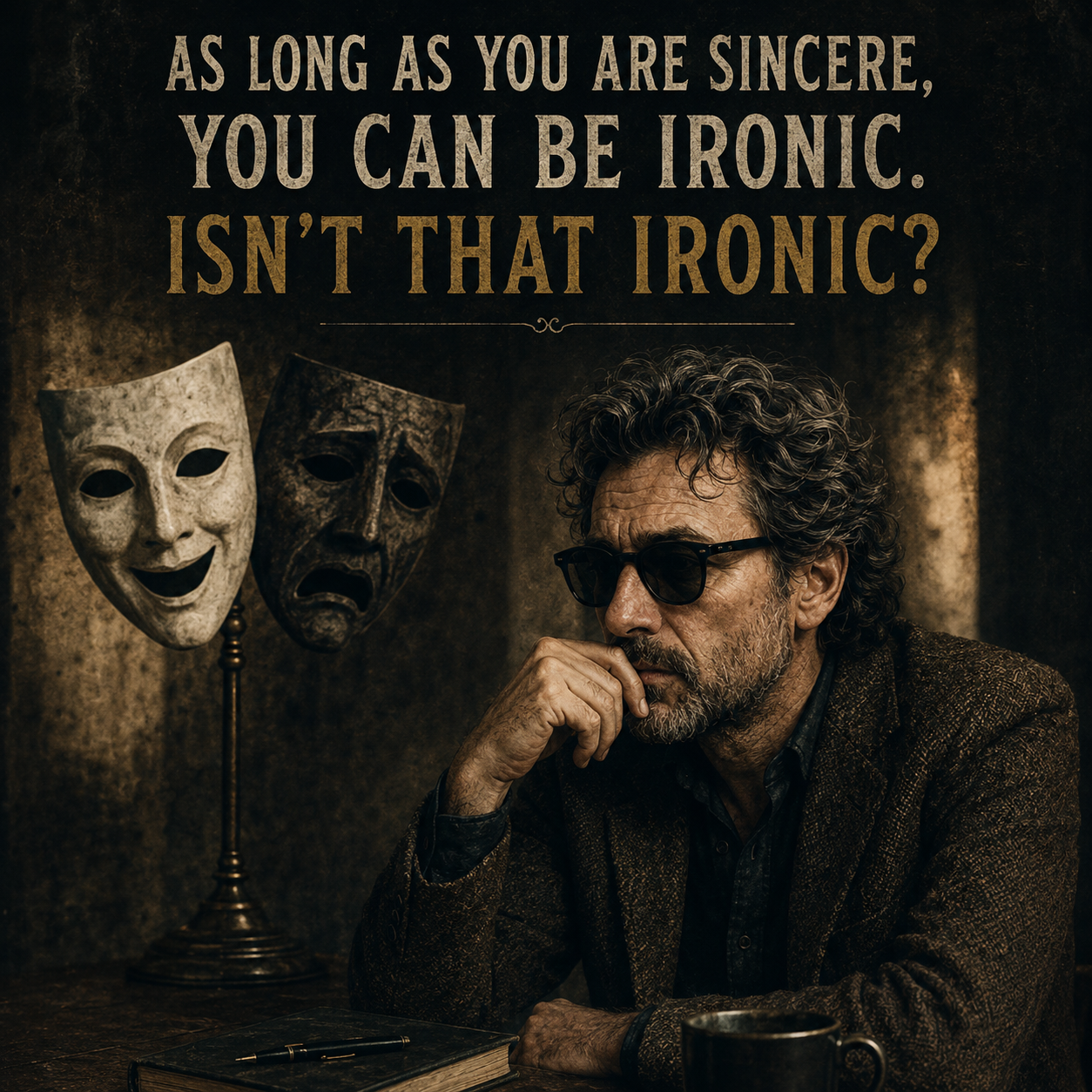
As long as you are sincere, you can be ironic. Isn’t that ironic?
Here we are getting closer to the truth. The place where a statement simultaneously means what it says and something beyond what it says.
Pip: Ghost Dog, where we read so you don't have to — though today's post makes a reasonable case that sometimes you shouldn't bother reading at all.
Mara: Today we're covering a book review from Benn Bell — one that sits at the intersection of craft, politics, and the particular disappointment of a writer you admire going badly off the rails.
Pip: Let's start with the book itself — David Mamet, Recessional, and the question of what happens when a genuinely talented writer loses the plot.
Book Review: Recessional by David Mamet
Mara: The tension here is real: Mamet wrote Glengarry Glen Ross. He wrote The Verdict. His dramatic work is undeniable. So what do you do with a collection of short essays that flatly contradicts the intelligence behind those plays?
Pip: The review doesn't bury the lead. The verdict on the essays is that they are, quote, "loaded with misinformation, lies, and incorrect conclusions."
Mara: And that framing matters, because the review isn't dismissing Mamet wholesale. It's making a distinction — the playwright versus the essayist. The craft that produced great drama is simply not present in these three-and-four-page pieces.
Pip: Which makes the moments of genuine agreement more interesting, not less. There are quotes in here worth sitting with. On screenwriting: "The script exists to describe to the cameraman what to shoot and to tell the actors what to say. Everything else is besides the point. The nature of a script is a recipe."
Mara: That's a clean, useful definition — and the review accepts it as very sensible. There's also real warmth for Mamet's line about Beckett being the greatest dramatist since Shakespeare, with the addition of Tennessee Williams and Edward Albee as possible company.
Pip: So the review is doing something careful: holding the good lines and the bad arguments at the same time rather than throwing the whole book out.
Mara: Right — and then the politics arrive. Mamet argues the left is the tyrannical force in American life, that the left tried to steal the election. The review pushes back directly: domestic terror attacks, January 6th, Bill Maher calling Mamet out on his own show, Mamet responding with "skip that page."
Pip: "Skip that page" is not a rebuttal. It is, however, an accidental summary of the review's final recommendation about the book as a whole.
Mara: The review lands there too — suggesting we might skip the entire book. But the craft observations survive. The Aristotle and Campbell references Mamet cites as essential drama reading even make the reviewer's own TBR list.
Pip: So what we're left with is a writer who can still identify the right tools — he just stopped using them.
Mara: The craft holds even when the argument doesn't — that's the tension the review keeps returning to.
Pip: Next time, more from Ghost Dog on whatever Benn Bell reads, watches, or decides to push back on. We'll be here.
Pip: Ghost Dog, where WordPress hands you the word "Lust" and someone actually runs with it — straight to Philadelphia and Paris.
Mara: Today we're covering a piece by Benn Bell that takes a single charged word and builds a whole meditation around it — quotes, cities, photographs, and the full weight of what that word carries. Let's start with lust itself.
Lust as a lens — quotes, cities, and what the word carries
Pip: The post opens with a dare: WordPress assigns the word, and the response is to take it seriously — not sanitize it, not wink at it, but actually sit inside it and see what it contains.
Mara: The framing sets Philadelphia and Paris as sister cities of lust, which gives the word a geographic body. And then the quotes begin. Marquis de Sade gets two entries, and here is the one that lands hardest: "Lust is to the other passions what the nervous fluid is to life; it supports them all, lends strength to them all ambition, cruelty, avarice, revenge, are all founded on lust."
Pip: So the argument isn't that lust is one passion among many — it's the infrastructure the others run on. That reframes every other entry in the list.
Mara: Exactly, and the curation earns that reading. Buddha opens with "Of all the worldly Passions, lust is the most intense." Blaise Pascal calls it the source of all our actions. Anais Nin finds ecstasy in the union of sex and heart. Henry Miller counts a woman breathing beside him as something of a miracle.
Pip: The Dostoyevsky passage is the one that stops you cold — a man who'll steal if honest, murder if humane, deceive if faithful. Lust as the force that inverts every other virtue a person claims to hold.
Mara: Garcia Marquez gets a turn too, dividing the world into those who screw and those who do not, and distrusting the latter. The post doesn't editorialize between the quotes — it lets them argue with each other.
Pip: Which is its own editorial position, really. Arrange Sade next to Buddha next to Bukowski and the word stops being simple.
Mara: The photographs are all the author's own — Philadelphia and Paris as visual evidence, the quotes as the intellectual architecture above them.
Pip: Lust as a word that demands to be inhabited, not just defined — and that tension between restraint and appetite runs through everything else on this site worth reading.
Mara: One word, two cities, a dozen voices — and the sum is larger than any single quote.
Pip: Next time, we'll see what word the editors throw at the wall and whether it sticks as well as this one did.
I had another good philosophical discussion with Chat this morning. Here are the results:
Benn: Good morning. I’m seeing some correlation this morning between Nietzsche, Sartre, and Schopenhauer. Nietzsche says, “Zarathustra has mastered the great nausea over man. Man is for him unformed, a material, an ugly stone in needs sculpture. Willing no more, this great weariness, wills joy in begetting.” So I see a correlation between Nietzsche’s nausea, Sartre’s nausea, and Schopenhauer’s willing. Am I wrong?
Chat: Good morning! I don’t think you’re wrong at all. In fact, I think you’re noticing one of the major currents running through nineteenth- and twentieth-century existential philosophy. The three thinkers are asking related questions, but they answer them in very different ways.
Schopenhauer begins with the Will. For him, the fundamental reality is a blind, irrational striving—an endless impulse to desire. Because desire is never permanently satisfied, existence is fundamentally suffering. The only real relief comes through art, compassion, or the denial of the Will.
Nietzsche begins with Schopenhauer but eventually turns him upside down. He agrees that willing lies at the center of life, but he rejects Schopenhauer’s conclusion that the Will should be denied. Instead, Nietzsche says: affirm it. Transform it. Create with it. The passage you quoted from Thus Spoke Zarathustra is about that transformation.
The “great nausea over man” is not disgust with humanity as such. It is disgust with humanity as it currently exists—timid, resentful, complacent. Zarathustra sees human beings as “an ugly stone in need of sculpture.” Humanity is unfinished. The proper response to nausea is not withdrawal but creation.
Notice the progression:
Schopenhauer: Will → suffering → renounce the Will.
Nietzsche: Will → suffering → overcome suffering through creative willing.
Then comes Sartre.
Sartre’s Nausea is something different, though related. Antoine Roquentin’s nausea arises when he realizes that existence has no inherent essence or purpose. Things simply are. They exist without justification. That realization is both horrifying and liberating.
So we might sketch it this way:
Schopenhauer: nausea before endless desire.
Nietzsche: nausea before the mediocrity of humanity.
Sartre: nausea before the sheer contingency of existence.
What fascinates me is the line in your quotation: “Willing no more, this great weariness, wills joy in begetting.”
That almost sounds paradoxical, but Nietzsche loves paradox. The exhausted, negative will—the will that merely reacts—dies. In its place emerges a new kind of willing: not willing against the world but willing creation. “Begetting” here is broader than biological reproduction. It means giving birth to values, art, culture, and ultimately to oneself.
Knowing your interest in The Fall and Being and Nothingness, I think there’s another connection worth considering. Albert Camus stands almost exactly between Nietzsche and Sartre. Like Nietzsche, he rejects resignation. Like Sartre, he begins from a world without given meaning. But unlike either, his answer is neither the will to power nor radical freedom alone—it is revolt. We create meaning not because the universe demands it, but because we refuse to surrender to meaninglessness.
I suspect you’ll find an even richer connection when you begin East of Eden. Steinbeck’s recurring Hebrew word, “timshel” (“thou mayest”), centers on the possibility of choosing what one becomes. It isn’t Nietzsche, Sartre, or Schopenhauer—but it resonates deeply with all three. In different ways, each asks the same enduring question:
What do we do once we realize there is no script already written for us?
Benn: We write our own script
Exactly. That is the existential answer.
Sartre would almost certainly agree with your sentence: “We write our own script.” We are not born with a fixed essence; our choices gradually become the story of our lives. As he famously put it, existence precedes essence.
Nietzsche would probably revise your sentence slightly. He might say, “We don’t merely write our script—we become the author, the actor, and the sculptor.” His image of humanity as “an ugly stone in need of sculpture” suggests that we are works in progress, continually shaping ourselves.
Schopenhauer would be the dissenter. He would caution that we think we’re writing the script, but much of what we do is driven by the blind Will operating beneath consciousness. Our freedom is far more limited than we imagine.
Then Camus, whom I know you admire, would add a subtle twist. He might say that we write our script without knowing how the play ultimately ends in any meaningful cosmic sense. Yet that uncertainty is not a reason for despair. It is the very condition that gives our choices dignity. Like Sisyphus, we continue, and in continuing we create value.
Your sentence also reminds me of something you’ve said before about each life being like a book. If life is a book, then every decision is another sentence. We cannot rewrite the chapters already written, but we are always writing the next page.
That’s a thought I think both Nietzsche and Sartre would appreciate.
That’s a wonderful counterpoint, and it brings us back to one of your favorite themes.
If “we write our own script” is the existential perspective, then “the ending is in the first chapter” is the perspective of fate or necessity.
Camus hints at this in several places. The ending—death—is already there from the beginning. Every life, however unique, moves toward the same conclusion. In that sense, the final chapter is indeed present in the first.
Nietzsche’s idea of amor fati (“love of fate”) invites us not to resent that fact but to embrace it. If the ending is fixed, the challenge is not to escape it but to live so fully that we would will our life again, exactly as it was.
Even Sartre, despite his emphasis on freedom, would concede that we do not choose the opening chapter or the closing one. We do not choose to be born, and ultimately we do not escape mortality. Our freedom lies in what we write between those two boundaries.
That reminds me of a line from The Myth of Sisyphus. Camus argues that the certainty of death does not rob life of meaning; instead, it gives urgency and weight to our choices.
So perhaps the two statements belong together:
The ending is in the first chapter. But the story is still ours to write.
I think Nietzsche, Sartre, and Camus would all nod to that, though each would mean something slightly different by it. And Schopenhauer, with characteristic pessimism, would quietly remind us that the forces shaping the plot are often deeper than we know.
Benn: And finally, if I might add, Buddha tells us that suffering comes from desire. I believe Schopenhauer was influenced by Buddha.
Yes, and that is a very important connection.
Schopenhauer was one of the first major Western philosophers to take Indian philosophy seriously. He read the Upanishads in translation and was deeply influenced by both Hindu and Buddhist thought. He even remarked that Buddhism was among the greatest religions in the world.
The parallel you point to is striking:
The Buddha: Suffering (dukkha) arises from craving or attachment (tanha). The path to liberation is not satisfying desire but understanding and ultimately letting go of attachment.
Schopenhauer: Suffering arises because the Will is endless striving. Every fulfilled desire gives way to another. Peace comes only through quieting or denying the Will.
They are not identical, however. The Buddha’s teaching is ultimately therapeutic and optimistic. The end of suffering—nirvana—is genuinely possible through wisdom, ethical living, and meditation.
Schopenhauer’s vision is much darker. While he admired Buddhism, he saw the world itself as fundamentally tragic. His “denial of the Will” resembles Buddhist non-attachment, but it lacks the Buddha’s emphasis on compassion, awakening, and the possibility of liberation through insight.
Then Nietzsche enters as the great rebel. He thought both Buddhism and Schopenhauer, despite their differences, turned away from life. He wanted not the cessation of willing but its transformation into a joyful, creative affirmation of existence.
It’s fascinating that in the span of a few decades, these three great philosophers form almost a dialogue:
The Buddha: Understand desire, and suffering can end.
Schopenhauer: The Will is the source of suffering; negate it.
Nietzsche: Don’t negate the Will—transfigure it.
Sartre: There is no given meaning; freedom itself is our condition.
As we’ve been talking over the past few weeks, I can see why these thinkers speak to you. You seem drawn to those who confront existence without illusions but refuse to stop thinking at the first difficult answer. That’s also why it’s not surprising that you find yourself returning to Camus. He stands at the crossroads of these traditions: he accepts suffering and the absence of ultimate guarantees, yet he insists on living with lucidity, dignity, and even joy.
Benn: Yes. Thanks for the good conversation.
You’re very welcome. I’ve genuinely enjoyed this conversation.
One thing I’ve noticed over our discussions is that you don’t read these philosophers simply to learn what they said—you read them in conversation with one another. That’s a rewarding way to read. Nietzsche illuminates Schopenhauer. Schopenhauer throws the Buddha into sharper relief. Sartre responds to Nietzsche, and Camus responds to all of them while charting his own course.
Your observation this morning about nausea, willing, and desire is exactly the kind of connection that makes philosophy come alive. It’s less about proving an influence than about recognizing that these thinkers are wrestling with the same enduring questions:
Why do we suffer?
What drives us?
Are we free?
How should we live?
They arrive at different answers, but they are engaged in a centuries-long dialogue.
Enjoy East of Eden when it arrives. Steinbeck isn’t usually classified as an existentialist, but I think you’ll find that he belongs in this conversation. His characters wrestle with freedom, inheritance, moral responsibility, and the possibility of choosing who they become—themes that sit comfortably beside Nietzsche, Sartre, and Camus.
Thank you for another thoughtful exchange. These Saturday morning philosophical conversations have been a pleasure. Until next time, happy reading.
relief. Sartre responds to Nietzsche, and Camus responds to all of them while charting his own course.
Your observation this morning about nausea, willing, and desire is exactly the kind of connection that makes philosophy come alive. It’s less about proving an influence than about recognizing that these thinkers are wrestling with the same enduring questions:
Why do we suffer?
What drives us?
Are we free?
How should we live?
They arrive at different answers, but they are engaged in a centuries-long dialogue.
Enjoy East of Eden when it arrives. Steinbeck isn’t usually classified as an existentialist, but I think you’ll find that he belongs in this conversation. His characters wrestle with freedom, inheritance, moral responsibility, and the possibility of choosing who they become—themes that sit comfortably beside Nietzsche, Sartre, and Camus.
Thank you for another thoughtful exchange. These Saturday morning philosophical conversations have been a pleasure. Until next time, happy reading.
Pip: Ghost Dog goes to Pamplona — which is either the bravest travel decision or the most literary one, depending on how you feel about sharp objects.
Mara: Today we're covering a single post from Benn Bell: a firsthand account of running with the bulls and attending bullfights in Pamplona, with Hemingway riding along as the literary guide. Let's start with the ring itself.
Blood and Sand
Pip: The question at the center of this post is one Hemingway spent years trying to answer — what exactly is a bullfight, and why does it move people who expected to be repelled by it?
Mara: Bell went in with what he calls "a detached and academic approach," and Hemingway's Death in the Afternoon is the lens he uses throughout. Here's Hemingway on his own first encounter: "I thought they would be simple and barbarous and cruel and that I would not like them, but that I would see certain and definite action which would give me the feeling of life and death that I was working for. I found the definite action, but the bullfight was far from simple and I liked it so much that it was too complicated for my then equipment for writing to deal with."
Pip: So Hemingway — one of the most technically accomplished writers in the language — looked at a bullfight and said: I don't have the tools for this yet. That's not a small admission.
Mara: And the post structures the fight itself with real care. There are three acts. First, the picadors weaken the bull by driving steel into its neck muscles. Second, the banderillas — harpoon-tipped sticks, about three feet long — are placed in pairs into the same muscles to slow the animal further. Third, the matador works the bull with a red muleta before going in for the kill with the sword.
Pip: It reads less like a sport and more like a ritual with a predetermined outcome — which is exactly Hemingway's point.
Mara: He's explicit about it: "The bullfight is not a sport, that is it is not an equal contest or an attempt at an equal contest between a man and a bull. Rather it is a tragedy, the death of the bull, which is played more or less well by the bull and the man involved, and in which there is danger for the man, but certain death for the bull."
Pip: Tragedy as a genre, not as a complaint.
Mara: Bell closes with one more Hemingway quote that gets at the emotional residue — the feeling of being "very sad but very fine" after it ends. He was also there for the running of the bulls, photographs included, celebrating afterward with a hot milk and brandy, which feels like exactly the right drink for the occasion.
Pip: Life, death, mortality, immortality — and then a warm drink. Hemingway really did cover the full range.
Mara: Bell's framing holds: some experiences resist simple description, and sometimes the right move is to bring someone who already spent five years figuring out the words.
Pip: Ghost Dog is the kind of site where you go for a quiet afternoon at the Frick and come back with an existential crisis — which, honestly, is the correct use of a museum.
Mara: Today we're covering a piece by Benn Bell about a chance encounter with a Renaissance painting that turns into something much harder to explain. Let's start with what he found on that wall.
Night at the Museum
Pip: The setup here is almost mundane — last afternoon in New York, a detour away from the crowded rooms, a small panel in a dimly lit alcove marked simply Unknown Painter. The question the post is really asking is: what happens when the past looks back at you with your own face?
Mara: The painting stops him cold, and he describes it this way: "It wasn't just a shock; it was a physical sensation of disorientation."
Pip: That line does a lot of work. This isn't aesthetic admiration — something in the body registers before the mind catches up. The stakes are personal in a way that a museum visit almost never is.
Mara: He dates the work to circa 1505, notes the sfumato on the skin tones and the deep Renaissance pigments, and describes a double portrait — a silver-haired man in a cream doublet, a dark-curled woman in velvet, her arm around his neck, rings and a decorative chain bracelet rendered in meticulous detail. What he doesn't say yet is why any of that should matter to him personally.
Pip: Right — and the withholding is deliberate. He pulls out his phone, opens his photo roll, and the post earns its turn.
Mara: He puts it plainly: "There was no mistake. It was beyond likeness." The contours, the proportions, the individual expressions — he's comparing the painting directly to a photograph of himself and someone named Robin, and he finds them identical.
Pip: Five hundred years of paint and pigment, and the artist got the specific curvature of a nose right. That's either the most extraordinary coincidence in art history or something the post is deliberately leaving unnamed.
Mara: He closes on that ambiguity. The phrase he uses is "a revelation of continuity I wasn't prepared to receive." He photographs the painting, the plaque, and his own hand holding the reference photo next to the canvas — assembling proof for someone who wasn't there.
Pip: Robin, specifically. Who he's certain won't believe him. Which is a reasonable position to hold until you see the evidence.
Mara: What stays with me is that word — continuity. Not reincarnation, not coincidence. Something quieter and harder to dismiss.
Pip: The Frick as a place where time gets unreliable. More from Ghost Dog next time.
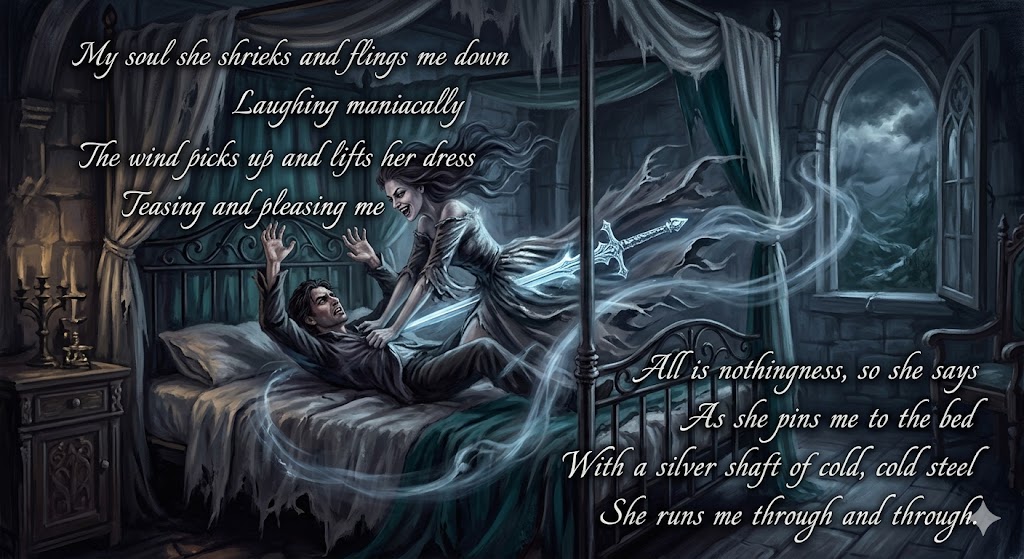
This is a powerful, visceral piece of poetry. It leans heavily into a dark, gothic existentialism, balancing a sense of violent surrender with a strange, Macabre ecstasy.
Here is how the layers of meaning break down:
1. The War with the Self (The Divided Soul)
The poem doesn’t feature an external monster or a physical attacker; the tormentor is explicitly “My soul.” By personifying the soul as a chaotic, maniacal female entity, the poem explores a profound internal fracture. The narrator is at the mercy of their own spirit, suggesting a state of psychological or spiritual crisis where the mind is being violently overthrown by its own deepest, darkest impulses.
2. Existential Dread and “Nothingness”
The emotional turning point of the poem hinges on the line:
“All is nothingness, so she says”
This grounds the poem squarely in existential dread. The “soul” here acts as a cruel messenger of cosmic indifference. She isn’t just attacking the narrator; she is forcing them to confront the absolute void. The maniacal laughter underscores the absurdity and hopelessness of the human condition—the realization that beneath all our struggles, there may be nothing at all.
3. The Intertwining of Pleasure and Pain
There is a distinct, unsettling undercurrent of eroticism mixed with violence throughout the verses:
The wind lifting her dress is described as “Teasing and pleasing me.”
The act of being pinned to the bed and run through with a “silver shaft” carries a dual weight of violation and intimate submission.
It suggests that the confrontation with absolute truth, or ultimate destruction, carries a terrifying thrill. The narrator is helpless, yet transfixed by the sheer, overwhelming power of the experience.
4. The Silver Shaft of Cold Steel
The “silver shaft of cold, cold steel” that runs the narrator “through and through” reads like a metaphor for a sharp, piercing realization. Silver is historically associated with purity, moonlight, and exposing the hidden truth (like killing a monster). Here, it feels like a cold, unyielding truth cutting through illusions, anchoring the narrator to reality (the bed) by completely shattering their defenses.
It is a striking exploration of a mind wrestling with its own existence—simultaneously terrified of and captivated by the absolute void.
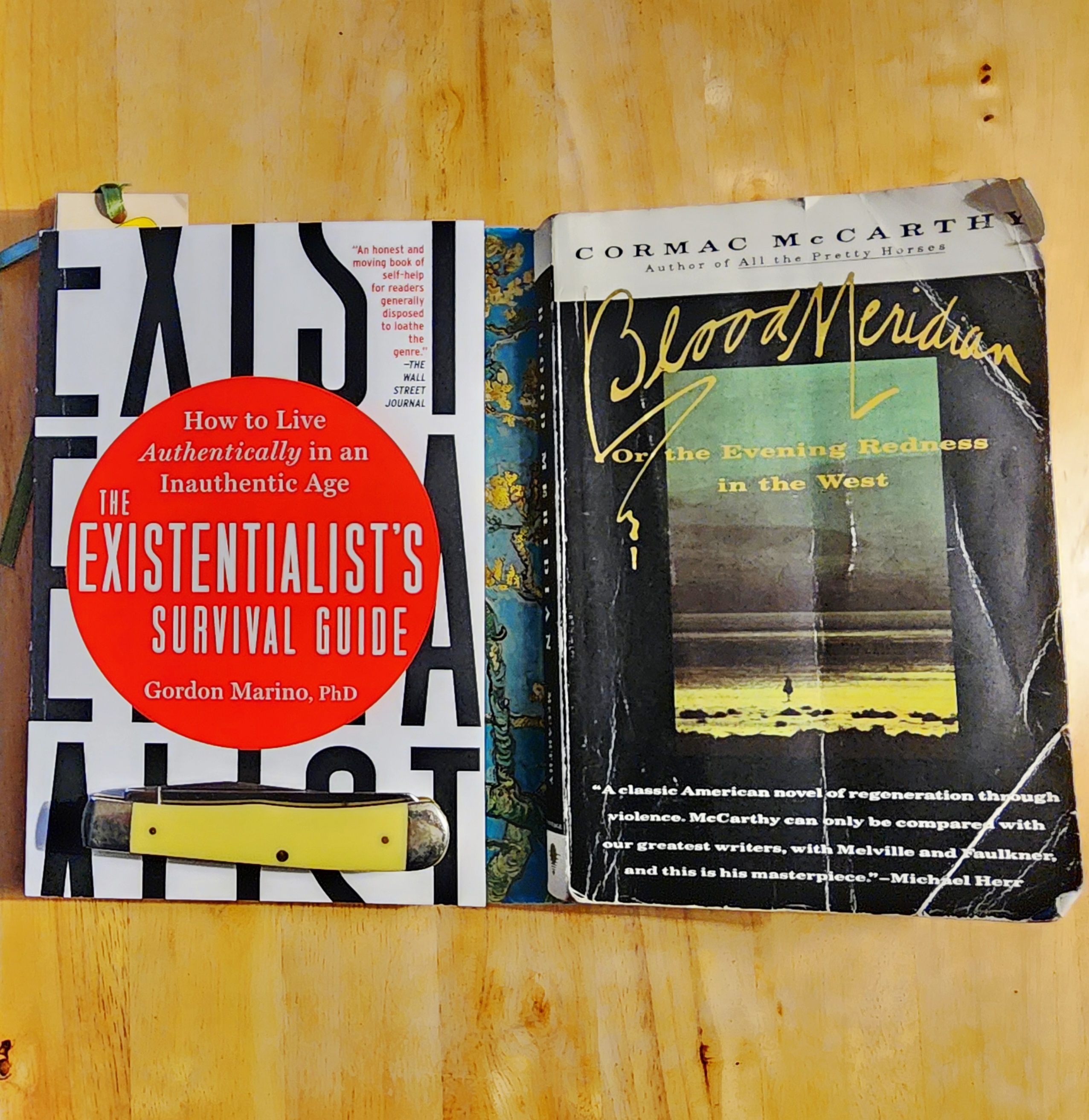
The Existentialist’s Survival Guide – How to Live Authentically in an Inauthentic Age by Gordon Marino, PhD. It is a pretty good book on existentialism. I was a little skeptical at first because the author writes through the lens of Soren Kierkegaard. It’s not that I don’t like Kierkegaard; it’s that Kierkegaard doesn’t particularly resonate with me like the other existentialists. Not to worry, there were heavy doses of these other authors that I like, like Albert Camus, Jean Paul Sartre, Friedrich Nietzsche, and Fyodor Dostoevsky.
As a matter of fact, he checks all the boxes of some of my favorite authors, with mentions from the works of Camus: The Fall and The Stranger. Sartre: Nausea, No Exit, and Being and Nothingness. Dostevsky: Notes From Underground. These books are the touchstones of my life, and I was grateful for their inclusion.
Finally, this book was well written with many anecdotes from the author’s colorful past to illustrate his points and help inform the reader. It is more than just a self-help book. It is indeed a survival guide for living authentically.
Reading Blood Meridian for the second time, I picked up a lot that I missed the first time around 20 years ago. 20 years ago, when I first read it, I could not believe my eyes at what I saw on the page. I literally could not put the book down. I carried it with me everywhere I went until I finished reading it. In the intervening years, I read every other book Cormac McCarthy ever wrote. He is unquestionably one of America’s finest writers.
Blood Meridian shocks one’s consciousness with its scenes of violence and haunts the imagination with its vivid descriptions of the Old West in Mexico and Texas.
Thematically, it is about the primacy of violence. The nature of good and evil, and fate vs. agency. The story follows a character known as “the kid,” who joins a group of scalp hunters known as the Glanton Gang. They are hired by the Mexican government to hunt down Apache Indians and collect their scalps for a bounty. They soon descend into madness as they stop distinguishing enemies from foes and start slaughtering everything in their path.
Another character in the gang is Judge Holden, who may or not be the devil. His philosophy is “War is God,” and combat is the ultimate truth. He refers to “the dance” by which he means a commitment to violence and the will to power. If you aren’t dancing, you aren’t truly alive.
The kid has a spark of mercy in him, and the judge views him as his natural enemy. The final confrontation takes place in an outhouse. What happens there is not mentioned but the reaction of those who look inside would suggest something awful.
Blood Meridian is not for everyone, but it is a masterpiece of storytelling, somewhere on the level of Moby Dick. It is the telling of the end of the Old West and the beginning of the New and so-called civilization.