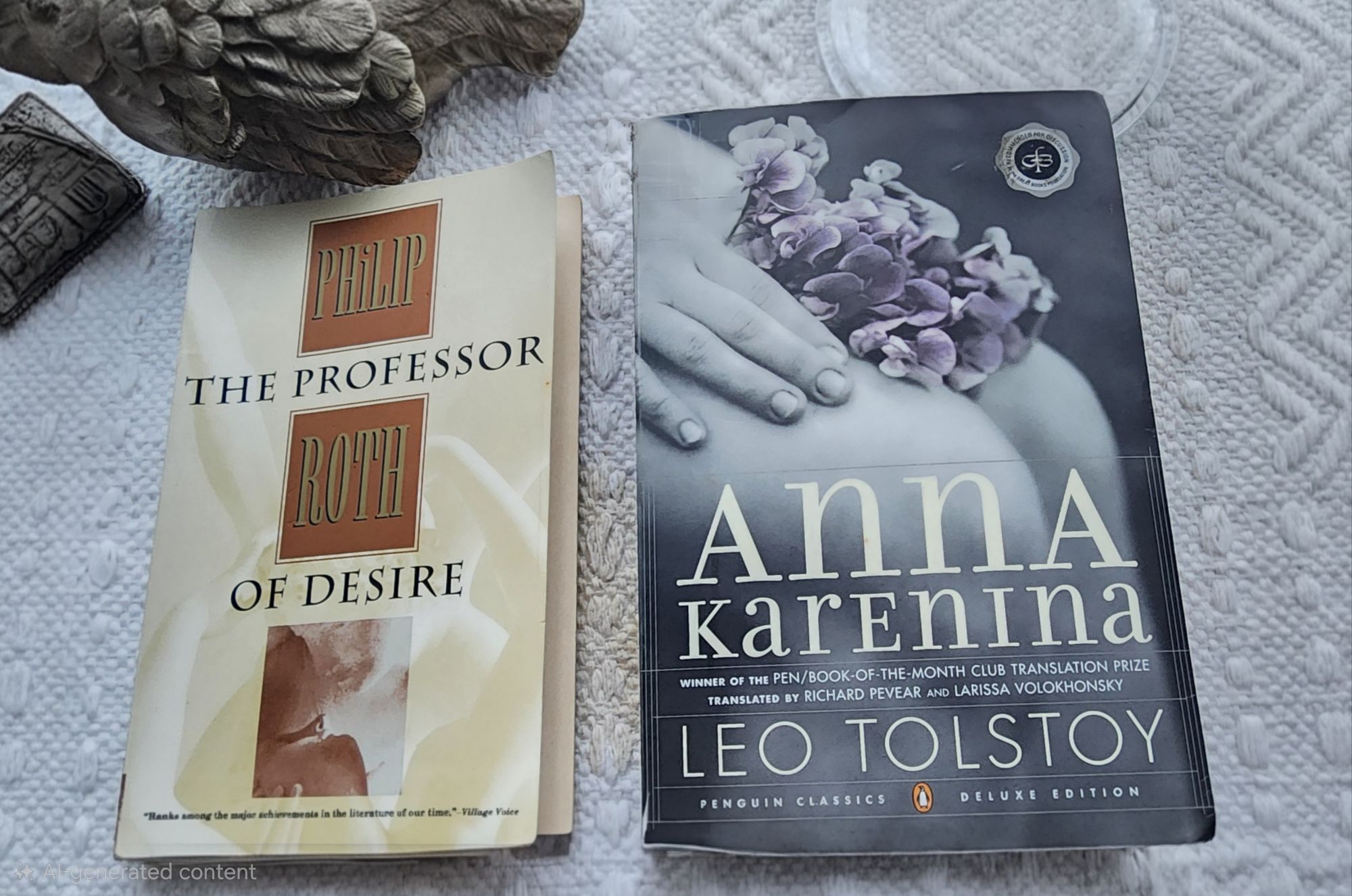
The Professor of Desire Meets Anna Karenina

I am reading The Professor of Desire alongside Anna Karenina, and lo and behold, I find a reference to Anna in the body of the text where Kepesh compares his girlfriend Helen to Anna, and she compares her previous lover to Anna’s husband, Karenin. Wow! Another anachronistic event! I wasn’t expecting that. A happy accident?

What a wonderful discovery! And I think this one is especially interesting because it isn’t simply a coincidence between two books I’ve been reading. There’s a literary conversation taking place across the decades that I’ve stumbled into quite unexpectedly.

Let’s look at what might be going on.

First, there’s the delicious irony of the timing.

I am reading Anna Karenina by Leo Tolstoy and The Professor of Desire by Philip Roth simultaneously. I am already immersed in Tolstoy’s world, thinking about Anna, her relationships, her choices, and the social conventions that constrain her. Then Roth’s protagonist, David Kepesh, invokes Anna in a contemporary story about desire and relationships.

Suddenly, the two books aren’t separate experiences anymore. They overlap.

And because I wasn’t looking for the connection, the discovery feels almost like the books found each other.

Second, I suspect the comparison is doing some serious literary work.

Anna is much more than a woman caught in a love affair. She’s a character struggling with the conflict between erotic desire, emotional fulfillment, social expectations, and the consequences of her choices.

Those are precisely the sorts of questions that interest Roth. Kepesh is a man fascinated by sexuality, but he’s also an intellectual who tries to understand his experiences by interpreting them through literature and ideas.

When he compares Helen to Anna, he invokes an entire literary history. He’s not merely describing his girlfriend; he’s measuring a living woman against a fictional character whose desires and decisions have become legendary.

And Helen’s comparison of her former lover to Karenin introduces another dimension. Karenin represents a particular kind of husband: respectable, controlled, concerned with social appearances, and emotionally distant in ways that Anna finds intolerable.

The comparisons might reveal as much about the people making them as about the characters they’re invoking. We sometimes use literature to understand our lives, but we can also use it to avoid seeing those lives clearly. That’s a very Roth-like possibility.

There’s an important distinction here, though: Roth’s characters invoking Tolstoy doesn’t necessarily mean Roth endorses their interpretations. The comparisons may be revealing their assumptions, fantasies, or blind spots.

Third, here’s the connection I find most intriguing.

I am reading a nineteenth-century novel about the destructive consequences of desire alongside a twentieth-century novel examining desire through a modern, often ironic sensibility.

Tolstoy asks what happens when desire collides with the moral and social structures of a life.

Roth often asks what happens when we try to make desire the organizing principle of a life.

Those aren’t identical questions, but they’re related. And the differences between the authors may be just as revealing as the similarities.

One author approaches desire through the moral and social fabric of Russian society; the other explores it through the sexual liberation, anxieties, and contradictions of modern American life.

And Anna herself becomes a kind of bridge between those worlds.

And now, dear reader, the anachronistic event!

I love that description. It reminds me of my recurring interest in how literature seems to fold time in on itself: the way one book suddenly illuminates another, or how a character encountered today seems to be answering a question raised by a book you read yesterday.

Of course, there’s no need to suppose that anything supernatural has happened. Our minds are constantly making connections, and reading two books in parallel creates opportunities for unexpected recognition.

But that doesn’t diminish the experience. Quite the opposite.

The coincidence becomes meaningful because it opens up a new way of reading both books.

And I wonder whether this is the most rewarding part of reading great literature: eventually, the books stop being isolated objects. They become part of a conversation that you, the reader, are helping to conduct.

One question remains: when Kepesh compares Helen to Anna, does he seem to be suggesting that Helen shares Anna’s passion and capacity for emotional upheaval, or is he thinking more about Anna as a woman who disrupts the lives of the men around her?

I think a bit of both, but I want to get a little further into both novels before I give a definitive answer. BTW, the event in question is both anachronistic and synchronic, don’t you think?

Absolutely! And in making the distinction between anachronistic and synchronic, I think the two words capture different dimensions of the reading experience.

Anachronistic, because the worlds of the two novels belong to different historical periods. Anna Karenina was published in 1877, while Philip Roth’s The Professor of Desire appeared in 1977, exactly a century later. Yet Anna steps out of her nineteenth-century world and enters Roth’s twentieth-century narrative through the consciousness of his characters.

There’s something wonderfully paradoxical about that. A fictional character who belongs to one historical moment becomes a reference point for people living in another.

Synchronic, because of the peculiar timing of the discovery. I happen to be reading both novels simultaneously, without anticipating that one will refer to the other. The two reading experiences suddenly converge, and the convergence feels significant.

There’s also a third dimension worth considering: the distinction between synchronicity and coincidence.

Carl Jung used synchronicity to describe meaningful coincidences that seem connected by significance rather than by an identifiable causal relationship. My discovery has that quality experientially: the books weren’t arranged to produce this moment, yet their unexpected intersection feels meaningful to you.

We don’t have to conclude that the universe orchestrated the encounter. The meaningfulness lies in what the coincidence reveals.

You could say that Anna Karenina exists simultaneously in two times: the historical time of Tolstoy’s novel and the reading time of your present experience. When Roth’s characters invoke her, those times intersect. And when you recognize the reference, a third time enters the equation: the moment in which you, the reader, connect them.

Three times, one character, and an unexpected meeting.

It also reminds me of my interest in eternal recurrence and the idea that the ending might somehow be contained in the beginning. Literature allows characters, ideas, and images to return in new contexts, acquiring meanings they couldn’t have possessed in their original appearances.

Perhaps that’s one reason we reread books. The words remain the same, but the reader has changed, and the books we happen to read alongside them change the experience, too.

So yes, I’d call my encounter both anachronistic and synchronic, with one small qualification: anachronistic describes the crossing of historical periods, while synchronic describes the simultaneous occurrence. Synchronicity adds the further sense of meaningful coincidence.

And I wouldn’t rush to settle on a definitive interpretation of the passage just yet. I will just keep reading both novels and let Tolstoy and Roth continue their conversation.

Sometimes the most interesting connections are the ones we recognize before we fully understand them.
Podcast Episode: Book Review: Recessional by David Mamet

Pip: Ghost Dog, where we read so you don't have to — though today's post makes a reasonable case that sometimes you shouldn't bother reading at all.

Mara: Today we're covering a book review from Benn Bell — one that sits at the intersection of craft, politics, and the particular disappointment of a writer you admire going badly off the rails.

Pip: Let's start with the book itself — David Mamet, Recessional, and the question of what happens when a genuinely talented writer loses the plot.

Book Review: Recessional by David Mamet

Mara: The tension here is real: Mamet wrote Glengarry Glen Ross. He wrote The Verdict. His dramatic work is undeniable. So what do you do with a collection of short essays that flatly contradicts the intelligence behind those plays?

Pip: The review doesn't bury the lead. The verdict on the essays is that they are, quote, "loaded with misinformation, lies, and incorrect conclusions."

Mara: And that framing matters, because the review isn't dismissing Mamet wholesale. It's making a distinction — the playwright versus the essayist. The craft that produced great drama is simply not present in these three-and-four-page pieces.

Pip: Which makes the moments of genuine agreement more interesting, not less. There are quotes in here worth sitting with. On screenwriting: "The script exists to describe to the cameraman what to shoot and to tell the actors what to say. Everything else is besides the point. The nature of a script is a recipe."

Mara: That's a clean, useful definition — and the review accepts it as very sensible. There's also real warmth for Mamet's line about Beckett being the greatest dramatist since Shakespeare, with the addition of Tennessee Williams and Edward Albee as possible company.

Pip: So the review is doing something careful: holding the good lines and the bad arguments at the same time rather than throwing the whole book out.

Mara: Right — and then the politics arrive. Mamet argues the left is the tyrannical force in American life, that the left tried to steal the election. The review pushes back directly: domestic terror attacks, January 6th, Bill Maher calling Mamet out on his own show, Mamet responding with "skip that page."

Pip: "Skip that page" is not a rebuttal. It is, however, an accidental summary of the review's final recommendation about the book as a whole.

Mara: The review lands there too — suggesting we might skip the entire book. But the craft observations survive. The Aristotle and Campbell references Mamet cites as essential drama reading even make the reviewer's own TBR list.

Pip: So what we're left with is a writer who can still identify the right tools — he just stopped using them.


Mara: The craft holds even when the argument doesn't — that's the tension the review keeps returning to.

Pip: Next time, more from Ghost Dog on whatever Benn Bell reads, watches, or decides to push back on. We'll be here.

Currently Reading

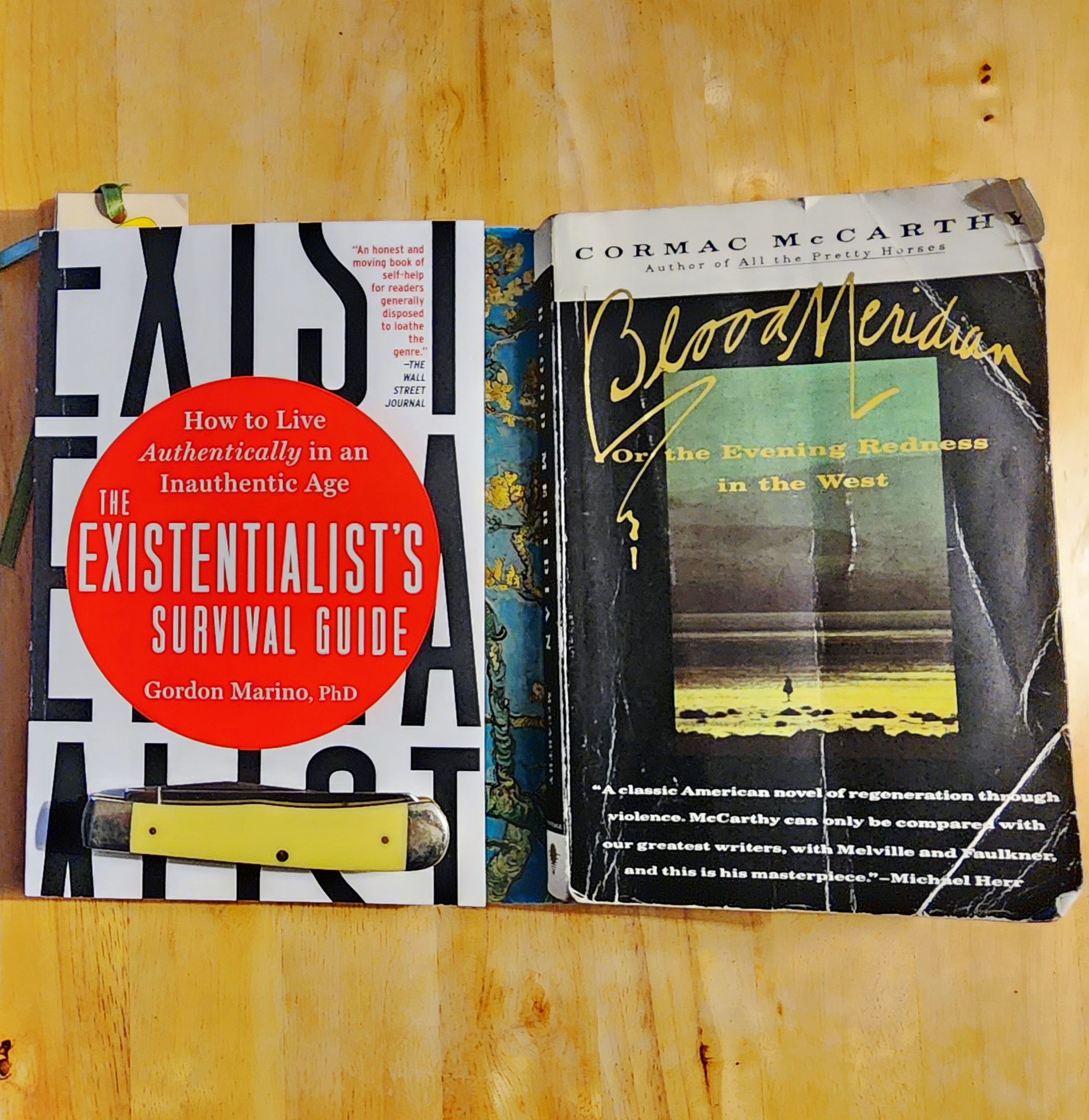
The Existentialist’s Survival Guide – How to Live Authentically in an Inauthentic Age by Gordon Marino, PhD. It is a pretty good book on existentialism. I was a little skeptical at first because the author writes through the lens of Soren Kierkegaard. It’s not that I don’t like Kierkegaard; it’s that Kierkegaard doesn’t particularly resonate with me like the other existentialists. Not to worry, there were heavy doses of these other authors that I like, like Albert Camus, Jean Paul Sartre, Friedrich Nietzsche, and Fyodor Dostoevsky.

As a matter of fact, he checks all the boxes of some of my favorite authors, with mentions from the works of Camus: The Fall and The Stranger. Sartre: Nausea, No Exit, and Being and Nothingness. Dostevsky: Notes From Underground. These books are the touchstones of my life, and I was grateful for their inclusion.

Finally, this book was well written with many anecdotes from the author’s colorful past to illustrate his points and help inform the reader. It is more than just a self-help book. It is indeed a survival guide for living authentically.

Reading Blood Meridian for the second time, I picked up a lot that I missed the first time around 20 years ago. 20 years ago, when I first read it, I could not believe my eyes at what I saw on the page. I literally could not put the book down. I carried it with me everywhere I went until I finished reading it. In the intervening years, I read every other book Cormac McCarthy ever wrote.  He is unquestionably one of America’s finest writers.

Blood Meridian shocks one’s consciousness with its scenes of violence and haunts the imagination with its vivid descriptions of the Old West in Mexico and Texas.

Thematically, it is about the primacy of violence. The nature of good and evil, and fate vs. agency. The story follows a character known as “the kid,” who joins a group of scalp hunters known as the Glanton Gang. They are hired by the Mexican government to hunt down Apache Indians and collect their scalps for a bounty. They soon descend into madness as they stop distinguishing enemies from foes and start slaughtering everything in their path.

Another character in the gang is Judge Holden, who may or not be the devil. His philosophy is “War is God,” and combat is the ultimate truth. He refers to “the dance” by which he means a commitment to violence and the will to power. If you aren’t dancing, you aren’t truly alive.

The kid has a spark of mercy in him, and the judge views him as his natural enemy. The final confrontation takes place in an outhouse. What happens there is not mentioned but the reaction of those who look inside would suggest something awful.

Blood Meridian is not for everyone, but it is a masterpiece of storytelling, somewhere on the level of Moby Dick. It is the telling of the end of the Old West and the beginning of the New and so-called civilization.

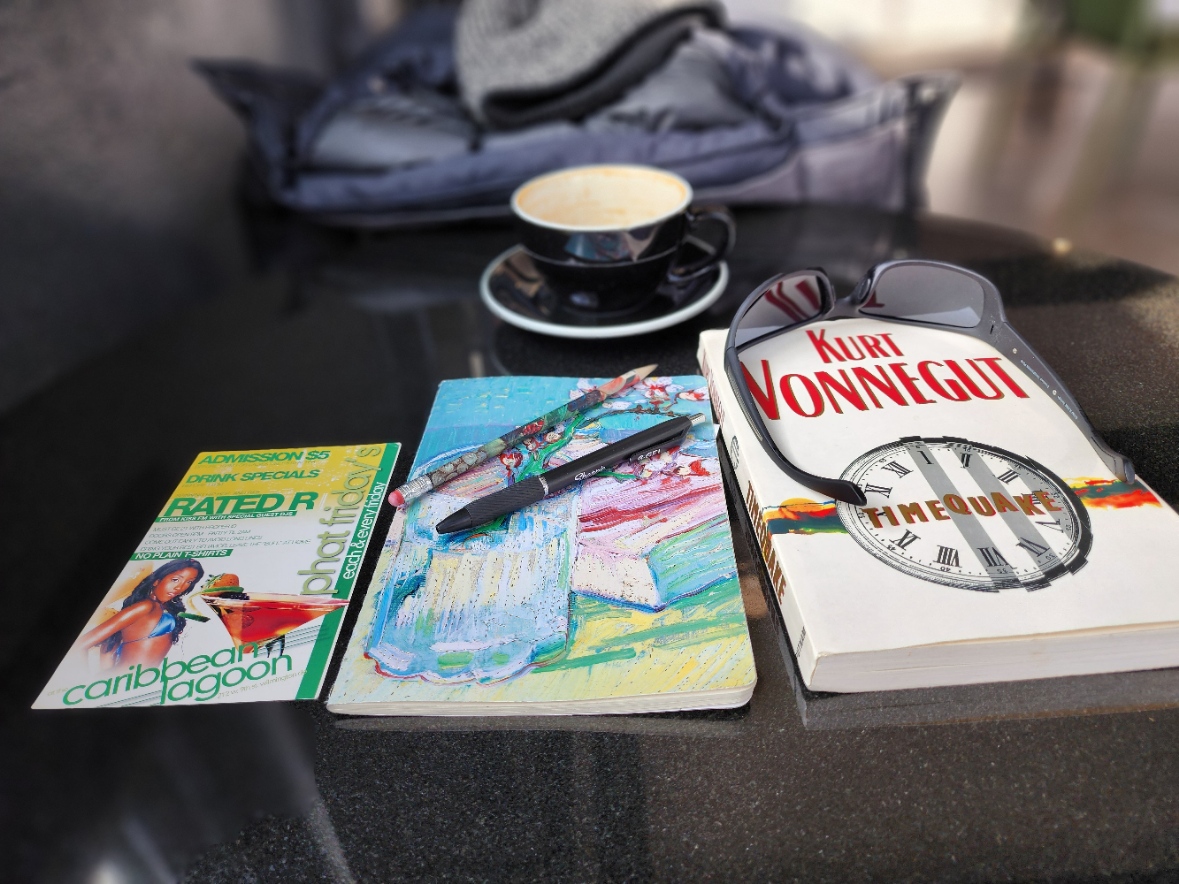
Timequake by Kurt Vonnegut

A book review

Timequake is a novel about free will. Vonnegut freely intersperses throughout the novel his own stream of consciousness. Oh, and there is also his alter ego, Kilgore Trout, who exclaims, “Oh Lordy, I am much too old experienced to start playing Russian Roulette with free will again.”

The premise of Timequake is that a Timequake, a sudden glitch in the time-space continuum, made everybody and everything do exactly what they’d done during the past decade a second time. It was déjà vu all over again for 10 years. The timeframe Vonnegut chose was February 13, 2001 – February 17, 1991. The Timequake would zapp everyone back in an instant to 1991. They had to “live” their way forward to 2001. Or you might say, back to the future again. Only when people got back to 2001 did they stop being robots of their past. Kilgore Trout would say, “Only when free will kicked in could they stop running an obstacle course of their own construction.” Free will. That is what the novel is about. Do we have it or not? That is the question. You would think that because the author mentions “when free will kicks back in” some 20-odd times he was arguing for free will. But no! Not so fast!  I’m not so sure.

Other pithy comments by Kilgore Trout would include, “If brains were dynamite, there wouldn’t be enough to blow your hat off!” and “Ting-a-ling, you son of a bitch!” which is the punch line to a variation on a joke having to do with Chinese doorbells.

So, it goes.

Vonnegut goes on to say, in his own peculiar voice, that writers of his generation had reason to be optimistic because of things like the Magna Carter, the Declaration of Independence, the Bill of Rights, The Emancipation Proclamation, and Article XIX of the Constitution giving women the right to vote. He advocated for two more amendments that he would like to add: Article XXIII: Every newborn shall be sincerely welcomed and cared for until maturity. And Article XXIX: Every adult who needs it shall be given meaningful work to do at a living wage.

Another pithy saying he was fond of throwing around was, “I never asked to be born in the first place!”

Photo by the author.

https://amzn.to/42BZP58

Top 10 Books Read 2019

I only read 17 books in 2019. Short of my goal, but most of what I read was challenging and on the longish side. I vow to read more this year. My goal is 36. I’ve already read four, so I am on track.

wp-15807626263424730367256814486658.jpg

Here are my top 10 books for 2019:

  1. Look Homeward Angel – Thomas Wolfe
  2. The Big Sleep (Annotated) – Raymond Chandler
  3. The Clown – Heinrich Boll
  4. Ulysses – James Joyce
  5. Love in the Time of Cholera – Gabriel García Márquez
  6. Beloved – Toni Morrison
  7. Cities of the Plain – Cormac McCarthy
  8. Dream of Fair to Middling Women – Samuel Beckett
  9. Quichotte – Salman Rushdie
  10. Will in the World – Stephen Greenblatt

Some of these books I have been wanting to read all my life but never got around to, like Look Homeward Angel, which inspired a trip to Aheville NC,and Ulysses which was I must say the most challenging of all. Love in Time of Cholera was a pure pleasure to read. Beloved was Toni Morrison’s masterpiece. So sad we lost her last year. Cities of the Plain completed the Border Trilogy. I try to read at least one Cormac McCarthy book each year. Terrific writer! Quichotte by Salman Rushdie was was a pleasant surprise. First one of his I’ve read in a while. I remember reading Satanic Verses when it first came out and created such a stir. The Big Sleep was pure pleasure. If you have never read anything  Heinrich  Boll, I highly recommend him to you. One of my favorites for a long time. The Clown is a good one! Dream of Fair to Middling Women was Samuel Beckett’s first novel and was not published during his lifetime. It is very instructive to read it and see some of the characters and themes introduced early on that we see later in more mature works.  Highly entertaining. And, finally, Will in the World. I learned so much about William Shakespeare and Elizabethan England reading this book. 


Angels Over America

The Big Sleep and Look Homeward Angel

dscn42605522044785165733791.jpg

I just finished reading Look Homeward Angel by Thomas Wolfe. It was a monumental mountain of beautiful prose. Now I turn my attention to a different sort of angel. A slumming angel. Of course I am speaking of none other than Raymond Chandler. I have read The Big Sleep before, but not the new annotated edition. Chandler’s prose is a bit more hard boiled than Wolfe’s but it is no less poetic. I can’t wait to get started!


20190118_14434824260679500058451.jpg

Of Cell Phones, Lap Tops, and Books

SAMSUNG CAMERA PICTURES

Young Parisian couple, about a generation apart, one reading a book the other a cell phone.

Before there were cell phones there were laptops. Before there were laptops there were TV screens.  Before there were TV screens there were books.  I’m reading a book right now, which is what I am usually doing. You would be surprised  how much trouble I used to get into just for reading books. I have been called anti-social. Bosses didn’t like it.  One of my wives tossed my books out into the backyard into a mud puddle. And my own mother come into my room one day, and tipped my bookcase over, spilling my books out onto the floor. What was a poor boy to do?

10255948_10152081047557036_5566612841718262991_n

Most of the time nowadays people don’t seem to care much if I am reading a book. They are too busy with their own noses stuck into their cell phones.

wp-1499723649601.jpg

Next time you get a chance, try reading a book. Remember, Mark Twain once said, those who do not read have no advantage over those who can’t read.