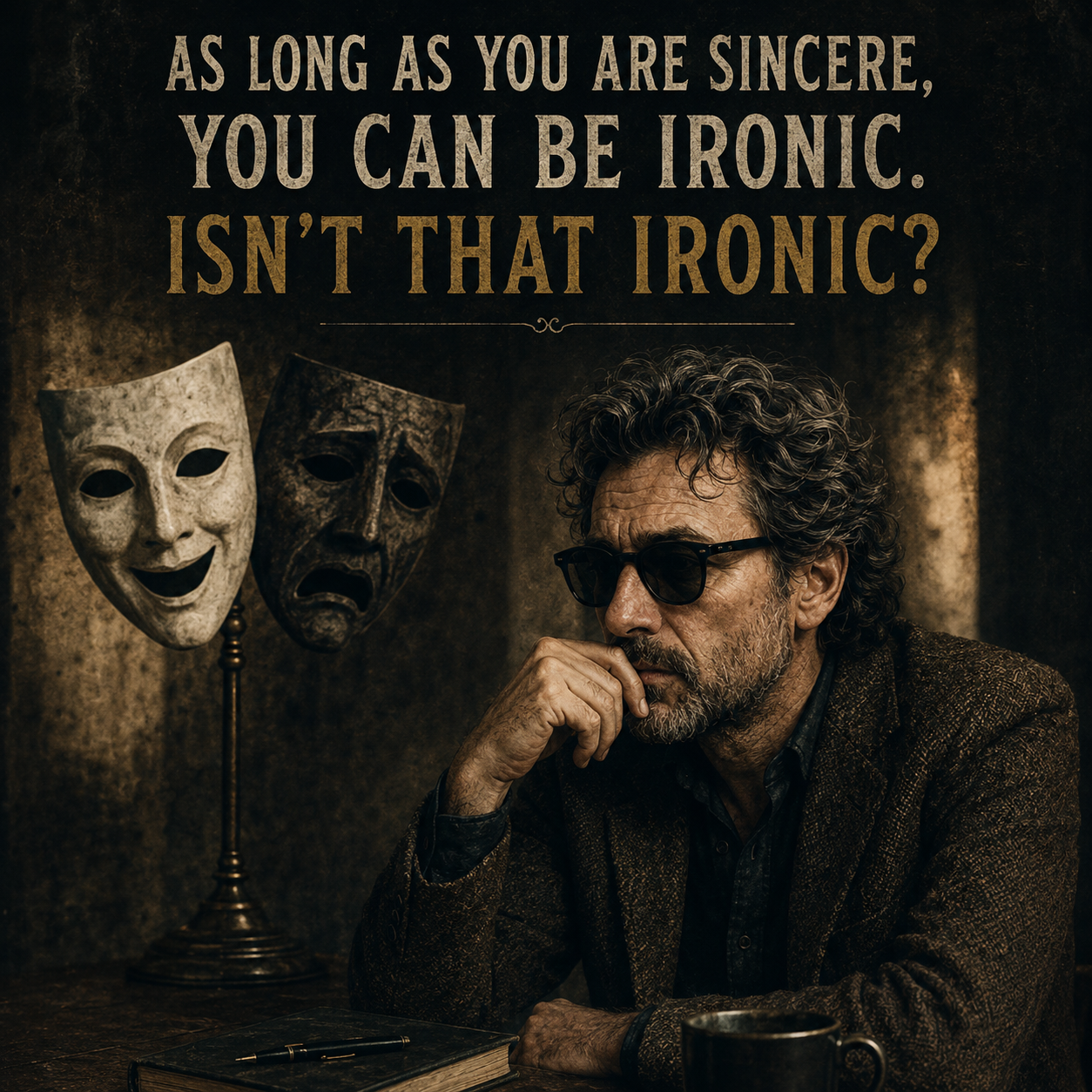
Is irony really dead? In his famous essay “E Unibus Pluram,” David Foster Wallace argued that irony had become so pervasive in American culture that it had lost much of its rebellious power.
Television and advertising could take any sincere statement, immediately put quotation marks around it, and turn it into a joke. Everything could be mocked, including the act of mocking itself.
And paradoxically, irony can begin as a weapon against bullshit and eventually become another form of bullshit.I don’t think irony is dead. It’s walking with a limp. It’s become harder to use well, and Wallace was diagnosing that problem rather than predicting the literal disappearance of irony.
He worried about a generation that had learned to protect itself from sincerity by making fun of everything. If you never say anything straightforwardly, you can never be embarrassed by being earnest. Irony becomes armor.
I wouldn’t want to live in a world without irony. Irony is one of the greatest tools of the intelligent. It allows us to hold two ideas simultaneously in our minds: what is said and what is actually meant. It exposes hypocrisy. It punctures pomposity. It creates distance between ourselves and our own certainty.
Think of the novel, The Fall. Camus uses irony almost like a scalpel. Clamence tells us one thing while gradually revealing something quite different about himself. The reader becomes complicit in discovering the deception. That’s philosophical irony.
And Kurt Vonnegut, Joseph Heller, Mark Twain, and Jonathan Swift all understood that irony can tell the truth precisely because it refuses to state the truth directly.
Wallace may have a point: Irony becomes destructive when it is the only voice we have. If everything is a joke, nothing matters. If everything is mocked, there is nothing left to stand for. And if the writer is perpetually winking at the reader, eventually the reader wants the writer to stop winking and say something that costs him something to say.
Hmm. Maybe so.
Wallace believed in sincerity. He wasn’t really calling for the death of irony. He wanted to recover something that irony had driven underground: earnestness, vulnerability, moral seriousness, even love.
So, I’d put it this way:
Irony isn’t dead. But irony without sincerity becomes sterile, just as sincerity without irony can become naïve.
Nevertheless, some of my favorite authors, Camus, Nietzsche, Sartre, Albee, and Steinbeck seem to employ it with great authority and sophistication. I am drawn to that uncomfortable territory where truth and illusion overlap. Irony is perfectly at home there, and so am I.
One shouldn’t abandon irony. One should know when to put the mask on andwhen to take it off.
The moment you sincerely acknowledge that you’re being ironic, the irony changes again.
As long as you are sincere, you can be ironic. Isn’t that ironic?
Here we are getting closer to the truth. The place where a statement simultaneously means what it says and something beyond what it says.
Irony isn’t dead.
It just needs a reason to live.

