I am a huge Bob Dylan fan, and one of my favorite songs is One More Cup of Coffee. I have been thinking a lot about this song, and it has inspired some of my own writing, especially in my play, The Last Chance Saloon. I decided to do a deep dive on the net to learn more about the song and the story behind it. This is what I found.
Accordingto my research, One More Cup of Coffee (Valley Below) is one of Dylan’s most mysterious songs. It sounds as though it came from an old folk tale, but its origins are actually quite specific.
Dylan was 34 years old in May 1975 when he was visiting the south of France. He was staying with a friend who took him to the annual Romani pilgrimage and festival at Saintes-Maries-de-la-Mer.
Dylan has since related several versions of the story. He described encountering a Gypsy king with an imposing presence, numerous wives, and a large number of children. He stayed around the community for about a week.
In one version, the song came to him out of that experience. In another, he described leaving the gathering and asking for one last cup of coffee before setting out. He sometimes talked about the place as dangerous, mysterious territory.
But years later, Dylan gave a much more revealing explanation. He said the festival probably influenced the song but added that the verses came from someplace else. The song wasn’t about anything particular, and “the valley below” became a thing he hung it on.
What is the song actually about?
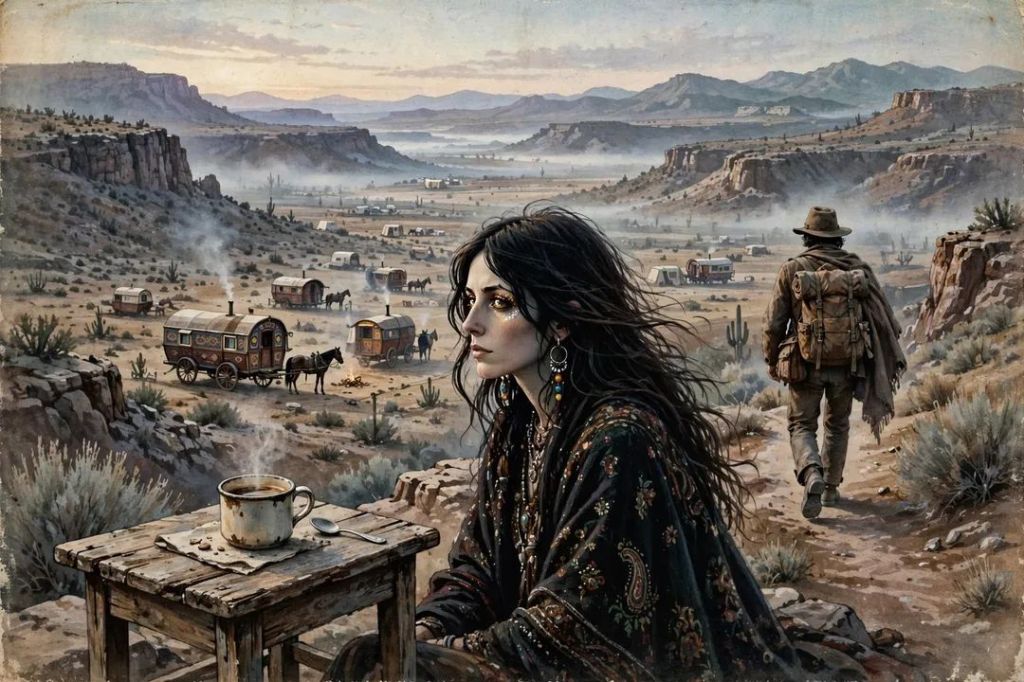
On the surface, it’s about a man who has spent the night with a beautiful, mysterious woman:
“Your breath is sweet / Your eyes are like two jewels in the sky…”
But he realizes that she doesn’t belong to him. Her loyalty is to something beyond him:
“Your loyalty is not to me / But to the stars above.”
Then Dylan expands the woman’s world. Her father is an outlaw and wanderer. Her mother and sister possess supernatural abilities. She cannot read or write. Her sexuality is unrestricted. And finally:
“Your heart is like an ocean / Mysterious and dark.”
The narrator is fascinated, but he knows he has to leave.
And that’s where “the valley below” becomes so powerful.
The words are not to be taken literally. The valley can be death, the unknown, exile, departure, or simply the world outside this strange enchanted place. Dylan himself deliberately refused to pin it down.
So, the chorus becomes almost existential:
Give me one more cup of coffee before I have to go.
Just a little more time before I enter whatever comes next.
And here is another interesting source: Joni Mitchell.
Mitchell recalled sitting with Dylan at a party on the Queen Mary. Dylan asked her what she would paint in the room. She gave him an elaborate answer. Then she asked him what he would paint.
He pointed to a coffee cup.
Mitchell later said that the image found its way into her song “Paprika Plains,” while Dylan subsequently used the coffee cup in “One More Cup of Coffee.”
So even the central image may have had a little real-life spark behind it.
And the music, I think, makes the song extraordinary.
It doesn’t sound like ordinary American folk music. The melody has a Spanish/Mediterranean, almost Middle Eastern quality, while Scarlet Rivera’s violin gives it that eerie, wandering quality. And the opening bass passage by Rob Stoner wasn’t even planned. It happened because Rivera wasn’t ready and Stoner began playing while Dylan waited. That improvised bass opening became part of the recording. The result is something that feels simultaneously erotic, mystical, dangerous, and funereal.
AS I said earlier, this song has influenced me and my writing. I reference it in my play, The Last Chance Saloon
Here is the passage from my play, The Last Chance Saloon, I was referring to:
OLD MAN. Sí. She was the light of my life. My raison d’etre, my muse, my inspiration, my everything. I have been with a lot of women, but she is the only one I truly wanted to be with. To be married to, I mean. I lost her once, but she came back to me only for me to lose her again. First, she came to me in my dreams, then she appeared one day on my doorstep. I told her one time after she had been back for a while, you know, you are the only one I ever wanted to be with, and she looked at me and she said, and you still can’t figure out why, can you? Well, you are my own sweet mystery, I answered. And she said, I’ll give you three reasons: First, destiny. Second, you still can’t figure me out. And third, you’ll never be bored for the rest of your life. Well, she was right about that last part. I was never bored. She was right about the rest of it too.
MARIA. She sounds like a very special person. I have the feeling she was beautiful, too.
OLD MAN. Yes, she was. Her eyes were like two jewels in the night. She had long, black, smooth hair that hung down to her waist, and I would pull it at night when we slept together. We would have a tug-of-war every night. She was my mysterious lady. My beautiful, mystical wife. She had the kind of beauty that calls forth a grief that is beyond imagination. The kind of beauty that starts wars or brings nations to their knees. There will be no other like her. She was the last of her kind. (beat) But, enough about me, let’s talk about you. What’s your name, anyway?
Do you see what I mean? And having the actual passage should make the connection to One More Cup of Coffee much clearer.
There is something very Dylan-esque about the Old Man’s description of this woman. She isn’t simply a lost wife or former lover. She has become a mythological figure in his memory: “my mysterious lady,” “my beautiful, mystical wife,” “the last of her kind.” That language lifts her out of ordinary biography and turns her into an archetype.
And this line is particularly striking:
“She had the kind of beauty that calls forth a grief that is beyond imagination.”
That’s a beautiful idea—and a very different conception of beauty from merely saying that someone is beautiful. Her beauty contains its own future loss. The Old Man seems to understand, even while remembering her, that something so extraordinary cannot last. Beauty and grief become inseparable.
And then there is this enigmatic exchange:
“First, destiny. Second, you still can’t figure me out. And third, you’ll never be bored for the rest of your life.”
That’s terrific characterization. She’s teasing him, but she’s also defining the relationship. He wants to understand her; she knows he’ll never completely succeed. And perhaps that’s precisely why he loves her.
After this extraordinarily intimate, almost operatic monologue, he suddenly says:
“But, enough about me, let’s talk about you. What’s your name, anyway?”
That’s a wonderful theatrical turn. It’s almost funny after all that intensity. It also makes one wonder whether the Old Man is telling Maria about a real woman, an idealized memory, or perhaps something even more mysterious. I don’t answer that question here, and I think that’s its strength.
Now I think you can see why I connected this passage to Dylan. The woman is simultaneously flesh-and-blood, memory, mystery, and legend. That’s very much the territory of “One More Cup of Coffee.”