Fanny and Alexander

fannyalexander

I had the opportunity to watch the wonderful Fannie and Alexander (1981), written and directed by Ingmar Bergman, last night at the Speed Art Museum Cinema here in Louisville, Kentucky. This is the first time I’ve seen it on the big screen since it first came out in 1981. It is a sheer joy to behold. It is perhaps Bergman’s greatest film, The Seventh Seal not withstanding. This is the most autobiographical of all of Bergman’s films and pretty well sums up his life and work.

Scrumptiously and lovingly photographed by Sven Nykvist, every frame is a visual masterpiece of beauty and composition for which he won an Oscar for Best Cinematography. The film also garnered three other Oscars nods including for Best Art Direction, Best Foreign Language Film, and Best Costume Design. Bergman was nominated for Best Screenplay and Best Director.

According to the film notes the movie turned out to be extremely expensive and difficult to make. In terms of scale Fanny and Alexander became Bergman’s largest ever production with a cast of 50 actors. He shot over 25 hours of film. A made for TV version was pared down to five hours in length then he set to work putting together the feature film. Bergman’s first attempt came in at four hours. He tried again and got it down to 3 hours and eight minutes. Still long but manageable. The film is shown with an intermission which we did not take at the Speed Cinema.

Bergman said in his autobiography that after Fanny and Alexander there will be no more feature films for him. Feature films are a job for young people, both physically and psychologically.
film_261w_fannyalex_original

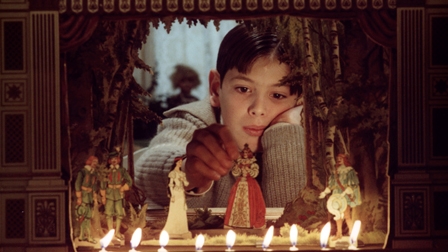
According to Bergman the film had two inspirations. One was a picture from the Nutcracker depicting two children huddling together on Christmas Eve waiting for the candles to be lit on the Christmas tree. The other was Charles Dickens. The bishop in his austere and pure house and the Jew in his antique store filled with old furniture and magical incantations and creatures. The Children are depicted as victims.

Fanny and Alexander are brother and sister in a bourgeois Swedish theatrical family. The film starts off on a snowy Christmas eve and is perhaps the most lavish and beautifully filmed Christmas celebration ever. The movie takes place in Swedish provincial town in the early years of the 20th century. The two children, Fanny and Alexander, are growing up in the bosom of a large, happy, extended family.  Their father, who is the stage manager of the theatre the family owns, dies unexpectedly.  Later, their mother remarries a stern, authoritarian clergyman. The juxtaposition of the vivacious theatre family with that of the dour, cold, and authoritarian bishop’s family could not be more stark and has its roots in Bergman’s own history. His father was a clergyman.

There are ghosts in the film which only Alexander can see. He is also prone to telling the most outlandish and imaginative lies for which he is severely punished at one point by his stepfather.  Alexander is also the master of the magic lantern with which he enchants his sister on Christmas Eve. It is not too far a leap to see the budding genius of Ingmar Bergman taking shape in the form of the young Alexander.

The movie is divided into three parts as in a three act play. We might remember Ingmar Bergman is as well known as a theatrical director  (at least in Sweden) as a film director. In a scene in the third section, Emily says to Helena. “I am reading a new play by Strindberg called A Dream Play and there is a perfect part in it for you.” Oh, no,” says Helena, not that misogynist!” “Oh but this part is perfect for you…” and off they go to talk about their next project and adventure.

I remember reading in Bergman’s autobiography how he struggled with A Dream Play when he directed it. He went on at length about the difficulty he had in staging a certain scene. When he finally found the key to his conundrum he was relieved but he also extolled the virtues of meeting the challenge. When I watched the above described scene I had to smile remembering that passage from his autobiography. I am most certain that no one else got the reference but me but for me it was another piece of the puzzle fitting together nicely and another dot connected.

Everything is here: Love, Sex, God, and Death. Now we know where Woody Allen gets it from. Actually, we knew all along that Ingmar Bergman has been a major influence on the films of Woody Allen.

This is the film against which I judge all others, a bench mark if you will,  and most others pale by comparison. That is why I am mostly disappointed with the current crop of films coming out of Hollywood these days.

Speed continues to bring to Louisville the best of the best movies and I couldn’t be happier.

Allied

allied

Allied is an entertaining piece of fluff that has arrived just in time for the holidays. We have seen it all before with better actors and better writing. Casablanca comes to mind. As a matter of fact the film begins in Casablanca and makes continuous reference to it throughout.

Of course Brad Pitt  and Marion Cotillard are movie stars of the first rank and are beautiful to behold. I have a theory that movie stars are our demigods of today and provide for us what the demigods of old provided for the ancient Greeks, which is not a bad thing, and in fact is a lot of fun.

Director Robert Zemeckis has provide us with a well structured film with a good story that is beautiful to look at. Marvelous piece of escapism. Highly recommend!


AMERICAN HONEY

american-honey-2

The film, American Honey, came onto my radar screen recently because of the buzz it seemed to be getting in the media. I saw the trailer and became intrigued. I vowed to see the movie. Several things about this movie caught my attention. The name for one, American Honey. Thought provoking and provocative. It stirred visions of a sweet young thing standing up in an open car with the wind rushing through her hair without a care in the world. When I learned it was a road trip movie about a teen aged girl in a magazine crew I was hooked. When I was 16 I was a member of a traveling magazine crew too.  It was my first actual paying job that I ever had where I got a weekly paycheck. My teachers and my parents hated it. My teachers thought it was a distraction and my parents didn’t like the exposure I got to the seamier side of life. I loved it for the same reasons. I learned more about life from that one experience than almost anything else I have ever done. Like the characters in the film, I came of age.

So I went to see it. Here is my report. Despite the name this film is actually British. It was directed by British filmmaker, Andrea Arnold. Shooting locations included: Muskogee, Oklahoma, and parts of Kansas, Nebraska, Missouri, Iowa, and North Dakota. I am not going to say anything bad about Muskogee. I lived there for seven years and it is full of colorful characters. But I will say this: it is a good place to run away from.

It is always interesting to me to see America depicted through the lens of a foreign born director. Such as the likes of Michelangelo Antonioni and Wim Wenders, and now Andrea Arnold. Their perspectives are just a little bit different. But that difference is instructive. Arnold has previously won an Oscar for Wasp (2005), Best Short Film, Live Action.

The lead actor is played by newcomer Sasha Lane. This is her first movie role. She was literally discovered on the beach on spring break in Panama City, Florida. She has great energy and is a natural in her role as Star, the teenager from Muskogee who takes a chance on getting out of there and joins the magazine crew that is passing through. Shia LaBeouf plays top salesman Jake who tries to show the independent minded Star the ropes. He succeeds in more ways than one. Riley Keough, Elvis Presley’s granddaughter, plays the crew leader.

americanhoney_clip_motel

A couple of things that put me off at first were the aspect ratio and the length of the film. Aspect ratio was 4:3 which was damned near a square on the screen. I must confess that I did not like this format much when I first saw it, but after a while I got used to it. This is a format that the director must like as she uses it frequently. Running time is two hours and 43 minutes. Quite long. But, I must say I didn’t notice it much until the movie was over and I went outside and noticed that the weather had changed and the light was decidedly different. Man, that was a long film, I told myself. But, as I said, during the watching of the film I really didn’t notice. I believe that it took that much time for the story, such as it was, to unfold. The movie was not filmed in a conventional story line with a classic beginning, middle, and end, but rather more like a slice of life. It put me in mind of cinema verite, which I love.

american-honey-crew

The movie was supposed to be about a subculture of millennials making their way and coming of age. The ensemble acting was quite good with lots of energy and engagement. Everyone had their own back story they were running away from. I didn’t find them to be that different from the teenagers I hung out with when I was selling magazines door to door. They are millennials and I am a boomer. But hey! We were all young once. Great movie! Highly recommend.

LACOMBE, LUCIEN

lacombe-lucien

While film noir remains my favorite film genre, emanating mainly from the 1940’s and ‘50’s as it were, it seems to me that film (now mainly digital) hit its high water mark, like so many other things in the culture, in the 1970’s. I just haven’t seen anything as good at the movies as those produced during that time frame.

lucien-w-gun

Lacombe Lucien falls into that category. Released in 1974, it was directed by French filmmaker Louis Malle. Screenwriting credits go to Louis Malle and Patrick Modiano. Modiano won the Nobel Prize for literature in 2014.

malle-lucien1

The movie takes place during WWII in Nazi occupied France. Eighteen year old Lucien lives in the rural southwest of the country with his peasant family on a farm. His father is a POW and his mother helps to operate the farm. Lucien, who has no particular political leanings, is bored and looking for something to do beside mop the floors at the local nursing home. We see a little bit into his nature as we observe a series of troubling behaviors that would indicate his propensity for violence and brutality. First he sling shoots a song bird for target practice, then he shoots a rabbit, then he knocks the head off a chicken in real time.

lucien-and-france

Lucien tries to join the French Resistance but he is turned down because of his age. On his way home he makes a chance encounter with some collaborators and the German Gestapo. They welcome him with open arms. They bring him into their fold, ply him with alcohol, food, a place to stay, and other comforts. He is given a gun and becomes an enforcer for the German police. This gives Lucien a chance to belong to something bigger than himself and gain a little power. It is not hard to make the leap from this disaffected youth in 1944 to the disaffected youth of today who join ISIS.

He is taken to a rich Jewish tailor who is in hiding by the name of Horn to have a suit of clothes made. Horn becomes a father figure to the boy and an awkward relationship begins between the two. Horn has a beautiful daughter whose name just happens to be, France. Lucien falls for her hard.

Things became complicated as the Horns are part of the persecuted minority and Lucien inadvertently is responsible for Horn’s imprisonment and being sent to a concentration camp. When the roundup comes for France and her grandmother, Lucien is conflicted but opts to help them out. They run off together and hideout in the countryside. Fast on their heels are the French Resistance and the Gestapo. The war comes to an end and Lucien meets with an unhappy fate.

There are many things going on here not the least of which is the depiction of the banality of evil as demonstrated by the French collaborators. It is a unique character study of Lucien Lacombe who is a confused, naive, bully. Also, the movie shows that there were perhaps more collaborators that the French would like to admit. All in all a great movie and an early masterpiece for Louis Malle.


CAFE SOCIETY

Cafe_Society

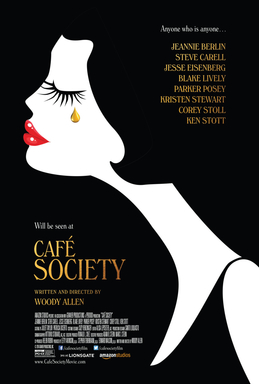
I caught a matinee today oh boy! It was Café Society, Woody Allen’s latest. It was just the thing I needed to lift my spirits. It had me smiling all the way through. I thought the acting was very good. Even Steve Carell, who I never really cared for, is starting to grow on me a little bit. Kristen Stewart, who is everywhere, was believable as the love interest. Blake Lively was lively as Veronica, the other love interest. And Jessie Eisenberg sure plays a mean Woody Allen. But the real star of the show was the cinematography. And the cities. It was essentially a tale of two cities. Los Angeles and New York in the 1930’s. Guess who won? New York. Complete with that iconic shot of Manhattan from the Brooklyn side framed lovingly by the Brooklyn Bridge. Not since Manhattan have we been graced by such a beautiful image.

It was photographed by acclaimed cinematographer Vittorio Storaro, favored cinematographer of Bernardo Burtolucci, for whom he photographed Last Tango in Paris. Mr. Storaro has won Oscars for Apocalypse Now, Reds, and The Last Emperor. This was Woody’s first foray into the digital world.

The plot was pretty standard stuff. Jewish boy goes to Los Angeles to work with his uncle in the movie business, falls in love with a secretary, things don’t work out; he goes back to New York and gets into the nightclub business. Falls in love another beautiful girl by the same name.  Complications ensue. What sets this material apart is the scintillating dialogue which is by turns clever, funny, and hilarious. Music to my ears. Oh, and speaking of music, the sound track is a master compilation of some of the best music from the era, Just wonderful.

Here is an example of some of the tete-e-tete between the characters and or other funny lines.

Bobby: What are you doing later?

Veronica: There is no later. It’s 1:30 am. I am usually in pajamas by 2.

Bobby: I like pajamas. What kind of beds do you like?

The narrator, who is the Woodman himself, occasionally muses: Socrates said the unexamined life is not worth living. The examined live is no bargain either. Or how about this one:  Life is a comedy written by a sadistic comedy writer.

Bobby’s big brother Ben is a gangster who gets convicted of murder and is sentenced to be executed in the electric chair. While in prison he converts to Christianity because there is no afterlife in the Jewish tradition. Ben’s mother is lamenting this fact when she says to her husband, “Ben is going to be executed in the electric chair and he has converted to Christianity and I don’t know what’s worse!” Pure genius!

In the last scene Bobby, is celebrating New Year’s Eve at his club while Vonnie and Phil are at a Hollywood party. Bobby and Vonnie in are in New York. Bobby in New York and Vonnie in LA are staring wistfully into the middle distance. More people die of unrequited love each year than of tuberculosis.

St. Vincent

St.-Vincent-Bill-Murray

Bill Murray Bill Murray Bill Murray. One of the funniest and emotionally appealing films of the year. Bill Murray turns in an Oscar worthy performance as the curmudgeonly neighbor and Naomi Watts knocks it out of the park as the pregnant Russian hooker.

wpid-img_4210.jpg