LACOMBE, LUCIEN

lacombe-lucien

While film noir remains my favorite film genre, emanating mainly from the 1940’s and ‘50’s as it were, it seems to me that film (now mainly digital) hit its high water mark, like so many other things in the culture, in the 1970’s. I just haven’t seen anything as good at the movies as those produced during that time frame.

lucien-w-gun

Lacombe Lucien falls into that category. Released in 1974, it was directed by French filmmaker Louis Malle. Screenwriting credits go to Louis Malle and Patrick Modiano. Modiano won the Nobel Prize for literature in 2014.

malle-lucien1

The movie takes place during WWII in Nazi occupied France. Eighteen year old Lucien lives in the rural southwest of the country with his peasant family on a farm. His father is a POW and his mother helps to operate the farm. Lucien, who has no particular political leanings, is bored and looking for something to do beside mop the floors at the local nursing home. We see a little bit into his nature as we observe a series of troubling behaviors that would indicate his propensity for violence and brutality. First he sling shoots a song bird for target practice, then he shoots a rabbit, then he knocks the head off a chicken in real time.

lucien-and-france

Lucien tries to join the French Resistance but he is turned down because of his age. On his way home he makes a chance encounter with some collaborators and the German Gestapo. They welcome him with open arms. They bring him into their fold, ply him with alcohol, food, a place to stay, and other comforts. He is given a gun and becomes an enforcer for the German police. This gives Lucien a chance to belong to something bigger than himself and gain a little power. It is not hard to make the leap from this disaffected youth in 1944 to the disaffected youth of today who join ISIS.

He is taken to a rich Jewish tailor who is in hiding by the name of Horn to have a suit of clothes made. Horn becomes a father figure to the boy and an awkward relationship begins between the two. Horn has a beautiful daughter whose name just happens to be, France. Lucien falls for her hard.

Things became complicated as the Horns are part of the persecuted minority and Lucien inadvertently is responsible for Horn’s imprisonment and being sent to a concentration camp. When the roundup comes for France and her grandmother, Lucien is conflicted but opts to help them out. They run off together and hideout in the countryside. Fast on their heels are the French Resistance and the Gestapo. The war comes to an end and Lucien meets with an unhappy fate.

There are many things going on here not the least of which is the depiction of the banality of evil as demonstrated by the French collaborators. It is a unique character study of Lucien Lacombe who is a confused, naive, bully. Also, the movie shows that there were perhaps more collaborators that the French would like to admit. All in all a great movie and an early masterpiece for Louis Malle.
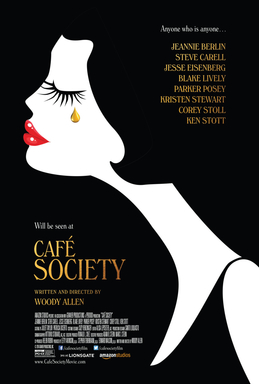
 

CAFE SOCIETY

Cafe_Society

I caught a matinee today oh boy! It was Café Society, Woody Allen’s latest. It was just the thing I needed to lift my spirits. It had me smiling all the way through. I thought the acting was very good. Even Steve Carell, who I never really cared for, is starting to grow on me a little bit. Kristen Stewart, who is everywhere, was believable as the love interest. Blake Lively was lively as Veronica, the other love interest. And Jessie Eisenberg sure plays a mean Woody Allen. But the real star of the show was the cinematography. And the cities. It was essentially a tale of two cities. Los Angeles and New York in the 1930’s. Guess who won? New York. Complete with that iconic shot of Manhattan from the Brooklyn side framed lovingly by the Brooklyn Bridge. Not since Manhattan have we been graced by such a beautiful image.

It was photographed by acclaimed cinematographer Vittorio Storaro, favored cinematographer of Bernardo Burtolucci, for whom he photographed Last Tango in Paris. Mr. Storaro has won Oscars for Apocalypse Now, Reds, and The Last Emperor. This was Woody’s first foray into the digital world.

The plot was pretty standard stuff. Jewish boy goes to Los Angeles to work with his uncle in the movie business, falls in love with a secretary, things don’t work out; he goes back to New York and gets into the nightclub business. Falls in love another beautiful girl by the same name.  Complications ensue. What sets this material apart is the scintillating dialogue which is by turns clever, funny, and hilarious. Music to my ears. Oh, and speaking of music, the sound track is a master compilation of some of the best music from the era, Just wonderful.

Here is an example of some of the tete-e-tete between the characters and or other funny lines.

Bobby: What are you doing later?

Veronica: There is no later. It’s 1:30 am. I am usually in pajamas by 2.

Bobby: I like pajamas. What kind of beds do you like?

The narrator, who is the Woodman himself, occasionally muses: Socrates said the unexamined life is not worth living. The examined live is no bargain either. Or how about this one:  Life is a comedy written by a sadistic comedy writer.

Bobby’s big brother Ben is a gangster who gets convicted of murder and is sentenced to be executed in the electric chair. While in prison he converts to Christianity because there is no afterlife in the Jewish tradition. Ben’s mother is lamenting this fact when she says to her husband, “Ben is going to be executed in the electric chair and he has converted to Christianity and I don’t know what’s worse!” Pure genius!

In the last scene Bobby, is celebrating New Year’s Eve at his club while Vonnie and Phil are at a Hollywood party. Bobby and Vonnie in are in New York. Bobby in New York and Vonnie in LA are staring wistfully into the middle distance. More people die of unrequited love each year than of tuberculosis.