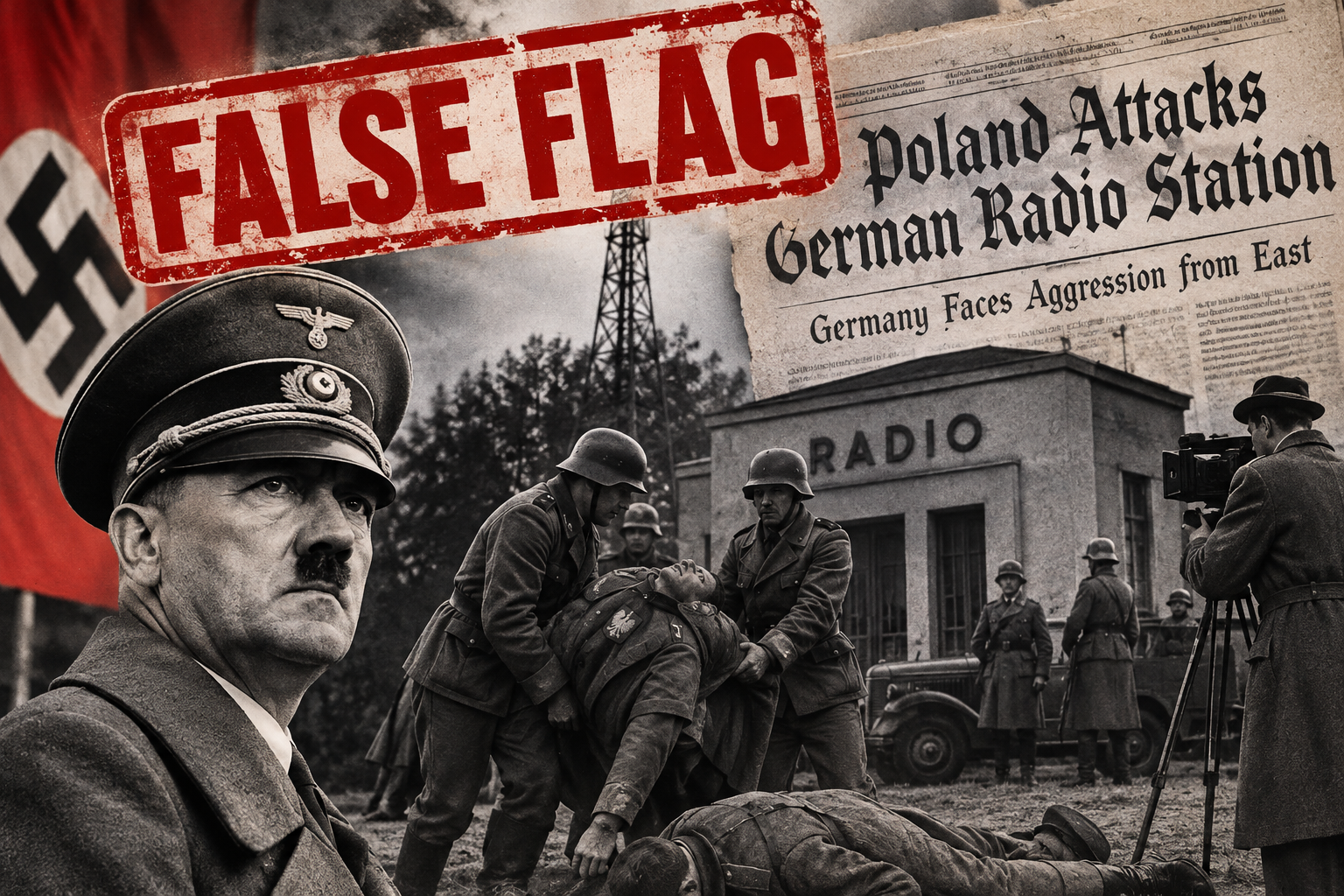
In the weeks before World War II began Germany created a false-flag operation to justify its invasion of Poland. This story was gleaned from the annals of William Shirer’s Rise and Fall of the Third Reich. I share it with you because I’m fascinated by this period in history; I find it interesting how what happened nearly 100 years ago is so eerily similar to some things that are happening today. What troubles me most is not simply that these events have happened, but how recognizable the methods seem today. History does not necessarily repeat itself, but human beings seem remarkably reluctant to abandon the techniques that have served them in the past.
The incidents were part of what became known as “Operation Himmler.” The plan was both simple and crude. The SS would stage a fake attack on a radio station in Gleiwitz, near the Polish border, and make it appear that Poles were responsible. Condemned prisoners were to be used as staged casualties in a series of fabricated border incidents, providing what the Nazis hoped would appear to be evidence of Polish aggression.
On August 31, 1939, the final order came down to simulate an attack on the radio station and to make it appear that the attacking force was Polish. Concrete proof was needed for these attacks for the foreign press as well as German propaganda. Instructions were given to seize the radio station long enough to permit a Polish-speaking German to broadcast a speech stating that the time had come for conflict between the Germans and the Poles.
There were also plans for another border incident made to look like Polish soldiers were attacking German troops. 12-13 condemned criminals were to be dressed in Polish uniforms and left on the ground to show that they had been killed while attacking. For this purpose, they were to be given fatal injections by a doctor employed by the Gestapo. Then they were also to be given gunshot wounds. After the incident, members of the press were taken to the site. The code name for this incident was “Canned Goods.”
While this elaborate deception was being orchestrated on land, Germany was quietly positioning its naval forces for a much larger conflict. On August 19, 1939, orders were issued to the German Navy: 21 submarines were directed to positions north and northwest of the British Isles. The pocket battleship Graf Spee departed for waters off the Brazilian coast on August 21, and her sister ship, the Deutschland, was to take position in British sea lanes in the North Atlantic on August 24.

