Movie Review
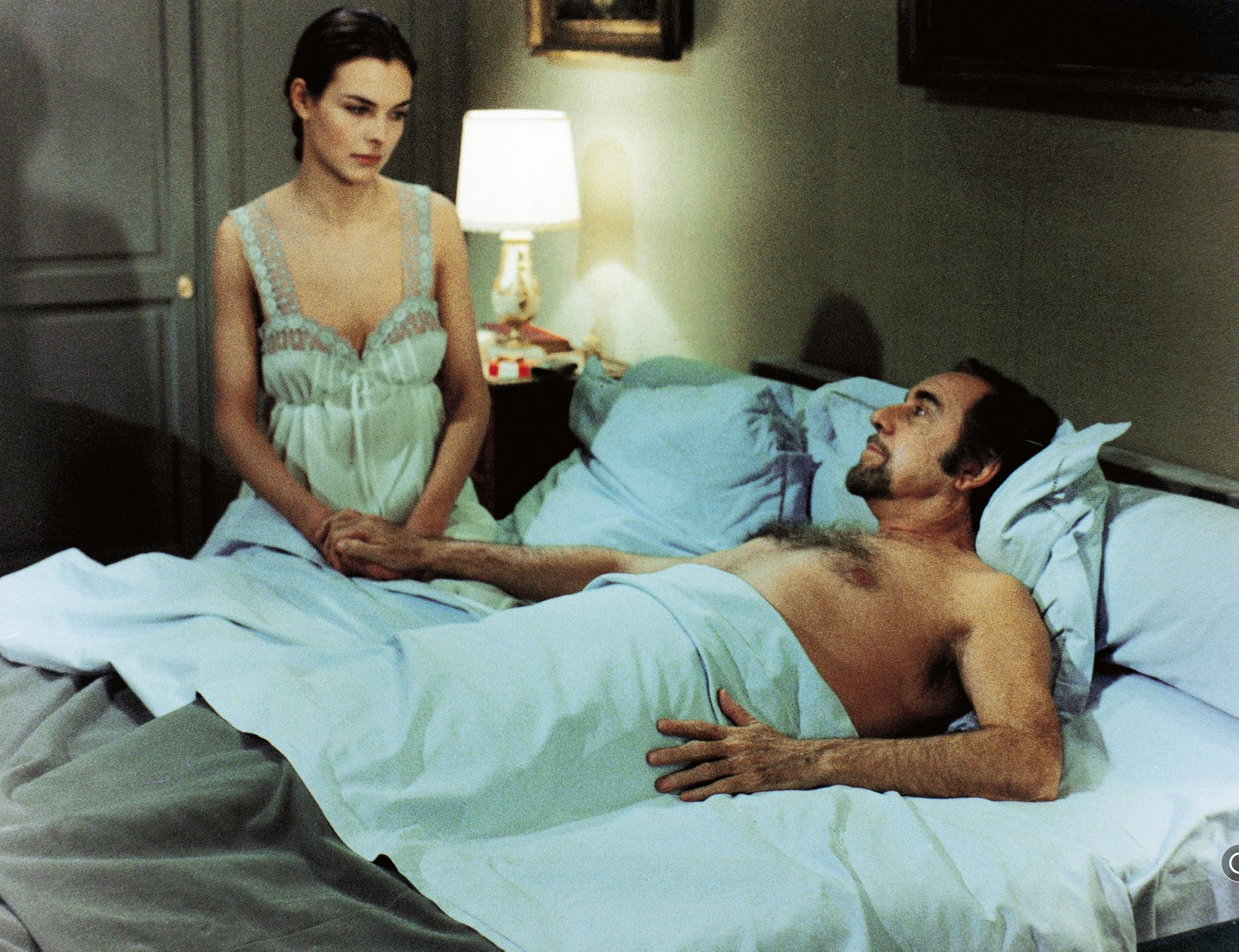
I watched Luis Buñuel’s That Obscure Object of Desire (1977) last night, for the second time. That Obscure Object of Desire is a wonderful film to revisit. Buñuel is not a director who necessarily gives up his secrets on the first viewing.
A couple of questions popped into my head while viewing the film. Why did Buñuel use two different actresses to play Conchita? And why are there all the bombings and terrorism scattered throughout the film?
I suspect the two actresses and the recurring terrorism are both part of a larger idea Buñuel is exploring: the impossibility of possessing something, or someone, that we believe we understand.
Let’s examine them separately.
Why two actresses playing Conchita?
The two actresses are Carole Bouquet and Ángela Molina.
This is one of the most fascinating decisions in the film. Buñuel deliberately gives the same character two different physical identities, sometimes even within the same scene.
There are several ways to interpret this:
First, Conchita is not a stable object of desire.
Mathieu believes he knows what he wants. He pursues Conchita, tries to understand her, tries to buy her affection, and repeatedly believes he is getting closer to possessing her.
But which Conchita is he pursuing?
Bouquet’s Conchita tends to appear cool, controlled, and somewhat aristocratic. Molina’s is more earthy, sensual, spontaneous, and physically expressive.
They are not simply two versions of the same personality. They represent different aspects of the woman Mathieu thinks he loves.
Second, perhaps the change is happening in Mathieu rather than Conchita.
We see Conchita through his recollections and perceptions. His desire transforms her. He idealizes her, becomes frustrated with her, feels betrayed by her, and then idealizes her again.
The two actresses make that instability visible.
Buñuel himself reportedly came up with the idea after experiencing difficulties with the original casting. Rather than treat the problem as an obstacle, he turned it into a cinematic device.
I particularly like the possibility that the two actresses represent the impossibility of reducing another human being to a single identity.
And that brings us to the title.
The object of desire remains obscure precisely because it cannot be possessed or completely understood.
There is an important qualification, though. Buñuel himself resisted assigning a neat psychological explanation to the switches. In an interview, he described the decision as arising out of necessity, and his screenwriter Jean-Claude Carrière regarded it partly as a game with the conventions of cinema. Some accounts even emphasize that the changes were deliberately random.
I rather like that. Buñuel may have wanted us to stop looking for a perfectly logical explanation.
The bombs remind us that his world, and perhaps the entire world, is beyond his control.
And there’s a lovely Buñuel irony here: Mathieu is terrified and outraged by the disorder around him, yet he seems almost oblivious to the irrationality of his own behavior.
The bombings are not directly tied to any particular political organization. Their arbitrary recurrence is important. The Museum of Modern Art, in its discussion of the film, specifically notes how these unexplained acts of public violence reflect the atmosphere of the 1970s.
He is condemned to repeat the same frustrations, just as the world around him repeats its cycles of violence.
It brings to mind Camus’s absurdity: our insistence on finding order and meaning in a universe that doesn’t promise either.
And yet Buñuel makes us laugh at the whole business.
That’s quite an accomplishment.

