Demons

Demons

Upon my life, the tracks have vanished,

We’ve lost our way, what shall we do?

It must be a demon’s leading us

This way and that around the fields.

-Alexander Pushkin

Demons, by Fyodor Dostoevsky, is 700 page pamphlet detailing the rise of the Russian proletariat and presaging the revolution of 1917. It’s about nihilism, anarchy, and atheism. It is a complicated novel detailing Russian society as it descends into chaos, anarchy, and madness. The demons referred to are actually ideas, emanating from the west, that infect the characters minds and causes them to take extreme actions such as suicide, murder and arson. The action takes place in a fictitious small town in provincial Russia but is based on a true story that Dostoevsky took from the newspapers.

Pesky Dostoevsky. Every time I say I am not going to read another 700 page book I get pulled back in! I say pamphlet because that is how it is described in the critical literature.  Only thing is, last time I checked, there are not that many 700 page pamphlets lying around. A few manifestos, no pamphlets.

I had to read 500 pages before I got to the part that inspired me to read this behemoth in the first place. The part that Camus refers to in his Myth of Sisyphus. “If there is no God life is meaningless. And without meaning, men and women will go stark, raving mad.” Camus described the novel’s importance this way: “The Possessed is one of the four or five works that I rank above all others. In more ways than one, I can say that it has enriched and shaped me.”

According to Camus all of Dostoevsky’s characters ask themselves about the meaning of life. Kirlov feels that God is necessary and that He must exist, but he knows that He cannot exist. “Why do you not realize that this is sufficient reason for killing oneself?” he asks. “If God does not exist, I am God.”

The book title was originally translated as, The Possessed. This is not the title Dostoevsky originally had in mind. The Russian title, Besy, does not refer to the possessed but rather to the possessors. Therefore the new title, Demons, refers to some of the characters in the book (from the foreword by Richard Pevar) and is more in line with Dostoevsky’s thinking.

All the characters have three names and each name has three syllables and each time a character is mentioned or introduced all three names are used except when they aren’t and then they are referred to by their nick names or their shortened names which we the reader have not been given fair warning and have absolutely no idea who the author is referring to. I had to take to underlining each character’s name each time they made an appearance and by page 500 or so I finally figured out who was who. I must say, the last 200 pages were page turners and my eyes were so glued to each page I couldn’t look away. The novel had to be good or I would not have stuck with it to the end.  I did and I am glad I did.

There is a missing chapter in the book which was censored by the Russian authorities when it was first published due to it’s salacious nature. I almost didn’t read it as it was included in the appendix and I didn’t realize how important it was. It is absolutely key to understanding the central character Stavrogin. It is called at At Tikhon’s and in it Stavrogin confesses to a horrible crime.

One of the most important takeaways from the novel for me were the revolutionary ideas of the intellectual of the revolutionary group, Shigalyev: “My conclusion stands in direct contradiction to the idea from which I started. Proceeding from unlimited freedom, I end with unlimited despotism. Ninety percent of society is to be enslaved to the remaining ten percent. Equality of the herd is to be enforced by police state tactics, state terrorism, and destruction of intellectual, artistic, and cultural life. It is estimated that about a hundred million people will be needed to be killed on the way to the goal.” This is oddly prophetic of what actually occurred in Russia under the dictatorship of Joseph Stalin.

I see strains of some of these ideas in modern day writers such as George Orwell who admonished us that if we want you want a vision of the future, imagine a boot stamping on a human face – forever. These currents have resurfaced again today in American politics and it is pretty frightening.

Like Camus, I can say that this novel has enriched and shaped me.


Islands in the Stream

Islands in the stream


Ernest Hemingways’s novel, Islands in the Stream, published posthumously, is the perfect counterpoint to his novel, For Whom the Bell Tolls, which was of course published during his lifetime. Hemingway takes his title, For Whom the Bell Tolls, from the poem of the same name by John Donne. The first line reads, “No man is an island entire of itself, every man is a piece of the continent a part of the main.”In both novels the protagonists die fighting for a cause larger than themselves that each believed in and that each felt he had a duty to fulfill. This is the Hemingway code of action that has lived with me so many years, ever since the first short story I read by him many years ago, The Short Happy Life of Francis Macomber. Hemingway comes full circle with this novel. From no man is a island to every many is an island. An island in a stream.

In the first case Robert Jordan is fighting fascism in Spain during the Spanish Civil War . In the other, Thomas Hudson is fighting fascism in Cuba during WWII. A German submarine has been damaged and the crew has come ashore and massacred a village of Indians and commandeered their turtle boat. The German crew are hiding out in the mangroves on the Cuban island. It is the duty of Thomas Hudson and his crew to hunt them down. This brilliantly written action sequence takes place in act three of the novel.

The novel is divided into three sections but the reads like three acts in a play. The first section is entitled Bimini. Here we are introduced to the isolated main character Thomas Hudson  who is a painter and lives in a house on the island of Bimini which is part of the Bahamas. It is summer and his three children, two by one wife and one by his first wife, come to visit him for the summer.  This is the happiest section of the book as the happy family interact and reminiscence with one another and go deep sea fishing together.

After the children leave, Hudson learns of a tragic car accident that has taken the lives of his two youngest children and their mother. This section ends with Hudson on a boat trip to Europe to attend their funeral. The tragic accident had a profound impact on Hudson driving him deeper and deeper into himself.

The next section of the book is entitled, Cuba. Most of the action in this section takes place in a bar in Havana called the Floridita. Hudson is knocking back frozen Margaritas (without sugar) and talking to a variety of motley characters who inhabit this world including an aging prostitute called Honest Lil. The conversations are often hilarious and the characters are well drawn and fascinating. Lil asks Hudson when was his happiest day? Hudson replies: “The happiest day I ever had was any when I woke in the morning when I was a boy and I did not have to go to school or work.” In this section Hudson learns of the death of his eldest son who was killed in action while flying over Germany. This was just about the last straw that does him in and he retreats further into himself. He soon receives his orders and goes once more back out to sea. He traded in his remorse for another horse that he was riding now.

The only thing Tom now has left is his duty. “Get it straight. Your boy you lose. Love you lose. Honor has been gone a long time. Duty you do. Sure and what’s your duty? What I said I’d do. And all the things you said you’d do.”

In this last section called, At Sea, Thomas Hudson does is duty. He is in pursuit of a German submarine crew whose submarine has been destroyed. They are hiding out in the mangroves of a Cuban island. The writing in this section is some of the best action writing I have ever read. At the climax there is a showdown between Hudson’s crew and the German crew. Hudson’s crew wins but Hudson gets shot it the process. As his ship cruises back to home port he realizes he is going to die. He thinks about sorrow. If it is cured by anything other than death, chances are that it was not true sorrow.


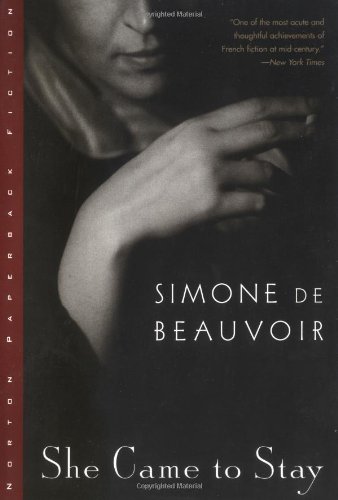
She Came to Stay

She Came to Stay

I usually read 6-8 books at a time. I have been doing this for years and it is my modus operandi. But, every once in a while I will run across a book that is so extraordinary, so compelling, that I will stick with that one book to the exclusion of all the others.

I have found the to be the case with, She Came to Stay, by Simone de Beauvoir. This is the book I chose to take to Paris with me and I am so glad I did. I have found some delightful and delicious parallels with my own life and I am sure that is part of the allure.

It is a novel set in Paris near the beginning of WWII and is based on some true life events in the lives of Simone de Beauvoir and Jean Paul Sartre and the affair with a young girl that came between them. It is by turns philosophical and hilarious. It is Simone’s first novel and I love it!

Suspended Sentences

Suspended Sentences

Suspended Sentences is a book of three novellas, written by Paul Modiano and translated into English by Mark Polizzotti.
Modiano is a French writer who in 2014 was awarded the Nobel Prize for literature. This book was my first exposure to this gifted writer with the exception of watching the film Lacombe Lucien in 1974 directed by Louis Malle. Modiano co-wrote the screenplay. At the time, frankly, I had no idea who Paul Modiano was.

The stories are set in Paris in a time gone by. Many of the buildings referred and streets referred to have been razed to make room for something else. This contributes to the dreaminess of the vision we are given of the mis-en-scene.
Modiano writes in an off handed style that is vague in its presentation. These stories are imperfect memories seen through a soft focused lens with a backward glance through time that seems to have a faded to a yellowish color not unlike sepia. It is an attempt to see into the past and is therefore an afterimage of the past and just as imprecise. In fact the first story is entitled, Afterimage. These stories or novels, were published separately over a period of five years. But they have the feeling of part of a whole. They fit well together. The other two books are, Suspended Sentences, and Flowers of Ruin.
The original title of the second story was Remise de peine. The literal translation of this phrase is a stay of sentence, but also it means a deferral of pain. The translator chose well the title Suspended Sentences as it seems to evoke both these attributes. A further resonance for me is the idea of written sentences literally hanging in midair, suspended so to say, which very much captures the style in which Modiano writes.
Here is an example of a suspended sentence that I particularly liked:
“Certain objects disappear from your life at the first lapse of attention, but the cigarette case has remained. I knew it would always be in reach in a night stand drawer, on a shelf in a clothes closet at the back of a desk, in the inner pocket of a jacket. I was so sure of its presence that I usually forgot about it. Except when I was feeling down. Then I would ponder it from every angle. It was the only object that bore witness to a period in my life that I couldn’t talk to anyone about, and whose very reality I sometimes doubted.”
I know exactly where he is coming from here as I have several objects I feel the same way about, almost talisman like in their quality in that they ground me to the earth and hold me fast to reality when in fact most of my life has been a blur.
My favorite story of the three is in fact Suspended Sentences. Who could not fall in love and become enchanted by the first sentences of the novel? “It was in the days when theater companies toured not just France, Switzerland, and Belgium, but also North Africa. I was ten years old. My mother had gone on the road for a play, and my brother and I were living with friends of hers, just outside of Paris.”
Hooked yet? I was.

One Hundred Years of Solitude

OneHundred

One Hundred Years of Solitude, by Gabriel Garcia Marquez is unlike any novel I have ever read. This is the third novel I have read by this author. From the very first line one is enchanted by the magical realism the writer imposes on the material. It is said that Garcia Marquez found his voice as a result of being raised by his grandmother in Aracataca, a small village in Colombia. This village is the basis for the mythical town of Macondo from the novel. His grandmother would tell him tell him the most fantastic stories in the most off hand way as if they were true. He adopted this style while telling the tale of the Buendia family. Marquez was also greatly influenced by Franz Kafka’s Metamorphosis. Traces of surrealism can be found throughout the novel.

One Hundred Years of Solitude is not an easy novel to read. It is about the Buendia family dynasty that began with the founding of the small mythical town of Macondo. Marquez chronicles the rise and fall of the town and the family over a one hundred year period. Some of the characters actually live to be over 100 years old. What is so confusing is that each character’s name is a variation of the family name Buendia: Jose Arcadio Buendia, Aureliano Buendia, Jose Arcadio, Aurliano Jose, Ursula, Remedios, and Amaranta. Well, you get the idea. These names repeat over six generations. You really couldn’t keep them straight. My approach to reading the novel was not to even try keep all the characters and events straight in my mind as I was reading, but rather to let the words wash over me and by the end a tapestry was woven from them wherein I could make sense of the whole. The idea, I think was to represent the repetition and the cyclic nature of life. In fact the whole novel could be described as a metaphor for human society and a running commentary on human nature.

The novel is biblical in nature and scope. It mimics many characters and events from the Bible such as Adam and Eve in the Garden of Eden, Moses in the bulrushes, and the great flood. One character even ascends to heaven.

The famous opening line of the novel is a good example of the style of the entire novel: “Many years later, as he faced the firing squad, Colonel Aurliano Buendia was to remember that distant afternoon when his father took him to discover ice.” This story is not revisited again until much later in the novel and in fact is two stories; one where Aurliano Buendia discovers ice and the other where he faces the firing squad. The novel careens back and forth between past, present, and future at will and with great ease, interweaving personal narratives of the characters and the epic sweep of the history of the town and the country. This includes a civil war between the liberals and conservatives, a banana company (United Fruit) exploiting the town, and a labor war resulting in the massacre of 3,000 workers.

wpid-sam_0188.jpg

I wondered as I was reading the novel just what Marquez meant by the one hundred years was and what did the solitude represent? By the time I got to end I knew. As previously mentioned some of the characters actually lived 100 years. The sweep of history regarding the town and its inhabitants was roughly 100 years. Throughout the novel Marquez make numerous references to the solitude of the characters, from each other and from society at large. And, as John Leonard said in his 1970 review: “Solitude is one’s admission of one’s own mortality and one’s discovery that the terrible apprehension is itself mortal, dies with you, and must be rediscovered and forgotten again endlessly.” I am also reminded of Hamlet’s famous soliloquy: “The undiscovered country from whose bourn no traveler returns.”

I highly recommend this acclaimed novel written in 1967. In my opinion it is one of the best written in the 20th century and one that put Marquez firmly on the road to winning the Nobel Prize for literature in 1982.