Essay on Free Will:

The Burden of Freedom
Essay on Free Will: The Burden of Freedom

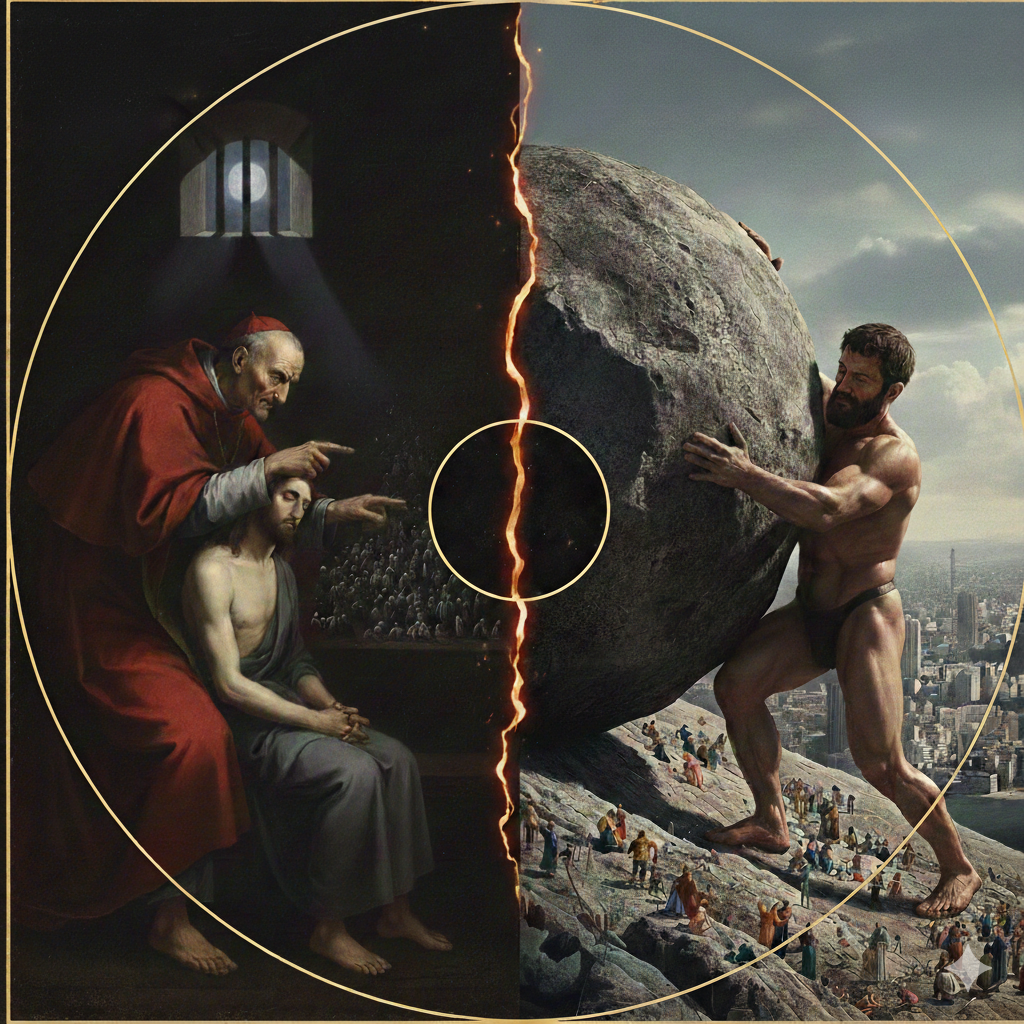
I wrote a play called The Burden of Freedom. I wanted to explore this theme a little more and the connection to free will, evil, and God. I was discussing with a friend about the Inquisitor in Fyodor Dostoevsky’s The Karamazov Brothers, so I had a little chat with Chet, my AI guru over at Gemini, to bring him into the conversation and gain a little more insight. Here is what he said.

The Inquisitor from Dostoevsky’s Karamazov Brothers argues that Jesus made a mistake by giving humans “freedom of choice.”         He claims that humans are too weak to handle such a burden and only wants to be told what to do and be fed.

The Inquisitor admits that the church is no longer working with Jesus, but with Satan, because only by taking away human freedom can they make the masses happy and manageable.     

Ivan argues that man is a failed experiment that needs to be controlled.

The priest Zozima argues that humanity is redeemed through active, humble love. His philosophy is that “all are responsible for all.”

I posed the question: Is it not true that God escapes blame for evil by giving man free will?

Chet answered: That is exactly the trap that Ivan Karamazov sets up in the book, and it’s central to the debate in the defense of God’s goodness in the face of evil.

Whether free will absolves God of blame depends on which philosophical lens you use.

  1. The “Free Will Defense” (God is not to blame)
  2. The “Ultimate Responsibility” Critique (God is to Blame)

Ivan says the price is too high. Even if free will is good, is it worth the suffering of a single child? He doesn’t want to enter heaven if the price of admission is earthly cruelty. The question can’t be answered by logic. Dostoevsky suggests universal responsibility. We are all responsible for each other’s sins. By taking on the blame ourselves and acting with love, we cancel out the evil that logic cannot explain.

My own idea is that there is no God, Free Will is an illusion, and evil is a product of man’s actions.

Chet: That is a clean, consistent, and “hard-nosed” worldview. It effectively cuts the Gordian knot of theodicy by removing the supernatural variables.

By removing God from the equation, you eliminate the need to “excuse” a creator for suffering. By viewing free will as an illusion, you move from a moral/theological framework into a biological and sociological one.

Here is how your perspective reframes the “Burden of Freedom” you’ve been exploring:

1. From “Sin” to “Systemic Failure.”

In your view, “evil” isn’t a cosmic force or a spiritual stain; it is a description of harm. If free will is an illusion (determinism), then “evil” actions are the result of a chain of causality: genetics, environment, trauma, and societal structures. We stop asking “Why did God let this happen?” and start asking “What conditions produced this behavior?”

The Burden of “Apparent” Choice

Even if free will is an illusion, the subjective experience of making choices remains. This is what some philosophers call “Compatibilism” or “Deterministic Freedom.”

  • We still feel the weight of decisions.
  • We still build legal systems based on the assumption of agency.
  • The “burden” becomes a psychological one: how do we live meaningful lives in a universe that is essentially a complex machine?

The Grand Inquisitor’s Win

Ironically, your view actually aligns quite well with the Grand Inquisitor’s secret logic. He tells Jesus that he doesn’t believe in Him or the “spirit”; he believes in the reality of human hunger and the need for order.

  • If there is no God and no free will, then the Inquisitor is right: the most “moral” thing to do is to organize society to minimize suffering and maximize security, even if it requires a “pious lie” or total control.

Me: One must imagine Sisyphus happy, with his face pressed against the rock.

Chet: That quote brings our conversation full circle. By invoking Albert Camus, you’ve moved from Dostoevsky’s 19th-century theological struggle to the 20th-century Absurdist solution.

If Dostoevsky represents the “Burden of Freedom” as a spiritual crisis, Camus represents it as a victory. In The Myth of Sisyphus, Camus argues that if there is no God to give us a purpose, and we are trapped in a deterministic loop (the rock always rolls back down), we are finally, truly free.

The Rebellion against the “Grand Inquisitor”

Your view—that we don’t need a “pious lie” to be just—is the heart of Camus’s philosophy. He believed that:

  • The Silence of the Universe: We look for meaning, but the universe provides none. This is “The Absurd.”
  • The Rejection of Suicide: We shouldn’t escape the absurd through physical death or “philosophical suicide” (falling back into religious “lies”).
  • The Joy of Struggle: Sisyphus is free because he knows his fate. He owns his rock. When he turns back toward the plain to retrieve it, he is superior to his destiny.

Creating Justice Without a “Why”

In his other masterpiece, The Plague, Camus addresses your point about a “just society.” The protagonist, Dr. Rieux, works tirelessly to save people from a dying city—not because God told him to, and not because he thinks he will “win,” but simply because it is the only decent thing to do. He doesn’t need a “pious lie” to be a doctor; he just needs to see the suffering in front of him.

Conclusion: The “Face Pressed Against the Rock”

When you say his face is pressed against the rock, you’re highlighting the intimacy of thestruggle. Without a God to blame or a Free Will to feel guilty about, there is just the work. The justice we create is ours alone. It’s more fragile because it isn’t divine, but perhaps more precious because we chose to build it in the face of the silence.

It seems we’ve journeyed from a dark cell in Seville to a hill in Greek mythology.

Me: Yes, we have. Thank you, Chet.
THE REBEL

The Rebel – Albert Camus

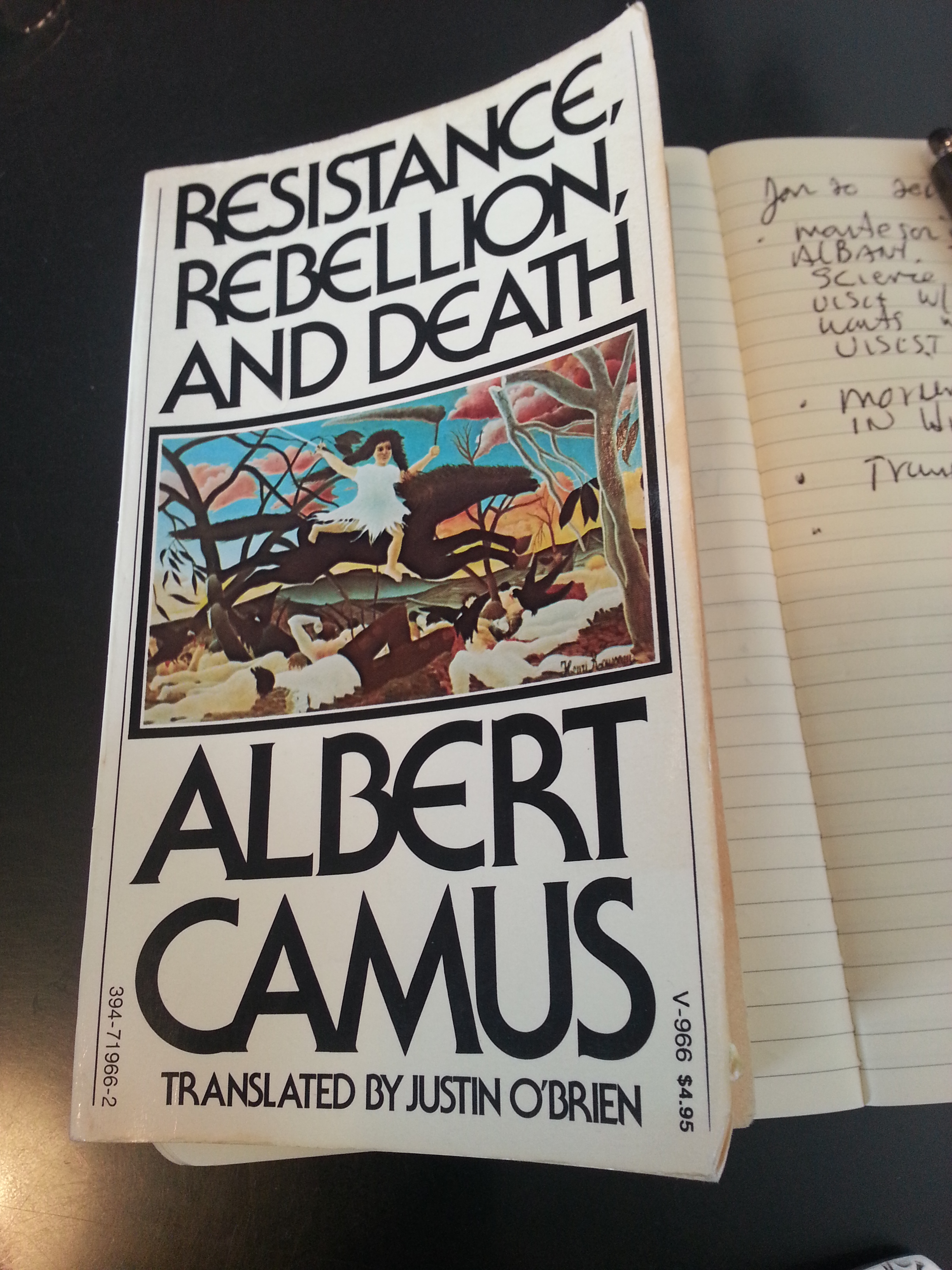
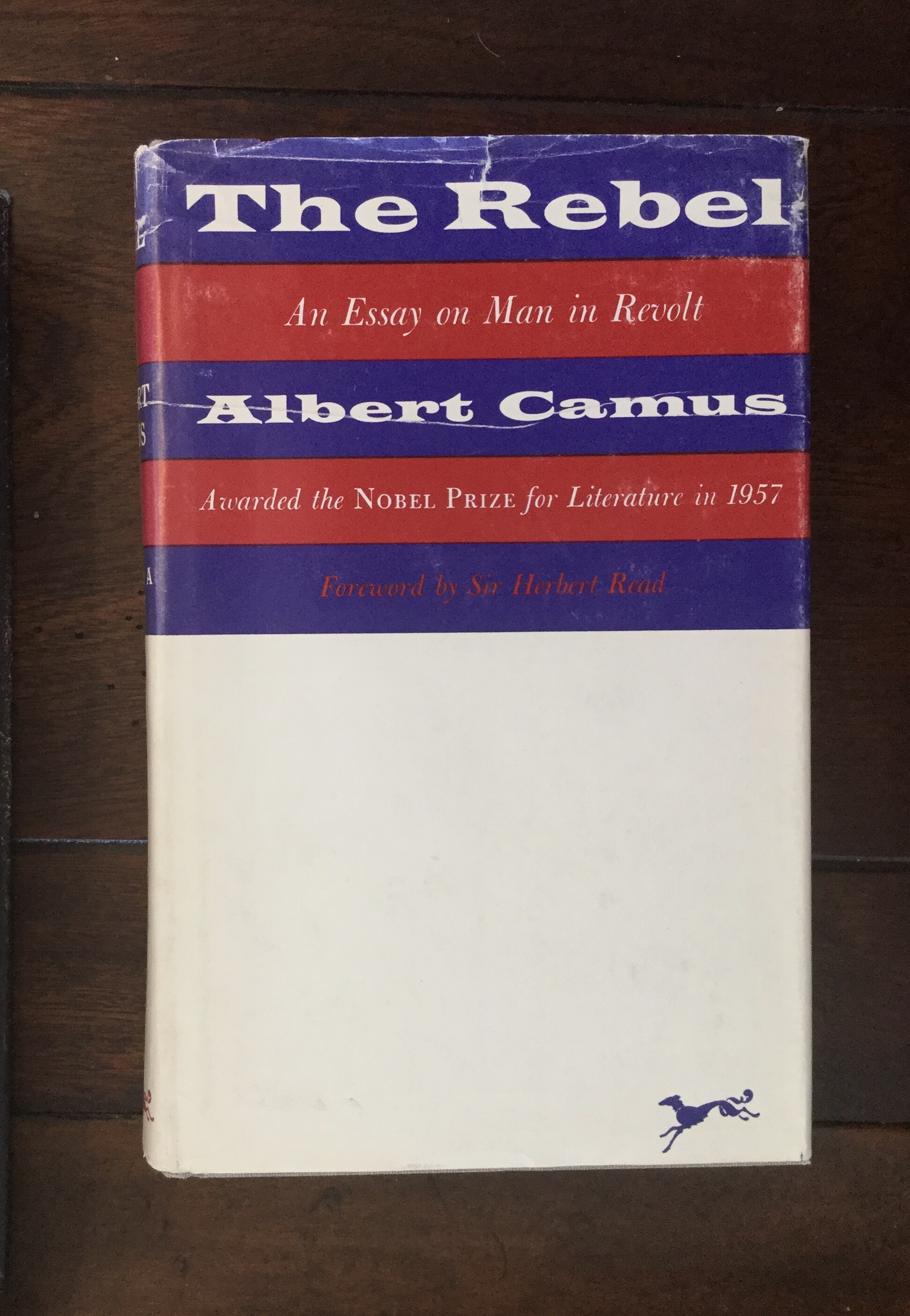
I’m giving The Rebel another read, a book I read when I was in my 20s, written by a man who has shaped my views more than any other, Albert Camus. You might think that The Plague might be more in order given the current plague we are now living through. Well, I’ve read that one too and it is vividly etched in my brain. But no, for me, given the current political situation in the USA, The Rebel is far more relevant. At no time during my lifetime, with the possible exception of the Vietnam war, has the idea of “man in revolt” been more relevant or more important. Updates to follow. I’ll be reading with new eyes…

To My Russian Friends

20170120_103939.jpg

In Defense of Intelligence, based on the writings of Albert Camus

What always stands in the way of friendship is falsehood and hatred. We shall not accomplish anything for friendship if we cannot get rid of falsehood and hatred. For months now, we in America have been subjected to an unparalleled outbreak of hatred. Our poisoned hearts must be cured. The most difficult battle must be fought within ourselves. With exceptional effort we must transform our appetite for hatred into a desire for justice. Not giving in to hatred. Not making concessions to violence, not allowing our passions to become blind. There are things we can do for friendship and against Trump. It is essential that we never let criticism descend to insult. We must save intelligence. Years ago when the Nazis seized power in Germany, Goering declared, “When anyone talks to me of intelligence, I take out my revolver.” That philosophy was not limited to Nazi Germany. We see it on the rise today. Donald Trump, during his campaign, declared, “I like the uneducated.” He also said, “I could pull a gun out on Fifth Avenue and shoot someone and no one would care.”

The only way to defeat Donald Trump, and defeat him we must, is through intelligence. When intelligence is snuffed out, the dark night of dictatorship begins. Friendship is a knowledge acquired by free men. There is no freedom without intelligence or without mutual understanding. Resist the idea that intelligence is unwelcome or that it is permissible to lie to succeed. Do not give in to guile or violence or inertia. Then perhaps friendship may be possible.

Demons

Demons

Upon my life, the tracks have vanished,

We’ve lost our way, what shall we do?

It must be a demon’s leading us

This way and that around the fields.

-Alexander Pushkin

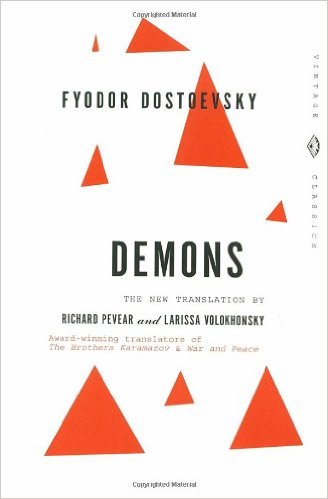
Demons, by Fyodor Dostoevsky, is 700 page pamphlet detailing the rise of the Russian proletariat and presaging the revolution of 1917. It’s about nihilism, anarchy, and atheism. It is a complicated novel detailing Russian society as it descends into chaos, anarchy, and madness. The demons referred to are actually ideas, emanating from the west, that infect the characters minds and causes them to take extreme actions such as suicide, murder and arson. The action takes place in a fictitious small town in provincial Russia but is based on a true story that Dostoevsky took from the newspapers.

Pesky Dostoevsky. Every time I say I am not going to read another 700 page book I get pulled back in! I say pamphlet because that is how it is described in the critical literature.  Only thing is, last time I checked, there are not that many 700 page pamphlets lying around. A few manifestos, no pamphlets.

I had to read 500 pages before I got to the part that inspired me to read this behemoth in the first place. The part that Camus refers to in his Myth of Sisyphus. “If there is no God life is meaningless. And without meaning, men and women will go stark, raving mad.” Camus described the novel’s importance this way: “The Possessed is one of the four or five works that I rank above all others. In more ways than one, I can say that it has enriched and shaped me.”

According to Camus all of Dostoevsky’s characters ask themselves about the meaning of life. Kirlov feels that God is necessary and that He must exist, but he knows that He cannot exist. “Why do you not realize that this is sufficient reason for killing oneself?” he asks. “If God does not exist, I am God.”

The book title was originally translated as, The Possessed. This is not the title Dostoevsky originally had in mind. The Russian title, Besy, does not refer to the possessed but rather to the possessors. Therefore the new title, Demons, refers to some of the characters in the book (from the foreword by Richard Pevar) and is more in line with Dostoevsky’s thinking.

All the characters have three names and each name has three syllables and each time a character is mentioned or introduced all three names are used except when they aren’t and then they are referred to by their nick names or their shortened names which we the reader have not been given fair warning and have absolutely no idea who the author is referring to. I had to take to underlining each character’s name each time they made an appearance and by page 500 or so I finally figured out who was who. I must say, the last 200 pages were page turners and my eyes were so glued to each page I couldn’t look away. The novel had to be good or I would not have stuck with it to the end.  I did and I am glad I did.

There is a missing chapter in the book which was censored by the Russian authorities when it was first published due to it’s salacious nature. I almost didn’t read it as it was included in the appendix and I didn’t realize how important it was. It is absolutely key to understanding the central character Stavrogin. It is called at At Tikhon’s and in it Stavrogin confesses to a horrible crime.

One of the most important takeaways from the novel for me were the revolutionary ideas of the intellectual of the revolutionary group, Shigalyev: “My conclusion stands in direct contradiction to the idea from which I started. Proceeding from unlimited freedom, I end with unlimited despotism. Ninety percent of society is to be enslaved to the remaining ten percent. Equality of the herd is to be enforced by police state tactics, state terrorism, and destruction of intellectual, artistic, and cultural life. It is estimated that about a hundred million people will be needed to be killed on the way to the goal.” This is oddly prophetic of what actually occurred in Russia under the dictatorship of Joseph Stalin.

I see strains of some of these ideas in modern day writers such as George Orwell who admonished us that if we want you want a vision of the future, imagine a boot stamping on a human face – forever. These currents have resurfaced again today in American politics and it is pretty frightening.

Like Camus, I can say that this novel has enriched and shaped me.


QOTD

As soon as some men are willing to serve good with the same stubborn and indefatigable energy with which other men serve evil, the forces of good will be in a position to triumph – for a very short time, perhaps, but still for a time and that triumph will be unprecedented.

– Albert Camus, November 4, 1944

957894

Best First Lines

Can you guess the names of the novels and the authors from the first lines?

Best First Lines to Novels
1. “What’s it going to be then, eh?”
2. I get the willies when I see closed doors.
3. Call me Ishmael.
4. In my younger and more vulnerable years my father gave me some advice that I’ve been turning over in my mind ever since.
5. Many years later, as he faced the firing squad, Colonel Aureliano Buendia was to remember that distant afternoon when his father took him to discover ice.
6. It was a bright cold day in April, and the clocks were striking thirteen.
7. Mother died today.
8. All this happened, more or less.
9. It was a pleasure to burn.
10. The house was built on the highest part of land between the harbor and the open sea.

Answers
1. A Clockwork Orange -Anthony Burgess
2. Something Happened -Joseph Heller
3. Moby Dick -Herman Melville
4. The Great Gatsby -F. Scott Fitzgerald
5. One Hundred Years of Solitude -Gabriel Garcia Marquez
6. 1984 -George Orwell
7. The Stranger -Albert Camus
8. Slaughter-House Five -Kurt Vonnegut
9. Fahrenheit 451 -Ray Bradbury
10. Islands in the Stream -Ernest Hemingway