A Novel by Albert Camus
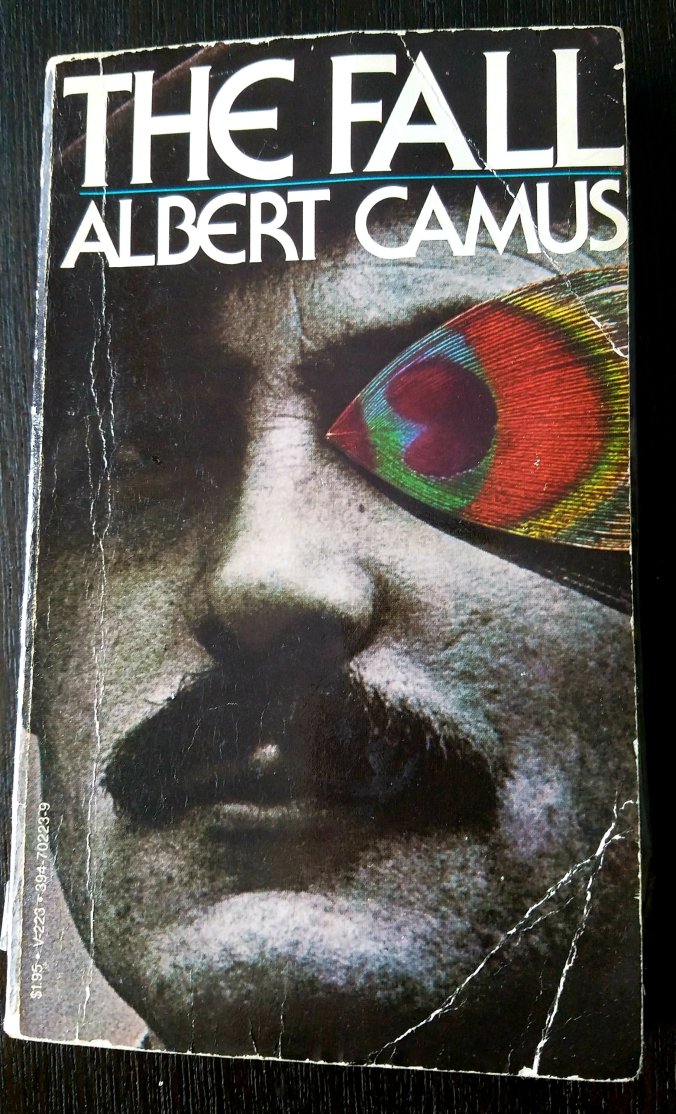
Every once in a while, I get inspired to reread one of my favorite books from the past. I have just read Camus’ The Fall for the third time. I read The Fall for the first time 34 years ago when I was age 36. It made a huge impression on me then and quickly became my favorite of Camus’ books. It somehow resonated with me in a way I didn’t quite understand. A second time in 2003….15 years ago when I was 55, a little grayer and a perhaps a little wiser.
Now, many years later, with a little more living under my belt, I am at it again. This time I have discovered a whole new territory. There on every page was an earthquake. In each sentence an incendiary device. What could I have been thinking all those years ago when I was reading this extraordinary book? How could I have missed so much? Was I sleeping? Well, the sleeper has awakened.
The novel opens with Jean-Baptiste Clamence, the main character, sitting in a dive bar named Mexico City located in the red light district of Amsterdam. He is talking to another patron. They discover they are compatriots, both hailing from Paris. Clamence tells his interlocutor about his past life in Paris as successful lawyer. The person he is talking to he refers to as “you.” This is a clever literary device by Camus. The “you” is actually you, the reader. Clamence regales you with stories of helping others. As a lawyer he takes most usually “widow and orphan” cases. He looks at himself as a person who lives solely for the purpose of benefiting others and living a life where virtue is its own reward.

Mexico City Bar, Amsterdam
He asks if you have you noticed that Amsterdam’s concentric canals resemble the circles of hell? The middle-class hell, of course, peopled with bad dreams. When one comes from the outside, as one gradually goes through those circles, life – and hence its crimes – becomes denser, darker. Here (in Mexico City), we are in the last circle.

Then he tells you about an incident that happened late one night in Paris while crossing the Seine on the Pont Royal on his way home from seeing his mistress. He comes across a woman dressed in black leaning over the edge of the bridge. He hesitates a moment but continues on his way. He had walked only a short distance when he heard the distinct sound of a body hitting the water. Clamence stops walking, knowing exactly what happened, but does nothing. The sound of screaming was repeated several times as it went downstream, then it ended. He continued on his way home doing nothing.

The Seine River, Paris, France. Photo: Benn Bell
This incident haunted Clamence throughout the rest of the novel and weighed heavily on his mind. There were a couple of other incidents that occurred that brought Clamence to the realization that he had actually lived a life seeking honor, recognition, and power over people. He was, in short, a hypocrite. Having come to this realization he knows he can no longer live the way he once lived. These factors precipitated his fall from grace and led to how he landed in Mexico City in the red light district of Amsterdam in the last circle of hell.

Bridge over the Seine River, Paris. Photo: Benn Bell
Clamence responds to his intellectual crisis by withdrawing from the world. He closes his law practice, avoids his former colleagues and people in general and throws himself into debauchery, which he describes in the absence of love is a suitable substitute. “True love is exceptional – two or three times a century, more or less. The rest of the time there is vanity or boredom.”
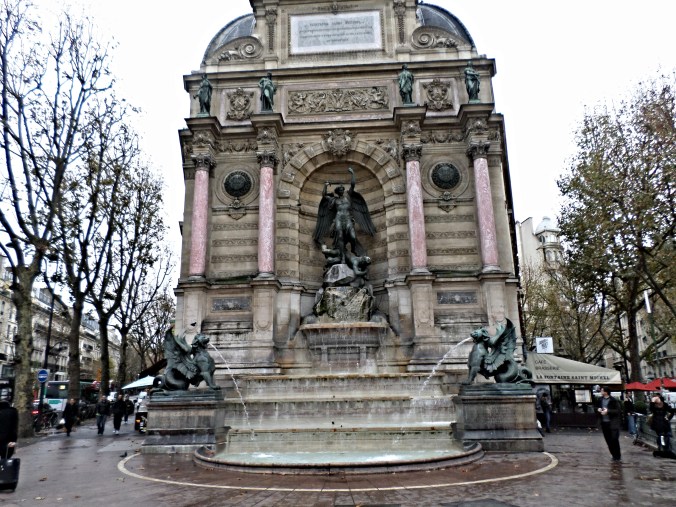
St Michael’s Fountain located in the neighborhood where Clamence lived in Paris. Photo: Benn Bell
“There is a certain degree of lucid intoxication, lying late at night between two prostitutes and drained of all desire, hope ceases to be a torture, you see the mind dominates the whole past and the pain of living is over forever. I went to bed with harlots and drank nights on end. Sensuality dominated my love life. I looked merely for objects of pleasure or conquests. For a ten-minute adventure I’d have disowned father and mother…I can’t endure being bored and appreciate only diversions in life… I have never been bored with women. I’d have given ten conversations with Einstein for an initial rendezvous with a pretty chorus girl.”
He thought for a while about joining the French Resistance, for this during the time of war, but decided against it as it was not suitable to his temperament. He preferred the “heights” and could not see himself part of a movement situated somewhere in a “cellar for days and nights on end with some brutes coming to haul me away from hiding, undo my weaving, and then drag me to another cellar and beat me to death.” He joins the army instead, gets captured by the Germans in Tunis, and is interred in a concentration camp in near Tripoli. Here he is elected to the position of “pope” by the other inmates and holds this position of power for a while. He drinks the water of a dying comrade, oh well, he was going to die anyway, and I needed to stay strong to survive to carry on continue to do more good, or at least that is how he rationalized it. He was eventually released and made his way to Amsterdam.

Foggy Amsterdam
On the way home, walking through the streets of Amsterdam, Jean-Baptiste Clamence tells you stories. He says he lives at the site of one of the greatest crimes of history, “the Jewish Quarter or what was called so until our Hitlerian brethren made room. What a clean-up! Seventy-five thousand Jews deported or assassinated: that’s real vacuum-cleaning. I admire the diligence, that’s methodical patience. When one has to apply a method. Here it did wonders incontrovertibly.”
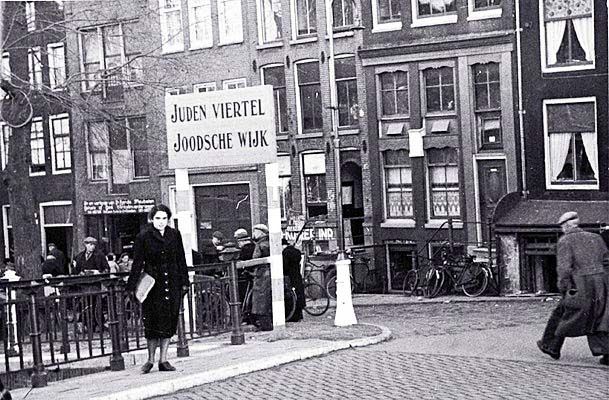
Jewish Quarter, Amsterdam
He relates this story: “In my little village, during a punitive operation, a German officer courteously asked an old woman to please choose which of her two sons would be shot as hostage? Choose! – Can you imagine that? That one? No, this one. And see him go. Let’s not dwell on it.”
Another story: “I knew a pure heart who rejected distrust. He was a pacifist and libertarian and loved all humanity and all the animals with an equal love. An exceptional soul, that’s certain. Well, during the last wars of religion in Europe he had retired to the country. He had written on his threshold: ‘Wherever you come from, come in and be welcome.’ Who do you think answered that noble invitation? The militia, who made themselves at home and disemboweled him.”
Jean-Baptiste Clamence’s final monologue takes place in his apartment. There he relates the story of how a famous 15th century painting came into his possession. One night a regular patron of Mexico City came into the bar with the priceless painting under his arm and offered to sell it to the bartender for a bottle of booze. It was hung on the back wall of the bar for some time until Clamence told the bartender the painting was in fact stolen and that police from several countries were searching for it. He offers to keep it for him and the bartender readily agrees.

The Just Judges
The painting is a panel from the Ghent Altarpiece known as The Just Judges. Clamence takes from this image the idea to identify himself as a “judge-penitent.” As a judge-penitent freedom is relinquished as a method of enduring the suffering imposed on us by virtue of living in a world without objective truth, and one that is therefore, ultimately meaningless. A judge-penitent confesses his sins so that he has the right to judge others.
The following snippets from the novel are spliced together and presented to you to give you a further flavor of the horror of the piece and are better told in the author’s own voice:
“I need your understanding. I have no friends, only accomplices.
The question is to slip through and, above all – yes above all, the question is to elude judgement. But one cannot dodge it so easily. Today we are always ready to judge as we are to fornicate.
People hasten to judge in order to not to be judged themselves.
The idea that comes naturally to man is his innocence. We all like that little Frenchman, Buchenwald, who was interested in registering a complaint with the clerk, himself a prisoner, who was recording his arrival. A complaint? The clerk and his comrades laughed: “Useless old man, you don’t lodge a complaint here!” “But you see sir,” said the little Frenchman, I am innocent!” We are all exceptional cases.
Let me tell you of the little-ease. I had to submit and admit my guilt. I had to live in the little-ease. To be sure you are not familiar with that dungeon cell that was called the little-ease in the middle ages. In general, one was forgotten there for life. That cell was distinguished from others by ingenious dimensions. It was not high enough to stand up nor yet wide enough to lie down in. One had to take an awkward manner and live on the diagonal. Sleep was a collapse, and waking a squatting. Every day, through the unchanging restriction that stiffened his body, the condemned man learned that he was guilty and that innocence consists in stretching joyously…we cannot assert the innocence of anyone, whereas we can state with certainty the guilt of all. I’ll tell you a big secret. Don’t wait for the Last Judgement. It takes place every day.”
“Do you know why he (Christ) was crucified? He knew that he was not altogether innocent. If he did not bear the weight of the crime he was accused of he had committed others – the slaughter of the innocents, the children of Judea massacred while his parents were taking him to a safe place. Why did they die if not for him? Those blood splattered soldiers, those infants cut in two filled him with horror…it was better to die, in order not to be the only one to live…he cried aloud his agony and that’s why I love him.
Since we are all judges, we are all guilty before one another.
A person I know used to divide human beings into three categories: those who prefer having nothing to hide, rather than being obliged to lie, those who prefer lying to having nothing to hide, and finally those who like both lying and the hidden. I’ll let you choose the pigeon hole that suits me.
But, let’s not worry! It’s too late now. It will always be too late. Fortunately!”
Conclusion
What is Camus telling us in this extraordinary novel? First of all, it is a novel of confession. The stories he tells his interlocutor are a confession. Jean-Baptiste Clamence says that one cannot die without confessing all one’s lies. It is also a novel about guilt: “I always hope my interlocutor will be a policeman and that he will arrest me for the theft of the Just Judges. Perhaps the rest will be taken care of subsequently; I would be decapitated for instance. I would have no more fear of death. I’d be saved. Above the gathered crowd. You would hold my still warm head so they could recognize themselves in it, and I could again dominate- an exemplar. I should have brought to a close, unseen, and unknown, my career as a false prophet crying in the wilderness.”
Clamence discovers he can’t condemn others without judging himself first. I am a judge-penitent, he says. The more I judge myself the more I can judge you. So, the idea is to heap judgments on himself in order to justify judging others. That’s why he is a judge. Someone who condemns others, but also a penitent, someone who recognizes and judges his own crimes. All men are guilty of something. We are guilty not only by our actions but by our inaction or our failure to act.
On the absurdity of existence Clamence tell us, “a single sentence will suffice for modern man: he fornicated and read the newspapers. Each day hundreds of millions of men, my subjects, painfully slip out of bed, a bitter taste in their mouths, to go to a joyless work.”
As for Truth: There is no objective truth.
And the fall from grace: The fall always occurs at dawn.











































 Ghost Dog