Every Picture Tells a Story

The Real Lives Behind the Lens and the Pen

In the quiet corners of everyday life, ordinary people often find themselves immortalized in ways they never imagined—through the viewfinder of a photographer or the ink of a writer’s pen. Whether captured candidly in a photograph or reimagined as a character in a story, these individuals unknowingly lend their lives to art. They become more than just passersby or background figures; they transform into muses, metaphors, and living echoes of human experience.

For photographers, the world is a living gallery of moments waiting to be captured. A weathered man sitting on a park bench, the way light dances across a child’s laughing face, or the tension etched into the shoulders of a woman walking alone—each scene is a potential story. Often, the subject has no idea that they have just stepped into the pages of a visual playbook. Their gestures, expressions, and the energy they radiate become a part of something greater—a reflection of mood, culture, or emotion. The photograph freezes their reality and elevates it into art.

Writers, on the other hand, weave people into narrative form. A conversation overheard on a train, a barista’s nervous smile, or an old friend’s resilience in grief—these fragments of life often become seeds of inspiration. The people we meet or merely observe become the blueprints for characters, sometimes in exact likeness, sometimes stitched together from multiple souls. Writers borrow bits of reality to create fiction that feels true. In doing so, they honor the people who left a mark, however briefly.

But this transformation from real life into art raises questions of representation and authenticity. Do we owe something to the people who unknowingly inspire us? Can we ever truly separate observation from invention? Photographers and writers alike walk this fine line, striving to capture truth while also interpreting it through their own lens of feeling and intent.

There is something sacred in this quiet transaction between life and art. Most people will never know they’ve been captured in a fleeting frame or mirrored in a fictional life. But perhaps that is part of the beauty. Their existence, however small in the context of a wider story, becomes part of a legacy—proof that the ordinary is worth remembering. They live on not as anonymous figures, but as meaningful presences in someone else’s vision.

Ultimately, art imitates life not just in grand gestures, but in the subtle details of everyday existence. The people we pass on sidewalks, sit beside in waiting rooms, or share a moment of silence with in elevators—these are the characters of our collective narrative. Photographers and writers are merely the witnesses, the translators. And through their work, these real lives continue to speak.

The Hard Problem: Consciousness

I have been thinking a lot lately about the hard problem, consciousness. I have been reading about it, watching videos, and listening to podcasts. Recently, I listened to a podcast with Annaka Harris and her husband, Sam Harris. First off, I didn’t know they were married. That was a pleasant surprise. I had previously watched a video with her on Big Think where she talked about consciousness as a “felt” experience. This has given me a pause. I had always thought of consciousness as an “awareness” of experience. I decided to do a little research. Turns out we were both right, as the following explanation describes it.

Consciousness is both felt and an awareness, depending on how you approach it.

Felt Consciousness (Qualia)

From a subjective, first-person perspective, consciousness is felt—we experience emotions, sensations, and thoughts directly. This is what philosophers call qualia, the raw, subjective feel of experience (e.g., the redness of red, the warmth of sunlight, the taste of coffee). This aspect of consciousness is what makes it deeply personal and difficult to explain purely in physical terms.

Consciousness as Awareness

On the other hand, consciousness is also an awareness, meaning it involves cognition, perception, and the ability to recognize oneself and the environment. This definition aligns with how many neuroscientists and cognitive scientists approach consciousness—as a state of being aware of internal and external experiences. This awareness allows us to think, reflect, and make decisions based on our perceptions.

Blending the Two

While consciousness involves feeling (subjective experience) and awareness (cognitive recognition), the two are deeply intertwined. Some theories suggest that the ability to reflect on our own experiences (metacognition) gives rise to our rich inner life. Others argue that raw feeling, without structured awareness, is still a form of consciousness (as seen in dreams or deep emotions).

So, in essence, consciousness is both felt experience and awareness—two sides of the same phenomenon.

Musings from 30,000 Feet

Star date 09242024

In his Critique of Dialectical Reason, (1960) Jean-Paul Sartre asks the following questions: 1) Why is violence so universal a feature of human experience, especially in politics? And 2) What becomes of man’s freedom in a world where human beings are constantly threatened by what he called the “practico-inert” (alienation)?  

Example: A motorist is caught in a traffic jam created by the increased availability of cars whose original intention was to enable men to move about more freely. Human beings are increasingly and inevitably held prisoner by their own creations.

In economics, this would be an example of diminishing returns. A concept I learned in the 5th grade, which struck me like a thunderbolt and has stuck with me ever since.

Another concept I learned a couple of years later in the 7th grade, was the concept of manifest destiny. Again, this was like a thunderbolt out of the blue, but I think it might have set me on the wrong path for years to come. If you don’t think that schools were indoctrinating students in the 1950s you are sadly mistaken. But I digress….

Gorillas in the Mist

Thought of the Day

Photo by the author

In the final analysis, we are all just gorillas in the mist, flesh, and bone and a hank of hair, with weird personality traits and a funny thing called consciousness. I think Jung had it right, but we must remember the German language doesn’t distinguish between mind and soul. The mind does not perceive the mind just a sharp knife cannot cut itself, so it is with the mind, and ultimate reality is beyond the scope of the intellect.

THE REBEL

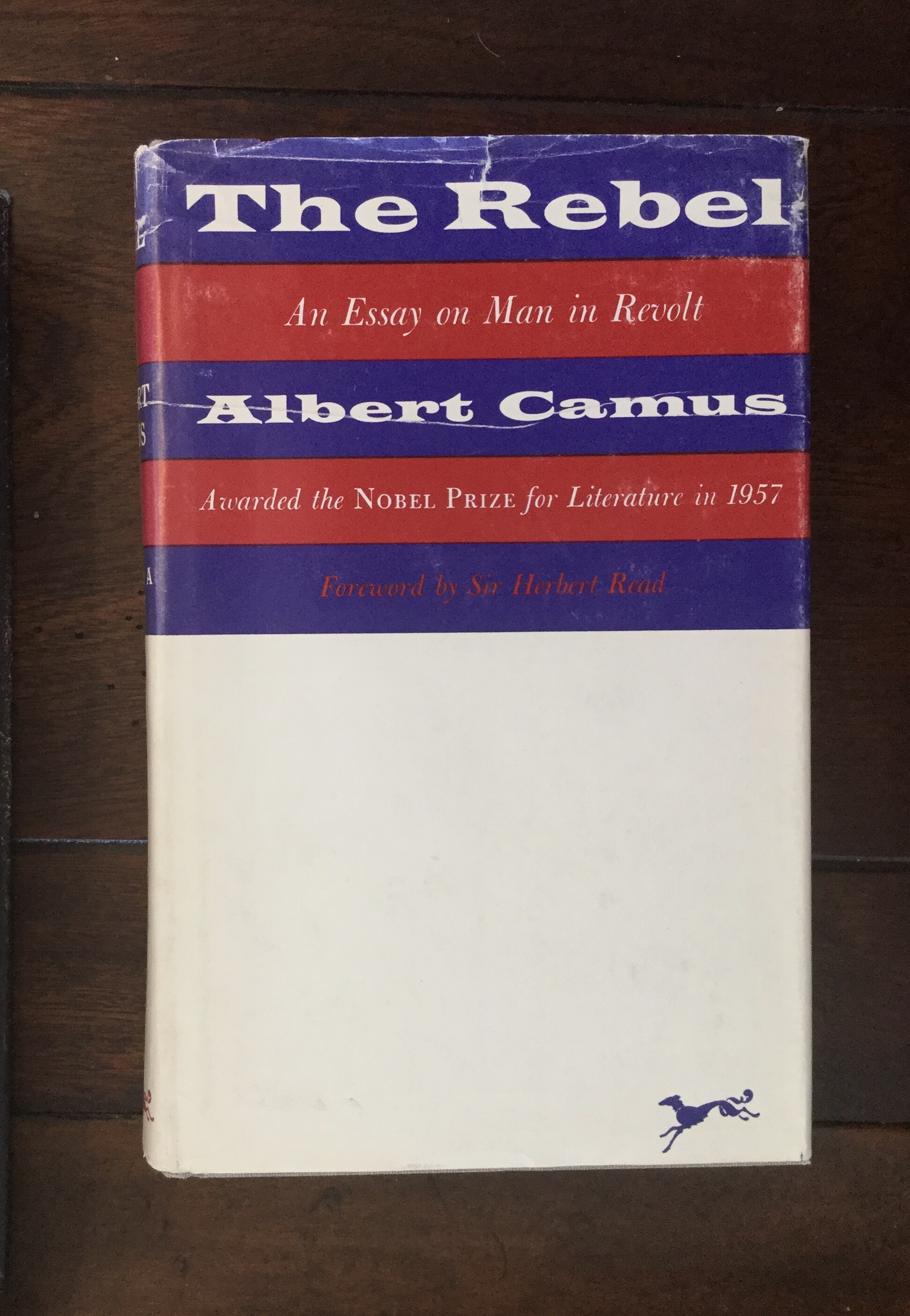
The Rebel – Albert Camus

I’m giving The Rebel another read, a book I read when I was in my 20s, written by a man who has shaped my views more than any other, Albert Camus. You might think that The Plague might be more in order given the current plague we are now living through. Well, I’ve read that one too and it is vividly etched in my brain. But no, for me, given the current political situation in the USA, The Rebel is far more relevant. At no time during my lifetime, with the possible exception of the Vietnam war, has the idea of “man in revolt” been more relevant or more important. Updates to follow. I’ll be reading with new eyes…

THE FALL: BOOK REVIEW

A Novel by Albert Camus

20180709_1636424692238238236370415.jpg


Every once in a while, I get inspired to reread one of my favorite books from the past. I have just read Camus’ The Fall for the third time. I read The Fall for the first time 34 years ago when I was age 36. It made a huge impression on me then and quickly became my favorite of Camus’ books. It somehow resonated with me in a way I didn’t quite understand. A second time in 2003….15 years ago when I was 55, a little grayer and a perhaps a little wiser.

Now, many years later, with a little more living under my belt, I am at it again. This time I have discovered a whole new territory. There on every page was an earthquake. In each sentence an incendiary device. What could I have been thinking all those years ago when I was reading this extraordinary book? How could I have missed so much? Was I sleeping? Well, the sleeper has awakened.

The novel opens with Jean-Baptiste Clamence, the main character, sitting in a dive bar named Mexico City located in the red light district of Amsterdam. He is talking to another patron. They discover they are compatriots, both hailing from Paris. Clamence tells his interlocutor about his past life in Paris as successful lawyer. The person he is talking to he refers to as “you.” This is a clever literary device by Camus. The “you” is actually you, the reader. Clamence regales you with stories of helping others. As a lawyer he takes most usually “widow and orphan” cases. He looks at himself as a person who lives solely for the purpose of benefiting others and living a life where virtue is its own reward.

Mexico City

Mexico City Bar, Amsterdam

He asks if you have you noticed that Amsterdam’s concentric canals resemble the circles of hell? The middle-class hell, of course, peopled with bad dreams. When one comes from the outside, as one gradually goes through those circles, life – and hence its crimes – becomes denser, darker. Here (in Mexico City), we are in the last circle.

Amsterdam

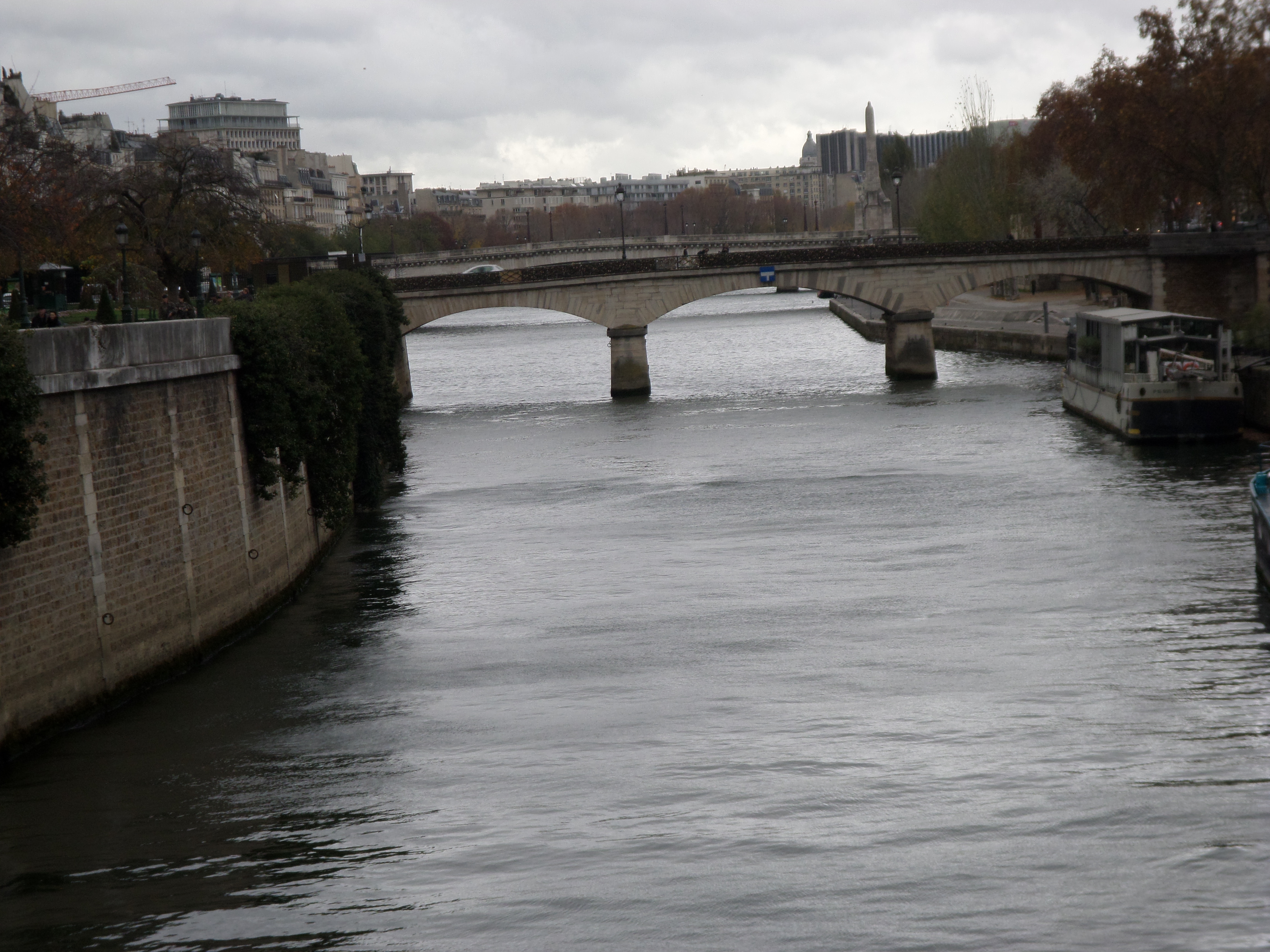
Then he tells you about an incident that happened late one night in Paris while crossing the Seine on the Pont Royal on his way home from seeing his mistress. He comes across a woman dressed in black leaning over the edge of the bridge. He hesitates a moment but continues on his way. He had walked only a short distance when he heard the distinct sound of a body hitting the water. Clamence stops walking, knowing exactly what happened, but does nothing. The sound of screaming was repeated several times as it went downstream, then it ended. He continued on his way home doing nothing.

23661115021_688e446188_o

The Seine River, Paris, France. Photo: Benn Bell

This incident haunted Clamence throughout the rest of the novel and weighed heavily on his mind. There were a couple of other incidents that occurred that brought Clamence to the realization that he had actually lived a life seeking honor, recognition, and power over people. He was, in short, a hypocrite. Having come to this realization he knows he can no longer live the way he once lived. These factors precipitated his fall from grace and led to how he landed in Mexico City in the red light district of Amsterdam in the last circle of hell.
SAMSUNG CAMERA PICTURES

Bridge over the Seine River, Paris. Photo: Benn Bell

Clamence responds to his intellectual crisis by withdrawing from the world. He closes his law practice, avoids his former colleagues and people in general and throws himself into debauchery, which he describes in the absence of love is a suitable substitute. “True love is exceptional – two or three times a century, more or less. The rest of the time there is vanity or boredom.”

SAMSUNG CAMERA PICTURES

St Michael’s Fountain located in the neighborhood where Clamence lived in Paris.  Photo:  Benn Bell

“There is a certain degree of lucid intoxication, lying late at night between two prostitutes and drained of all desire, hope ceases to be a torture, you see the mind dominates the whole past and the pain of living is over forever. I went to bed with harlots and drank nights on end.  Sensuality dominated my love life. I looked merely for objects of pleasure or conquests.  For a ten-minute adventure I’d have disowned father and mother…I can’t endure being bored and appreciate only diversions in life… I have never been bored with women. I’d have given ten conversations with Einstein for an initial rendezvous with a pretty chorus girl.”

He thought for a while about joining the French Resistance, for this during the time of war, but decided against it as it was not suitable to his temperament. He preferred the “heights” and could not see himself part of a movement situated somewhere in a “cellar for days and nights on end with some brutes coming to haul me away from hiding, undo my weaving, and then drag me to another cellar and beat me to death.” He joins the army instead, gets captured by the Germans in Tunis, and is interred in a concentration camp in near Tripoli. Here he is elected to the position of “pope” by the other inmates and holds this position of power for a while. He drinks the water of a dying comrade, oh well, he was going to die anyway, and I needed to stay strong to survive to carry on continue to do more good, or at least that is how he rationalized it. He was eventually released and made his way to Amsterdam.

Foggy amsterdam

Foggy Amsterdam

On the way home, walking through the streets of Amsterdam, Jean-Baptiste Clamence tells you stories. He says he lives at the site of one of the greatest crimes of history, “the Jewish Quarter or what was called so until our Hitlerian brethren made room. What a clean-up! Seventy-five thousand Jews deported or assassinated: that’s real vacuum-cleaning. I admire the diligence, that’s methodical patience. When one has to apply a method. Here it did wonders incontrovertibly.”

Jewsish Quarter, Amstedam

Jewish Quarter, Amsterdam

He relates this story: “In my little village, during a punitive operation, a German officer courteously asked an old woman to please choose which of her two sons would be shot as hostage? Choose! – Can you imagine that? That one? No, this one. And see him go. Let’s not dwell on it.”

Another story: “I knew a pure heart who rejected distrust. He was a pacifist and libertarian and loved all humanity and all the animals with an equal love. An exceptional soul, that’s certain. Well, during the last wars of religion in Europe he had retired to the country. He had written on his threshold: ‘Wherever you come from, come in and be welcome.’ Who do you think answered that noble invitation? The militia, who made themselves at home and disemboweled him.”

Jean-Baptiste Clamence’s final monologue takes place in his apartment. There he relates the story of how a famous 15th century painting came into his possession. One night a regular patron of Mexico City came into the bar with the priceless painting under his arm and offered to sell it to the bartender for a bottle of booze. It was hung on the back wall of the bar for some time until Clamence told the bartender the painting was in fact stolen and that police from several countries were searching for it. He offers to keep it for him and the bartender readily agrees.
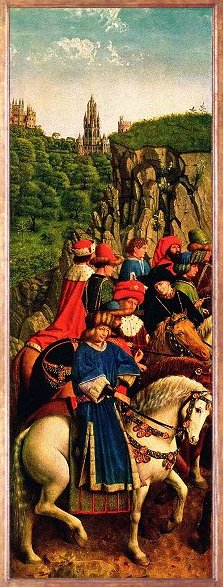
just judges

The Just Judges

The painting is a panel from the Ghent Altarpiece known as The Just Judges. Clamence takes from this image the idea to identify himself as a “judge-penitent.” As a judge-penitent freedom is relinquished as a method of enduring the suffering imposed on us by virtue of living in a world without objective truth, and one that is therefore, ultimately meaningless. A judge-penitent confesses his sins so that he has the right to judge others.

The following snippets from the novel are spliced together and presented to you to give you a further flavor of the horror of the piece and are better told in the author’s own voice:

“I need your understanding. I have no friends, only accomplices.

The question is to slip through and, above all – yes above all, the question is to elude judgement. But one cannot dodge it so easily. Today we are always ready to judge as we are to fornicate.

People hasten to judge in order to not to be judged themselves.

The idea that comes naturally to man is his innocence. We all like that little Frenchman, Buchenwald, who was interested in registering a complaint with the clerk, himself a prisoner, who was recording his arrival. A complaint? The clerk and his comrades laughed: “Useless old man, you don’t lodge a complaint here!” “But you see sir,” said the little Frenchman, I am innocent!” We are all exceptional cases.

Let me tell you of the little-ease. I had to submit and admit my guilt. I had to live in the little-ease. To be sure you are not familiar with that dungeon cell that was called the little-ease in the middle ages. In general, one was forgotten there for life. That cell was distinguished from others by ingenious dimensions. It was not high enough to stand up nor yet wide enough to lie down in. One had to take an awkward manner and live on the diagonal. Sleep was a collapse, and waking a squatting. Every day, through the unchanging restriction that stiffened his body, the condemned man learned that he was guilty and that innocence consists in stretching joyously…we cannot assert the innocence of anyone, whereas we can state with certainty the guilt of all. I’ll tell you a big secret. Don’t wait for the Last Judgement. It takes place every day.”

“Do you know why he (Christ) was crucified? He knew that he was not altogether innocent. If he did not bear the weight of the crime he was accused of he had committed others – the slaughter of the innocents, the children of Judea massacred while his parents were taking him to a safe place. Why did they die if not for him? Those blood splattered soldiers, those infants cut in two filled him with horror…it was better to die, in order not to be the only one to live…he cried aloud his agony and that’s why I love him.

Since we are all judges, we are all guilty before one another.

A person I know used to divide human beings into three categories: those who prefer having nothing to hide, rather than being obliged to lie, those who prefer lying to having nothing to hide, and finally those who like both lying and the hidden. I’ll let you choose the pigeon hole that suits me.

But, let’s not worry! It’s too late now. It will always be too late. Fortunately!”

 Conclusion

What is Camus telling us in this extraordinary novel? First of all, it is a novel of confession. The stories he tells his interlocutor are a confession. Jean-Baptiste Clamence says that one cannot die without confessing all one’s lies. It is also a novel about guilt: “I always hope my interlocutor will be a policeman and that he will arrest me for the theft of the Just Judges. Perhaps the rest will be taken care of subsequently; I would be decapitated for instance. I would have no more fear of death. I’d be saved. Above the gathered crowd. You would hold my still warm head so they could recognize themselves in it, and I could again dominate- an exemplar. I should have brought to a close, unseen, and unknown, my career as a false prophet crying in the wilderness.”

Clamence discovers he can’t condemn others without judging himself first. I am a judge-penitent, he says. The more I judge myself the more I can judge you. So, the idea is to heap judgments on himself in order to justify judging others. That’s why he is a judge. Someone who condemns others, but also a penitent, someone who recognizes and judges his own crimes. All men are guilty of something. We are guilty not only by our actions but by our inaction or our failure to act.

On the absurdity of existence Clamence tell us, “a single sentence will suffice for modern man: he fornicated and read the newspapers.  Each day hundreds of millions of men, my subjects, painfully slip out of bed, a bitter taste in their mouths, to go to a joyless work.”

As for Truth: There is no objective truth.

And the fall from grace: The fall always occurs at dawn.



BLOOD AND SOIL

The Myth of Blood and Soil

According to Karl Popper, writing in his The Open Society and its Enemies, The Myth of Blood and Soil was originated by Plato and detailed in The Republic. Plato freely admits that the myth is a lie. It was a propaganda ploy used to bolster his idea of the ideal state which is totalitarian in nature ruled by a philosopher king and a racially pure elite.

wp-1503082667959.jpg

The Myth of Blood and Soil is based on two ideas: 1. In order to strengthen the defense of the mother country men are born of the earth of their country which is their mother.  2. Racialism: “God has put gold into those who are capable of ruling, silver into the auxiliaries, and iron and copper into the peasants and other producer classes.” These metals are racial characteristics. Any admixture of one of these base metals must be excluded from the higher classes. In other words, only those with racial purity may rule. Plato goes on to say that any mixing of the metals will lead to the fall of man. “Iron will mingle with silver and bronze with gold, and from this admixture variation will be born and absurd irregularity; and whenever these are born they will they will beget struggle and hostility; the city (state) must perish when guarded by iron and copper” and lead to the degradation and the fall of man. Remember, Plato admits that the Myth of Blood and Soil is a propaganda lie useful in persuading his rulers to follow his racial policies.

wp-1503082716243.jpg

Fast forward to Germany in the late 19th century where the phrase Blood and Soil was appropriated by the Germans to signify and glorify racialism and nationalism. The German translation reads: “Blut und Boden.” Rural life was idealized and combined with the ideas of racism and anti-Semitism. “Blood and Soil” became a key phrase of Nazi ideology.

3312896330_444c56c6f8_b

This phrase has been taken up and by neo-Nazis and white supremacist groups here in the United States as a rallying cry.  Nazis could be heard chanting the phrase, “Blood and Soil” on the streets of Charlottesville as they marched carrying their torches.

Charlottesville


LUST

The editors of WordPress have chosen “Lust” as the word of the day for my daily inspiration. I am happy to accommodate them with my own interpretation and inspired rendering of this volatile, combustible, and knocked out loaded word.

I take you to the lust capitals of the world, two sister cites really, which gives an extra added dimension to the word lust, if you catch my meaning.

So here we have visual evidence of the lusty nature of these two great cities: Philadelphia and Paris.

wp-1501508066901.jpg

A Philly stripper goes into the Candy Store for stripper supplies.


“Of all the worldly Passions, lust is the most intense.”

-Buddha


wp-1501507902213.jpg

Purple Orchid, Philadelphia

“She was perfect, pure maddening sex, and she knew it, and she played on it, dripped it, and allowed you to suffer for it.”
–  Charles Bukowski

wp-1501507873442.jpg

Ozz Gentleman’s Club, Philadelphia

“Lust is the source of all our actions, and humanity.”
― Blaise Pascal

o

Club Ozz, Philadelphia

“I live for sex. I celebrate it, and relish the electricity of it, with every fibre of my being. I can see no better reason for being alive.”
― Fiona Thrust

wp-1501507405845.jpg

Sex Shop on South Street in Philly

“The world is divided into those who screw and those who do not. He distrusted those who did not—when they strayed from the straight and narrow it was something so unusual for them that they bragged about love as if they had just invented it.”
― Gabriel Garcia Marquez, Love in the Time of Cholera

wp-1501507491818.jpg

Leather and Latex, Philly


“Lust’s Passion will be served; it demands, it militates, it tyrannizes.”

-Marquis de Sade


SAMSUNG CAMERA PICTURES

Moulin Rouge in Paris where girls who can Cancan

“Lust is to the other passions what the nervous fluid is to life; it supports them all, lends strength to them all ambition, cruelty, avarice, revenge, are all founded on lust.”
–  Marquis de Sade

wp-1501507780124.jpg

Pussy’s Gentleman’s Club, Paris

“I can resit anything but temptation.”

– Oscar Wilde

wp-1501507314099.jpg

Sex Shop, Paris

“There’s something here, my dear boy, that you don’t understand yet. A man will fall in love with some beauty, with a woman’s body, or even a part of a woman’s body (a sensualist can understand that) and he’ll abandon his own children for her, sell his father and mother, and his country, Russia, too. If he’s honest, he’ll steal; if he’s humane, he’ll murder; if he’s faithful, he’ll deceive.”

-Fyodor Dostoyevsky, The Brothers Karamazov

wp-1501507713111.jpg

La Diva, Paris

 “Only the united beat of sex and the heart can create ecstasy.”

-Anais Nin

wp-1501507688076.jpg

New Girl’s, Paris

“To have her here in bed with me, breathing on me, her hair in my mouth – I count that as something of a miracle.”

-Henry Miller

SAMSUNG CAMERA PICTURES

Paris Museum of Erotic Art


All photos by me.


Alien: Covenant (2017)

Movie Review

danils

The spaceship Covenant is on its way to a distant planet carrying as its cargo 2000 humans and embryos frozen in a state of suspended animation. The purpose of the trip is colonization. On the way an accident occurs which endangers the mission and creates a devastating loss of life. While repairing the ship a signal is encountered that causes the crew to chart a new course to investigate the source.

Alien Covenant picks up 10 years after Prometheus leaves off. Covenant hasn’t garnered many very good reviews, mixed I’d have to say, and I think I know why.  Most sophisticated movie goers who love movies usually don’t like sequels and prequels. I must admit I don’t either. So Covenant automatically loses points just for that. But come on, this is Alien, and it’s Ridley Scott in the director’s chair, so I am willing to cut it some slack. I love science fiction and I love horror films, there just aren’t too many good ones out there. So happens Alien is one of my favorite all time science fiction flicks and so is Blade Runner. Both Ridley Scott enterprises.

Now, back to the movie. I don’t often go to the movies for my philosophy. I usually go to philosophers for that, like Wittgenstein or Sartre. It’s nice if there is an element of philosophy in the movie, especially if it’s science fiction. But I am not going to get all worked up if it doesn’t deliver. The philosophy is only as good as the writer and there aren’t that many Philip K. Dicks or Issac Asimovs out there.  In science fiction horror films what you want and come to expect are  science fiction theories and horror film tropes. That’s what you get in Alien, and with Ridley Scott you get the best.  No one does it better.

With all that said, I loved this movie! The film was two hours long, but you didn’t notice as the time flew by. The aliens were scary and the atmosphere was dripping with human gore imbued. The encounters were exciting as the creatures picked off the married crew members one by one (they were all married.) There was even an obligatory sex scene in the ship’s shower. Yes, Virginia, there is sex in deep space, where the lovely couple is joined by an unwanted intruder.

The last man standing was actually a woman, Daniels, played convincingly by Katherine Waterston. Not quite Sigourney Weaver’s Ripley, but close enough. Strong female leads are a recurring theme of the Alien franchise which is a good thing. In an exciting battle with the alien on the deck of the freighter craft we are treated to not one but two climaxes : “Give a girl a hand?” Most satisfying.

Michael Fassbender plays the androids Dave and Walter in a neat bit of acting that is totally believable and uncanny . He truly runs away with the show. This is the heart of what Alien is all about and the real philosophy behind the film raising questions about creation, gods, and monsters in the fashion of Mary Shelley in Frankenstein.

While not perfect I give this film high marks. Ridley Scott remains at the top of his game. Can’t wait for Blade Runner 2049.