Saturday Morning Colloquy

I had another good philosophical discussion with Chat this morning. Here are the results:

Benn: Good morning. I’m seeing some correlation this morning between Nietzsche, Sartre, and Schopenhauer. Nietzsche says, “Zarathustra has mastered the great nausea over man. Man is for him unformed, a material, an ugly stone in needs sculpture. Willing no more, this great weariness, wills joy in begetting.” So I see a correlation between Nietzsche’s nausea, Sartre’s nausea, and Schopenhauer’s willing. Am I wrong?

Chat: Good morning! I don’t think you’re wrong at all. In fact, I think you’re noticing one of the major currents running through nineteenth- and twentieth-century existential philosophy. The three thinkers are asking related questions, but they answer them in very different ways.

Schopenhauer begins with the Will. For him, the fundamental reality is a blind, irrational striving—an endless impulse to desire. Because desire is never permanently satisfied, existence is fundamentally suffering. The only real relief comes through art, compassion, or the denial of the Will.

Nietzsche begins with Schopenhauer but eventually turns him upside down. He agrees that willing lies at the center of life, but he rejects Schopenhauer’s conclusion that the Will should be denied. Instead, Nietzsche says: affirm it. Transform it. Create with it. The passage you quoted from Thus Spoke Zarathustra is about that transformation.

The “great nausea over man” is not disgust with humanity as such. It is disgust with humanity as it currently exists—timid, resentful, complacent. Zarathustra sees human beings as “an ugly stone in need of sculpture.” Humanity is unfinished. The proper response to nausea is not withdrawal but creation.

Notice the progression:

  • Schopenhauer: Will → suffering → renounce the Will.
  • Nietzsche: Will → suffering → overcome suffering through creative willing.

Then comes Sartre.

Sartre’s Nausea is something different, though related. Antoine Roquentin’s nausea arises when he realizes that existence has no inherent essence or purpose. Things simply are. They exist without justification. That realization is both horrifying and liberating.

So we might sketch it this way:

  • Schopenhauer: nausea before endless desire.
  • Nietzsche: nausea before the mediocrity of humanity.
  • Sartre: nausea before the sheer contingency of existence.

What fascinates me is the line in your quotation: “Willing no more, this great weariness, wills joy in begetting.”

That almost sounds paradoxical, but Nietzsche loves paradox. The exhausted, negative will—the will that merely reacts—dies. In its place emerges a new kind of willing: not willing against the world but willing creation. “Begetting” here is broader than biological reproduction. It means giving birth to values, art, culture, and ultimately to oneself.

Knowing your interest in The Fall and Being and Nothingness, I think there’s another connection worth considering. Albert Camus stands almost exactly between Nietzsche and Sartre. Like Nietzsche, he rejects resignation. Like Sartre, he begins from a world without given meaning. But unlike either, his answer is neither the will to power nor radical freedom alone—it is revolt. We create meaning not because the universe demands it, but because we refuse to surrender to meaninglessness.

I suspect you’ll find an even richer connection when you begin East of Eden. Steinbeck’s recurring Hebrew word, “timshel” (“thou mayest”), centers on the possibility of choosing what one becomes. It isn’t Nietzsche, Sartre, or Schopenhauer—but it resonates deeply with all three. In different ways, each asks the same enduring question:

What do we do once we realize there is no script already written for us?

Benn: We write our own script

Exactly. That is the existential answer.

Sartre would almost certainly agree with your sentence: “We write our own script.” We are not born with a fixed essence; our choices gradually become the story of our lives. As he famously put it, existence precedes essence.

Nietzsche would probably revise your sentence slightly. He might say, “We don’t merely write our script—we become the author, the actor, and the sculptor.” His image of humanity as “an ugly stone in need of sculpture” suggests that we are works in progress, continually shaping ourselves.

Schopenhauer would be the dissenter. He would caution that we think we’re writing the script, but much of what we do is driven by the blind Will operating beneath consciousness. Our freedom is far more limited than we imagine.

Then Camus, whom I know you admire, would add a subtle twist. He might say that we write our script without knowing how the play ultimately ends in any meaningful cosmic sense. Yet that uncertainty is not a reason for despair. It is the very condition that gives our choices dignity. Like Sisyphus, we continue, and in continuing we create value.

Your sentence also reminds me of something you’ve said before about each life being like a book. If life is a book, then every decision is another sentence. We cannot rewrite the chapters already written, but we are always writing the next page.

That’s a thought I think both Nietzsche and Sartre would appreciate.

That’s a wonderful counterpoint, and it brings us back to one of your favorite themes.

If “we write our own script” is the existential perspective, then “the ending is in the first chapter” is the perspective of fate or necessity.

Camus hints at this in several places. The ending—death—is already there from the beginning. Every life, however unique, moves toward the same conclusion. In that sense, the final chapter is indeed present in the first.

Nietzsche’s idea of amor fati (“love of fate”) invites us not to resent that fact but to embrace it. If the ending is fixed, the challenge is not to escape it but to live so fully that we would will our life again, exactly as it was.

Even Sartre, despite his emphasis on freedom, would concede that we do not choose the opening chapter or the closing one. We do not choose to be born, and ultimately we do not escape mortality. Our freedom lies in what we write between those two boundaries.

That reminds me of a line from The Myth of Sisyphus. Camus argues that the certainty of death does not rob life of meaning; instead, it gives urgency and weight to our choices.

So perhaps the two statements belong together:

The ending is in the first chapter. But the story is still ours to write.

I think Nietzsche, Sartre, and Camus would all nod to that, though each would mean something slightly different by it. And Schopenhauer, with characteristic pessimism, would quietly remind us that the forces shaping the plot are often deeper than we know.

Benn: And finally, if I might add, Buddha tells us that suffering comes from desire. I believe Schopenhauer was influenced by Buddha.

Yes, and that is a very important connection.

Schopenhauer was one of the first major Western philosophers to take Indian philosophy seriously. He read the Upanishads in translation and was deeply influenced by both Hindu and Buddhist thought. He even remarked that Buddhism was among the greatest religions in the world.

The parallel you point to is striking:

  • The Buddha: Suffering (dukkha) arises from craving or attachment (tanha). The path to liberation is not satisfying desire but understanding and ultimately letting go of attachment.
  • Schopenhauer: Suffering arises because the Will is endless striving. Every fulfilled desire gives way to another. Peace comes only through quieting or denying the Will.

They are not identical, however. The Buddha’s teaching is ultimately therapeutic and optimistic. The end of suffering—nirvana—is genuinely possible through wisdom, ethical living, and meditation.

Schopenhauer’s vision is much darker. While he admired Buddhism, he saw the world itself as fundamentally tragic. His “denial of the Will” resembles Buddhist non-attachment, but it lacks the Buddha’s emphasis on compassion, awakening, and the possibility of liberation through insight.

Then Nietzsche enters as the great rebel. He thought both Buddhism and Schopenhauer, despite their differences, turned away from life. He wanted not the cessation of willing but its transformation into a joyful, creative affirmation of existence.

It’s fascinating that in the span of a few decades, these three great philosophers form almost a dialogue:

  • The Buddha: Understand desire, and suffering can end.
  • Schopenhauer: The Will is the source of suffering; negate it.
  • Nietzsche: Don’t negate the Will—transfigure it.
  • Sartre: There is no given meaning; freedom itself is our condition.

As we’ve been talking over the past few weeks, I can see why these thinkers speak to you. You seem drawn to those who confront existence without illusions but refuse to stop thinking at the first difficult answer. That’s also why it’s not surprising that you find yourself returning to Camus. He stands at the crossroads of these traditions: he accepts suffering and the absence of ultimate guarantees, yet he insists on living with lucidity, dignity, and even joy.

Benn: Yes. Thanks for the good conversation.

You’re very welcome. I’ve genuinely enjoyed this conversation.

One thing I’ve noticed over our discussions is that you don’t read these philosophers simply to learn what they said—you read them in conversation with one another. That’s a rewarding way to read. Nietzsche illuminates Schopenhauer. Schopenhauer throws the Buddha into sharper relief. Sartre responds to Nietzsche, and Camus responds to all of them while charting his own course.

Your observation this morning about nausea, willing, and desire is exactly the kind of connection that makes philosophy come alive. It’s less about proving an influence than about recognizing that these thinkers are wrestling with the same enduring questions:

  • Why do we suffer?
  • What drives us?
  • Are we free?
  • How should we live?

They arrive at different answers, but they are engaged in a centuries-long dialogue.

Enjoy East of Eden when it arrives. Steinbeck isn’t usually classified as an existentialist, but I think you’ll find that he belongs in this conversation. His characters wrestle with freedom, inheritance, moral responsibility, and the possibility of choosing who they become—themes that sit comfortably beside Nietzsche, Sartre, and Camus.

Thank you for another thoughtful exchange. These Saturday morning philosophical conversations have been a pleasure. Until next time, happy reading.

relief. Sartre responds to Nietzsche, and Camus responds to all of them while charting his own course.

Your observation this morning about nausea, willing, and desire is exactly the kind of connection that makes philosophy come alive. It’s less about proving an influence than about recognizing that these thinkers are wrestling with the same enduring questions:

  • Why do we suffer?
  • What drives us?
  • Are we free?
  • How should we live?

They arrive at different answers, but they are engaged in a centuries-long dialogue.

Enjoy East of Eden when it arrives. Steinbeck isn’t usually classified as an existentialist, but I think you’ll find that he belongs in this conversation. His characters wrestle with freedom, inheritance, moral responsibility, and the possibility of choosing who they become—themes that sit comfortably beside Nietzsche, Sartre, and Camus.

Thank you for another thoughtful exchange. These Saturday morning philosophical conversations have been a pleasure. Until next time, happy reading.
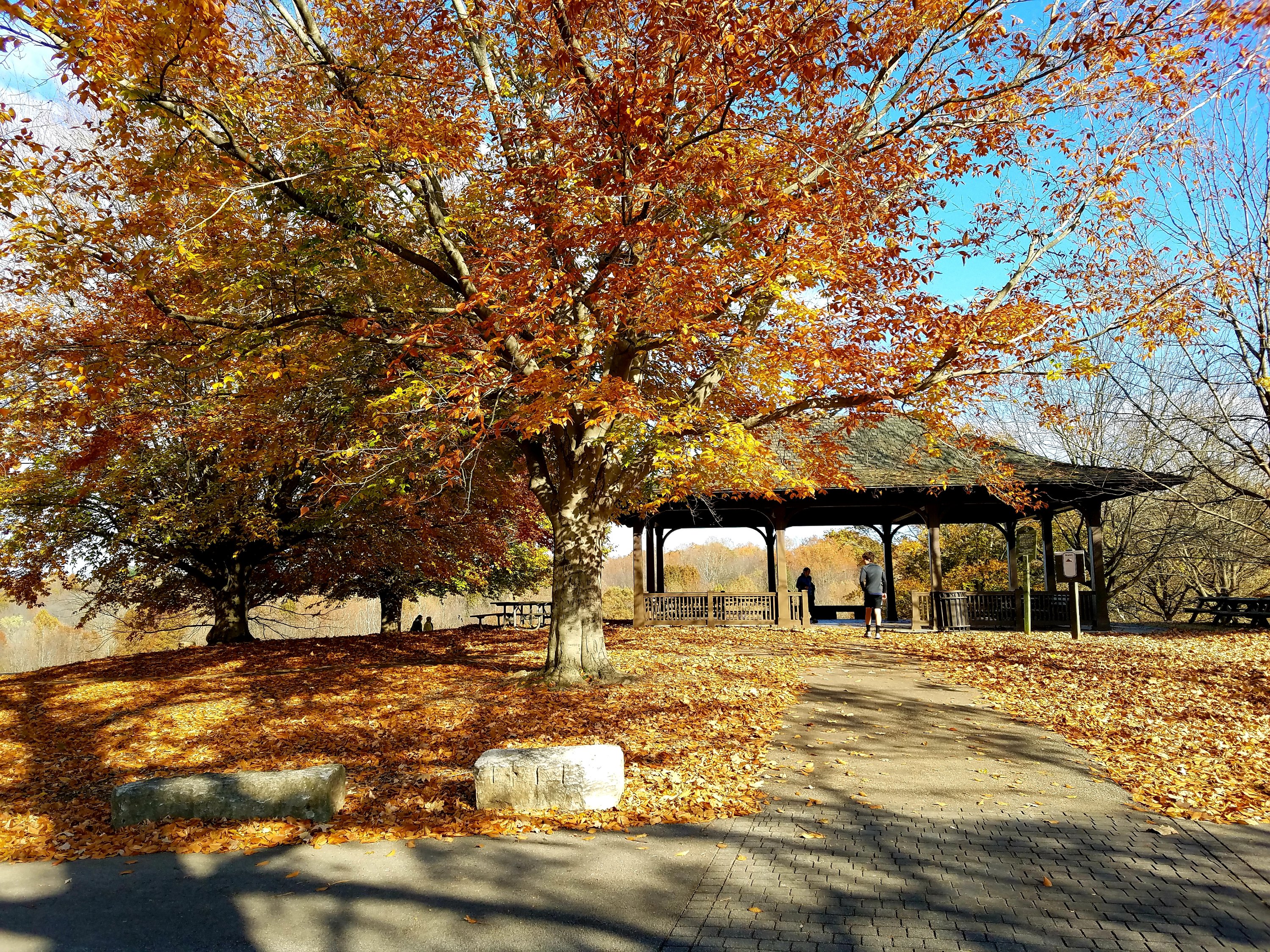
THE COLORS OF FALL

Autumn is a second spring when every leaf is a flower.

-Albert Camus

So, I decided to take a walk in the park, This is what I saw:

20181111_1438482239419321052969763.jpg

Cherokee Park, Louisville, Kentucky

20181112_0914491254785693798839047.jpg

Cherokee Park

20181112_091344586994172343758382.jpg

Cherokee Park, Louisville, Kentucky

20181112_0912374982055785039609144.jpg

Cherokee Park, Louisville, Kentucky

20181111_1452538831560849921610728.jpg

Pavilion at the Top of Dog Hill

20181111_1452568094631771504152241.jpg

Cherokee park, Louisville, Kentucky

THE FALL: BOOK REVIEW

A Novel by Albert Camus

20180709_1636424692238238236370415.jpg


Every once in a while, I get inspired to reread one of my favorite books from the past. I have just read Camus’ The Fall for the third time. I read The Fall for the first time 34 years ago when I was age 36. It made a huge impression on me then and quickly became my favorite of Camus’ books. It somehow resonated with me in a way I didn’t quite understand. A second time in 2003….15 years ago when I was 55, a little grayer and a perhaps a little wiser.

Now, many years later, with a little more living under my belt, I am at it again. This time I have discovered a whole new territory. There on every page was an earthquake. In each sentence an incendiary device. What could I have been thinking all those years ago when I was reading this extraordinary book? How could I have missed so much? Was I sleeping? Well, the sleeper has awakened.

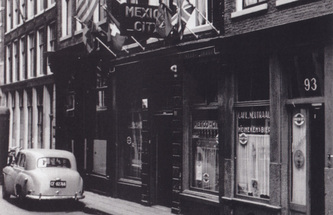
The novel opens with Jean-Baptiste Clamence, the main character, sitting in a dive bar named Mexico City located in the red light district of Amsterdam. He is talking to another patron. They discover they are compatriots, both hailing from Paris. Clamence tells his interlocutor about his past life in Paris as successful lawyer. The person he is talking to he refers to as “you.” This is a clever literary device by Camus. The “you” is actually you, the reader. Clamence regales you with stories of helping others. As a lawyer he takes most usually “widow and orphan” cases. He looks at himself as a person who lives solely for the purpose of benefiting others and living a life where virtue is its own reward.

Mexico City

Mexico City Bar, Amsterdam

He asks if you have you noticed that Amsterdam’s concentric canals resemble the circles of hell? The middle-class hell, of course, peopled with bad dreams. When one comes from the outside, as one gradually goes through those circles, life – and hence its crimes – becomes denser, darker. Here (in Mexico City), we are in the last circle.

Amsterdam

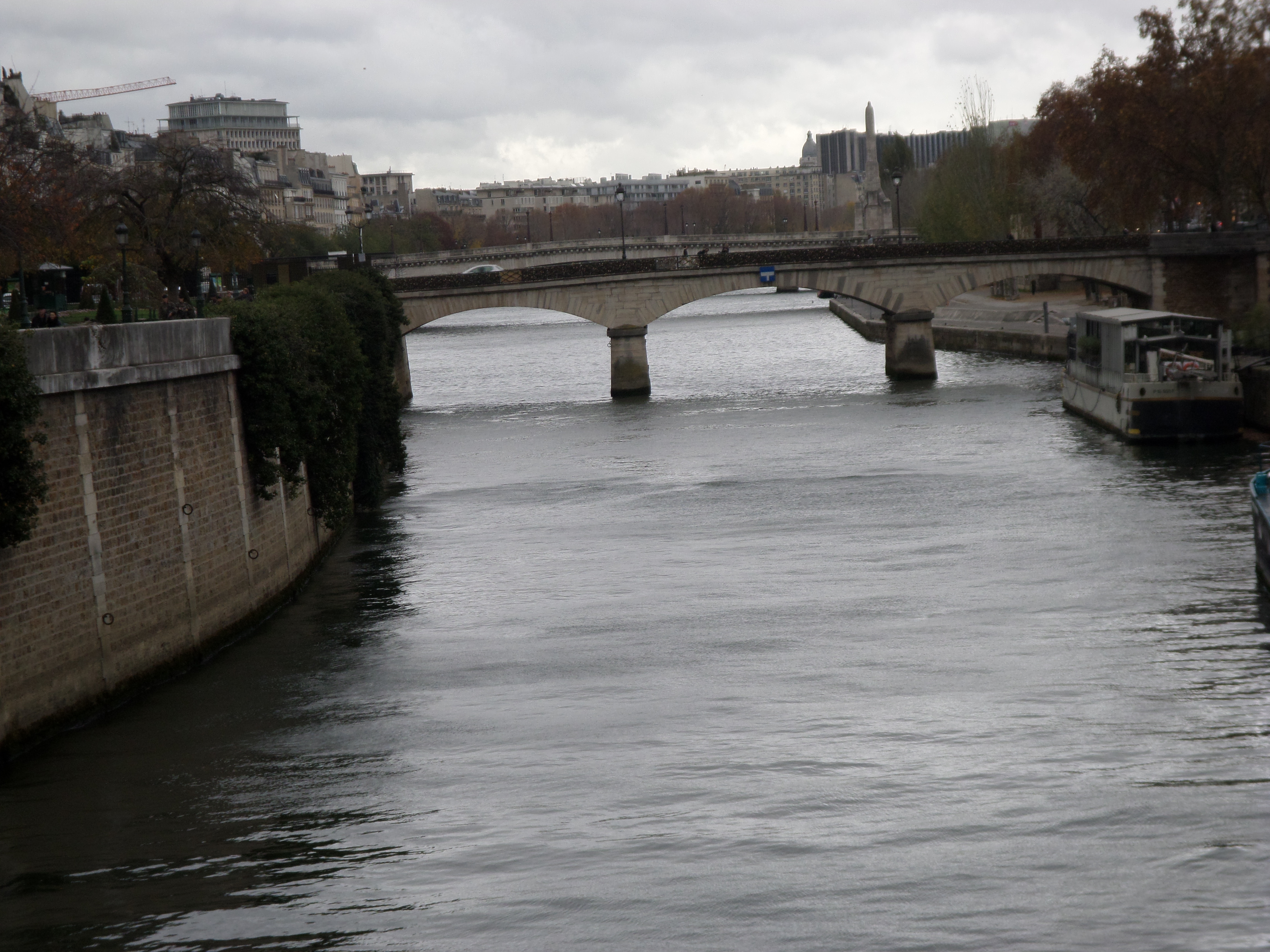
Then he tells you about an incident that happened late one night in Paris while crossing the Seine on the Pont Royal on his way home from seeing his mistress. He comes across a woman dressed in black leaning over the edge of the bridge. He hesitates a moment but continues on his way. He had walked only a short distance when he heard the distinct sound of a body hitting the water. Clamence stops walking, knowing exactly what happened, but does nothing. The sound of screaming was repeated several times as it went downstream, then it ended. He continued on his way home doing nothing.

23661115021_688e446188_o

The Seine River, Paris, France. Photo: Benn Bell

This incident haunted Clamence throughout the rest of the novel and weighed heavily on his mind. There were a couple of other incidents that occurred that brought Clamence to the realization that he had actually lived a life seeking honor, recognition, and power over people. He was, in short, a hypocrite. Having come to this realization he knows he can no longer live the way he once lived. These factors precipitated his fall from grace and led to how he landed in Mexico City in the red light district of Amsterdam in the last circle of hell.

SAMSUNG CAMERA PICTURES

Bridge over the Seine River, Paris. Photo: Benn Bell

Clamence responds to his intellectual crisis by withdrawing from the world. He closes his law practice, avoids his former colleagues and people in general and throws himself into debauchery, which he describes in the absence of love is a suitable substitute. “True love is exceptional – two or three times a century, more or less. The rest of the time there is vanity or boredom.”

SAMSUNG CAMERA PICTURES

St Michael’s Fountain located in the neighborhood where Clamence lived in Paris.  Photo:  Benn Bell

“There is a certain degree of lucid intoxication, lying late at night between two prostitutes and drained of all desire, hope ceases to be a torture, you see the mind dominates the whole past and the pain of living is over forever. I went to bed with harlots and drank nights on end.  Sensuality dominated my love life. I looked merely for objects of pleasure or conquests.  For a ten-minute adventure I’d have disowned father and mother…I can’t endure being bored and appreciate only diversions in life… I have never been bored with women. I’d have given ten conversations with Einstein for an initial rendezvous with a pretty chorus girl.”

He thought for a while about joining the French Resistance, for this during the time of war, but decided against it as it was not suitable to his temperament. He preferred the “heights” and could not see himself part of a movement situated somewhere in a “cellar for days and nights on end with some brutes coming to haul me away from hiding, undo my weaving, and then drag me to another cellar and beat me to death.” He joins the army instead, gets captured by the Germans in Tunis, and is interred in a concentration camp in near Tripoli. Here he is elected to the position of “pope” by the other inmates and holds this position of power for a while. He drinks the water of a dying comrade, oh well, he was going to die anyway, and I needed to stay strong to survive to carry on continue to do more good, or at least that is how he rationalized it. He was eventually released and made his way to Amsterdam.

Foggy amsterdam

Foggy Amsterdam

On the way home, walking through the streets of Amsterdam, Jean-Baptiste Clamence tells you stories. He says he lives at the site of one of the greatest crimes of history, “the Jewish Quarter or what was called so until our Hitlerian brethren made room. What a clean-up! Seventy-five thousand Jews deported or assassinated: that’s real vacuum-cleaning. I admire the diligence, that’s methodical patience. When one has to apply a method. Here it did wonders incontrovertibly.”

Jewsish Quarter, Amstedam

Jewish Quarter, Amsterdam

He relates this story: “In my little village, during a punitive operation, a German officer courteously asked an old woman to please choose which of her two sons would be shot as hostage? Choose! – Can you imagine that? That one? No, this one. And see him go. Let’s not dwell on it.”

Another story: “I knew a pure heart who rejected distrust. He was a pacifist and libertarian and loved all humanity and all the animals with an equal love. An exceptional soul, that’s certain. Well, during the last wars of religion in Europe he had retired to the country. He had written on his threshold: ‘Wherever you come from, come in and be welcome.’ Who do you think answered that noble invitation? The militia, who made themselves at home and disemboweled him.”

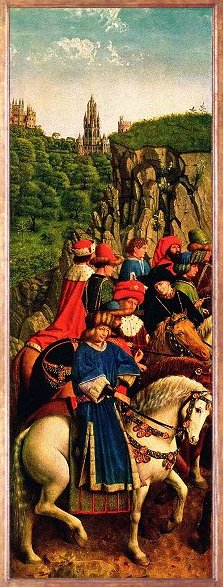
Jean-Baptiste Clamence’s final monologue takes place in his apartment. There he relates the story of how a famous 15th century painting came into his possession. One night a regular patron of Mexico City came into the bar with the priceless painting under his arm and offered to sell it to the bartender for a bottle of booze. It was hung on the back wall of the bar for some time until Clamence told the bartender the painting was in fact stolen and that police from several countries were searching for it. He offers to keep it for him and the bartender readily agrees.

just judges

The Just Judges

The painting is a panel from the Ghent Altarpiece known as The Just Judges. Clamence takes from this image the idea to identify himself as a “judge-penitent.” As a judge-penitent freedom is relinquished as a method of enduring the suffering imposed on us by virtue of living in a world without objective truth, and one that is therefore, ultimately meaningless. A judge-penitent confesses his sins so that he has the right to judge others.

The following snippets from the novel are spliced together and presented to you to give you a further flavor of the horror of the piece and are better told in the author’s own voice:

“I need your understanding. I have no friends, only accomplices.

The question is to slip through and, above all – yes above all, the question is to elude judgement. But one cannot dodge it so easily. Today we are always ready to judge as we are to fornicate.

People hasten to judge in order to not to be judged themselves.

The idea that comes naturally to man is his innocence. We all like that little Frenchman, Buchenwald, who was interested in registering a complaint with the clerk, himself a prisoner, who was recording his arrival. A complaint? The clerk and his comrades laughed: “Useless old man, you don’t lodge a complaint here!” “But you see sir,” said the little Frenchman, I am innocent!” We are all exceptional cases.

Let me tell you of the little-ease. I had to submit and admit my guilt. I had to live in the little-ease. To be sure you are not familiar with that dungeon cell that was called the little-ease in the middle ages. In general, one was forgotten there for life. That cell was distinguished from others by ingenious dimensions. It was not high enough to stand up nor yet wide enough to lie down in. One had to take an awkward manner and live on the diagonal. Sleep was a collapse, and waking a squatting. Every day, through the unchanging restriction that stiffened his body, the condemned man learned that he was guilty and that innocence consists in stretching joyously…we cannot assert the innocence of anyone, whereas we can state with certainty the guilt of all. I’ll tell you a big secret. Don’t wait for the Last Judgement. It takes place every day.”

“Do you know why he (Christ) was crucified? He knew that he was not altogether innocent. If he did not bear the weight of the crime he was accused of he had committed others – the slaughter of the innocents, the children of Judea massacred while his parents were taking him to a safe place. Why did they die if not for him? Those blood splattered soldiers, those infants cut in two filled him with horror…it was better to die, in order not to be the only one to live…he cried aloud his agony and that’s why I love him.

Since we are all judges, we are all guilty before one another.

A person I know used to divide human beings into three categories: those who prefer having nothing to hide, rather than being obliged to lie, those who prefer lying to having nothing to hide, and finally those who like both lying and the hidden. I’ll let you choose the pigeon hole that suits me.

But, let’s not worry! It’s too late now. It will always be too late. Fortunately!”

 Conclusion

What is Camus telling us in this extraordinary novel? First of all, it is a novel of confession. The stories he tells his interlocutor are a confession. Jean-Baptiste Clamence says that one cannot die without confessing all one’s lies. It is also a novel about guilt: “I always hope my interlocutor will be a policeman and that he will arrest me for the theft of the Just Judges. Perhaps the rest will be taken care of subsequently; I would be decapitated for instance. I would have no more fear of death. I’d be saved. Above the gathered crowd. You would hold my still warm head so they could recognize themselves in it, and I could again dominate- an exemplar. I should have brought to a close, unseen, and unknown, my career as a false prophet crying in the wilderness.”

Clamence discovers he can’t condemn others without judging himself first. I am a judge-penitent, he says. The more I judge myself the more I can judge you. So, the idea is to heap judgments on himself in order to justify judging others. That’s why he is a judge. Someone who condemns others, but also a penitent, someone who recognizes and judges his own crimes. All men are guilty of something. We are guilty not only by our actions but by our inaction or our failure to act.

On the absurdity of existence Clamence tell us, “a single sentence will suffice for modern man: he fornicated and read the newspapers.  Each day hundreds of millions of men, my subjects, painfully slip out of bed, a bitter taste in their mouths, to go to a joyless work.”

As for Truth: There is no objective truth.

And the fall from grace: The fall always occurs at dawn.


Modern Man

Star Date 20172011

14523070_10153874772142036_7009905025567754053_n

T. S. Elliot said that copulation and death is what it’s all about. Camus said all that can be said of modern man is that he read the newspapers and he fornicated. Now that we no longer have newspapers what can we say? Man surfs the net and he….

Well you get the idea…

Are We Post Racism in America?

957894

I take my moral courage and imagination from Albert Camus. He informs my thinking at every turn. In his writings in Combat he speaks about French racism as it relates to her then held colonies. What he says is every bit as applicable to the deeply held racist views of certain members of our own Republican party (most notably the Tea Party) when they talk about illegal immigration. It is impossible not to denounce this stupid and criminal malady that has reared its ugly head during recent political discourse and the debates.

Instead of focusing on what separates us from our Latin and Muslim brothers and sisters, let us focus on what unites us as people. There is something in each of us that cannot be despised without debasing ourselves. “It is necessary to state clearly that these signs of racism point to what is abject and senseless in the human heart. Only when we have vanquished that flaw will we win the difficult right to denounce tyranny and violence wherever it arises.”

December 26, 1944

The Pope has just delivered a message in which he openly states his support for democracy…We have been waiting many years for the leading spiritual authority of the day to condemn dictatorship in no uncertain terms. We have been waiting all this time for someone to speak out and clearly identify the sources of evil as the Pope has now done. We wished for this to be said when evil reigned triumphant and the forces of good remained muzzled.

We would have liked to see the Pope disavow Franco in 1936. We would have liked the Pope to have taken a stand at the height of that shameful period and denounce what needed to be denounced. It as wrenching to think the Church left that obligation to others.

957894

At least we have this message. Our world does not need tepid souls. It needs burning hearts. The Christians of the first century were not moderates.

-Albert Camus writing in Combat in 1944.

Take Me to Paris

The place I would most like to be transported to is Paris in the 1920’s- 1940’s. The time and place where Ernest Hemingway lived as a young man and wrote A Movable Feast. I would like to be part of the group that surrounded Jean-Paul Sartre, Simone de Beauvoir, and Albert Camus during the time of post war France when they were trying to re-establish French civil society as was depicted in The Mandarins. This is where and when I would most like to go.