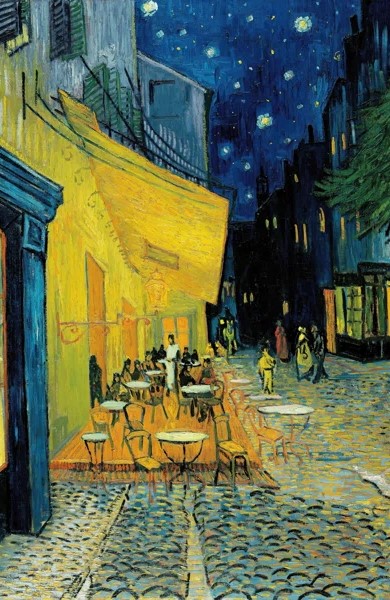
This is Vincent van Gogh’s Café at Night. I had a print of this for years hanging in my bedroom when I lived in Philly. I always liked it, but never really had a deep understanding of what it was about until recently.
During his nearly fifteen-month stay in Arles, Vincent van Gogh created this depiction of the Café de la Gare, an all-night establishment on the city’s Place Lamartine. With varying reds and greens, as well as saturated yellows applied in thick patches, the artist sought to convey—as he wrote to his brother Theo—“the terrible passions of humanity.” For van Gogh, these clashing colors not only evoked an aura of restlessness, but they also expressed “an idea that the café is a place where one can ruin oneself, go mad, or commit a crime.”
But there is something more. There are 12 figures sitting under the light in the café. The central figure is dressed in white. Behind this figure, you can make out the shape of a cross. This is Van Gogh’s interpretation of the Last Supper. Christ is the central figure, and the figure leaving the scene is Judas.
When I heard this interpretation, I experienced an aha event. A little satori in the evening of my discontent.

