One Battle After Another

Movie Review

The revolution will not be televised.

The film’s title is taken from a 1969 statement from the revolutionary political group The Weather Underground that was published in an issue of New Left Notes, a left-wing periodical from the Students for a Democratic Society. The statement read: “From here on out, it’s one battle after another – with white youth joining in the fight and taking the necessary risks. Pig Amerika beware. There’s an army growing in your guts and it’s going to bring you down.” The first and last sentences of this statement are both used in dialogue in the first act of the film.

This is the film we need to see now. A revolution is coming to America, and it won’t be pretty. Paul Thomas Anderson has taken a book that was written by Thomas Pynchon and created a masterpiece of the cinema. The acting, writing, and direction are all superb. The cast includes three Academy Award winners: Leonardo DiCaprio, Sean Penn, and Benicio Del Toro. The movie has a Tarantino-esque quality to it, and it pays homage to the movie Bullitt, starring Steve McQueen, featuring one of the most exciting chase scenes I’ve seen since 1968, featuring a Mustang pursuing a Charger in bright California sunlight with cinematic elevation changes.

If you care about anything about movies or America, go see this movie now!

The Yards (2000)

Movie Blurb

I’ve been watching the James Gray New York Collection on the Criterion Channel. I can’t believe how good they are. I’ve seen a couple in the past like The Immigrant and We Own the Night, and I remember them to have been quite excellent. I don’t know how I missed some of these other little gems like Little Odessa and The Yards, which I watched last night. Outstanding performances by an ensemble cast including Mark Wahlberg, Joaquin Phoenix Charlize Theron, James Caan, Faye Dunaway, and Ellen Burstyn. I will continue to watch the rest of the collection. I enjoy the character-driven stories taking place in a city that I love, New York, which has a character all its own.

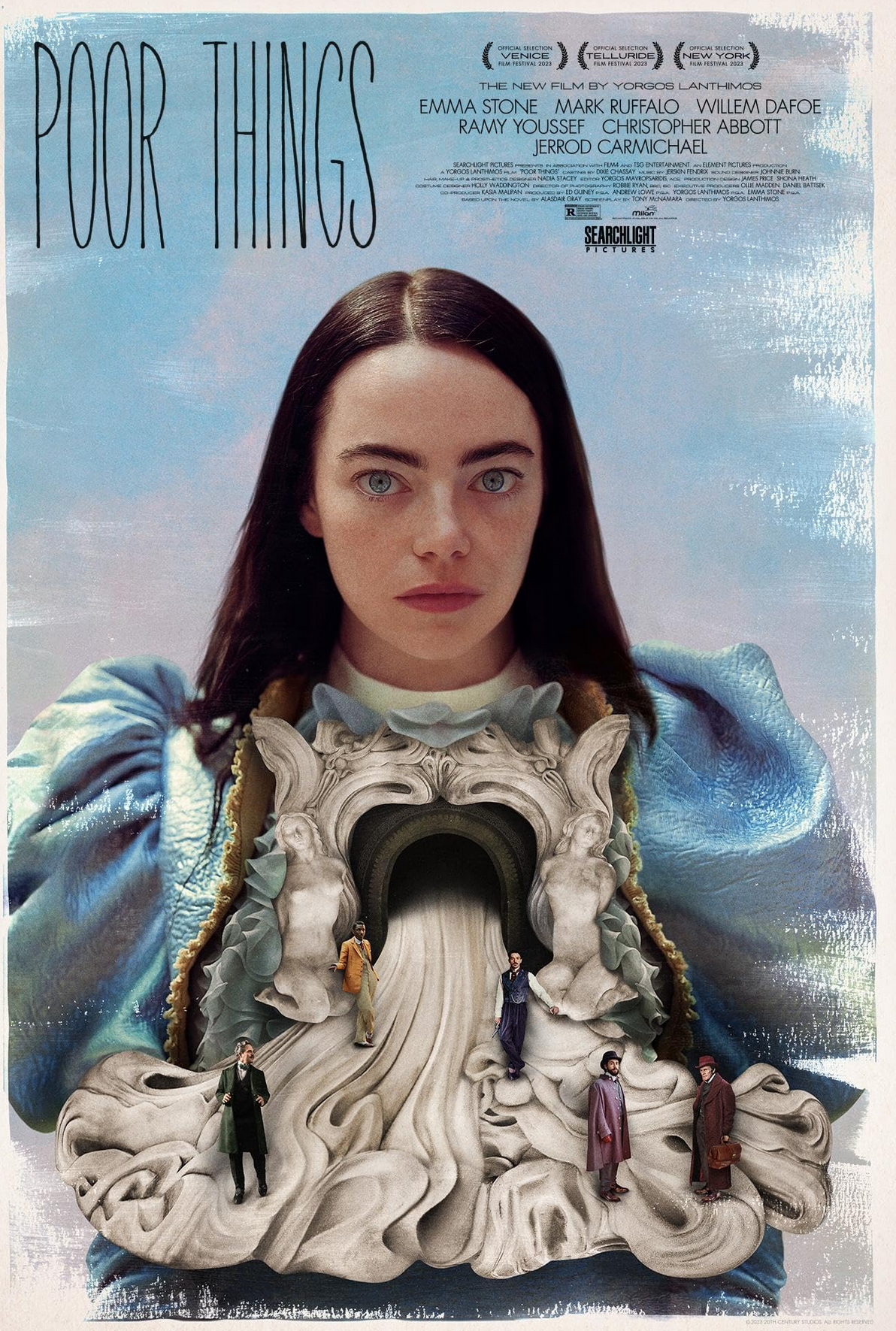
Poor Things (2023)

Movie review

Poor Things is a cross between Frankenstein and Alice in Wonderland. One of the most original and freshest films I have seen in a long while. Emma Stone is a wonder as Bella Baxter. She fearlessly portrays the evolution of the creature animated by the mad scientist Dr. Godwin Baxter, played brilliantly by Willem Defoe. Mark Ruffalo shines as the nefariously debauched lawyer Duncan Wedderburn who whisks Bella away on a journey across the continents only to be quickly ditched by her as she outgrows him.

The story has as many twists and turns as a rabbit hole as it depicts Bellas’s evolution and sexual awakening. Poor Things is a feminist tale writ large.

Visually stunning sets and costumes are a feast for the eye that combines unusual Victorian features with a sci-fi futuristic look that dazzles.

Directed by Yorgos Lanithmos, who brought you The Lobster and The Killing of a Sacred Deer. This guy is quickly becoming one of my favorite directors.

This one will be hard to beat. I give it my highest rating. Definitely the best movie in 2023 in a field of hot competitors. Best seen on the big screen.

Jeanne Dielman, 23, quai du Commerce, 1080 Bruxelles (1975)

Movie Review

Jeanne Dielman, 23, quai du Commerce, 1080 Bruxelles (1975)

Extraordinary film exceedingly slow but fascinating to watch. In fact, you can’t seem to take your eyes off it while waiting for something to happen. To say Jeanne Dielman lives a life of deadly routine would perhaps give too much away. I loved the use of the static camera as she walked in and out of the frame turning lights on and off as she went from room to room. There is one moment of stark reality which brings one back to one’s senses and brings unity to the entire affair. An unusual film, but a must-see, for all film buffs.

OPPENHEIMER

Film Review

“Prometheus stole fire from the gods and gave it to man. For this, he was chained to a rock and tortured for eternity.”
“I am become death, the destroyer of worlds”
These are two tag lines from Christopher Nolan’s excellent Bio-pic, Oppenheimer, which I saw yesterday. Perhaps the best and most important film made in the last 100 years That is to say, ever! Must see in IMAX! Highest quality, both for sound and visuals. It was like being on acid without the acid. The acting was superb. Cillian Murphy was excellent as Oppenheimer and Robert Downey Jr. gave perhaps the best performance of his career. One should never forget two things. There are warring nations on Earth right now that have nuclear weapons capable of destroying the world and wiping out civilization. And the other thing is The United States is the only country in the world to drop an atomic bomb on another country. The targets were cities populated by civilians. It is debatable whether this heinous act saved lives or ended the war. But one thing for sure is that tens of thousands of people were instantaneously incinerated and thousands more died of radiation poisoning. This is a heavy burden to carry as an American and as Oppenheimer himself said, we have blood on our hands. Go see this movie!

Tar

Movie Blurb

I had an interesting discussion last night with my family on the Movie Tar. The movie, starring Cate Blanchett, is about a female conductor who rose to the heights of her profession, abused her power, and had a precipitous fall from grace. I have watched this difficult movie twice and must confess I found it quite fascinating.

My granddaughter, who is a musical conductor herself, hasn’t seen it. She said she didn’t want to see a film that disparages her chosen field. Her husband watched it and said he liked it. My brother-in-law said there was no one to like in this film. My sister said that the woman on whom the film was based said it was an inaccurate portrayal of her and her profession. Well, it was a fictional character. Actually, she said the film was anti-woman.

I have a little different take. I believe the film was about “cancel culture” and the current #MeToo movement which seems to be pervading the art world lately and is a cautionary tale to be not too quick to “cancel” artists and their great works which would be tantamount to erasing history. Miss Blanchett in a recent interview about the subject gave Picasso as an example. There were probably a lot of things going on around his studio but who can deny the power and majesty and sheer genius of Guernica?

These ideas are well worth thinking about.

Your thoughts?

Is that a Dagger I See Before Me?

The Tragedy of Macbeth (2021)

Denzel Washington and Frances McDormand in “The Tragedy of Macbeth,” Courtesy of Apple/A24

Macbeth, directed by Joel Coen and shot entirely on a sound stage, was certainly a sight to behold. It was filmed in luscious black and white giving the movie an instant classic look and taking the viewer out of the realm of reality and plunging them straight into the surreal and pathological world of the Thane of Cawdor.    

This was Joel’s first foray into film without his brother Ethan at his side and what a miracle of rare device it was. With his emphasis on camera angles, close-ups, medium shots, long shots, and long and dark shadows, I was reminded of past movies of film noir and German expressionism, such as the films of F. W. Murnau, Fritz Lang, and Orson Welles. The aspect ratio of 1.37:1, almost square, recalls the classic films of old.

The performances by all the actors were uniformly excellent. Frances McDormand put in a very solid performance as Lady Macbeth. One might quarrel with her interpretation but really, I don’t see how it could be improved. I thought Denzel Washington excelled in his role as Macbeth and both actors played well together. I loved what Coen did with the weird sisters, all three played by the diminutive Kathryn Hunter.

The overall piece was visually stunning, full of sound and fury, and filled with an abundance of symbology.

A very satisfying cinematic event. Highly recommend!

August Strindberg

Sunday. 2/6/2022. 2:58 pm Riot Café. Reading August Strindberg – Miss Julie and Other Plays. Notes to follow.

Riot Café. Photo by the author

The Red Room, A satirical novel written by Strindberg in 1879. It is not a far cry to go from Red Room to Redrum to Murder. Just saying.

“Strindberg’s naturalism is not a slice of life, but rather the intense, immediate drama associated with what he called, ‘the battle of the brains.’ This is fought, not with theatrical swords or daggers, but with the equally lethal mental cut and thrust of two implacably hostile minds, bound to each other by desire and hatred. It is a battle in which one of them ultimately destroys the other’s will and commits ‘soul murder.’” One is immediately put in mind of Edward Albee’s, Who’s Afraid of Virginia Woolf?

Indeed, Translator Michael Robinson makes the very same observation writing about, The Dance of Death, a play written by August Strindberg in 1900, as a depiction of a marital inferno. He cites the numerous critics who regard it as the forerunner to Eugene O’Neill’s, Long Day’s Journe into Night and Edward Albee’s, Who’s Afraid of Virginia Wolf?

Why read Strindberg today? Because he is as relevant today as he was in 1887.

Strindberg was one of the most extreme theatrical innovators of the late 19th century and ultimately the most influential. The five plays presented here mark his transition from naturalism to modernism.

In The Father, Strindberg shifts away from social and political questions towards more psychological writing. Strindberg was more concerned with the discussion going on in Scandinavia at the time about the “woman question,” sexual morality, marriage, and the shifting psychological states of his characters (Robinson).

The Father is a three-act play with eight characters. The two principal characters are the Captain and his wife, Laura. It is a naturalistic tragedy about the struggle between parents over the future of their child.

The Captain is a scientist and freethinker whose marriage has gone south. He is engaged in a power struggle with his wife, Laura, over their daughter who wants to keep the girl home under her own influence whereas he wants to send the girl away to school. In an attempt to dominate her husband and get her way, Laura decides to drive her husband insane by first insinuating that he is not the girl’s father. The mother (Laura), uses her cunning to subdue and finally destroy the father (The Captain).

Strindberg is a great purveyor of naturalism, but in The Father, he is reaching for “greater naturalism” which is intense, immediate, and associated with a battle of the brains. (Battle of the sexes, battle of wills). The two main characters can be seen as representing the male and female principles.             

Strindberg believed that life is a series of struggles between weaker and stronger wills.

What initially brought me to revisit Strindberg were the films of Ingmar Bergman. Always a big fan of Bergman I began to realize what an influence Strindberg had on the filmmaker. I began to do a little research and it turns out in his lifetime Bergman directed eleven Strindberg plays for the stage, eight for radio and two for television. He was responsible for altogether twenty-eight Strindberg productions. He often returned to the same plays, producing A Dream Play and The Ghost Sonata four times, The Pelican three times and Miss Julie, Playing with Fire and Stormy Weather twice.

My favorite Bergman movie is The Seventh Seal. It has many similarities to the play, The Saga of the Folkungs. They are both set in the 14th century, the plague is present and religion is a major component.

Sources:

  1. Michael Robinson, Translator, Introduction and Notes to Miss Julie and Plays by August Strindberg.
  2. Strindberg and Bergman, Egil Tornquist, November 2012

Nomadland (2020)

Movie Review

Nomadland (2020)

Directed by Chloe Zhao, starring Frances McDormand, David Strahairn, Linda May

This is a movie about America. There are two Americas. The haves and the have nots. This about the have nots who choose a life on the open road and freedom. It is not a life I would choose but it is a fascinating portrait of those who do. They are called American Nomads.

Frances McDormand turns in another brilliant but understated performance as Fern, the strong and determined woman, who takes to the open road after she loses her job at US Gypsum, a plant where she and her husband, who has recently died, had worked for years. The plant closing in Empire, a small town in Nevada, causes the economic collapse of the town. This is the sad reality of so many small towns in America.  

Fern sells her stuff and buys a van and takes to the road searching for work. She outfits the van to live in. She first takes a seasonal job at an Amazon fulfillment center through the winter. Whenever I buy anything at from Amazon, I cringe a little bit thinking of the workers at the fulfilment center, although Fern seems to thrive in this environment. A co-worker invites Fern to visit a desert winter gathering in Arizona organized by Bob Wells, which provides a support system and community for fellow nomads. At the gathering, Fern meets fellow nomads and learns basic survival and self-sufficiency skills for the road.

Fern later takes other jobs down the road: an RV camp host, a worker in a beet harvest, and a worker in a fast-food restaurant. It is a tough life living at the margins. She continues to run across some of the other nomads she has met along the way as she continues her travels and they become her friends and kind of a family or tribe. She does have a chance to settle down a couple of times along the way but continues to choose a life on the road to be free and independent if, lonely.

There is not much of a dramatic story here, more of a character study and a documentary on the nomadic existence in America. Even if we can’t identify with her way of life we can empathize with her very human feelings of loneliness and her desire to be free. As Bob Wells so aptly put it, “I’ll see you down the road.”

Judas and the Black Messiah (2021)

Movie Review

LaKieth Stanfield in Judas and the Black Messiah

Directed by Shaka King, starring: Daniel Kaluuya, LaKief Stanfield, Jessie Plemons.

Judas and the Black Messiah (2021) is an important movie about a chapter of the Black Panthers in Chicago and the charismatic leader who led it, Fred Hampton. Part documentary and part bio-pic it delivers a history lesson on that volatile period in America when race relations were at an ebb. It is an interesting juxtaposition of events to the events happening today when once again the tension between the races is at a snapping point. The organization Black Lives Matter draws eerie parallels to The Black Panther Party.

The Messiah in this case is Fred Hampton, played by Daniel Kaluuya in a resplendent performance. Two other black messiahs who came before him were scarified on the altar of white supremacy, Martin Luther King and Malcom X. His betrayer, or the Judas of the title, is FBI informant William O’Neal (LaKieth Stanfield) who infiltrated the Black Panthers and gained the trust of Hampton. It was O’Neal who provided the layout of the apartment to the FBI which was crucial information that led to his assassination by the FBI and the Chicago police.

When law enforcement entered the apartment on Monroe Street where Fred was sleeping guns blazing, I was put in mind of the Breonna Taylor case where Louisville police officers entered her apartment while she was asleep on a “no knock” warrant and assassinated her. Police brutality and extra-judiciary killing continue to be a problem for the black community to this day.

Fred Hampton’s rhetoric was indeed inflammatory but he never actually declared war on the United States. He merely threatened the status quo. FBI director J. Edgar Hoover wanted get rid of Hampton because  he thought the rise of another black messiah would unify and electrify the militant nationalist movement. Fred Hampton was an upstart crow, but he didn’t deserve to die. The FBI now has other fish to fry with the rise of white nationalism, which poses an even graver threat to American security.

LaKieth Stanfield was excellent as the informant William O’Neal delivering a nuanced performance of an underwritten part. Dominique Fishback as Deborah Johnson, Hampton’s coworker and eventual lover I thought was particularly good and Jesse Plemons as the baby-faced FBI agent who compromised O’Neal into betraying Hampton, played his part with equal parts menace and moral queasiness.

Excellent movie. Highly recommend!