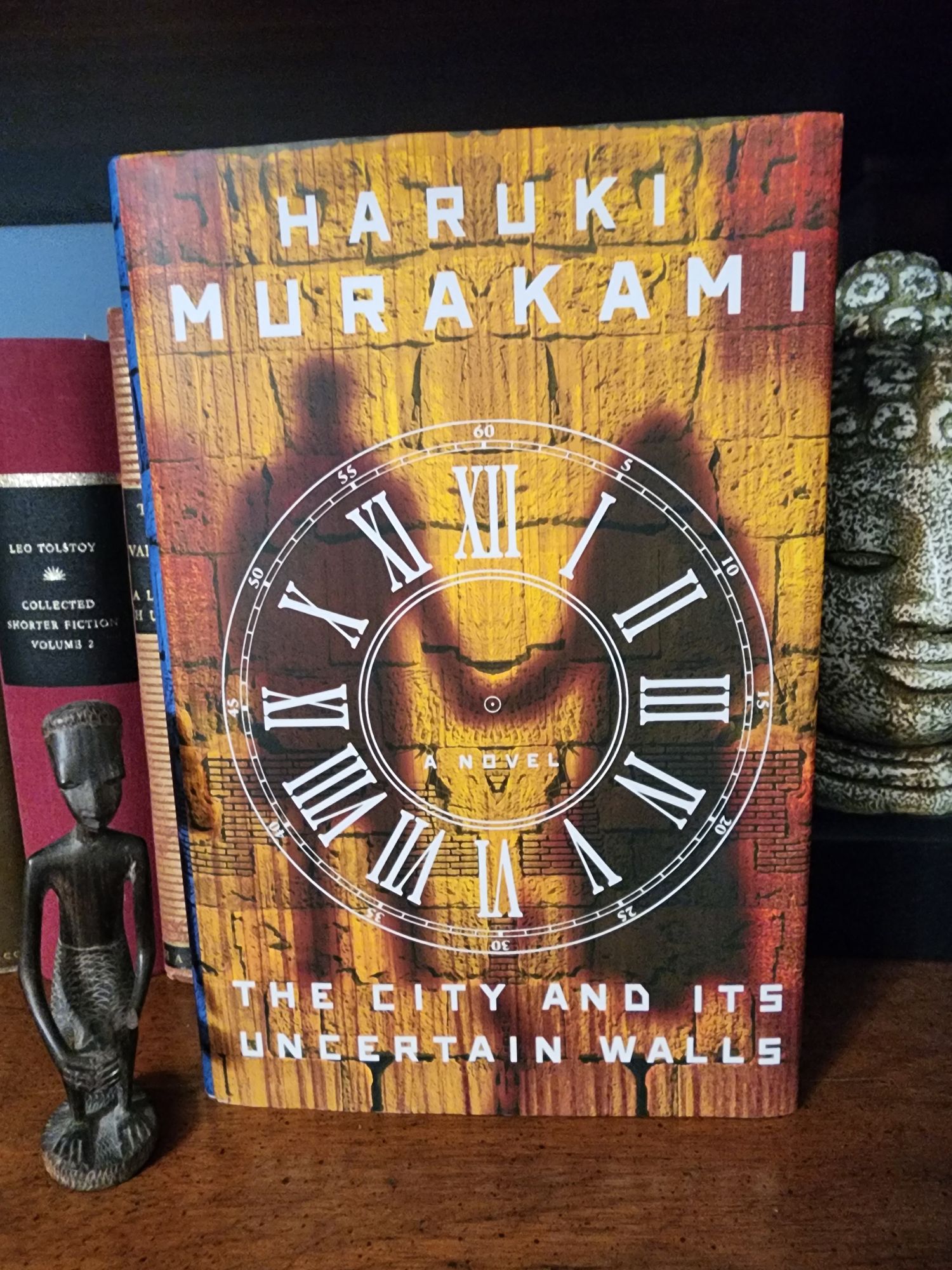
“The City and Its Uncertain Walls” by Haruki Murakami is a richly imagined and thought-provoking narrative that explores the themes of isolation, identity, and the complexities of urban life. This is a take-off from another of his novels, “Hard Boiled Wonderland and the End of the World”. If you drill deeper into the history of this novel, you will find a short story or novella that Murakami wrote early in his career that he was unsatisfied with. I think he may have achieved perfection with this latest iteration.
In this book, Murakami masterfully constructs a labyrinthine cityscape that serves as a mirror to the inner worlds of its inhabitants. The protagonist, whose name remains undisclosed, journeys through this enigmatic urban sprawl, encountering a myriad of characters who each add a layer of complexity to the narrative. Their stories intertwine, creating a tapestry of human experience that is as fragmented as it is compelling.
The protagonist’s quest for meaning and connection is punctuated by encounters with figures such as a reclusive artist, a disillusioned academic, and a mysterious woman who seems to hold the key to the city’s secrets. Each of these individuals grapples with their own existential dilemmas, reflecting the broader themes of isolation and identity that pervade the novel.
Murakami’s prose is both lyrical and haunting, imbuing the city with a sense of melancholy beauty. The walls that encircle the city are not just physical barriers, but also metaphors for the psychological and emotional confines that the characters must confront. The walls seem to be alive and have a life of their own as they change slightly from day to day and represent for me a sense of consciousness. They are interior walls as well.
The novel is essentially a ghost story. We don’t realize this until we are well into the narrative. Murakami is a master of magical realism, and he refers to the magical realism of Gabriel Garcia Marquez in his telling of the tale.
Through the struggles of the various characters, the narrative probes into what it means to seek freedom and understanding in a world that is perpetually uncertain.
Some authors’ voices are missed when absent for a while. Murakami is one such author. I return to him again and again.
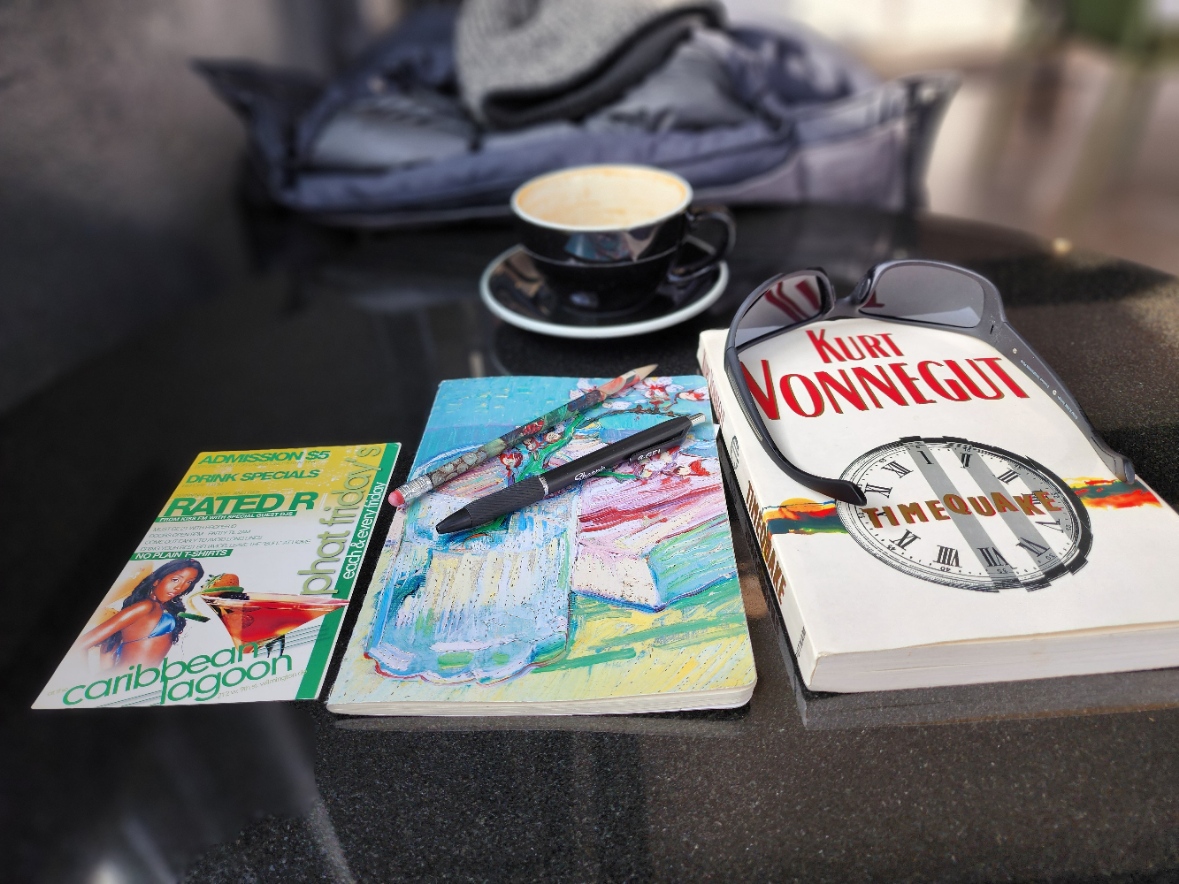
Timequake is a novel about free will. Vonnegut freely intersperses throughout the novel his own stream of consciousness. Oh, and there is also his alter ego, Kilgore Trout, who exclaims, “Oh Lordy, I am much too old experienced to start playing Russian Roulette with free will again.”
The premise of Timequake is that a Timequake, a sudden glitch in the time-space continuum, made everybody and everything do exactly what they’d done during the past decade a second time. It was déjà vu all over again for 10 years. The timeframe Vonnegut chose was February 13, 2001 – February 17, 1991. The Timequake would zapp everyone back in an instant to 1991. They had to “live” their way forward to 2001. Or you might say, back to the future again. Only when people got back to 2001 did they stop being robots of their past. Kilgore Trout would say, “Only when free will kicked in could they stop running an obstacle course of their own construction.” Free will. That is what the novel is about. Do we have it or not? That is the question. You would think that because the author mentions “when free will kicks back in” some 20-odd times he was arguing for free will. But no! Not so fast! I’m not so sure.
Other pithy comments by Kilgore Trout would include, “If brains were dynamite, there wouldn’t be enough to blow your hat off!” and “Ting-a-ling, you son of a bitch!” which is the punch line to a variation on a joke having to do with Chinese doorbells.
So, it goes.
Vonnegut goes on to say, in his own peculiar voice, that writers of his generation had reason to be optimistic because of things like the Magna Carter, the Declaration of Independence, the Bill of Rights, The Emancipation Proclamation, and Article XIX of the Constitution giving women the right to vote. He advocated for two more amendments that he would like to add: Article XXIII: Every newborn shall be sincerely welcomed and cared for until maturity. And Article XXIX: Every adult who needs it shall be given meaningful work to do at a living wage.
Another pithy saying he was fond of throwing around was, “I never asked to be born in the first place!”
It took me quite a while to get around to reading Herzog. It has been sitting around in my personal library since 1985 when I purchased it in a used bookshop in Tulsa, Oklahoma. Since then, I and my books have moved around several times, but we have now finally come to rest in Louisville, Kentucky. Maybe we will be here a little bit longer. The book was published in 1964 and was awarded the National Book Award for Fiction. Bellow, himself, won the Nobel Prize for Literature in 1976.
I have been reading Bellow since the 1970s and for a long time considered him to be my favorite author. Until Philp Roth came along and then I was in this author’s thrall for many years and stopped reading Saul. Much to my detriment, I may add, but now I happily return to Saul Bellow in this wonderful book, Herzog.
Herzog is a classic novel that explores the existential crisis of a middle-aged man who is dissatisfied with his life. The protagonist, Moses Herzog, a middle-aged intellectual living in Chicago is a writer and a thinker, grappling with personal and philosophical questions and writes letters to various people, both living and dead, as a way of coping with his failures and frustrations. The novel is a rich and complex portrait of a man who is searching for meaning and identity in a chaotic and absurd world. It is also very funny.
As I read this story, I couldn’t help but relate to the main character, Moses Herzog. His story deeply resonated with me, and I felt it was a bit synchronous with my own life. For example, Moses had lived in a small town in Massachusetts near Pittsfield. I lived in a small town near Pittsfield. Moses has an affair with a woman in New York while living and teaching in Philadelphia. I lived in Philadelphia and was having an affair with a woman from New York. Like Moses, I would travel back and forth between the two cities. Moses at one time had an Asian girlfriend. I was married to a Korean woman for 14 years. Moses was going through a second divorce as he tried to sort out his life and survive a midlife crisis. Been there, done that. And finally, at lot of the action takes place in Chicago, a city I love and adore.
One of the central themes of Herzog is identity. Moses Herzog is a character deeply rooted in his own sense of self, and the novel examines how he grapples with this identity in the midst of personal and societal turmoil. Herzog’s journey is marked by his attempts to make sense of his failed marriages, his complex relationships, and his role as a father. His introspection on his own identity is similar to the search for meaning that many other individuals undertake in their lives.
Spirituality is another significant theme in Herzog. The novel raises questions about the nature of faith and belief. Herzog’s exploration of spirituality is a deeply personal one, as he grapples with the concepts of God and meaning. He is a secular man, yet he contemplates the existence of a higher power and the role of religion in human life. This internal spiritual journey is one that many people undertake in their search for purpose and transcendence.
Saul Bellow’s prose is rich and thought-provoking. He skillfully weaves together Herzog’s reflections with vivid descriptions of the world around him. Bellow’s writing captures the essence of the mid-20th century and provides a snapshot of American society at the time, with its cultural and intellectual upheavals.
The character of Moses Herzog himself is a complex and deeply human protagonist. He is flawed, struggling, and as I said earlier deeply relatable. His journey of self-discovery and reflection makes Herzog a timeless tale that continues to resonate with readers today. It did with me.
The Zone of Interest, by Martin Amis, is a provocative and disturbing examination of one of the darkest periods in human history. I ran across this book while reading another Martin Amis book, Inside Story. Inside Inside Story, Amis discusses how he came to write and publish TheZone Of Interest. What caught my interest was the critical reaction to the book. It seems you can’t interject humor into an account of the horrors of the Holocaust. Imagine that. Well, I needed to see what the fuss was all about, so I set about to find said tome which wasn’t easy as it was out of print. Amazon didn’t have it. Half Price Books didn’t have it, and Barnes and Noble didn’t have it. I was left with having to scour the used bookstores of the nation. Finally, in a little bookshop in Chicago, I found it and sent in my order straight away. In a few days, it arrived on my doorstep in pristine condition. Needless to say, by the time it got there my interest level was elevated.
Amis tells the story of the Holocaust from the perspectives of each of the three main characters living in and operating a death camp at Auschwitz. This camp is the “Zone of Interest” from the title of the novel. Using this narrative technique Amis gives us a clear view of the atrocities occurring daily in the concentration camp. The story unfolds primarily through the viewpoints of Angelus Thomsen, a high-ranking Nazi officer; Paul Doll, the camp commandant; and Szmul, a Jewish inmate forced to work in the camp’s Sonderkommando. There is a love story attached that involves Thomsen and the commandant’s wife, Hannah Doll. It is unrequited but carries much of the weight of the novel. This story serves to illustrate the blurring of the lines between victim and perpetrator.
Jewish “evacuees” are brought by train to be used as forced labor or to be gassed, their remains incinerated and then buried in the disgusting-smelling Spring Meadow by the “sonderkommado.” Szmul is a sonder. He is Jewish and is allowed to live as long as he performs his service, but he knows his time is limited too. He describes himself and his crew as the saddest, most disgusting men in the camp. They work with the dead, with heavy scissors, pliers, and mallets. There are three reasons for them to go on living: first to bear witness, second to extract mortal revenge if possible, and third to save a life from time to time to time, mostly young Jewish males.
Amis’ writing style is both terrifying and moving as he describes the brutality and horror of the camp. There are moments of dark humor and absurdity which I found to be quite appropriate. The juxtaposition of horror and humor produces a shroud of surrealism that makes one think about the moral and ethical implications elicited from the Holocaust. Amis incorporates many German words and phrases into the narrative giving one a sense of verisimilitude. I am reminded of Anthony Burgess’ Clockwork Orange where he created an entirely new language composed of both English and Russian and combinations of the two.
Zone of Interest is an examination of what Hannah Arendt described in her book Eichman inJerusalem as the “banality of evil.” Amis portrays characters going about their daily tasks in the camp as if they were managing any other administrative task. This chilling portrayal underscores the idea that ordinary people can become complicit in unimaginable atrocities under the right circumstances.
Zone of Interest is a challenging and haunting novel that offers a unique perspective on the Holocaust. Through its complex characters, dark humor, and unflinching portrayal of life in Auschwitz, the book forces readers to confront the darkest aspects of human nature and the enduring questions of morality and complicity. This powerful book has stayed with me long after I read it and is, I think an important contribution to the literature of the Holocaust.
The Old Absinthe House, one of the venues depicted in the novel. Photo by the author.
Take a deep dive with me to the bottom of The Gulf of Mexico as we explore along with Bobby Western the depths of the human consciousness.
Cormac McCarthy’s, The Passenger starts off with a mystery as Bobby Western, a deep sea salvage diver, explores a downed plane in the Gulf of Mexico off the Mississippi coastline. He and his friend Oiler find the plane submerged under 40 feet of water and all of the passengers onboard are dead and one is missing. Also missing is the black box. This missing passenger is the passenger from the title of the novel but we soon find that that is not what the book is about at all. Bobby is the actual passenger, as are we the readers, following along on Bobby’s journey into darkness.
We follow Bobby into the seedy bars on Bourbon Street in the City of New Orleans and meet a cadre of colorful characters from blue collar workers in the salvage business to street philosophers, transsexuals, race car drivers, mathematicians, physicists, and a Jewish private detective.
This is a novel of intrigue, paranoia, loss, grief and despair. It is also very funny with many moments of dark humor sprinkled throughout.
Bobby Western’s father worked with Oppenheimer on the atomic bomb for which he experiences generational guilt. His sister, Alicia, is a math wizard who is haunted by a crew of imaginary characters emanating from her schizophrenic mind. She is also a great beauty and Bobby is deeply in love with her.
The whole novel has a dreamlike quality to it but never fails to compel the reader to keep turning the pages to see what happens next.
This is perhaps McCarthys swan song and it echos much of his previous work. It is a tribute to a life well lived and a career well made. McCarthy has been compared to Melville, but I see traces of Beckett, and as another reviewer has pointed out, Kafka.
Much has been made of his signature style of no punctuation and a lack of tags for the dialogue. Sometimes one has to go back and reread a section to understand who it is talking. I found that to be true in this novel. But, I think the ambiguity is intentional on McCarthy’s part as it adds to the dreamlike quality of the work. Has written a prequel to this novel which acts as kind of a “coda” to The Passenger. I haven’t read Stella Maris as yet but when I do I expect it to give me a greater understanding of this one.
This book covers the waterfront on a variety of topics. Topics I am sure are McCarthys interests. He weaves them into the story in a very realistic, convincing and entertaining way. Here is a compendium of what his characters talk about or are involved in: Vietnam, the Kennedy assassination, a trans-woman, incest, food and wine, schizophrenia, philosophy, particle physics, mathematics, and paranoia.
McCarthy has a prose style that is incomparable to other modern day writers. His descriptions are sublime and memorable. Such as: “ The lamps had come on down Bourbon Street. It had rained earlier and the moon lay in the wet street like a platinum manhole cover.” Or: “…the tide pools stood like spills of blood.” Or: “ …sunrise. It sat swagged and red in the smoke like a matrix of molten iron swung wobbling up out of a furnace.”
All in all a fine read of a much anticipated novel that more than delivers on expectations.
There is so much going on these days that one feels whipsawed by the turn of events. While I don’t comment on everything, even though it is tempting, I feel that I would be remiss not to comment on the recent savage stabbing of author Salman Rushdie. In 1989 Iranian Supreme Leader Ayatollah Khomeini issued a fatwa against the famed author for alleged apostasy in his newly released book, “The Satanic Verses.” A fatwa is a sentence of death and a bounty of several million dollars was placed on Rushdie’s head. I protested then and I protest now, 33 years later. Also involved in the fatwa was anyone associated with the book including editors and publishers. At the time bookstores were afraid to display Rushdie’s books in their store windows. I called them out on their cowardice. I have my copy proudly displayed on my main bookcase in the living room of my home alongside my other “good” books.
To say this was a barbarous act of cowardice on the part of the would-be assassin would be an understatement. It deals a powerful blow to the right of free expression and free speech. It is anathema to our way of life in the free world and puts a chill in the air of artistic freedom. It demonstrates the complete absurdity and insanity of religious fanaticism. I hasten to add that it is a perversion of Islam and does not represent the mainstream which is by far more tolerant.
I believe in freedom of religion, and I respect everyone’s right to believe what they choose. But you don’t have the right to impose your belief on me or anyone else. You certainly don’t have the right to kill me if I don’t agree with you.
It looks like Mr. Rushie is going to pull through despite his many injuries. For that, I am very grateful and wish him the best and a speedy recovery, although there will be lasting effects from his injuries including the probable loss of an eye.
I condemn this senseless act of violence in the strongest possible way, and I trust his assailant will be held fully accountable. Meanwhile, “The Satanic Verses” is soaring on the charts.
I am doing a deep dive into Samuel Beckett, and I feel that I must come up for air. I can’t go on, but I must go on.
I just finished reading The Unnamable, the third novel in the trilogy after Molloy, and Malone Dies. There have been about 20 years intervening between each reading and I have read a lot of other books since including other works by Beckett.
The Unnamable is the story of the self that strives for silence but is obliged to go on. It is about three things: The inability to speak, the inability to be silent, and solitude. It is full of internal contradictions, doubt, and paradoxes.
I keep coming back to Beckett because something about his work resonates. Not only that but I came across an interesting tome by Paul Foster that analyzes Beckett’s work in terms of the “dilemma” presented in his work through the lens of Zen Buddhism. Wow! That is what I said. So, I read The Unnamable in preparation for Beckett and Zen, by Paul Foster.
One of the dilemmas alluded to in Beckett and Zen is the doctrine of grace: grace given, and grace withheld. St. Augustine tells the story of the two thieves that are crucified with Christ, one is saved, and the other is damned. How can we make sense of this division Beckett wants to know? There is a scene in Waiting for Godot where this theme is played out by the characters Vladimir and Estragon.
Then there is the dilemma of human reason confronted by an outrageous relentless irrationality, a universe giving birth to the spectacle of life, of which the main feature is suffering and death.
There is the problem of time which leads to decay and into the abyss. Personal identity and isolation and need I say, alienation?
Distress is at the heart of Beckett’s work which arises from a mental and spiritual confusion resulting from the recognition of the dilemma of existence.
The problem of God. Does God exist? If He does is He an all-loving God or a monster? And what about the Silence of God? Why don’t we hear from Him?
Beckett refers to a fundamental sound resounding in the universe that can only be described as a howl of pain.
That is enough for now. I think I have caught my breath and can now emerge from this rabbit hole that I seem to have fallen into and get about my day.
Spoiler alert! Plot point giveaways straight ahead!
She was discontent. She was married to a country doctor and lived in a small town in France not far from Rouen. Her husband would do anything for her and loved her dearly but he was just a country bumpkin and he bored her. Emma Bovary had two love affairs that did not end well and she ran her household into debt trying to buy gifts for her lovers and trying to keep up appearances. Then, when everything was about to come crashing down on her head and the creditors were at the door ready to repossess all her belongings, she ate a handful of poison and died a painful death. Her heartbroken husband followed soon thereafter and her little daughter wound up working in a cotton factory. A story that one might say had tragic dimensions.
Now, this all might seem rather straightforward, hackneyed, and mundane, but it is not so. One, it is a prototype for many stories just like it that were to be repeated again and again into the future. But, two, it is the writing style Flaubert engages in that holds our attention and keeps us turning the pages. The book has been called a masterpiece and for good reason.
I came upon this novel the same way I come upon so many things in life, by way of another novel: MyLife as a Man, by Philip Roth. In it, Roth refers to Flaubert again and again, quoting him liberally. For example, in a letter to his mistress, Colet, in 1853, which Roth cites as an example to his writing students, Flaubert writes the following: “What seemed to me to be the highest and most difficult achievement of art is not to make us laugh or cry, but to do as nature does – that is, fill us with wonder.” And that is exactly what Flaubert has achieved in this magnificent work, he has filled us with wonder. I was hooked and vowed to read Madame Bovary as my very next novel.
In his description of country life in the small town of Yonville, Flaubert has created some unforgettable characters and has given us a taste of what it must have been like to live among them at that time and place. We have presented to us two funerals and a wedding, and a country fair. They spring to life for us before our very eyes.
We meet such characters as, Homais, the town pharmacist who was a know-it-all and loved to hear himself talk. Leon, a young law clerk who falls in love with Emma. Rodolphe, is a wealthy landowner, and a ladies’ man. Lheureux, is a local merchant, and a moneylender. Binet, the tax collector who retreats to his attic and spins out countless wooden napkin holders on his wood lathe. Abbe Bournisien, the town priest. And an assorted number of other colorful characters.
It is alleged that Flaubert once said, “I am Emma Bovary.” I haven’t been able to substantiate that claim anywhere, but I wouldn’t doubt that he identified with his heroine. Quite frankly, I identified with her as well. She must appeal to the anima that resides in my soul. But more than that she is a romantic figure much influenced by her reading of romantic novels and being in love with love. At one point she muses, “Love, she believed, must come suddenly, with great thunderclaps and bolts of lightning, – a hurricane from heaven that drops down on your life, overturns it tears away your will like a leaf, and carries your whole heart off with it into the abyss.”
Emma also rails against the French Bourgeois society of 19 th century France, which Flaubert also hated. She is trapped in a society where women have no agency and only a limited amount of freedom. Her only power comes from her sexuality.
Flaubert also explores the theme of fate (chance) vs free will illustrated by the following passages:
“You and I, for instance, why did we meet? What chance decreed it? It must be that, like two rivers flowing across the intervening distance and converging, our own particular inclinations impelled us toward one another.” Rodolphe to Emma
“One can’t fight against providence; one can’t resist the smiles of an angel!”
“Our destinies are bound together now, aren’t they?”
“Fate is to blame, only fate!”
And boredom. Anna was bored: “…boredom, that silent spider, was spinning its web in the darkness in every corner of her heart.”
A note about the translation. There is nothing more important to me in the enjoyment of a book written in a language other than my own than a good translation. The version I read was translated by Lydia Davis and it is excellent.
This is what Flaubert had to say about the importance of a good translation: “A good sentence should be like a good line in poetry, unchangeable, as rhythmic, as sonorous.” And Davis has achieved this as the novel reads like poetry and it goes down like drinking a glass of cool refreshing water.
The miners came in ‘49 The whores in ‘51 They jungled up in Texas And begot the native son
-Old Song
Somebody in Boots was originally titled Native Son, but Nelson Algren gave this title away to Richard Wright who used it to his great advantage.
Boots were a symbol of power, status, and authority. When someone in boots was approaching, you knew you were in trouble: “Someone was coming. Someone in boots. Cass heard his boots moving faster and faster. Such boots were two despisers of small things. They were high heeled sharp pointed, embedded deeply with sharp pointed spikes, shining with sun or bright with rain wet.”
This was Nelson Algren’s first novel and it has all the raw power and awkwardness of unrefined prose. Algren, himself, did not much care for the novel and would rework some of the material into a much better book, A Walk on the Wild Side. He wrote Somebody in Boots in 1936 and didn’t write another novel until 1940. By the time he got to The Man with the Golden Arm he was writing masterful prose and he made his words sing. But, he never lost his edge.
And this is an edgy novel to say the least. Personally, I loved this book and was in its thrall all the way through to the end. It has unforgettable characters and vivid situations and opens a window onto the events occurring in this country almost 100 years ago during the great depression, or the “great trouble” as it was described by one of the characters. The novel ends in Chicago during the 1933-34 World’s Fair. It is a novel of casual racism, police brutality, sexism, and misogyny. It might also be considered an anti-capitalist screed. It details he lives of hobos, homeless, and the haunted.
Cass McKay was a poor young man from the hills of West Texas. He lived in a one room shack with a dirt floor with his brother, sister and a brute of a father. He left home after a savage fight broke out between his brother and father and started riding the rails at the tender age of seventeen. First he went to New Orleans where he got his throat cut by a pimp in whore house. He then went back to Texas for couple of years the hit the road again drifting back and forth between Chicago and Texas, and all points south. He had a lot of adventures along the way.
“Wherever he walked that winter, whether in New Orleans along icy docks or on Railroad Street in Baton Rouge, he saw the vast army of America’s homeless ones; the boys and old women, the old men and young girls, a ragged parade of dull gray faces, begging, thieving, hawking, selling and whoring. Faces haggard and hungry, and cold, and afraid; as they passed, booted men followed and watched.” In Chicago “He walked up and down West Madison Street every day one ragged bum among ten thousand ragged bums.” He met a girl there by the name of Norah who was down on her luck. She had been working as a seamstress in a sweat shop and lost that job for mouthing off to the boss. She then started working a strip club called Little Rialto after seeing an ad in the Chicago Tribune: “WANTED: DANCER. EXP. PREF. APPLY HAUSER’S RIALTO.-S. STATE”
Cass got involved with her and they started knocking off drugstores together. One night they got caught and Cass end up doing 10 months in the joint. Norah got away.
Racism and police brutality quite often make an appearance on the page and sometimes they intersect as they do in the following passage illustrating once again that the more things change the more they stay the same. Black lives mattered then about as much as they do now.
“One Sam Phillips, black as ink and Alabama born, was in Chicago only two days when he got picked up on South Prairie Avenue by Sergeant M___ of the South Park Police. Sure the boy looked suspicious-he was in rags, and he had no place to sleep and he was a nigger. So what ? So M___ says, “Run eight-ball, or I’ll put you in for vag.” Sam Phillips didn’t know very much, he’d only been in town two days, but Sam did know that he didn’t like jails, and that he could run pretty fast all right. Two hundred yards I’ll give you,” the sergeant offered-and black Sammy Phillips just took it on the lam. He ran 20 feet; M___ dropped to one knee in the proper manner and let her flicker, one through the legs and five to the belly- but he got his promotion so, I guess it’s all right.”
I think it is interesting to go back and read the earlier works of authors you love, like I love Algren. That way you can see their development over the years as an artist. I wouldn’t recommend Somebody in Boots to the newbie Algren fan, but if you have read all his other work, this is a fascinating read. I would recommend, rather, The Man with the Golden Arm, or Never Come Morning. Both excellent.


 Ghost Dog