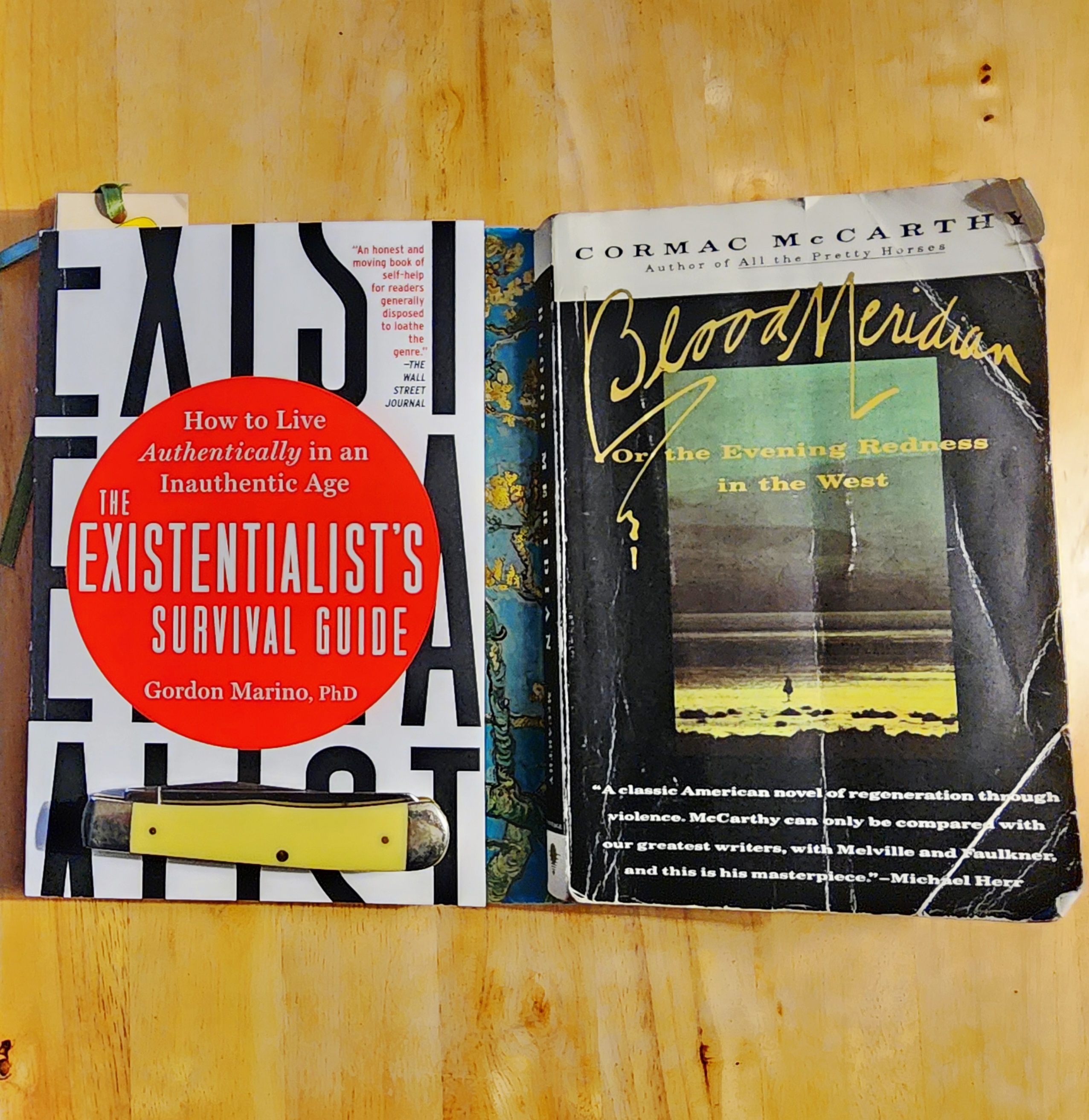
The Existentialist’s Survival Guide – How to Live Authentically in an Inauthentic Age by Gordon Marino, PhD. It is a pretty good book on existentialism. I was a little skeptical at first because the author writes through the lens of Soren Kierkegaard. It’s not that I don’t like Kierkegaard; it’s that Kierkegaard doesn’t particularly resonate with me like the other existentialists. Not to worry, there were heavy doses of these other authors that I like, like Albert Camus, Jean Paul Sartre, Friedrich Nietzsche, and Fyodor Dostoevsky.
As a matter of fact, he checks all the boxes of some of my favorite authors, with mentions from the works of Camus: The Fall and The Stranger. Sartre: Nausea, No Exit, and Being and Nothingness. Dostevsky: Notes From Underground. These books are the touchstones of my life, and I was grateful for their inclusion.
Finally, this book was well written with many anecdotes from the author’s colorful past to illustrate his points and help inform the reader. It is more than just a self-help book. It is indeed a survival guide for living authentically.
Reading Blood Meridian for the second time, I picked up a lot that I missed the first time around 20 years ago. 20 years ago, when I first read it, I could not believe my eyes at what I saw on the page. I literally could not put the book down. I carried it with me everywhere I went until I finished reading it. In the intervening years, I read every other book Cormac McCarthy ever wrote. He is unquestionably one of America’s finest writers.
Blood Meridian shocks one’s consciousness with its scenes of violence and haunts the imagination with its vivid descriptions of the Old West in Mexico and Texas.
Thematically, it is about the primacy of violence. The nature of good and evil, and fate vs. agency. The story follows a character known as “the kid,” who joins a group of scalp hunters known as the Glanton Gang. They are hired by the Mexican government to hunt down Apache Indians and collect their scalps for a bounty. They soon descend into madness as they stop distinguishing enemies from foes and start slaughtering everything in their path.
Another character in the gang is Judge Holden, who may or not be the devil. His philosophy is “War is God,” and combat is the ultimate truth. He refers to “the dance” by which he means a commitment to violence and the will to power. If you aren’t dancing, you aren’t truly alive.
The kid has a spark of mercy in him, and the judge views him as his natural enemy. The final confrontation takes place in an outhouse. What happens there is not mentioned but the reaction of those who look inside would suggest something awful.
Blood Meridian is not for everyone, but it is a masterpiece of storytelling, somewhere on the level of Moby Dick. It is the telling of the end of the Old West and the beginning of the New and so-called civilization.
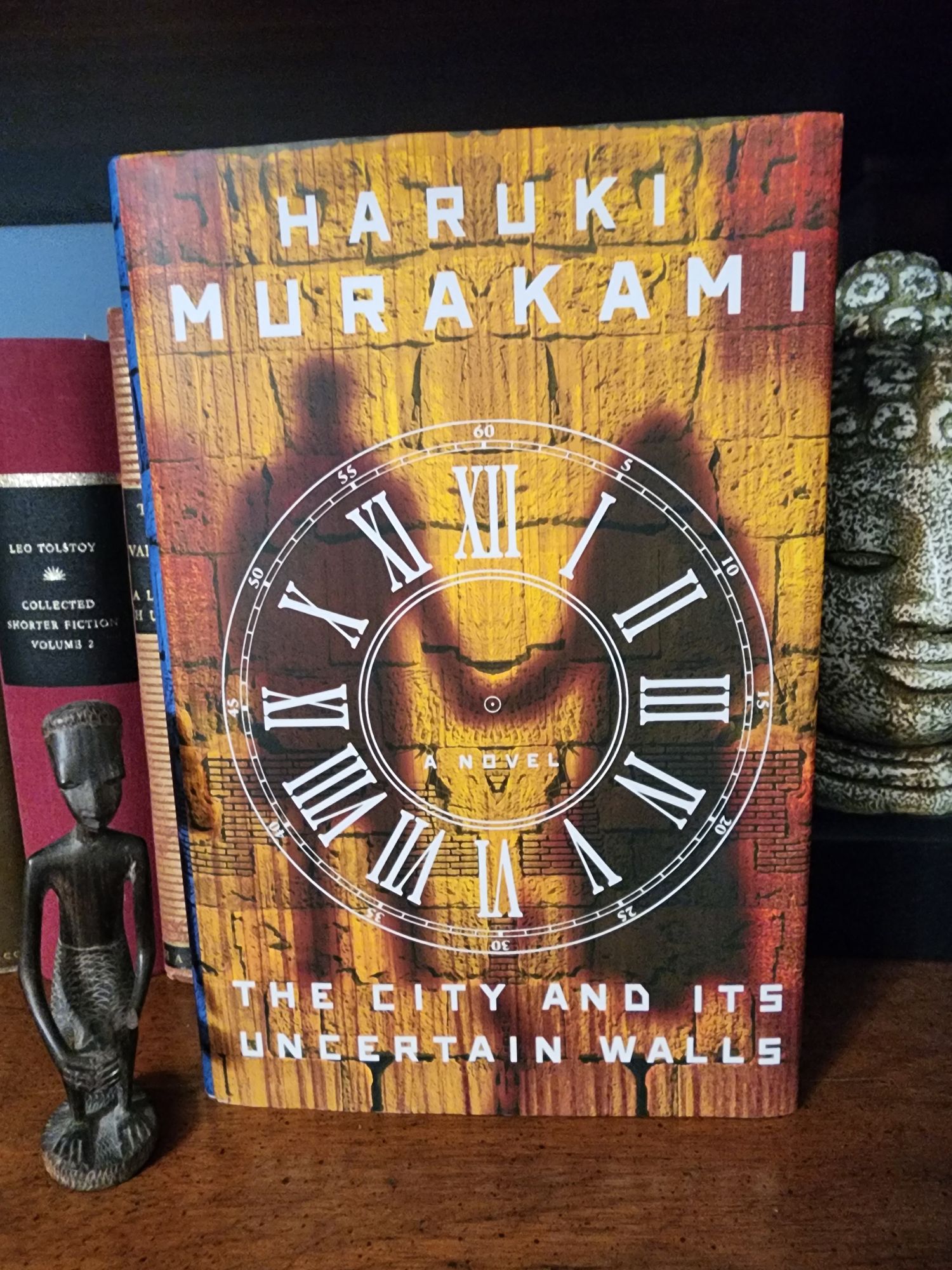
“The City and Its Uncertain Walls” by Haruki Murakami is a richly imagined and thought-provoking narrative that explores the themes of isolation, identity, and the complexities of urban life. This is a take-off from another of his novels, “Hard Boiled Wonderland and the End of the World”. If you drill deeper into the history of this novel, you will find a short story or novella that Murakami wrote early in his career that he was unsatisfied with. I think he may have achieved perfection with this latest iteration.
In this book, Murakami masterfully constructs a labyrinthine cityscape that serves as a mirror to the inner worlds of its inhabitants. The protagonist, whose name remains undisclosed, journeys through this enigmatic urban sprawl, encountering a myriad of characters who each add a layer of complexity to the narrative. Their stories intertwine, creating a tapestry of human experience that is as fragmented as it is compelling.
The protagonist’s quest for meaning and connection is punctuated by encounters with figures such as a reclusive artist, a disillusioned academic, and a mysterious woman who seems to hold the key to the city’s secrets. Each of these individuals grapples with their own existential dilemmas, reflecting the broader themes of isolation and identity that pervade the novel.
Murakami’s prose is both lyrical and haunting, imbuing the city with a sense of melancholy beauty. The walls that encircle the city are not just physical barriers, but also metaphors for the psychological and emotional confines that the characters must confront. The walls seem to be alive and have a life of their own as they change slightly from day to day and represent for me a sense of consciousness. They are interior walls as well.
The novel is essentially a ghost story. We don’t realize this until we are well into the narrative. Murakami is a master of magical realism, and he refers to the magical realism of Gabriel Garcia Marquez in his telling of the tale.
Through the struggles of the various characters, the narrative probes into what it means to seek freedom and understanding in a world that is perpetually uncertain.
Some authors’ voices are missed when absent for a while. Murakami is one such author. I return to him again and again.
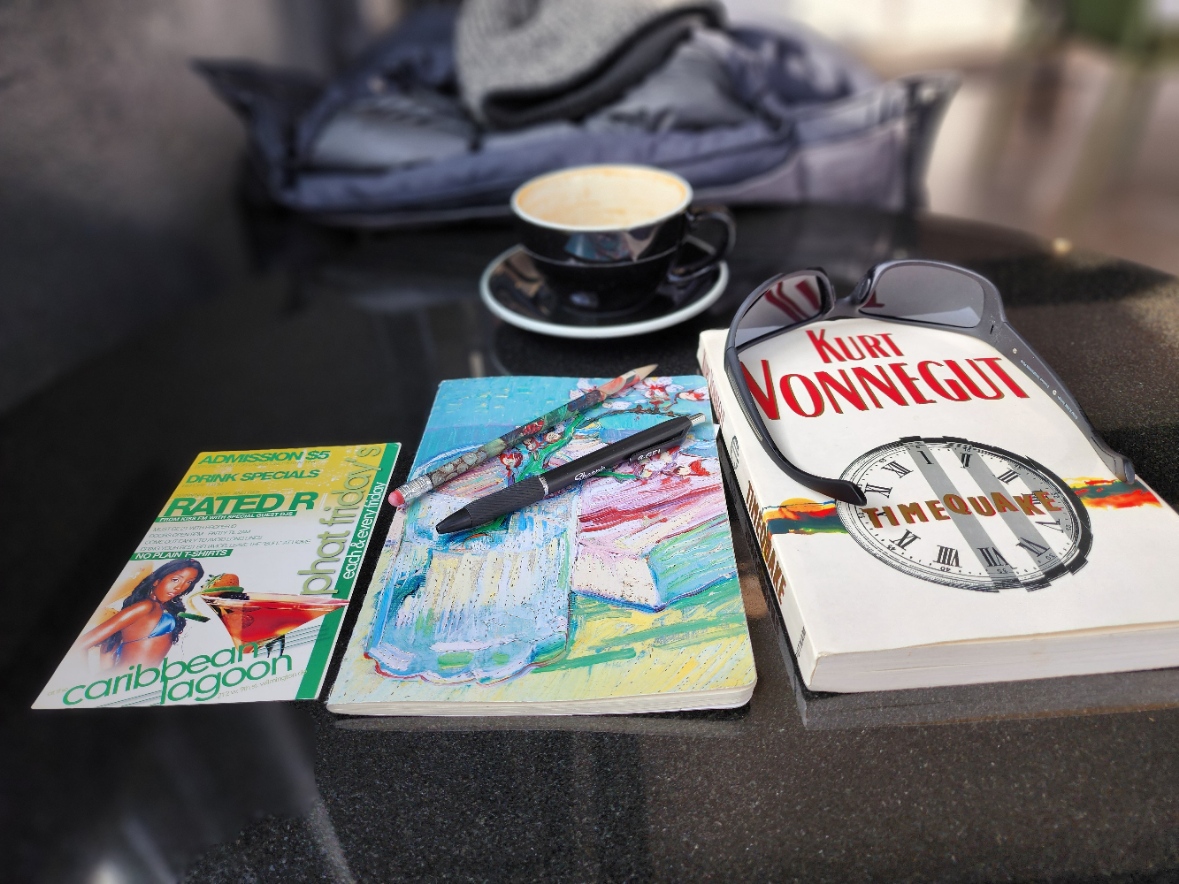
Timequake is a novel about free will. Vonnegut freely intersperses throughout the novel his own stream of consciousness. Oh, and there is also his alter ego, Kilgore Trout, who exclaims, “Oh Lordy, I am much too old experienced to start playing Russian Roulette with free will again.”
The premise of Timequake is that a Timequake, a sudden glitch in the time-space continuum, made everybody and everything do exactly what they’d done during the past decade a second time. It was déjà vu all over again for 10 years. The timeframe Vonnegut chose was February 13, 2001 – February 17, 1991. The Timequake would zapp everyone back in an instant to 1991. They had to “live” their way forward to 2001. Or you might say, back to the future again. Only when people got back to 2001 did they stop being robots of their past. Kilgore Trout would say, “Only when free will kicked in could they stop running an obstacle course of their own construction.” Free will. That is what the novel is about. Do we have it or not? That is the question. You would think that because the author mentions “when free will kicks back in” some 20-odd times he was arguing for free will. But no! Not so fast! I’m not so sure.
Other pithy comments by Kilgore Trout would include, “If brains were dynamite, there wouldn’t be enough to blow your hat off!” and “Ting-a-ling, you son of a bitch!” which is the punch line to a variation on a joke having to do with Chinese doorbells.
So, it goes.
Vonnegut goes on to say, in his own peculiar voice, that writers of his generation had reason to be optimistic because of things like the Magna Carter, the Declaration of Independence, the Bill of Rights, The Emancipation Proclamation, and Article XIX of the Constitution giving women the right to vote. He advocated for two more amendments that he would like to add: Article XXIII: Every newborn shall be sincerely welcomed and cared for until maturity. And Article XXIX: Every adult who needs it shall be given meaningful work to do at a living wage.
Another pithy saying he was fond of throwing around was, “I never asked to be born in the first place!”
The Wind-Up Bird Chronicle is the fourth Murakami novel that I have read. The others are Kafka on theShore, Norwegian Wood, and Hardboiled-Wonderland and the End of the World. I would be loath to say which one I liked the best. Probably Norwegian Wood is the greatest departure from the other three, but they all stand on their own and are all equally excellent in my view.
I love the way Murakami blends magical realism and naturalism into his novels and the way he sprinkles his writing with cultural references (mostly Western).
Wind-Up Bird is the chronicle of a man who first loses his cat and then loses his wife. It is partly a detective story as the main character searches for his cat and his missing wife. Along the way, we meet some fascinating characters and find ourselves at the bottom of a deep dark well contemplating the mysteries of the universe.
Some of the themes Murakami explores are Identity and journey to the self, polar opposites, the forgotten war, parallel universes, past and present; marriage and love, alienation, aloneness, and isolation; loyalty and trust, subconscious, and reality, and finally the power of fate.
This is a big long book and perhaps a little rambling, and at times incoherent, but it is pure Murakami and if you have a taste for his writing it is a joy to read.
The Old Absinthe House, one of the venues depicted in the novel. Photo by the author.
Take a deep dive with me to the bottom of The Gulf of Mexico as we explore along with Bobby Western the depths of the human consciousness.
Cormac McCarthy’s, The Passenger starts off with a mystery as Bobby Western, a deep sea salvage diver, explores a downed plane in the Gulf of Mexico off the Mississippi coastline. He and his friend Oiler find the plane submerged under 40 feet of water and all of the passengers onboard are dead and one is missing. Also missing is the black box. This missing passenger is the passenger from the title of the novel but we soon find that that is not what the book is about at all. Bobby is the actual passenger, as are we the readers, following along on Bobby’s journey into darkness.
We follow Bobby into the seedy bars on Bourbon Street in the City of New Orleans and meet a cadre of colorful characters from blue collar workers in the salvage business to street philosophers, transsexuals, race car drivers, mathematicians, physicists, and a Jewish private detective.
This is a novel of intrigue, paranoia, loss, grief and despair. It is also very funny with many moments of dark humor sprinkled throughout.
Bobby Western’s father worked with Oppenheimer on the atomic bomb for which he experiences generational guilt. His sister, Alicia, is a math wizard who is haunted by a crew of imaginary characters emanating from her schizophrenic mind. She is also a great beauty and Bobby is deeply in love with her.
The whole novel has a dreamlike quality to it but never fails to compel the reader to keep turning the pages to see what happens next.
This is perhaps McCarthys swan song and it echos much of his previous work. It is a tribute to a life well lived and a career well made. McCarthy has been compared to Melville, but I see traces of Beckett, and as another reviewer has pointed out, Kafka.
Much has been made of his signature style of no punctuation and a lack of tags for the dialogue. Sometimes one has to go back and reread a section to understand who it is talking. I found that to be true in this novel. But, I think the ambiguity is intentional on McCarthy’s part as it adds to the dreamlike quality of the work. Has written a prequel to this novel which acts as kind of a “coda” to The Passenger. I haven’t read Stella Maris as yet but when I do I expect it to give me a greater understanding of this one.
This book covers the waterfront on a variety of topics. Topics I am sure are McCarthys interests. He weaves them into the story in a very realistic, convincing and entertaining way. Here is a compendium of what his characters talk about or are involved in: Vietnam, the Kennedy assassination, a trans-woman, incest, food and wine, schizophrenia, philosophy, particle physics, mathematics, and paranoia.
McCarthy has a prose style that is incomparable to other modern day writers. His descriptions are sublime and memorable. Such as: “ The lamps had come on down Bourbon Street. It had rained earlier and the moon lay in the wet street like a platinum manhole cover.” Or: “…the tide pools stood like spills of blood.” Or: “ …sunrise. It sat swagged and red in the smoke like a matrix of molten iron swung wobbling up out of a furnace.”
All in all a fine read of a much anticipated novel that more than delivers on expectations.
I was at a hotel seminar led by former marine generals. The meeting was about turning a company around. I was one of the employees of the company that needed to be prepared to make a speech, but I was not called on to do so. The seminar was held in one of the large hotel conference rooms. Ballroom A? And there were about 100 people attending.
After the seminar was over, I was heading back to my room when I was approached by a short, plain, middle-aged woman who bore a remarkable resemblance to Madelaine Albright.
She came up to me and I looked down at her upcast eyes which seemed to be imploring me to do something. She begged me to come back to her room with her.
“I’m so all alone,” she said. It seemed as if we already knew each other and had had an affair in the past.
At the same time Madeleine and I were talking, I was approached by another individual who turned out to be Christopher Hitchens. He gave me a bear hug.
“I lost a dear friend last night old boy,” he said.
“Died?” I asked.
“No, he passed out with drink,” Christopher smiled.
“Where are you going now?” I asked his receding figure.
“I am going to the bar for a double scotch, old boy.”
“OK, I’ll meet you there later.”
“I hope you have more to say than you did at the meeting earlier tonight.” Then he was gone.
I looked back at Madeleine and told her I was very sorry, but I couldn’t be with her tonight. That I had to talk to Christopher.
I drove the 117 miles to Owensboro and arrived at Buddha’s in the early afternoon. This was the first leg of our journey to the heart of the American Dream. I gassed up the White Whale, a 2011 gas guzzling Nissan Maxima, the day before, and put together a road trip mix to listen to on our way down to Galveston. We were going to Galveston to recapture our past and rekindle a friendship that had cooled off over the years.
We had both been to Galveston before and though we had separate memories we were both eager to see her pretty sea wall, hear the sea wind blowing, and see her dark eyes glowing.
I like to listen to the sounds of the 60s while on a road trip with nothing else on my mind but driving fast, grooving to the music, and avoiding the law if at all possible.
Daniel “Buddha” Hildenbrandt was one of my oldest friends and a spiritual adviser. He was also a teacher at the local community college. He taught communications and was fond of saying, “the main problem with communication is the illusion that it has taken place.”
We called him Buddha because of the pudgy nature of his physique. He just looked like a Buddha.
When I got to his place, we watched TV until about 5:30 pm when his daughter, Mara, arrived to fetch a key. After she left, we went out to get a bite to eat at Owensboro’s one and only Sushi place. I knew it was going to be a problem when I noticed the chefs behind the sushi bar were Mexican. I had the Hibachi Chicken. It was terrible.
We went back to Buddha’s place for drinks and more TV. I lucked into a Harold Pinter play on YouTube I’ve been wanting to see: “The Birthday Party,” starring Harold Pinter himself and Joan Plowright, in a BBC production. It was pretty good, but you have to be into Pinter to enjoy it. Buddha wasn’t so he went to bed to read while I watched the rest of the play.
The next day was Friday, October 2. I woke to the news that Donald Trump and Melania Trump both have contracted the coronavirus. Is that karma or what?
We are living in strange times. I was thinking of love in the time of Coronavirus. 1,000,000 dead and Donald Trump was still president. This was before the insurrection at the nation’s capital and Moscow had yet to declare war on Ukraine. The best was yet to come.
We packed and loaded the car. We had to make a pit stop in Evansville so Buddha could see his psychiatrist and check up on his meds. Apparently, I am traveling with a madman. That’s OK. We’re all as mad as hatters here. All the best people are.
We finally got on the road and headed west. I figured to push as far into Arkansas as I possibly could before stopping for the night. We made it to Hope, which was in the first ring of hell. It wasn’t quite dark yet, but it was getting there. We crossed the river Acheron into the abyss. The dreams weren’t broken down there, but they were definitely walking with a limp.
We checked into the Best Western Motel. The maskless clerk behind the desk kept asking us if we wanted one bed or two.
“Two beds, dammit!” Buddha muttered, shaking his shaggy head.
“Do we get a discount?” I asked. “AAA? AARP?”
“Yeah, I’ll give you a discount alright,” the clerk snapped.
“Well, what’s the rate?”
“$75.00 including tax. Do you want one bed or two?”
“Two beds, dammit!”
“OK! Can I see your credit card?”
“Any restaurants in the area?”
“You can Google them and they will deliver.”
“OK. What room?”
“105. Right around the corner.”
Buddha was already heading out the door on his way to the room on foot. I drove around. We unlocked the door and unloaded the car, then took a moment to get settled. Buddha went to get ice.
I Googled the restaurants in the area and found a Pizza Hut and a Dominos. I called both but got put on hold at both places. Well, what could you expect in a little town called Hope, deep in the Arkansas interior? Bill Clinton territory as it were. The town sucked just like Monica Lewinski. Finally, Dominos answered.
“I’ll have a medium Supreme delivered to room 105 at the Best Western Motel, please. When will you deliver it? One hour? Wow! Well, go ahead. We will just have to wait.”
While waiting for the pizza to arrive we made the drinks.
We had picked up some liquor a few exits back. We got separate liquors because Buddha always buys cheap booze and I can’t stand the whiskey he usually gets, so I get something a little better. Turns out he got Ezra Brooks and I got Jack Daniels.
“Well, hell, if I’d a known you were getting Ezra Brooks, I would have drunk your booze. Ezra Brooks ain’t bad!”
“No, you wouldn’t! You’re not drinking my booze! You just drink your Jack Daniels!”
“What the hell Buddha? You don’t think I would have replaced your whiskey? You mean to tell me you wouldn’t have shared?”
“I don’t want to have this conversation right now!”
“Why not?”
“Just don’t.”
“OK.”
We drove the rest of the way in silence.
Meanwhile, back in the motel room, we decided to watch a little TV while waiting for the pizza. It was 9 pm EST and 8 pm Central. Buddha grabbed the remote and engaged the “on” button. TV said, “No Signal.”
“Call the front desk and tell them the TV doesn’t work,” I said.
Buddha grabbed the phone, listened intently, punched the dial hooks repeatedly, looked up wild-eyed.
“No dial-tone! Motherfucker don’t work!”
“Call him on your cell phone.”
Buddha stared at the black desk set and started stabbing the numbers into his cell phone.
“Hello? Yeah, this is Buddha in room 105. The phone don’t work…. I’m calling you on my cell phone…. OK…OK…Ok. That’s not why I’m calling you. The TV don’t work either…OK…. OK…Ok.”
He hung up.
“What’d he say?”
“He said he would come down and try to reboot it himself.”
“Well OK then.”
So, we waited a few minutes, freshened our drinks, and munched on some smoked almonds. Pretty soon there was a knock at the front door.
Buddha let in the night clerk who again was maskless, but he was at least pretty friendly. He took the remote and began trying to reboot the TV.
About that time, we got another knock at the door. It was Dominos. Buddha answered the door. He paid for the pizza, $20.00 including tip.
The smell of the pizza filled the room.
“Wow, if you are getting pizza, I’m getting hungry.” This from the maskless night clerk.
“You want a slice?” I asked.
“No. No.”
The clerk didn’t have any luck getting the TV to work either.
“Let’s see, the TV don’t work, and the phone don’t work. Don’t you think we should get another discount?” I asked.
“Yeah, I’ll give you another discount. I’ll give it to you right now.”
And with that, he left.
Buddha and I just looked at each other and shrugged. Then we devoured the pizza.
A little later on that night, the night clerk showed up with our receipt which included our discounts. All in all, an $85.00 room ended up costing us $65.00. Not bad.
We got up early the next morning and hit the road again right after breakfast. It was around Texarkana when the drugs started kicking in. It was only a matter of time before we would see the bats.
As soon as we crossed the Texas state line the environment seemed to change. The horizon stretched out further, the roads became wider, and the countryside a lot brighter. You could see further in all directions. There were also a lot of Trump signs. We were definitely in Trump country. If there ever was time to be traveling armed, this was it.
Donald Trump. The 45th president of the United States of America was nothing more than a screaming hyena, a barking dog, a snake oil salesman, and a carnival barker. But he held a death grip on American politics for four years, and even though he was impeached twice and lost a fair and free election he still has a death grip on the GOP and a large number of the electorate. One-third of the country thinks the election was stolen and that Joe Biden is not the legitimate president. What a mess! But I digress.
There we were, driving along US Highway 59 with an open road in front of us and Ruby and the Romantics blaring on the radio and I couldn’t help but think that here we are, 20 years into the next century. I remember the 60s as being a beacon of hope when the culture hit a high watermark. If you look back and squint your eyes just right, you can almost see where the crest of the wave finally broke and rolled back. It’s been downhill pretty much ever since.
Aunt Renie came to Louisville, Kentucky for a visit. It was in the spring of the year and nearing Derby Day, so I decided to take her out to Churchill Downs to watch the horses run.
We drove to south Louisville where the track is located and parked the car a few blocks away and walked the remaining distance to the track entrance. Aunt Renie is pretty spry for an old lady.
We were both able to get in for the admission price of only $1.00 as we were both senior citizens. Louisville likes to encourage its seniors to go to the track. We made our way through the throng of horseracing fans to a booth where they sell racing forms. I bought one and stuck it in my pocket. Then we walked out to the track and sat in the sun on hard benches and studied the form to make our picks.
We studied the racing form and saw that there was a field of eight horses for the next race. Aunt Renie had never been to a racetrack before so I had to teach her how to handicap the race. I am not an expert myself but here’s how I do it. The first thing I do is to study the form for the information listed about the horses for that particular race. First of all, I look for names I like. Something that clicks. Then, I look at the stats on that horse. Who is the trainer, who is the jockey, how much weight does the horse carry, how many races did the horse win this year, and last, what are the odds?
I take all these things into consideration and make a selection. I picked what looked like a winner: Psycho Blue Boots, the number 5 horse in the 3rd race. I suggested to Aunt Renie that we bet $10.00 to win on the 5 horse. If it won, we would split the winnings. She agreed.
I pushed my way through the crowd to the parimutuel window and placed my bet.
“$10.00 to win on the 5 horse in the 3rd race,” I said. The teller smiled, took my money, and punched my ticket.
The race was about to begin as was indicated by the trumpet call to the gate. I hurried back to where Aunt Renie was sitting and showed her our ticket. Just then the announcer announced, “They’re off!” And the race began.
“On the lead was Solient Green, on the outside Golden Band. On the rail was Shiftless Joe followed by Psycho Blue Boots. Royal Pain was moving up to fourth place, Psycho Blue Boots makes a sudden move…They are in the turn, Royal Pain is in third. Psycho Blue Boots moving up on the outside…now moving in…in the stretch Psycho Blue Boots takes the lead…at the wire…Psycho Blue Boots wins by nose!”
The crowd goes wild. I go wild Aunt Renie goes wild. We are winners!
We won enough on the race we were able to celebrate at one of Louisville’s most prestigious steak houses, Jack Fry’s. We had quite a day at the races and a nice meal to boot.
The next morning, I took Aunt Renie to the airport where she resumed her travels.
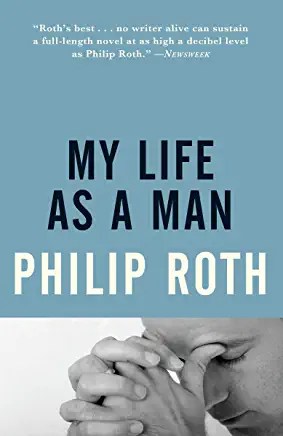
My Life as a Man, a novel written by Philip Roth, comes from Roth’s middle period, after Goodbye Columbus and Portnoy’s Complaint, but before American Pastoral, I Married a Communist, and The Human Stain. Roth has written some 30 odd books, not all of them odd but some pretty strange, and he is possibly America’s best writer, if not one of the most prolific. Beats me why he never won the Nobel, for he was surely deserving.
I’ve read most of his later works and all of his earlier works and I am slowly catching up on his middle period. I don’t profess to be an expert on Roth, but I certainly like his writing I and return to him over and over again.
This book, My Life as a Man, is a story within a story, or two stories within a story, then Peter Tarnopol’s (narrator) true story. It concerns his marriage to Maureen Tarnopol who tricked him into marrying him and has become his arch-enemy. Maureen, in their divorce proceedings, described him as, “…a well-known seducer of college girls.”
Peter Tarnopol is a promising young writer who is also a college professor who teaches creative writing. He occasionally gets involved with his young students who become grist for his mill. He teaches literature and creative writing at The University of Wisconsin and Hofstra College on Long Island. He was a patient of Dr. Otto Spielvogel, a Manhattan psychoanalyst, from 1962-1967. Spielvogel considered Peter Tarnopol to be among the nation’s top young narcissists in the arts.
As usual, Roth draws from his own life and previous fiction and writes about what he knows best.
It is a rollicking satire teetering on the edge of tragedy as Roth brilliantly tells the tale of his marriage and his many peccadillos.
Roth writes in an attempt to make art out of his calamitous life and to spin gold out of straw. Is it him or his characters, or is it Memorex? You be the judge. For him, (Tarnopol), “…writing is a vain attempt to get myself to feel like something other than a foreigner being held against his will in a hostile and alien country.”
For Philip Roth, life is a Kafkaesque nightmare whereupon the dreamer ruminates on the possibility of being transformed into a gigantic cockroach. Upon awakening, he heeds the advice of Gustave Flaubert who suggests leading a regular and orderly life and being violent and original in his writing. This is a lesson Philip Roth seems to have taken to heart.
So, I’ve read my first book of 2022: George Orwell’s, Coming up for Air, and boy, was it a ride! One has to look beyond Orwell’s most famous books, 1984 and Animal Farm, and get into the weeds with some of his lesser-known works to find the real Orwell. This book has been described as an account of a man trying to recapture the lost innocence of his childhood. My main takeaway is that the more things change the more they stay the same. But it is more complicated than that of course. It is more like: you can never go home again.
George Bowling is being smothered in a middle-class existence, mired in a loveless marriage on the eve of WWII. He takes a week off and travels to his hometown in Lower Binfield, only to discover that it is no longer there. It has been completely engulfed by urban sprawl.
I love the first line of the novel, “The idea really came to me the day I got I got my new false teeth.” The idea to travel back to his childhood home of Lower Binfield, that is.
George Bowling was the product of shop keepers who struggled to keep their business alive as he describes in this passage: “It’s a fact that very few shopkeepers in those days actually ended in the workhouse. With any luck, you died with a few pounds still your own. It was a race between death and bankruptcy, and, thank God, death got Father first, and mother too.”
He details the banal middle-class existence as only Orwell can, interweaving some heavy commentary on the horrors of war and the disgusting nature of human beings they can sometime exhibit as this example of a discussion of the Boer War between two of George Bowling’s relatives readily shows: “…surely he couldn’t think it right for these here Boers to throw babies in the air and catch them on their bayonets, even if they were only, nigger babies?” “Uncle Ezekiel just laughed in his face. Father had it all wrong! It wasn’t the Boers who threw the babies in the air, it was the British soldiers!”
In this book, Orwell refers to several wars, The Boer War, WWI, and the pending WWII. More on war: “It was unspeakably meaningless, that time in 1918. Here I was sitting beside the stove in an army hut …when a few hundred miles away in France the guns were roaring and droves of wretched children, wetting their bags with fright, were being driven into the machine gun barrage like you’d shoot small coke into a furnace. …It was a lunatic’s dream….if the war didn’t kill you, it was bound to start you thinking.”
There was a scene in Lower Binfield, when Geroge went back to visit, where an RAF bomber making a practice run accidentally drops a bomb on the village killing three people. Thinking it was the Germans and expecting a second bomb to drop Orwell describes the following surreal scene: “And then I saw an extraordinary sight. At the other end of the market-place the High Street rises a little. And down this little hill, a herd of pigs was galloping, a sort of huge flood of pig-faces. The next moment, of course, I saw what it was. It wasn’t pigs at all, it was only the schoolchildren in their gas masks.”
George Bowling’s visit to Lower Binfield taught him one thing: “It’s all going to happen. All the things you’ve got in the back of your mind, the things you’re terrified of, the things that you tell yourself are just a nightmare or only happen in foreign countries. The bombs, the food-queues, the rubber truncheons, the barbed wire, the coloured shirts, the slogans, the enormous faces, the machine-guns squirting out of bedroom windows. It’s all going to happen. I know it -at any rate – I knew it then. There’s no escape. Fight against it if you like, or look the other way and pretend not to notice, or grab your spanner and rush out to do a bit of face-smashing along with the others. But there’s no way out. It’s just something that’s got to happen.”
Lest you think it was all doom and gloom, not so. There was quite a lot of humor injected into the novel. Dark humor. This novel, is, after all, satire.




 Ghost Dog