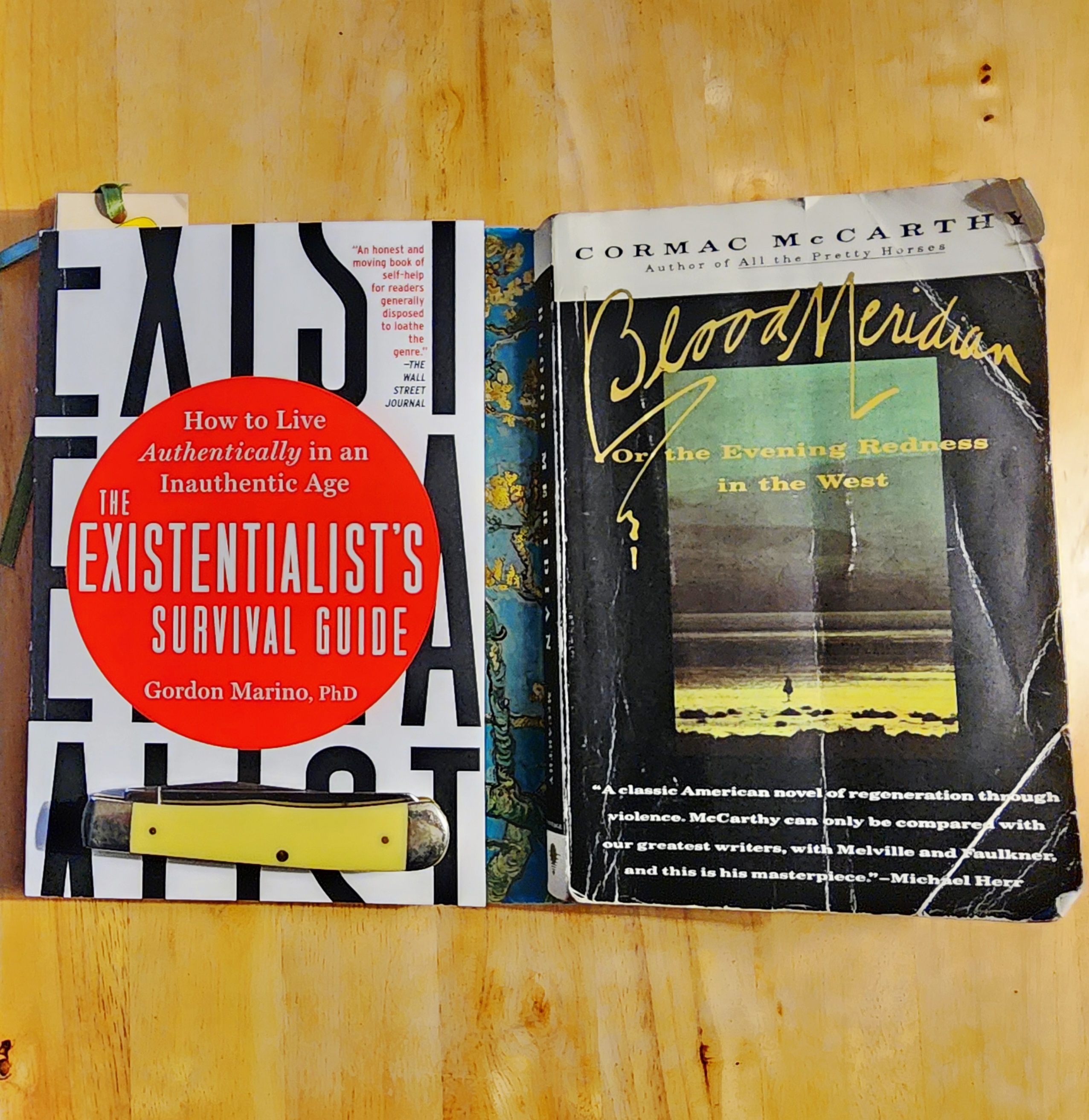
Currently Reading

The Existentialist’s Survival Guide – How to Live Authentically in an Inauthentic Age by Gordon Marino, PhD. It is a pretty good book on existentialism. I was a little skeptical at first because the author writes through the lens of Soren Kierkegaard. It’s not that I don’t like Kierkegaard; it’s that Kierkegaard doesn’t particularly resonate with me like the other existentialists. Not to worry, there were heavy doses of these other authors that I like, like Albert Camus, Jean Paul Sartre, Friedrich Nietzsche, and Fyodor Dostoevsky.

As a matter of fact, he checks all the boxes of some of my favorite authors, with mentions from the works of Camus: The Fall and The Stranger. Sartre: Nausea, No Exit, and Being and Nothingness. Dostevsky: Notes From Underground. These books are the touchstones of my life, and I was grateful for their inclusion.

Finally, this book was well written with many anecdotes from the author’s colorful past to illustrate his points and help inform the reader. It is more than just a self-help book. It is indeed a survival guide for living authentically.

Reading Blood Meridian for the second time, I picked up a lot that I missed the first time around 20 years ago. 20 years ago, when I first read it, I could not believe my eyes at what I saw on the page. I literally could not put the book down. I carried it with me everywhere I went until I finished reading it. In the intervening years, I read every other book Cormac McCarthy ever wrote.  He is unquestionably one of America’s finest writers.

Blood Meridian shocks one’s consciousness with its scenes of violence and haunts the imagination with its vivid descriptions of the Old West in Mexico and Texas.

Thematically, it is about the primacy of violence. The nature of good and evil, and fate vs. agency. The story follows a character known as “the kid,” who joins a group of scalp hunters known as the Glanton Gang. They are hired by the Mexican government to hunt down Apache Indians and collect their scalps for a bounty. They soon descend into madness as they stop distinguishing enemies from foes and start slaughtering everything in their path.

Another character in the gang is Judge Holden, who may or not be the devil. His philosophy is “War is God,” and combat is the ultimate truth. He refers to “the dance” by which he means a commitment to violence and the will to power. If you aren’t dancing, you aren’t truly alive.

The kid has a spark of mercy in him, and the judge views him as his natural enemy. The final confrontation takes place in an outhouse. What happens there is not mentioned but the reaction of those who look inside would suggest something awful.

Blood Meridian is not for everyone, but it is a masterpiece of storytelling, somewhere on the level of Moby Dick. It is the telling of the end of the Old West and the beginning of the New and so-called civilization.
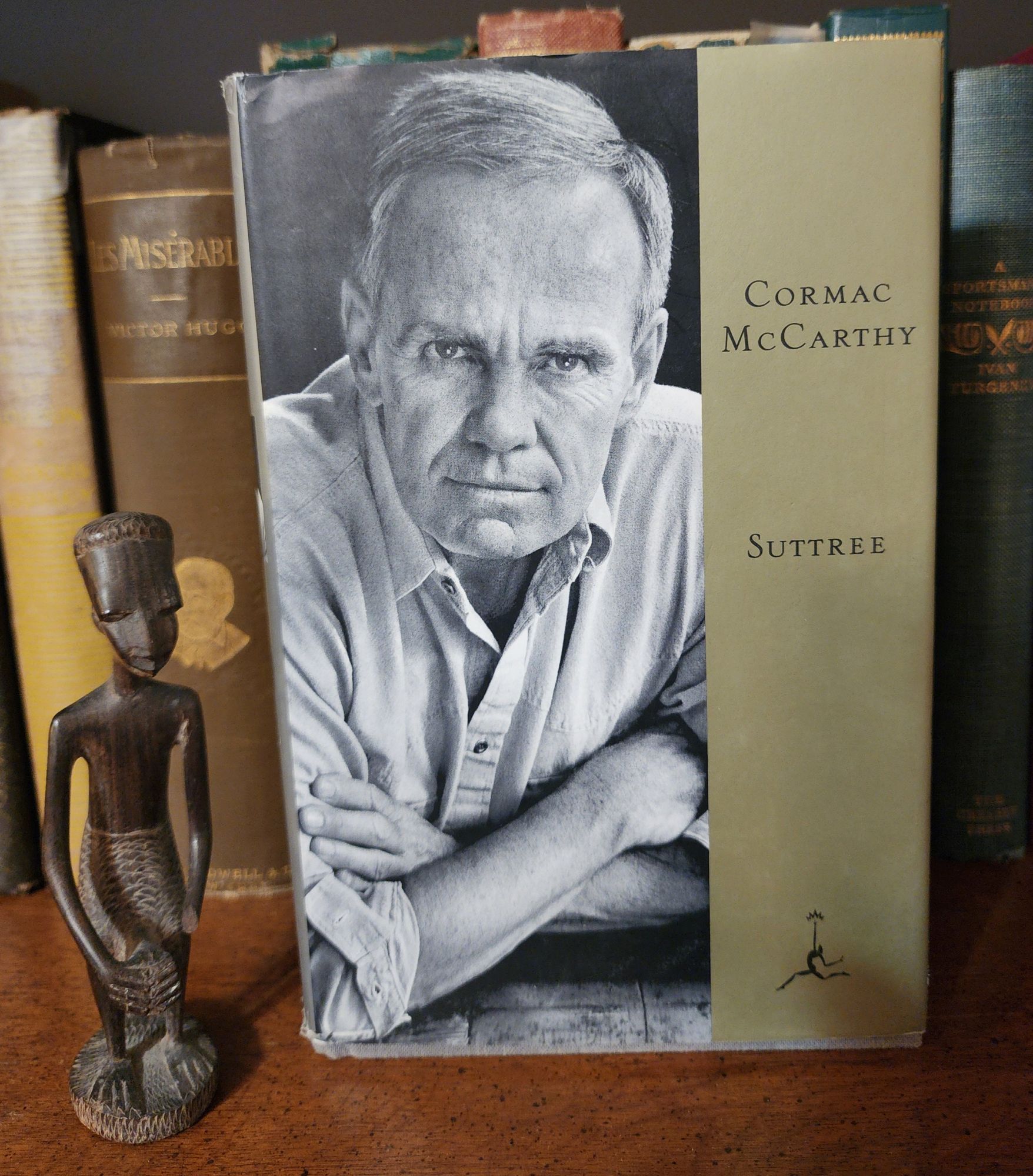
Top 10 Books 2024

I read 34 books in 2024, some for the second time, like The Old Man and the Sea and The Lady in the Lake. I also read a lot of plays. I like to read plays because I can Imagine the actors’ actions when they play their parts upon the stage. Also, I am writing a couple of plays, and the best way to learn how to write a play is to read a lot of plays. Here is my list of my top 10 books in no special order. However, if I had to pick a favorite it would be Suttree, by Cormac McCarthy—happy reading to all who read in 2025.

  1. The Dragon Country – Tennessee Williams
  2. The Lady in the Lake – Raymond Chandler
  3. Suttree – Cormac McCarthy
  4. The Old Man and the Sea – Ernest Hemingway
  5. The Bluest Eye – Toni Morrison
  6. The Sunset Limited – Cormac McCarthy
  7. Rhinoceros – Eugene Ionesco
  8. The Savage Detectives – Roberto Bolano
  9. Hollywood – Charles Bukowski
  10. Deception – Philip Roth

The Passenger, by Cormac McCarthy

Book Review

The Old Absinthe House, one of the venues depicted in the novel. Photo by the author.

Take a deep dive with me to the bottom of The Gulf of Mexico as we explore along with Bobby Western the depths of the human consciousness.

Cormac McCarthy’s, The Passenger starts off with a mystery as Bobby Western, a deep sea salvage diver, explores a downed plane in the Gulf of Mexico off the Mississippi coastline. He and his friend Oiler find the plane submerged under 40 feet of water and all of the passengers onboard are dead and one is missing. Also missing is the black box. This missing passenger is the passenger from the title of the novel but we soon find that that is not what the book is about at all. Bobby is the actual passenger, as are we the readers, following along on Bobby’s journey into darkness.

We follow Bobby into the seedy bars on Bourbon Street in the City of New Orleans and meet a cadre of colorful characters from blue collar workers in the salvage business to street philosophers, transsexuals, race car drivers, mathematicians, physicists, and a Jewish private detective.

This is a novel of intrigue, paranoia, loss, grief and despair. It is also very funny with many moments of dark humor sprinkled throughout.

Bobby Western’s father worked with Oppenheimer on the atomic bomb for which he experiences generational guilt. His sister, Alicia, is a math wizard who is haunted by a crew of imaginary characters emanating from her schizophrenic mind. She is also a great beauty and Bobby is deeply in love with her.

The whole novel has a dreamlike quality to it but never fails to compel the reader to keep turning the pages to see what happens next.

This is perhaps McCarthys swan song and it echos much of his previous work. It is a tribute to a life well lived and a career well made. McCarthy has been compared to Melville, but I see traces of Beckett, and as another reviewer has pointed out, Kafka.

Much has been made of his signature style of no punctuation and a lack of tags for the dialogue. Sometimes one has to go back and reread a section to understand who it is talking. I found that to be true in this novel. But, I think the ambiguity is intentional on McCarthy’s part as it adds to the dreamlike quality of the work. Has written a prequel to this novel which acts as kind of a “coda” to The Passenger. I haven’t read Stella Maris as yet but when I do I expect it to give me a greater understanding of this one.

This book covers the waterfront on a variety of topics. Topics I am sure are McCarthys interests. He weaves them into the story in a very realistic, convincing and entertaining way. Here is a compendium of what his characters talk about or are involved in: Vietnam, the Kennedy assassination, a trans-woman, incest, food and wine, schizophrenia, philosophy, particle physics, mathematics, and paranoia.

McCarthy has a prose style that is incomparable to other modern day writers. His descriptions are sublime and memorable. Such as: “ The lamps had come on down Bourbon Street. It had rained earlier and the moon lay in the wet street like a platinum manhole cover.” Or: “…the tide pools stood like spills of blood.” Or: “ …sunrise. It sat swagged and red in the smoke like a matrix of molten iron swung wobbling up out of a furnace.”

All in all a fine read of a much anticipated novel that more than delivers on expectations.