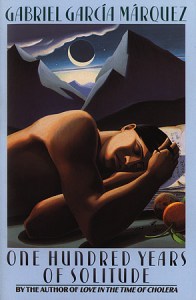
One Hundred Years of Solitude, by Gabriel Garcia Marquez is unlike any novel I have ever read. This is the third novel I have read by this author. From the very first line one is enchanted by the magical realism the writer imposes on the material. It is said that Garcia Marquez found his voice as a result of being raised by his grandmother in Aracataca, a small village in Colombia. This village is the basis for the mythical town of Macondo from the novel. His grandmother would tell him tell him the most fantastic stories in the most off hand way as if they were true. He adopted this style while telling the tale of the Buendia family. Marquez was also greatly influenced by Franz Kafka’s Metamorphosis. Traces of surrealism can be found throughout the novel.
One Hundred Years of Solitude is not an easy novel to read. It is about the Buendia family dynasty that began with the founding of the small mythical town of Macondo. Marquez chronicles the rise and fall of the town and the family over a one hundred year period. Some of the characters actually live to be over 100 years old. What is so confusing is that each character’s name is a variation of the family name Buendia: Jose Arcadio Buendia, Aureliano Buendia, Jose Arcadio, Aurliano Jose, Ursula, Remedios, and Amaranta. Well, you get the idea. These names repeat over six generations. You really couldn’t keep them straight. My approach to reading the novel was not to even try keep all the characters and events straight in my mind as I was reading, but rather to let the words wash over me and by the end a tapestry was woven from them wherein I could make sense of the whole. The idea, I think was to represent the repetition and the cyclic nature of life. In fact the whole novel could be described as a metaphor for human society and a running commentary on human nature.
The novel is biblical in nature and scope. It mimics many characters and events from the Bible such as Adam and Eve in the Garden of Eden, Moses in the bulrushes, and the great flood. One character even ascends to heaven.
The famous opening line of the novel is a good example of the style of the entire novel: “Many years later, as he faced the firing squad, Colonel Aurliano Buendia was to remember that distant afternoon when his father took him to discover ice.” This story is not revisited again until much later in the novel and in fact is two stories; one where Aurliano Buendia discovers ice and the other where he faces the firing squad. The novel careens back and forth between past, present, and future at will and with great ease, interweaving personal narratives of the characters and the epic sweep of the history of the town and the country. This includes a civil war between the liberals and conservatives, a banana company (United Fruit) exploiting the town, and a labor war resulting in the massacre of 3,000 workers.

I wondered as I was reading the novel just what Marquez meant by the one hundred years was and what did the solitude represent? By the time I got to end I knew. As previously mentioned some of the characters actually lived 100 years. The sweep of history regarding the town and its inhabitants was roughly 100 years. Throughout the novel Marquez make numerous references to the solitude of the characters, from each other and from society at large. And, as John Leonard said in his 1970 review: “Solitude is one’s admission of one’s own mortality and one’s discovery that the terrible apprehension is itself mortal, dies with you, and must be rediscovered and forgotten again endlessly.” I am also reminded of Hamlet’s famous soliloquy: “The undiscovered country from whose bourn no traveler returns.”
I highly recommend this acclaimed novel written in 1967. In my opinion it is one of the best written in the 20th century and one that put Marquez firmly on the road to winning the Nobel Prize for literature in 1982.



 Ghost Dog