The Zone Of Interest

Book Review

The Zone of Interest, by Martin Amis, is a provocative and disturbing examination of one of the darkest periods in human history. I ran across this book while reading another Martin Amis book, Inside Story. Inside Inside Story, Amis discusses how he came to write and publish The Zone Of Interest. What caught my interest was the critical reaction to the book. It seems you can’t interject humor into an account of the horrors of the Holocaust. Imagine that. Well, I needed to see what the fuss was all about, so I set about to find said tome which wasn’t easy as it was out of print. Amazon didn’t have it. Half Price Books didn’t have it, and Barnes and Noble didn’t have it. I was left with having to scour the used bookstores of the nation. Finally, in a little bookshop in Chicago, I found it and sent in my order straight away. In a few days, it arrived on my doorstep in pristine condition. Needless to say, by the time it got there my interest level was elevated.

Amis tells the story of the Holocaust from the perspectives of each of the three main characters living in and operating a death camp at Auschwitz.  This camp is the “Zone of Interest” from the title of the novel. Using this narrative technique Amis gives us a clear view of the atrocities occurring daily in the concentration camp. The story unfolds primarily through the viewpoints of Angelus Thomsen, a high-ranking Nazi officer; Paul Doll, the camp commandant; and Szmul, a Jewish inmate forced to work in the camp’s Sonderkommando. There is a love story attached that involves Thomsen and the commandant’s wife, Hannah Doll. It is unrequited but carries much of the weight of the novel. This story serves to illustrate the blurring of the lines between victim and perpetrator.

Jewish “evacuees” are brought by train to be used as forced labor or to be gassed, their remains incinerated and then buried in the disgusting-smelling Spring Meadow by the “sonderkommado.” Szmul is a sonder. He is Jewish and is allowed to live as long as he performs his service, but he knows his time is limited too. He describes himself and his crew as the saddest, most disgusting men in the camp. They work with the dead, with heavy scissors, pliers, and mallets. There are three reasons for them to go on living: first to bear witness, second to extract mortal revenge if possible, and third to save a life from time to time to time, mostly young Jewish males.

Amis’ writing style is both terrifying and moving as he describes the brutality and horror of the camp. There are moments of dark humor and absurdity which I found to be quite appropriate. The juxtaposition of horror and humor produces a shroud of surrealism that makes one think about the moral and ethical implications elicited from the Holocaust. Amis incorporates many German words and phrases into the narrative giving one a sense of verisimilitude. I am reminded of Anthony Burgess’ Clockwork Orange where he created an entirely new language composed of both English and Russian and combinations of the two.

Zone of Interest is an examination of what Hannah Arendt described in her book Eichman in Jerusalem as the “banality of evil.”  Amis portrays characters going about their daily tasks in the camp as if they were managing any other administrative task. This chilling portrayal underscores the idea that ordinary people can become complicit in unimaginable atrocities under the right circumstances.

Zone of Interest is a challenging and haunting novel that offers a unique perspective on the Holocaust. Through its complex characters, dark humor, and unflinching portrayal of life in Auschwitz, the book forces readers to confront the darkest aspects of human nature and the enduring questions of morality and complicity. This powerful book has stayed with me long after I read it and is, I think an important contribution to the literature of the Holocaust.

The Passenger, by Cormac McCarthy

Book Review

The Old Absinthe House, one of the venues depicted in the novel. Photo by the author.

Take a deep dive with me to the bottom of The Gulf of Mexico as we explore along with Bobby Western the depths of the human consciousness.

Cormac McCarthy’s, The Passenger starts off with a mystery as Bobby Western, a deep sea salvage diver, explores a downed plane in the Gulf of Mexico off the Mississippi coastline. He and his friend Oiler find the plane submerged under 40 feet of water and all of the passengers onboard are dead and one is missing. Also missing is the black box. This missing passenger is the passenger from the title of the novel but we soon find that that is not what the book is about at all. Bobby is the actual passenger, as are we the readers, following along on Bobby’s journey into darkness.

We follow Bobby into the seedy bars on Bourbon Street in the City of New Orleans and meet a cadre of colorful characters from blue collar workers in the salvage business to street philosophers, transsexuals, race car drivers, mathematicians, physicists, and a Jewish private detective.

This is a novel of intrigue, paranoia, loss, grief and despair. It is also very funny with many moments of dark humor sprinkled throughout.

Bobby Western’s father worked with Oppenheimer on the atomic bomb for which he experiences generational guilt. His sister, Alicia, is a math wizard who is haunted by a crew of imaginary characters emanating from her schizophrenic mind. She is also a great beauty and Bobby is deeply in love with her.

The whole novel has a dreamlike quality to it but never fails to compel the reader to keep turning the pages to see what happens next.

This is perhaps McCarthys swan song and it echos much of his previous work. It is a tribute to a life well lived and a career well made. McCarthy has been compared to Melville, but I see traces of Beckett, and as another reviewer has pointed out, Kafka.

Much has been made of his signature style of no punctuation and a lack of tags for the dialogue. Sometimes one has to go back and reread a section to understand who it is talking. I found that to be true in this novel. But, I think the ambiguity is intentional on McCarthy’s part as it adds to the dreamlike quality of the work. Has written a prequel to this novel which acts as kind of a “coda” to The Passenger. I haven’t read Stella Maris as yet but when I do I expect it to give me a greater understanding of this one.

This book covers the waterfront on a variety of topics. Topics I am sure are McCarthys interests. He weaves them into the story in a very realistic, convincing and entertaining way. Here is a compendium of what his characters talk about or are involved in: Vietnam, the Kennedy assassination, a trans-woman, incest, food and wine, schizophrenia, philosophy, particle physics, mathematics, and paranoia.

McCarthy has a prose style that is incomparable to other modern day writers. His descriptions are sublime and memorable. Such as: “ The lamps had come on down Bourbon Street. It had rained earlier and the moon lay in the wet street like a platinum manhole cover.” Or: “…the tide pools stood like spills of blood.” Or: “ …sunrise. It sat swagged and red in the smoke like a matrix of molten iron swung wobbling up out of a furnace.”

All in all a fine read of a much anticipated novel that more than delivers on expectations.


Never Come Morning

BOOK REVIEW

While visiting the city of brotherly love I finished reading a novel about the city with the big shoulders. Of course I’m referring to Philadelphia and Chicago.

The novel was Never Come Morning and the writer was Nelson Algren.

Algren specialized in writing gritty tales of the denizens of Chigago’s underclass. For Algren, these individuals struggling to survive are all too human.

He wrote about the dregs of society, the convicts and the prostitutes as referred to in the Walt Whitman poem, Leaves of Grass: “I feel that I am all of them – I belong to those convicts and prostitutes myself, and henceforth, I will not deny them, for how can I deny myself.”

Never Come Morning is the story about a street gang of Polish American immigrant kids always scheming always getting into trouble with the law, fighting, robbing, raping, killing, whoring, pimping, and dealing with crooked cops.

There is a whole section where one of the characters is picked up on suspicion of shooting a drunk in an alley off Chicago Avenue. He ends up doing time in the workhouse or “workie” as it is referred to in the novel.

This would be “Lefty” Bruno Bicek, who has ambitions of becoming heavy weight champion not of Illinois but from Illinois. When he gets out of the workhouse he takes up pimping at a whorehouse accross the street from the Broken Knuckle Bar run by a Polish barber, another small time crook always looking for a fast buck. Leftie did nothing to help his girl friend, Steffi, when she was gangraped by the boys and this weighed heavily on his conscience throughout the rest of the novel. She ended up working for the barber as one of the girls in the whorehouse while he was in the workie.

Lefty’s big ambition is to win a title fight and get enough money to take Steffi away from all this misery. He gets his big chance in the last chapter of the book, “Toward Evening Lands.” Here, Algren describes a fight scene between Lefty and a black fighter called Honeyboy Tucker, the sons of a Polish baker and a mulatto pig sticker. Lefty is referred to as a white hope. This chapter contains one of the best descriptions of a boxing match I have ever read. The fight goes on for eight rounds. Two minutes and 48 seconds into the eighth, Lefty is declared the winner by a knockout.

“The bleachers howled like wind through an empty shack.”

But, the victory was short-lived however, as police captain Tenczara enters the dressing room and whispers into Lefty’s ear, “Got you for the Greek, Left Hander, two witnesses.”

Lefty was led out through the middle aisles in manacles.

“Knew I’d never get to be twenty-one anyhow,” he said.

He had won the fight but lost the battle.

Bell.

WINGED SERAPHS I HAVE KNOWN

Reverend Billy Bob Weatherspoon

Winged Seraphs


Hello friends! Rev. Billy Bob Weatherspoon here for the Space Chapel of Life….

Ya know…just how many times have ya wondered how many angels could dance on the top of a Bic Butane Lighter?

Have ya ever wondered where ya could find a Guardian Angel when ya really needed one?

And what about Charlie’s Angels?

….The answers to these and many more important questions may be found in my latest book:

WINGED SERAPHS I HAVE KNOWN

This book is available in both the hard and soft editions. Also available is the Leather bound edition which comes suspended from a chain.

So ya don’t forget, send NOW to:

SPACE CHAPEL OF LIFE

BOX 666

ANAHIEM, CALIFORNIA

8.96 RECORDS

9.96 TAPES


Juxtapose

23665484761_d1838275db_z

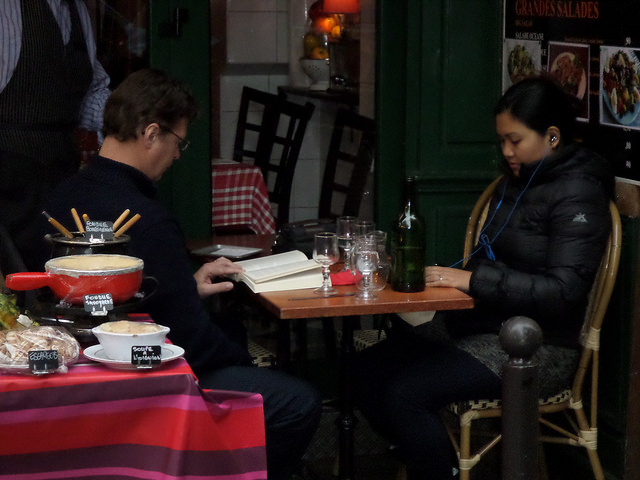
In this photograph we see a young Parisian couple dining at a sidewalk cafe in the Latin Quarter of Paris. The  Flagrant Delice specializes in French Cuisine. The photograph illustrates perfectly a classic example of the juxtaposition of old and new and east meets west. Notice the male figure in the picture is probably one generation older than the female. He is Caucasian and she is Asian. Finally, he is reading a book, old technology, and she is reading her cell phone, new technology. Yes, Paris is indeed a movable feast.