Yes, indeed he is. And I think he owes us all an apology.
In fact, the Church has apologized. In the year of our Lord 2000, His Holiness Pope Paul II begged forgiveness for, among some other things, the crusades, the Inquisition, the persecution of the Jewish people, and injustice towards women, that’s half the human race, and the forced conversion of indigenous peoples, especially in South America, the African slave trade, the admission that Galileo was right, and for silence during Hitler’s Final Solution. And let us not forget the abomination that is known as limbo. A place where unbaptized babies were sent when they died.
And it doesn’t end there. There have been regrets, a few, for the rape and torture of orphans and other children in church-run schools in almost every country on Earth.
Am I angry? You bet I am. The Church should be roundly condemned for the mayhem it has perpetrated on the human race. Its walls should crumble and fall to the ground.
As far as “Ratso” Ratzinger is concerned, it is a matter of profound indifference to me whether he lives or dies.
I was at a hotel seminar led by former marine generals. The meeting was about turning a company around. I was one of the employees of the company that needed to be prepared to make a speech, but I was not called on to do so. The seminar was held in one of the large hotel conference rooms. Ballroom A? And there were about 100 people attending.
After the seminar was over, I was heading back to my room when I was approached by a short, plain, middle-aged woman who bore a remarkable resemblance to Madelaine Albright.
She came up to me and I looked down at her upcast eyes which seemed to be imploring me to do something. She begged me to come back to her room with her.
“I’m so all alone,” she said. It seemed as if we already knew each other and had had an affair in the past.
At the same time Madeleine and I were talking, I was approached by another individual who turned out to be Christopher Hitchens. He gave me a bear hug.
“I lost a dear friend last night old boy,” he said.
“Died?” I asked.
“No, he passed out with drink,” Christopher smiled.
“Where are you going now?” I asked his receding figure.
“I am going to the bar for a double scotch, old boy.”
“OK, I’ll meet you there later.”
“I hope you have more to say than you did at the meeting earlier tonight.” Then he was gone.
I looked back at Madeleine and told her I was very sorry, but I couldn’t be with her tonight. That I had to talk to Christopher.
I went to Pamplona to run with the bulls and catch a couple of bullfights. I had never been to a bullfight before and didn’t know what to expect. I had rather a detached and academic approach towards the whole affair but I must admit I was fascinated by what I saw and emotionally moved.
To prepare for my journey I brought with me to read, Death in the Afternoon by Ernest Hemingway. I have prepared some quotes from the book to accompany the pictures I took. No on can quite explain the experience of bullfighting like Ernest Hemingway. He is the master.
Here I am getting ready to runHere come the bulls!Here I am after the Run celebrating with a Hot Milk and Brandy
There are three acts to every bullfight. They are always the same. The first act is where the bull charges the picadors and the matador distracts the bull with his cape. The picador drives the steel of the pic into the neck muscles of the bull to weaken it.
Act two is the banderillas. They are a pair of sticks about three feet long tipped with a harpoon-like shaped steel point at on the end four centimeters long. They are placed two at a time in the humped muscles at the top of the bulls neck as the bull is charging the matador. They are designed to complete the work of slowing the bull down. Four pair are usually put in.
The Bull charges the horse and PicadorThe Picador weakens the bull by stabbing it in the neck muscles.The matador protects the picador by distracting the bull with his cape
“So, I went to Spain to see bullfights and to try to write about them for myself. I thought they would be simple and barbarous and cruel and that I would not like them, but that I would see certain and definite action which would give me the feeling of life and death that I was working for. I found the definite action, but the bullfight was far from simple and I liked it so much that it was too complicated for my then equipment for writing to deal with, and aside from four very small sketches, I was not able to write anything about it for five years and I wish I would have waited ten.”
-Ernest Hemingway, Death in the Afternoon
The moment of truth
The last act is the sword and the muleta. The muleta is a red cloth folded over a stick. With the muleta the matador masters the bull before going in for the kill. Finally the matador kills the bull by thrusting the sword high between the shoulder blades of the bull.
The coup de grace
“The bullfight is not a sport, that is it is not an equal contest or an attempt at an equal contest between a man and a bull. Rather it is a tragedy, the death of the bull, which is played more or less well by the bull and the man involved, and in which there is danger for the man, but certain death for the bull.”
-Ernest Hemingway, Death in the Afternoon
Death in the Afternoon
“So far, about morals, I only know what is moral is what makes you feel good after, and what is immoral is what you feel bad after and judged by those moral standards, which I do not defend, the bullfight is very moral to me because I feel very fine while it is going on and have a feeling of life and death and mortality and immortality, and after it is over I feel very sad but very fine.”
-Ernest Hemingway, Death in the Afternoon
Blood and SandThe bull is dragged off by a team of horsesHemingway’s presence was felt everywhere
All photos by the author except the photos of himself which were taken by his wife, Maureen
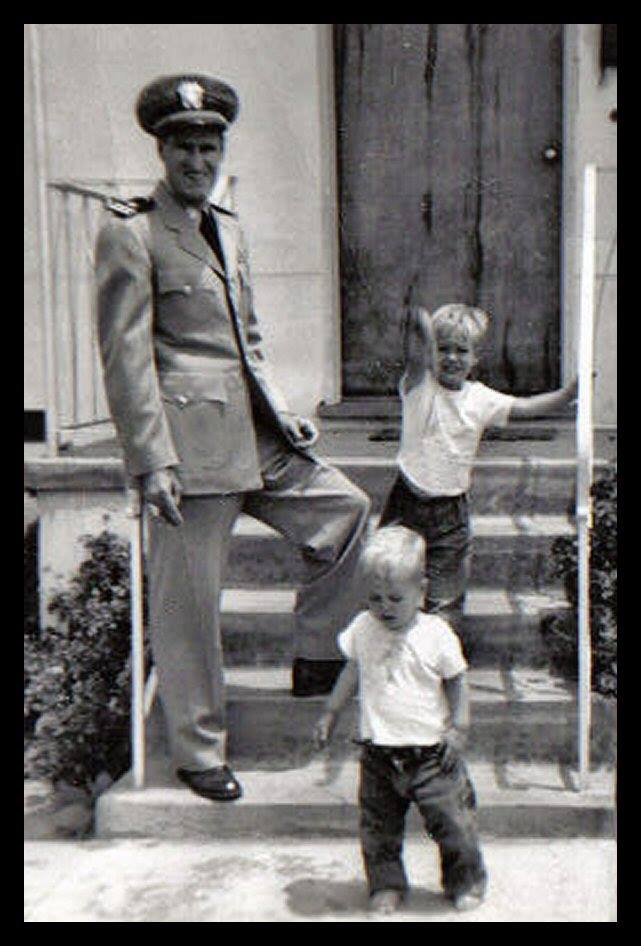
I come from a long line of warriors. My grandfather, Samuel V. Bell Sr., served in WWI, my brother, Christopher Allen Bell, served in Viet-Nam, and my father, Samuel V. Bell Jr., served in Korea. This Veterans Day I pay special tribute to my father, Lt. Commander Samuel V. Bell Jr., who served in the United States Navy for 22 years.
According to his unpublished auto-biography, Commander Bell saw action as a young man on seas off the coast of Korea where he fought the North Koreans and the Chinese. He and his ship, the USS Zellars, provided support for General Douglas MacArthur’s 10th Army Corps which consisted of 50,000 troops. He also participated in the opening of Wonsan Harbor on the East Coast of Korea.
Lt. Commander Samuel V. Bell Jr. entered the U.S. Navy in 1943 when he was seventeen. He was accepted into an officers training programmed and became a commissioned officer 1945 just as WWII was drawing to a close. He was at the Navy Ship Yards in Philadelphia when I was born in 1948 in Louisville, Kentucky. Two years later, my brother Chris was born, while my father was fighting the Chinese in Korea. This information and what follows was gleaned from a family scrapbook which was lovingly put together by his daughters and his grand daughters, Susan Bell, Whitney Vale, Lisa Bell, and Summer Sneed.
Served on the following ships and duty Stations:
• 1945-1946 USS Tarawa – Aircraft Carrier
• 1947-1949 USS Joseph P. Kennedy, Jr. – Destroyer
• 1950-1951 USS Zellars – Destroyer
• 1953-1956 USS Norton Sound – Experimental Missile Ship
• 1956-1957 China Lake, California – Guided Missile Unit 25
• 1958-1961 Norfolk, Virginia, Staff of Amphibious Group, Atlantic Fleet
• 1962-1963 USS Columbus, Guided Missile Cruiser
• 1963-1964 General Electric, Pittsfield, Mass. Technical Advisor on Navy’s Polaris Submarine Ballistic Missile program
Awarded the following Medals:
• American Campaign Medal
• WWII Victory Medal
• Commendation Medal with Combat
• Navy Occupation Medal
• China Service Medal
• Korean Service Medal with 4 Battle Stars
• United Nations Service Medal
• Korean Presidential Unit Citation
• American Defense Service Medal
In 1964 He retired from the Navy and began his second career at University of Louisville teaching electrical engineering. He retired from teaching in 1995 and lives in Louisville, Kentucky where he is cared for by his family.
As the saying goes, old soldiers never die, they just fade way. My father’s light is not burning as bright as it once was but still it burns. He will be remembered for his impact on his family’s lives, his service to his country, and for the values he always projected: Courage, honor, and duty. Raised during the so called Great Depression, he was a hard-working man who taught me the value of hard work and discipline. We salute you, Dad, on Veterans Day!
Lightghts up to dim. There are two chairs located center stage. Rev. Billy and Jimmy Joe Starter are sitting in the chairs in silhouette.)
ANNOUNCER: (Disembodied voice) Good evening, ladies, and gentlemen, and welcome to MEET THE REVEREND! A thirty-minute question and answer show where issues of national importance are discussed with prominent individuals from our society and the world at large.
Our guest this evening will be former president, Jimmy Joe Starter from Monkey’s Eyebrows, Kentucky…and to start the questioning will be the host of our show- Reverend Billy Bob Weatherspoon of the Space Chapel of Life.
Reverend Billy…
(Lights up full)
REV. BILLY: (Rises from his chair and crosses down center to address the audience directly) Thank you, Fred. Friends, I want to welcome y’all here to my new weekly show, MEET THE REVEREND! I’m sure y’all are going to enjoy it. I know I am. And be sure to tell all your friends and relatives to tune in too and just keep those contributions rolling in…cause ya know, it cost so much money to appear on TV and it cost so much money to spread the word…and friends you all know how much I like to spread the word.
And now…I’d like to welcome our guest, President Jimmy Joe Starter! (Crosse back to centers and resumes sitting across from Jimmy Joe Starter).
President Starter…
JIMMY JOE: Please…call me Jimmy Joe.
REV. BILLY: Why I’d be happy to Jimmy Joe…and you can call me Rev. Billy.
JIMMY JOE: Okay Reverend Billy. Ya know, I’ve got a brother named Billy. He’s kind of the black sheep of the family. Of course, when we were growing up back in Monkey’s Eyebrows, we always used to call him the goat. You know Billy Goat…that’s because he’d eat anything he’d put his hands on. I’d be going, “Now Billy, don’t be going putting your hand on that. Well, as you can imagine it got pretty embarrassing sometimes. (Big smile)
REV. BILLY: Monkey’s Eyebrows…Now that’s a strange name for a town. I wonder…I wonder if you could shed some light on that for us, Jimy Joe. Just why do they call your town Monkey’s Eyebrows?
JIMMY JOE: (Blank stare) Ya know…I don’t rightly know…but I’ll be glad to look that up for you and get back to you sometime next week.
REV. BILLY: No, that won’t be necessary Jimmy Joe. Now, Jimmy Joe, what would you say was the biggest surprise of your administration? Was it anything as surprising as the Iran/Contra affair or Ollie North and Fawn Hill? Or what about the current fiasco with Donald Trump and the Big Lie? Not to Mention January 6th?
JIMMY JOE: Well, Billy, I’d say the biggest surprise was that the job was going to be as hard as it turned out to be. Ya know, when I first took office back in ’76, 1976, not 1776, (Big Smile) I thought the presidency was going to be a snap, but I soon learned that it was going to be more of a Zbigniew Brezenski. Then things sort of went on the Fritz after I gave America the Lance-thank God for Vance- he was a real credit to the arms race. So, I’d have to say that my biggest surprise was that it was going to be so hard.
REV. BILLY: Have there been any other surprises?
JIMMY JOE: Well, yes. Another surprise was that there were so many bathrooms in the Whitehouse.
REV. BILLY: Bathrooms?
JIMMY JOE: Yes, Billy. There are some 46 of them, and all of them are inside too! I never did get around to using all of them, but I did commission a white paper…or was that toilet paper… No, it was a white paper, on how one could accomplish this task during one administration. I’ll be glad to get back to you later with the results of that study if you like.
REV. BILLY: No, that won’t be necessary. Tell me, Jimmy Joe, what do you think of the current situation in Ukraine with the Russian invasion and all in light of your own SALT II Treaty which you negotiated with the Ruskies?
JIMMY JOE: Yes…I’m proud of my record on SALT. The most significant part of that agreement was to trade Amarillo, Texas for Leningrad in the event of a first strike situation involving nuclear weapons.
REV BILLY: Would you gentlemen have seriously considered offering a Russian an Amarillo?
JIMMY JOE: Yes…We believed that using this small Texas town as a bargaining chip would be in the best interest of the country.
REV. BILLY: Do you hold out any hopes of stopping or at least curbing nuclear proliferation?
JIMMY JOE: Yes…What I plan to do is…
REV. BILLY (interrupting) Before you answer that question, let me break way for a message of vital importance…
(WINGES SERAPHS COMMERCIAL. Crosses stage right to a prop table where the book is staged. Light fades on center stage as a spot comes up on Reverend Billy at the table where he delivers his commercial speech)
REV: BILLY: Hello friends. Rev. Billy Bob Weatherspoon here for the Space Chapel of Life…
Ya know…just how many times have ya wondered how many angels could dance on the top of a Bic Butane Lighter?
Have ya ever wondered where ya could find a Guardian Angel when ya really needed one?
And what about Charlies Angels?
…The answers to these and many more important questions may be found in my latest book—
WINGED SERAPHS I HAVE KNOWN
This book is available in both the hard and soft editions. Also, available is the leather-bound edition which comes suspended from a chain.
So ya don’t forget, send now to
SPACE CHAPEL OF LIFE
BOX 666
ANAHEIM, CALIFORNIA
$8.96 RECORDS
$9.96 TAPES
And now, back to the show…
(Crosses back to the center and resumes sitting across from Jimmy Joe Starter. Light fades out at right and comes up center).
Okay, Jimmy Joe, now we can continue the fascinating conversation about the wonderful world of weapons.
JIMMY JOE: Yes, as I was saying, I support the introduction of legislation by congress that would make it a federal crime to own a nuclear weapon if you are a convicted felon, drug addict, or legally insane. Also, we hope to register all nuclear weapons. In this way, we will know who has them and we will have additional control over who gets them.
In addition, I am proposing an outright ban on the most insidious nuclear device of them all, the Saturday Night Special. These small, concealable radiation-enhanced devices are capable of taking out small targets such as single-family dwellings with little or no blast damage to the surrounding area. These weapons are, however, a very “dirty weapon,” spreading deadly radiation for many square blocks killing all life forms within the size of oh, say, Fort Knox. These devices would make the riots of the 60s look like pep rallies. (Big smile.)
REV. BILLY: Well, Jimmy Joe, you certainly paint a grim picture. What are your feelings about the peaceful use of nuclear energy, say as an alternative energy source?
JIMMY JOE: Well, Billy…I feel that nuclear power will most likely be the energy source of the future, along with solar power and wind. Eventually, we will run out of coal. We are going to run out of oil, but according to leading experts, we won’t run out of matter for several thousand years…and being a nuclear physicist myself, I ain’t just whistling Dixie (Big Smile).
REV. BILLY: As a scientist, I wonder if you could comment on the recent UFO controversy.
Jimmy Joe: Yes, Billy, I have myself, seen a UFO…it was a close encounter of the weird kind.
Rev. Billy: You have??!! Well, Jimmy Joe…that’s truly an amazing statement. Would you care to elaborate?
JIMMY JOE: Sure. You see, I was on my farm back in Kentucky, plowing a field on a tractor when all of a sudden, a shadow fell over me and I looked up and there was this strange craft hovering overhead.
REV. BILLY: Wow! Was it big?
JIMMY JOE? Big? I’ll say!
REV. BILLY: Well, how big was it?
Jimmy Joe: It was big I tell ya! (Starts gesturing with his hands and arms) It was a hunnert foot, by a hunnert foot, by a hunnert foot, you know BIG!
REV. BILLY: (Interrupts for a commercial): Excuse me Jimmy Joe, but we need to fit in a break.
(YOU TOO CAN BECOME AN ORDAINED MINISTER COMMERCIAL. Rev Billy crosses to the prop table again to deliver the net commercial. Light fade center and come up on the table).
Friends! You too can become an ordained minister! Through the special powers invested in me…you can become an ordained minister in the Space Chapel of Life – think of it friends – for only $6.95 you can save souls – perform miracles – perform marriages – perform funeral services – and perhaps the best advantage of all – tax-exempt status – That’s right folks, you heard it here tax-exempt status! – so ya don’t forget, send $6.95 today for your credentials to: Space Chapel of Life, Box 666, in care of this Television station – Thank you so much!
(Crosses back center and resumes interview. Lights fade at the table and come up at center.)
…and now, please continue on with this alleged story about beings from outer space.
JIMMY JOE: Well like I was saying, there I was out there on God’s little acre, plowing my fields and minding my own business when there appeared up in the sky a giant alien spacecraft. It was just hovering overhead, and it let out a slight humming noise, and all of a sudden it emitted a beam of light and the light fell over me and bathed my entire body and the next thing I knew I was being pulled off my tractor up into that beam of light and heading towards the spacecraft… that’s the last thing I remember until the next day when I was returned to earth and there I was, as naked a Jaybird in my ‘backer field, singin’ my fool head off!
REV. BILLY: Yes, well isn’t that special. Well, Jimmy Joe, we are just about out of time, here, and as you know, time is money. I would however like to ask you just one more two-part question. Number one, are you really a born-again Christian? And part two, have you ever really had lust in your heart?
JIMMY JOE: Well Billy, I don’t really feel that these two are mutually exclusive – In answer to your first question. Yes, I am a Born-again Christian; and in answer to your second question, yes, I have had lust in my heart…but it was lust for another Christian.
REV. BILLY: Well, there you have it, friends! Right from the former president’s own mouth. I’d like to thank President Starter for taking time out of his busy schedule to be with us tonight, and I’d like to invite all of you to tune in next week to another exciting episode of, MEET THE REVEREND! My next week’s guest will be that silly old buffoon and darling of the media, Attorney Michael Cohen! Watch him drop a dime on his former boss, Donald J. Trump!
(Jimmy Joe exits. Rev. Billy crosses down center).
And now, my friends, comes a very special part of our show, the hour of power. During this period of the show, I would like to take a few moments to demonstrate the power of our Lord and say a few words and lay a few hands.
(Lights dim)
Announcer: And now, ladies and gentlemen, I present to you, Reverend Billy Bob Weatherspoon, in all his magnificent glory, preaching to you all on the word of the Lord coming to you straight from our studios here in the Space Chapel of Life. Reverend Billy!
(Lights up full)
REV.BILLY: Good evening, friends – This is Rev. Billy Bob Weatherspoon here and I want to welcome you all here to Space Chapel. It’s so good to see ya! I’m so glad ya could make it out this evening. Ya know, we are all brothers and sisters on this spaceship we call mother earth, hurtling through space at thousands of miles an hour – why, when you think about it, it’s quite a miracle. It’s a miracle we don’t all fall off!
Now, my friends, we are gathered here this evening to worship Jesus – Oh Sweet Jesus – praise the Lord! But I need your help.
Now, give me a “Praise the Lord!”
(Pause for the response)
Now give me a “Hallelujah!”
(Pause for the response)
Now give me an “Amen, brother!”
That’s wonderful! God is with us here tonight! Can you feel him my friends? Can you feel the power of the Lord?
Now, my friends, I’ve got so much to tell ya! I’ve got so much to tellya! I’m going to tell you about communism. It’s everywhere!
I’m, going to tell ya about fascism. It’s everywhere!
And friends, the worst evil of all, Socialism! Why, I’d rather be dead, than red!
Wouldn’t you?
And I’m going to tell ya bout Satan. Satan is an all-pervading evil force that lives right here in our very midst. It’s Satan that makes you go out on Saturday night and sow your wild oats. It’s Satan that makes ya come to church on Sunday morning and pray for crop failure. It’s Satan that makes us tell lies. Satan is the master of lies. And it is Satan that leads us into temptation. We have to tell Satan to get behind us. Say, “Get behind me Satan! Get Behind me Satan!” Why, I believe that is Satan behind me right now…He’s a sneaky little devil! He will creep up on ya when you least suspect it.
But mostly, I want to tell ya about our Sweet Jesus – and after the service is over, I’m going to ask you all to come forward and accept Jesus as your personal savior.
But before that, my favorite part of our service – We are going to play a little game that I think you will enjoy. It’s called “Stump the Choir.”
If any of you in the congregation can name a hymn our choir cannot sing, then you are going to win dinner for four at the Last Supper. Judas his Seven Piece of Silver will be playing for your listening enjoyment.
Now, it’s time for a miracle – Praise the Lord! I feel the power of the lord coursing through my body. Who needs a miracle? Bring me you afflicted, bring me your sick, bring me your wounded. Let the Blood of Jesus make you whole again. Who needs the hand of the Lord? Who needs to be healed? Don’t be shy – come forward.
(Someone from the audience, the actor who played Jimmy Joe Starter, stumbles forward with his arms extended)
BLIND MAN: Rev. Billy! Rev. Billy! Can you help me? I cant’ see! I’ve been blind since birth!
REV. BILLY: Why yes! Come on up her young man! (Speaking in tongues, waving his arms about, placing his hand on the blind man’s shoulder.). Son, do you feel the power of the Lord? Do feel the power?
BLIND MAN: (Nods his assent)
REV. BILLY: There are none so blind as those who will not see! (Places his hand on the Blind man’s forehead. Pushes him away and throws his hands into the air)
BLIND MAN: (Drops his cane) I can see! I can see! It’s a miracle! (Runs off stage)
REV BILLY: All right young man. Go and sin no more. And while you are at it, go up to the bar and bring me back a drink. That was quite a miracle!
I’d like to finish tonight by singing along with the choir an old favorite of mine, “Save a Place in the Light Bulb For me.” This song has a lot of meaning to me. And while we sing along, I would like to ask for your generous contributions to the Space Chapel of Life so that we can continue our important work. Please be generous my friends, please be generous! And now, like I said, “Save a place in the light Bulb for Me.”
(The actor who played the Blind man now comes on stage to a microphone and plays acoustic guitar and sings the song: “Save a place in the Light Bulb for Me.”)
SINGER: (Singing) Save A SPACE IN THE Lightbulb For Me (Lyrics by Daniel Buddha Hildenbrandt)
Leave me room for my couch and tv
Well don’t worry about the weather
Just as long as we’re together
Save a space in the lightbulb for me
Weather started getting rough
Went to turn the gas on
Lit a match, stuck it in the hatch
Blew me to Saskatchawan
Save A SPACE IN THE Lightbulb for me
Leave me room for my couch and tv
Well don’t worry about the weather
Just as long as we’re together
Save a space in the lightbulb for me
Sheila’s such a pretty girl
Sure knows how to use it
If I get a hold of what she’s got
I’m afraid I might abuse it
Save A SPACE IN THE Lightbulb for me
Leave me room for my couch and tv
Well don’t worry about the weather
Just as long as we’re together
Save a space in the lightbulb
Don’t forget the right bulb
Save a space in the lightbulb for me
REV. Billy: This concludes this evening’s service…Thank you very much and may God bless!
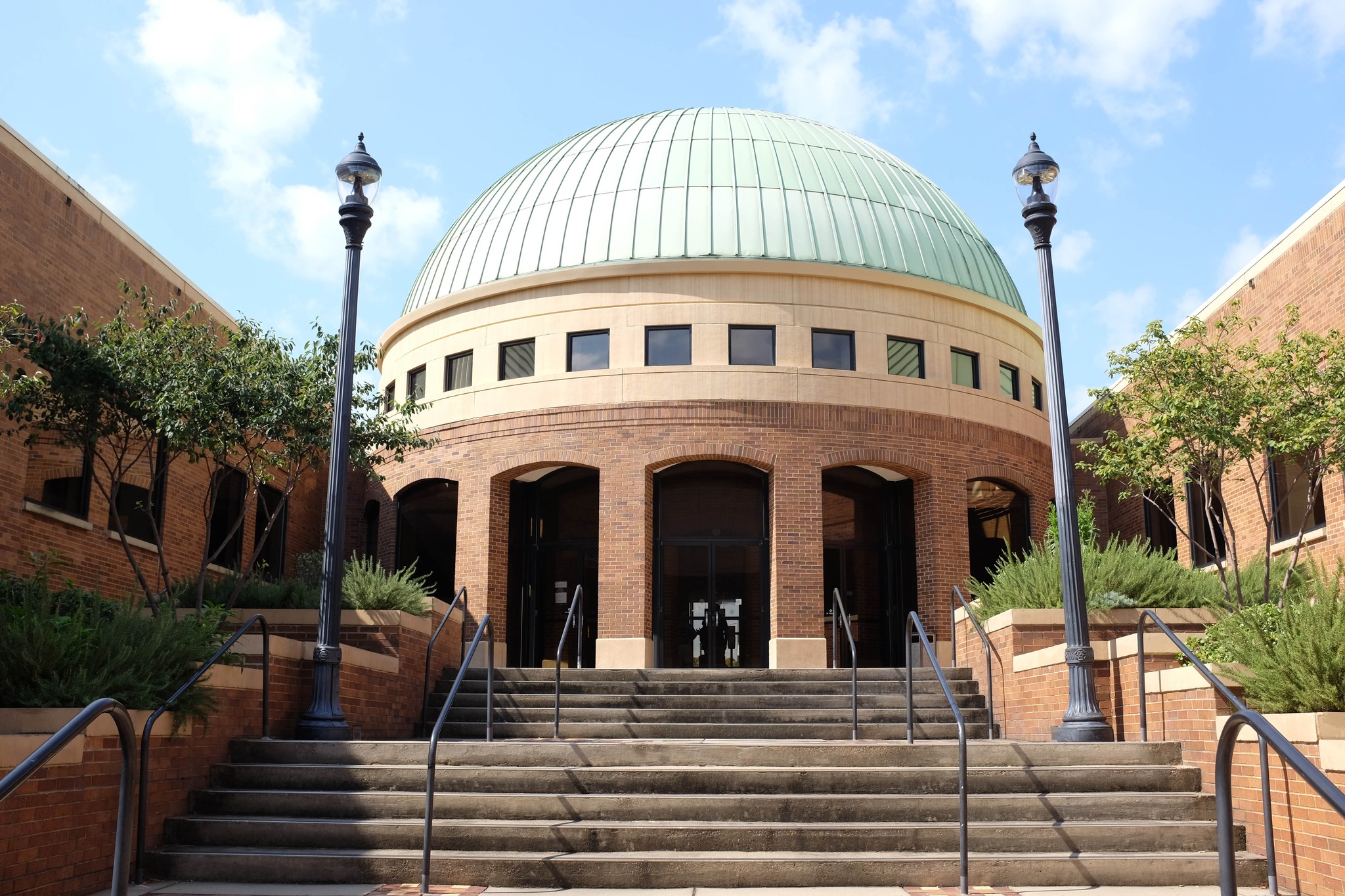
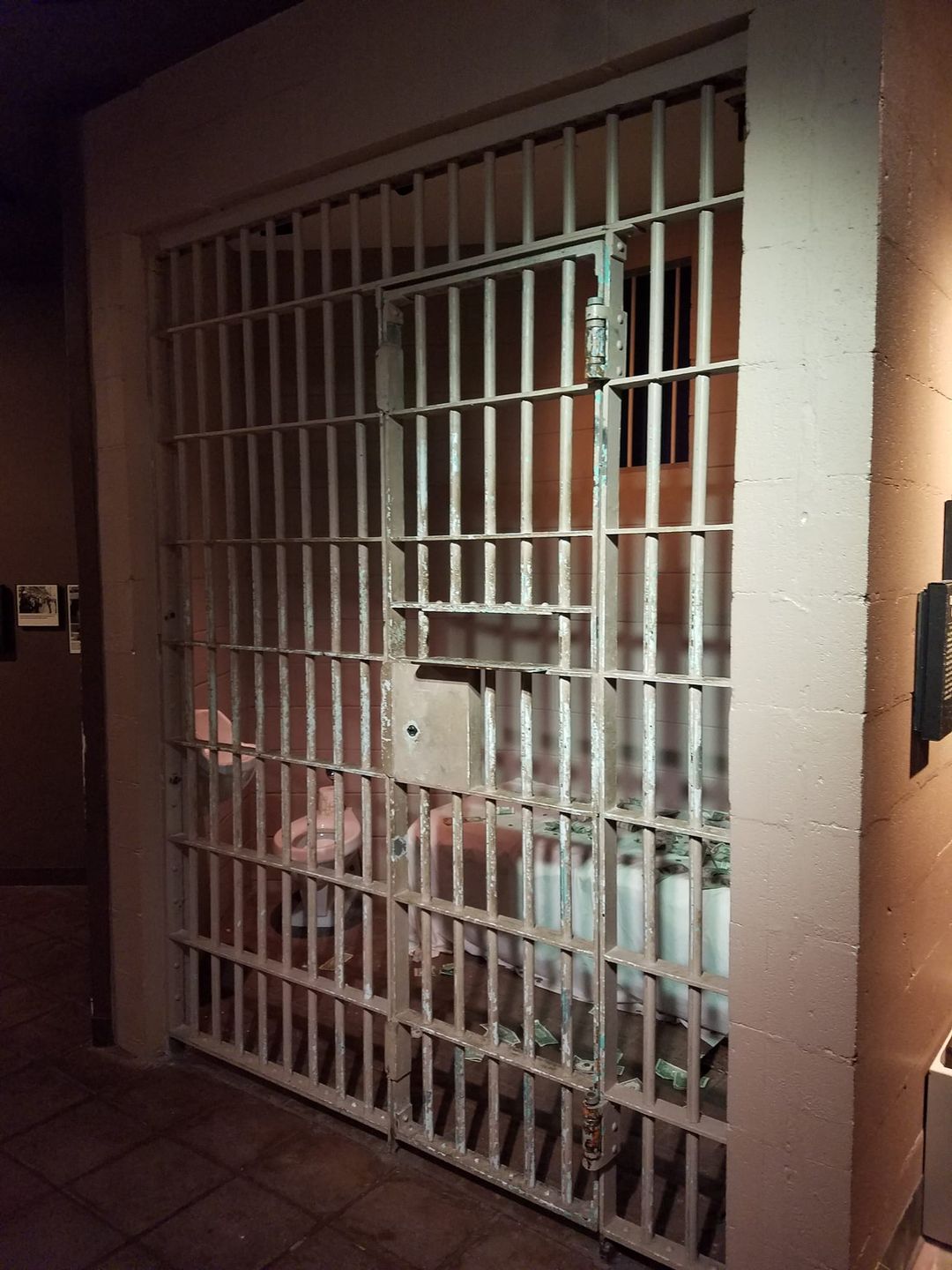
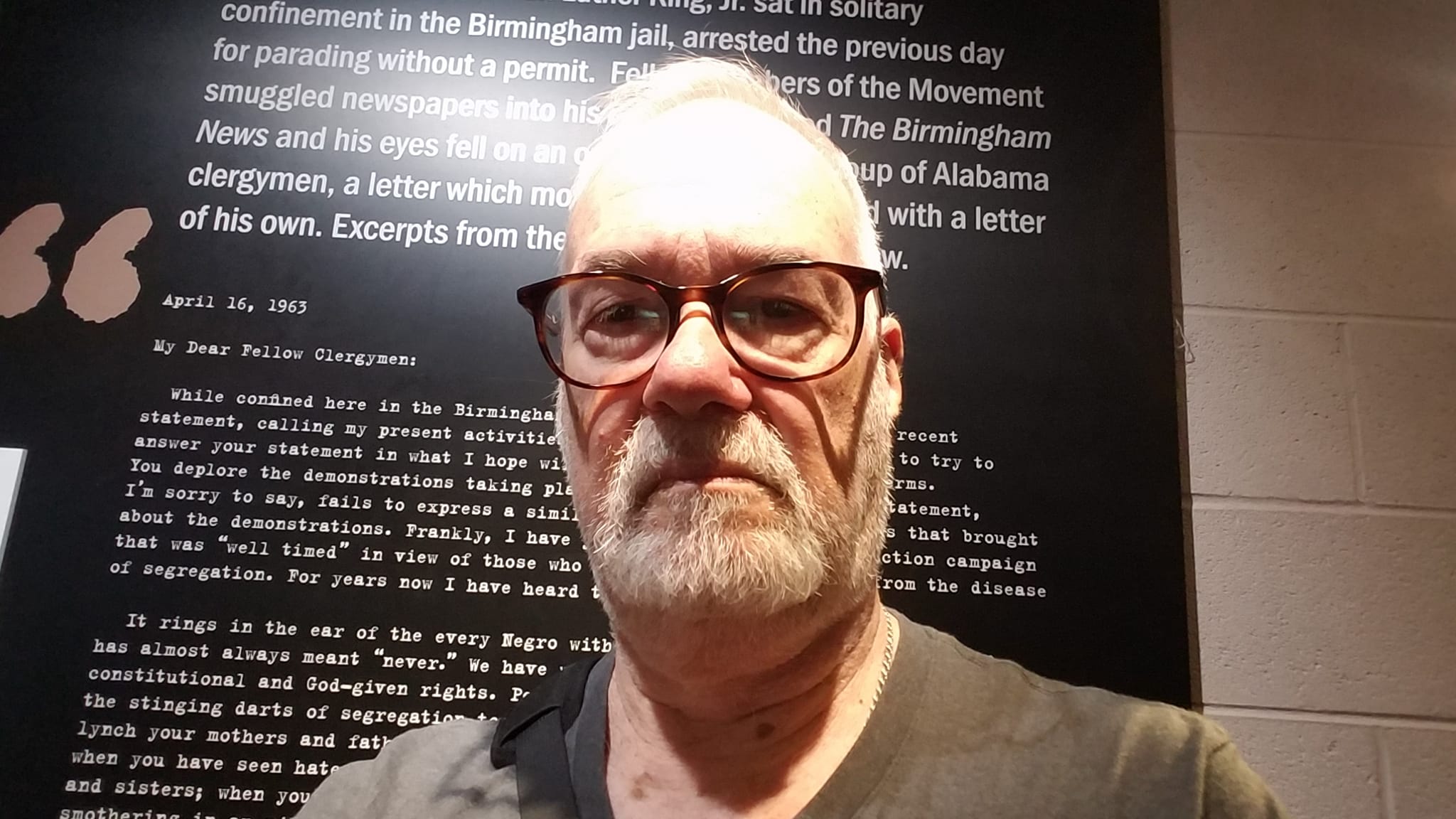
On a recent trip to Birmingham I visited the Birmingham Civil Rights Institute. Across the street from the Institute on the side is the 16ths Street Baptist Church. Directly across the street on the front side is Kelly Ingram Park. This complex is steep in the history of Birmingham and the Civil Rights movement in this country.
16th Street Baptist Church
The 16th Street Baptist Church in Birmingham, Alabama, was bombed by white supremacist terrorists on September 15, 1963. Four members of the Ku Klux Klan planted 19 sticks of dynamite attached to a timing device beneath the steps on the east side of the church.
There were four girls were killed in the attack: Addie Mae Collins, Cynthia Wesley, Carole Robertson, and Carol Denise McNair, and between 14 and 22 other people were injured.
Martin Luther King Jr. described the bombing as “one of the most vicious and tragic crimes perpetrated against humanity.”
The 16th Street Baptist Church bombing marked a turning point in the United States during the civil rights movement and contributed to support for the passage of the Civil Rights Act of 1964 by Congress.
In the years leading up to the 16th Street Baptist Church bombing, Birmingham had earned a national reputation as a tense, violent, and racially segregated city, in which racial integration was met with violent resistance. Martin Luther King Jr. described Birmingham as “probably the most thoroughly segregated city in the United States.”
Four Spirits
The Four Spirits sculpture was unveiled at Kelly Ingram Park on September 2013 to commemorate the 50th anniversary of the 16th Street Church bombing. The sculpture was crafted by Birmingham-born sculptor Elizabeth MacQueen and designed as a memorial to the four girls killed in the bombing. It depicts the four girls in preparation for the church sermon at the 16th Street Baptist Church in the moments immediately before the explosion. The youngest girl killed in the explosion (Carol Denise McNair) is depicted releasing six doves into the air as she stands tiptoed and barefooted upon a bench another barefooted girl (Addie Mae Collins) is depicted kneeling upon the bench, affixing a dress sash to McNair; a third girl (Cynthia Wesley) is depicted sitting upon the bench alongside McNair and Collins with a book in her lap. The book depicts a refrain from William Butler Yeats’ poem, The Stolen Child. The fourth girl (Carole Robertson) is depicted standing and smiling as she motions the other three girls to attend their church sermon. At the base of the sculpture is an inscription of the name of the sermon the four girls were to attend prior to the bombing—”A Love that Forgives.”
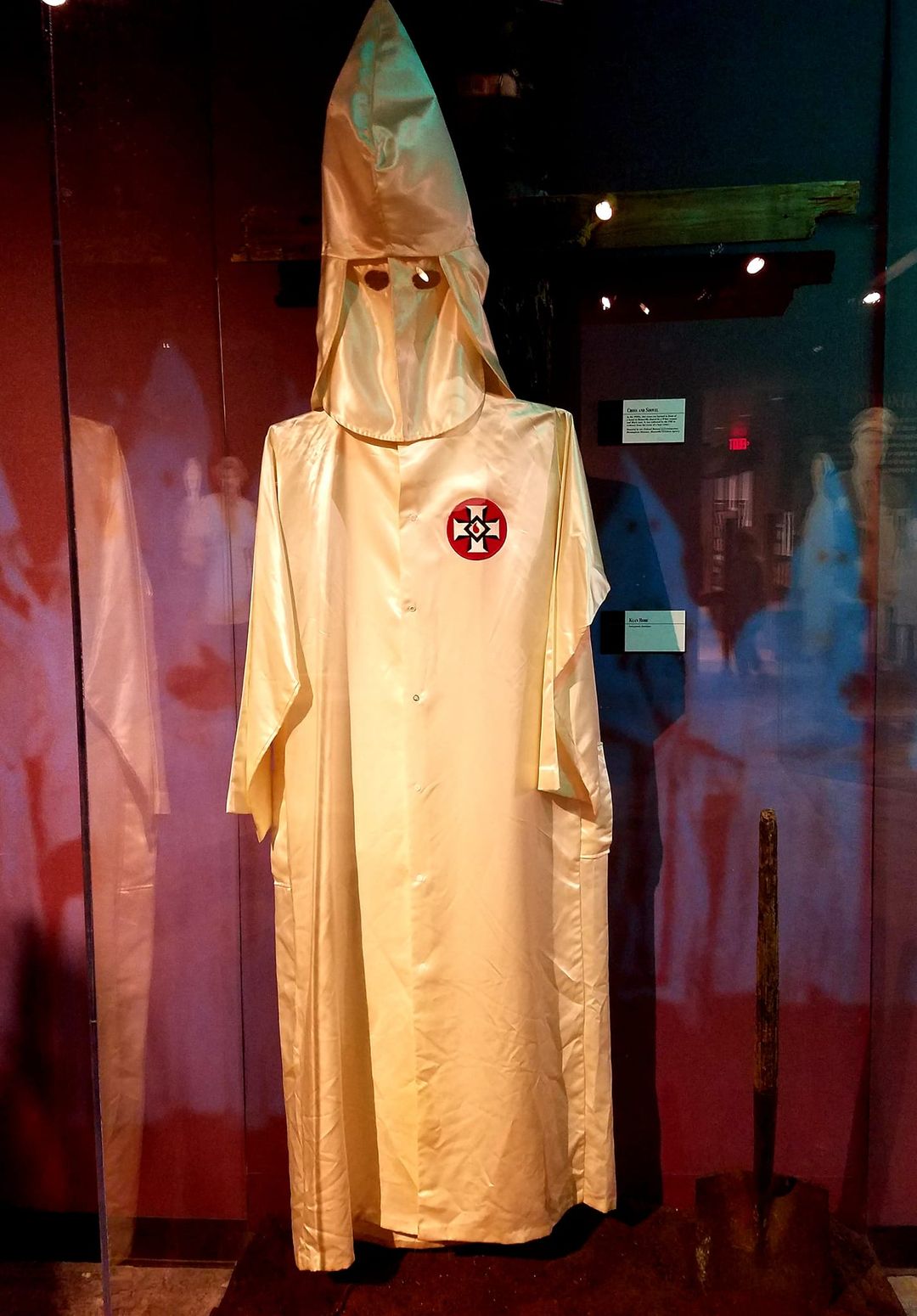
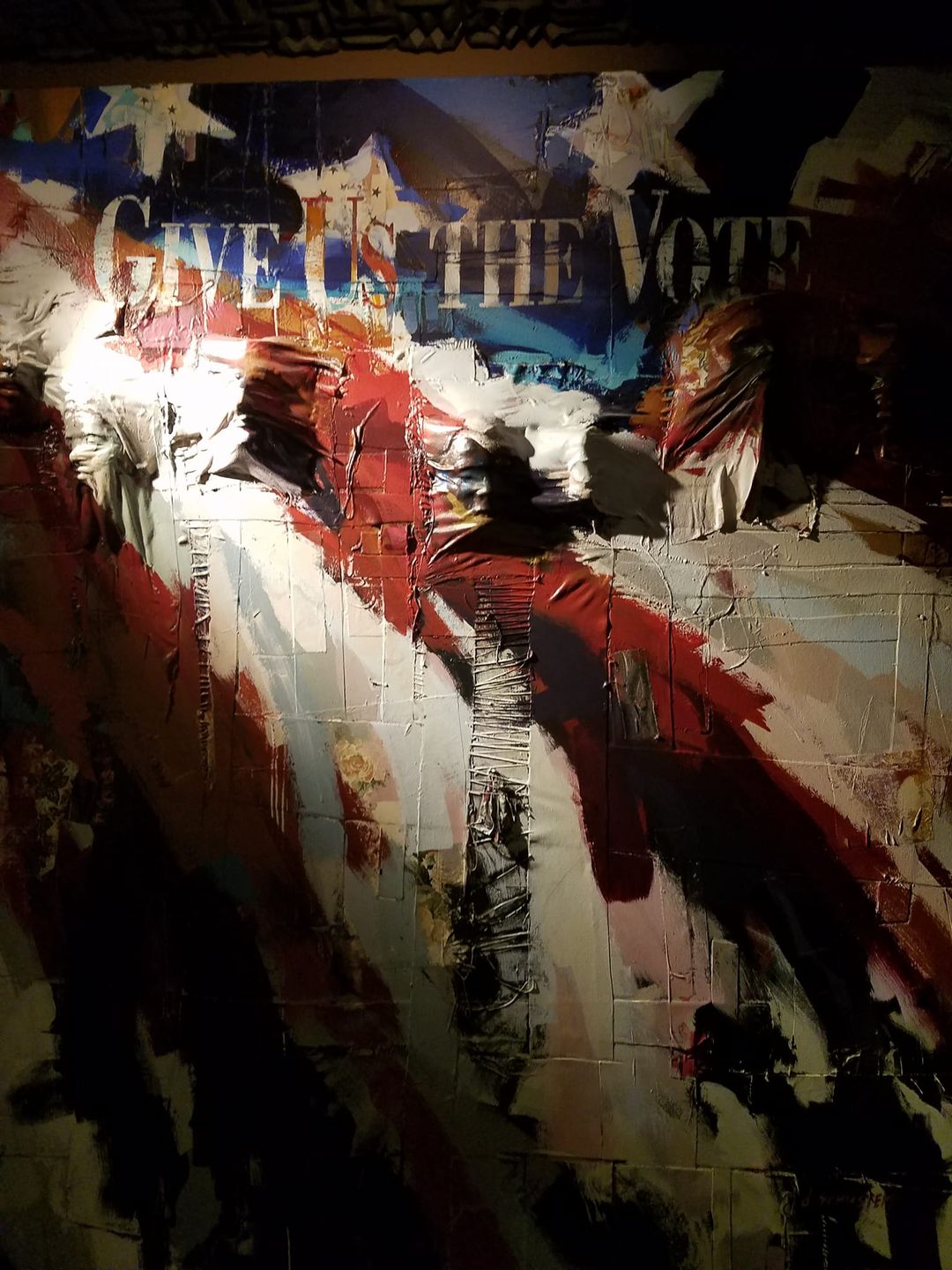
Birmingham, the world is watchingKlan RobeGive us the Vote!White People Only – Rosa ParksBirmingham JailLetter from the Birmingham Jail written by Martin Luther King Jr.Telling the TaleJoy to the World
My visit was quite a history lesson. It is one I believe everyone should be aware of and, in my opinion should be taught in schools all across America and not covered up. Those who do not learn history are doomed to repeat it.
ANNOUNCER: Good evening, ladies, and gentlemen, and welcome to MEET THE REVEREND! A thirty-minute question and answer show where issues of national importance are discussed with prominent individuals from our society and the world at large.
Our guest this evening will be former president, Jimmy Joe Starter from Monkey’s Eyebrows, Kentucky…and to start the questioning will be the host of our show- Reverend Billy Bob Weatherspoon of the Space Chapel of Life.
Reverend Billy…
REV. BILLY: Thank you, Fred. Friends, I want to welcome y’all here to my new weekly show, MEET THE REVEREND! I’m sure y’all are going to enjoy it. I know I am. And be sure to tell all your friends and relatives to tune in too and just keep those contributions rolling in…cause ya know, it cost so much money to appear on TV and it cost so much money to spread the word…and friends you all know how much I like to spread the word.
And now…I’d like to welcome our guest, President Jimmy Joe Starter!
President Starter…
JIMMY JOE: Please…call me Jimmy Joe.
REV. BILLY: Why I’d be happy to Jimmy Joe…and you can call me Rev. Billy.
JIMMY JOE: Okay Reverend Billy. Ya know, I’ve got a brother named Billy. He’s kind of the black sheep of the family. Of course, when we were growing up back in Monkey’s Eyebrows, we always used to call him the goat. You know Billy Goat…that’s because he’d eat anything he’d put his hands on. I’d be going, “Now Billy, don’t be going putting your hand on that. Well, as you can imagine it got pretty embarrassing sometimes. (Big smile)
REV. BILLY: Monkey’s Eyebrows…Now that’s a strange name for a town. I wonder…I wonder if you could shed some light on that for us, Jimy Joe. Just why do they call your town Monkey’s Eyebrows?
JIMMY JOE: (Blank stare) Ya know…I don’t rightly know…but I’ll be glad to look that up for you and get back to you sometime next week.
REV. BILLY: No, that won’t be necessary Jimmy Joe. Now, Jimmy Joe, what would you say was the biggest surprise of your administration? Was it anything as surprising as the Iran/Contra affair or Ollie North and Fawn Hill? Or what about the current fiasco with Donald Trump and the Big Lie? Not to Mention January 6th?
JIMMY JOE: Well, Billy, I’d say the biggest surprise was that the job was going to be as hard as it turned out to be. Ya know, when I first took office back in ’76, 1976, not 1776, (Big Smile) I thought the presidency was going to be a snap, but I soon learned that it was going to be more of a Zbigniew Brezenski. Then things sort of went on the Fritz after I gave America the Lance-thank God for Vance- he was a real credit to the arms race. So, I’d have to say that my biggest surprise was that it was going to be so hard.
REV. BILLY: Have there been any other surprises?
JIMMY JOE: Well, yes. Another surprise was that there were so many bathrooms in the Whitehouse.
REV. BILLY: Bathrooms?
JIMMY JOE: Yes, Billy. There are some 46 of them, and all of them are inside too! I never did get around to using all of them, but I did commission a white paper…or was that toilet paper… No, it was a white paper, on how one could accomplish this task during one administration. I’ll be glad to get back to you later with the results of that study if you like.
REV. BILLY: No, that won’t be necessary. Tell me, Jimmy Joe, what do you think of the current situation in Ukraine with the Russian invasion and all in light of your own SALT II Treaty which you negotiated with the Ruskies?
JIMMY JOE: Yes…I’m proud of my record on SALT. The most significant part of that agreement was to trade Amarillo, Texas for Leningrad in the event of a first strike situation involving nuclear weapons.
REV BILLY: Would you gentlemen have seriously considered offering a Russian an Amarillo?
JIMMY JOE: Yes…We believed that using this small Texas town as a bargaining chip would be in the best interest of the country.
REV. BILLY: Do you hold out any hopes of stopping or at least curbing nuclear proliferation?
JIMMY JOE: Yes…What I plan to do is…
REV. BILLY (interrupting) Before you answer that question, let me break way for a message of vital importance…
(WINGES SERAPHS COMMERCIAL)
REV: BILLY: Hello friends. Rev. Billy Bob Weatherspoon here for the Space Chapel of Life…
Ya know…just how many times have ya wondered how many angels could dance on the top of a Bic Butane Lighter?
Have ya ever wondered where ya could find a Guardian Angel when ya really needed one?
And what about Charlies Angels?
…The answers to these and many more important questions may be found in my latest book—
WINGED SERAPHS I HAVE KNOWN
This book is available in both the hard and soft editions. Also, available is the leather-bound edition which comes suspended from a chain.
So ya don’t forget, send now to
SPACE CHAPEL OF LIFE
BOX 666
ANAHEIM, CALIFORNIA
$8.96 RECORDS
$9.96 TAPES
And now, back to the show…
Okay, Jimmy Joe, now we can continue the fascinating conversation about the wonderful world of weapons.
JIMMY JOE: Yes, as I was saying, I support the introduction of legislation by congress that would make it a federal crime to own a nuclear weapon if you are a convicted felon, drug addict, or legally insane. Also, we hope to register all nuclear weapons. In this way, we will know who has them and we will have additional control over who gets them.
In addition, I am proposing an outright ban on the most insidious nuclear device of them all, the Saturday Night Special. These small, concealable radiation-enhanced devices are capable of taking out small targets such as single-family dwellings with little or no blast damage to the surrounding area. These weapons are, however, a very “dirty weapon,” spreading deadly radiation for many square blocks killing all life forms within the size of oh, say, Fort Knox. These devices would make the riots of the 60s look like pep rallies. (Big smile.)
REV. BILLY: Well, Jimmy Joe, you certainly paint a grim picture. What are your feelings about the peaceful use of nuclear energy, say as an alternative energy source?
JIMMY JOE: Well, Billy…I feel that nuclear power will most likely be the energy source of the future, along with solar power and wind. Eventually, we will run out of coal. We are going to run out of oil, but according to leading experts, we won’t run out of matter for several thousand years…and being a nuclear physicist myself, I ain’t just whistling Dixie (Big Smile).
REV. BILLY: As a scientist, I wonder if you could comment on the recent UFO controversy.
Jimmy Joe: Yes, Billy, I have myself, seen a UFO…it was a close encounter of the weird kind.
Rev. Billy: You have??!! Well, Jimmy Joe…that’s truly an amazing statement. Would you care to elaborate?
JIMMY JOE: Sure. You see, I was on my farm back in Kentucky, plowing a field on a tractor when all of a sudden, a shadow fell over me and I looked up and there was this strange craft hovering overhead.
REV. BILLY: Wow! Was it big?
JIMMY JOE? Big? I’ll say!
REV. BILLY: Well, how big was it?
Jimmy Joe: It was big I tell ya! (Starts gesturing with his hands and arms) It was a hunnert foot, by a hunnert foot, by a hunnert foot, you know BIG!
REV. BILLY: (Interrupts for a commercial): Excuse me Jimmy Joe, but we need to fit in a break.
(YOU TOO CAN BECOME AN ORDAINED MINISTER COMMERCIAL)
Friends! You too can become an ordained minister! Through the special powers invested in me…you can become an ordained minister in the Space Chapel of Life – think of it friends – for only $6.95 you can save souls – perform miracles – perform marriages – perform funeral services – and perhaps the best advantage of all – tax-exempt status – That’s right folks, you heard it here tax-exempt status! – so ya don’t forget, send $6.95 today for your credentials to: Space Chapel of Life, Box 666, in care of this Television station – Thank you so much!
…and now, please continue on with this alleged story about beings from outer space.
JIMMY JOE: Well like I was saying, there I was out there on God’s little acre, plowing my fields and minding my own business when there appeared up in the sky a giant alien spacecraft. It was just hovering overhead, and it let out a slight humming noise, and all of a sudden it emitted a beam of light and the light fell over me and bathed my entire body and the next thing I knew I was being pulled off my tractor up into that beam of light and heading towards the spacecraft… that’s the last thing I remember until the next day when I was returned to earth and there I was, as naked a Jaybird in my ‘backer field, singin’ my fool head off!
REV. BILLY: Yes, well isn’t that special. Well, Jimmy Joe, we are just about out of time, here, and as you know, time is money. I would however like to ask you just one more two-part question. Number one, are you really a born-again Christian? And part two, have you ever really had lust in your heart?
JIMMY JOE: Well Billy, I don’t really feel that these two are mutually exclusive – In answer to your first question. Yes, I am a Born-again Christian; and in answer to your second question, yes, I have had lust in my heart…but it was lust for another Christian.
REV. BILLY: Well, there you have it, friends! Right from the former president’s own mouth. I’d like to thank President Starter for taking time out of his busy schedule to be with us tonight, and I’d like to invite all of you to tune in next week to another exciting episode of, MEET THE REVEREND! My next week’s guest will be that silly old buffoon and darling of the media, Attorney Michael Cohen! Watch him drop a dime on his former boss, Donald J. Trump! Until then, I wish all of you a pleasant good night, and may Glod bless.















 Ghost Dog