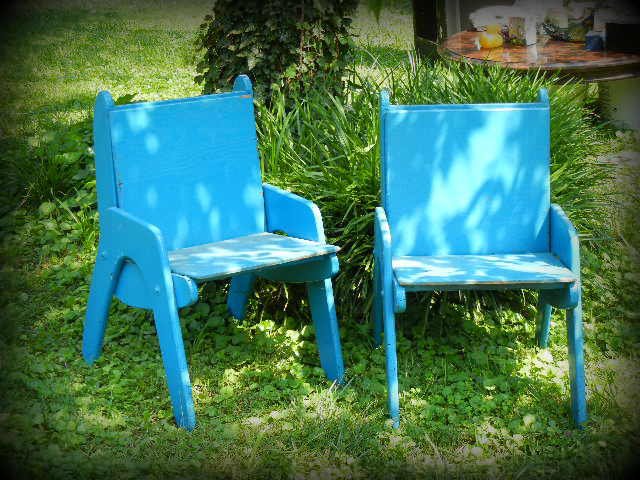
The Tragedy of the Chairs

My Photo

I have been reading Eugene Ionesco’s The Chairs – A Tragic Farce, in the service of a play that I am writing called, The Tragedy of the Bull. Ionesco because he is a master of the Theater of the Absurd. Absurd because my play is existential. Existential in the sense that life is meaningless and man’s relationship to life is absurd. I often read other plays when I am writing for inspiration. Now, here is where the tricky part comes in. This play was written in 1950. I have never read it before. Many eerie similarities are revealed in The Chairs that are relevant to my life and my play. For instance, here is a bit of dialogue from The Tragedy of the Bull:

                                                                  OLD MAN

Do you believe in coincidence, Maria?

                                                                   MARIA

I have heard of coincidences, senor, but no, I don’t really believe in them.

OLD MAN

Neither do I. But I do believe in synchronicity. I connect the dots and look for patterns and when I see them, I pay attention. They are like signposts guiding my way. And that is what ultimately led me here. To you. Tonight.                 

MARIA

What are you talking about?

                                                                   OLD MAN

I have a picture of Silvia Morales in my apartment that was painted by my friend Diane Kahlo.       

                                                                     MARIA

Oh, that is a coincidence, Old Man.

                                                                    OLD MAN

You must let me march with you. I will carry the portrait of Silvia Morales in the parade while marching by your side.

                                                                     MARIA

Si. I think it is a good idea senor. We will march together.

The main character in my play is named Old Man. The main character in The Chairs is named Old Man. The conversation between the Old Man and Maria is about coincidence and synchronicity. That is what I found to be strange about some of the references in The Chairs besides the fact the two main characters have the same name. There are other points of synchronicity.

Such as: The Old Man in the Chairs claims to be a general factotum. He makes a running joke of it as if he is an actual general. Part of the essence of the absurd is the contradictory construction of the language. Words used together that have the opposite meanings. Here’s where the coincidence comes in. For years I have claimed to be a “factotum” as a joke. I put it in my bios, and it is on my Facebook page.  I originally got the idea from a book I read by Charles Bukowski entitled, Factotum. There is also a movie based on the book of the same title starring Matt Dillon. I, of course, identified with the main character and to a certain extent Charles Bukowski himself and I adopted the name “factotum” for myself. Years ago.

What else? There are other points of synchronicity that I will reference, although the whole play seems oddly familiar.  First, the Old Man says, “It’s all a marvelous dream.” This is the main theme of The Tragedy of the Bull. Most of the play is a dream sequence The Old Man is having while he dies. One of my characters says, “Truth and illusion, Ron, you don’t seem to know the difference.”  This indicates that what we are seeing might be a dream or an illusion.

The Old Man says, “I’m proud of it…proud and humble.”

Another one of my stock phrases is, “I’m right happy, humble, and proud to be here…” I say this whenever I am called upon to make a speech. I love the contradictory paradoxical nature of the construction of it. How can you be proud and humble at the same time? Brilliant! Now, I stole this saying directly from a past governor of Texas who always began his speeches, “I am right happy, humble, and proud to be here tonight.” Governor John Connely. When I first heard him say that I was tickled pink. I’m not sure he realized the irony of it, but I sure did and I have been using it ever since. For years.

The Old Man says, “In order to forget I went in for sports…for mountain climbing. I wanted to travel, I wanted to cross the river, they burned my bridges.” I was never one for sports but I did like the sport of Mountain climbing. I have done quite a lot of hiking and I have claimed some modest mountains. On my bucket list has always been MT. Kilimanjaro.  Traveling has also been my passion and I have traveled extensively around the world. And lastly, I have crossed many rivers. I have lived for years along the Ohio and the Delaware Rivers.

Coincidence? I think not. Like Maria, I don’t believe in coincidence. But I do believe in Synchronicity. After three points of synchronicity are chalked up on the board, I see a pattern and from that pattern, I derive a meaning. It is perhaps the only meaning I find in a meaningless universe.

The Poetry of William Butler Yeats (1865-1939)

A Critical Review

wp-1492866262901.jpg

William Butler Yeats is widely considered to be one of the greatest poets of the 20th century. He was the winner of the Nobel Prize for Literature 1923. He had the gift for enchanting the ear. His themes were: Life and Death, Love and Hate, man’s condition, and the meaning and patterns of history.

The poems present images and magical incantations that resonate deeply with the reader apart from their literal meaning.  Hear the music…visualize the pictures they project. Yeats considered himself to be one of the last Romantic poets. The element of song is always present in his works. Everywhere the theme of music and singing recurs constantly.

He believed that certain patterns or cycles of civilization existed throughout history, the most important being what he called gyres, interpenetrating cones representing mixtures of opposites of both a personal and historical nature portrayed as rotating gyres forever whirling into one another’s centers, merging, and then separating. Yeats used the term “gyre” in his most famous poem, “The Second Coming.”

“Turning and turning in the widening gyre

The falcon cannot hear the falconer”

He contended that gyres were initiated by the divine impregnation of a mortal woman, first, the rape of Leda by Zeus, then later, the immaculate conception of Mary. Yeats found that within each 2000 year era, certain symbolic moments of balance occurred at the midpoints of the 1000 year cycle designating moments of high achievement in the culture. Yeats cited as examples the glory of Athens at 500 B.C., Byzantium at 500 A.D., and the Italian Renaissance at 1500  A.D.

Certain patterns of history recur that are entirely indifferent to human suffering. History, like art, teaches us that only through identification with the impersonal can we transcend human suffering and limitations. A symbol of this transcendence for Yeats was the Byzantine Civilization. Byzantium became for Yeats the purest embodiment of the union and subsequent transfiguration through art of the fleshly condition and the ideal of holiness. (Byzantium is the name given to both the state and the culture of the Eastern Roman Empire in the middle ages. Istanbul is now the name of what was formally called Constantinople, the empire’s capital city).

He was a symbolist poet, using allusive imagery and symbolic structures throughout his career. He chose words that, in addition to a particular meaning, they suggested abstract thoughts that may seem more significant and resonant. His use of symbols is usually something physical that is both itself and a suggestion of other  possibly immaterial and  timeless qualities.

Yeats employed the continental stanza and used straightforward syntax. He wrote in iambic pentameter which is a line of verse with five metrical feet, each consisting of one short (unstressed) syllable) followed by one long (stressed) syllable. For example: “Two households, both alike in dignity.” He also used what is known as the heroic couplet, which is a pair of rhyming iambic pentameters. This is a traditional form of English poetry used for epic and narrative poetry.

Yeats was 62 when he wrote, “Sailing to Byzantium.”

Sailing to Byzantium, by William Butler Yeats

I

That is no country for old men. The young

In one another’s arms, birds in the trees,

—Those dying generations—at their song,

The salmon-falls, the mackerel-crowded seas,

Fish, flesh, or fowl, commend all summer long

Whatever is begotten, born, and dies.

Caught in that sensual music all neglect

Monuments of unageing intellect.

II

An aged man is but a paltry thing,

A tattered coat upon a stick, unless

Soul clap its hands and sing, and louder sing

For every tatter in its mortal dress,

Nor is there singing school but studying

Monuments of its own magnificence;

And therefore I have sailed the seas and come

To the holy city of Byzantium.

III

O sages standing in God’s holy fire

As in the gold mosaic of a wall,

Come from the holy fire, perne in a gyre,

And be the singing-masters of my soul.

Consume my heart away; sick with desire

And fastened to a dying animal

It knows not what it is; and gather me

Into the artifice of eternity.

IV

Once out of nature I shall never take

My bodily form from any natural thing,

But such a form as Grecian goldsmiths make

Of hammered gold and gold enamelling

To keep a drowsy Emperor awake;

Or set upon a golden bough to sing

To lords and ladies of Byzantium

Of what is past, or passing, or to come.

Allusions and terminology

“Perne in a gyre”- a perne is a bobbin. A gyre is a circular motion. A perne in a gyre is your life spinning out before you.

“No Country for Old Men”, a title to a popular book by Cormac McCarthy and a popular movie by the Cohen Brothers

“The Dying Animal”, the title to a popular book by Philip Roth, and a popular movie made from the book.

“The Golden Bough” is from Roman Mythology. It was a tree branch that allowed Aenas to travel safely through the underworld guided by Sybil so that he could learn of the fate of his people. It is referenced in the epic poem he Aeneid by Virgil.

“God’s Holy Fire” is a miracle that occurs every year at the Church of the Holy Sepulchre in Jerusalem on Holy Saturday, the day preceding Easter. A blue light emanates within Jesus’ tomb which forms a column of fire from which candles are lit.

Byzantium, by William Butler Yeats

The unpurged images of day recede;

The Emperor’s drunken soldiery are abed;

Night resonance recedes, night-walkers’ song

After great cathedral gong;

A starlit or a moonlit dome disdains

All that man is,

All mere complexities,

The fury and the mire of human veins.


Before me floats an image, man or shade,

Shade more than man, more image than a shade;

or Hades’ bobbin bound in mummy-cloth

May unwind the winding path;

A mouth that has no moisture and no breath

Breathless mouths may summon;

I hail the superhuman;

I call it death-in-life and life-in-death.


Miracle, bird or golden handiwork,

More miracle than bird or handiwork,

Planted on the starlit golden bough,

Can like the cocks of Hades crow,

Or, by the moon embittered, scorn aloud

In glory of changeless metal

Common bird or petal

And all complexities of mire or blood.


At midnight on the Emperor’s pavement flit

Flames that no faggot feeds, nor steel has lit,

Nor storm disturbs, flames begotten of flame,

Where blood-begotten spirits come

And all complexities of fury leave,

Dying into a dance,

An agony of trance,

An agony of flame that cannot singe a sleeve.


Astraddle on the dolphin’s mire and blood,

Spirit after spirit! The smithies break the flood,

The golden smithies of the Emperor!

Marbles of the dancing floor

Break bitter furies of complexity,

Those images that yet

Fresh images beget,

That dolphin-torn, that gong-tormented sea.


 The Second Coming, by William Butler Yeats

Turning and turning in the widening gyre

The falcon cannot hear the falconer;

Things fall apart; the centre cannot hold;

Mere anarchy is loosed upon the world,

The blood-dimmed tide is loosed, and everywhere

The ceremony of innocence is drowned;

The best lack all conviction, while the worst

Are full of passionate intensity.


Surely some revelation is at hand;

Surely the Second Coming is at hand.

The Second Coming! Hardly are those words out

When a vast image out of Spiritus Mundi

Troubles my sight: somewhere in sands of the desert

A shape with lion body and the head of a man,

A gaze blank and pitiless as the sun,

Is moving its slow thighs, while all about it

Reel shadows of the indignant desert birds.

The darkness drops again; but now I know

That twenty centuries of stony sleep

Were vexed to nightmare by a rocking cradle,

And what rough beast, its hour come round at last,

Slouches towards Bethlehem to be born?

References

 Information for this article was gleaned from the flowing sources:

  1. William Butler Yeats, Selected Poems and Plays, Edited with and Introduction by M. L. Rosenthal
  2. The Poetry Foundation
  3. Wikipedia