Norwegian Wood

A Novel by Haruki Murakami

Norwegian Wood is the second Murakami book that I have read. The first one was Kafka on the Shore. I was looking for a second book to get into when I landed on Norwegian Wood. I understand that it is a bit of a departure from his other books, but that is ok because I really loved Norwegian Wood.  It was not what I was expecting, but it was perhaps better than what my expectations were. It is essentially a love story of a young man coming of age in Japan in the late 60s.

In Chapter one, Toru Watanabe hears the strains of the Beatles song, Norwegian Wood, as he lands at an airport in Hamburg, Germany. This song recalls to his mind the loves story of his youth in Tokyo when he was attending college. The rest of the novel tells that story.

In the telling, Murakami evokes the sights and sounds of the turbulent 60s, the songs of the period, the student unrest, and the pangs of falling in love. He has created some unforgettable characters, who by the end of the novel, we feel emotionally bonded to and care deeply about.

Spoiler alert!

There are five deaths in the novel, four suicides, and one illness. But the way Murakami tells it, they are played “off stage” and are referred to rather than happening on the page. This gives a little emotional distance from the deaths but never the less has a powerful impact. When Toru got word of Naoko’s suicide in the last chapter it was like a punch to the gut. I literally let out an, “Oh no!” and went on reading. I don’t usually cry at novels but this was an exceptionally gut-wrenching moment.

I started off by saying this was a love story, and so it was, but I think it was more a book about loneliness, mental illness, and suicide. But Murakami is such a beautiful writer the way he presents his story is not depressing, but quite beautiful and poignant.  I truly loved this novel.

Is that a Dagger I See Before Me?

The Tragedy of Macbeth (2021)

Denzel Washington and Frances McDormand in “The Tragedy of Macbeth,” Courtesy of Apple/A24

Macbeth, directed by Joel Coen and shot entirely on a sound stage, was certainly a sight to behold. It was filmed in luscious black and white giving the movie an instant classic look and taking the viewer out of the realm of reality and plunging them straight into the surreal and pathological world of the Thane of Cawdor.    

This was Joel’s first foray into film without his brother Ethan at his side and what a miracle of rare device it was. With his emphasis on camera angles, close-ups, medium shots, long shots, and long and dark shadows, I was reminded of past movies of film noir and German expressionism, such as the films of F. W. Murnau, Fritz Lang, and Orson Welles. The aspect ratio of 1.37:1, almost square, recalls the classic films of old.

The performances by all the actors were uniformly excellent. Frances McDormand put in a very solid performance as Lady Macbeth. One might quarrel with her interpretation but really, I don’t see how it could be improved. I thought Denzel Washington excelled in his role as Macbeth and both actors played well together. I loved what Coen did with the weird sisters, all three played by the diminutive Kathryn Hunter.

The overall piece was visually stunning, full of sound and fury, and filled with an abundance of symbology.

A very satisfying cinematic event. Highly recommend!

Psycho Blue Boots in the 3rd

Travels with Aunt Renie

Photo by the Author

Aunt Renie came to Louisville, Kentucky for a visit. It was in the spring of the year and nearing Derby Day, so I decided to take her out to Churchill Downs to watch the horses run.

We drove to south Louisville where the track is located and parked the car a few blocks away and walked the remaining distance to the track entrance. Aunt Renie is pretty spry for an old lady.

We were both able to get in for the admission price of only $1.00 as we were both senior citizens. Louisville likes to encourage its seniors to go to the track. We made our way through the throng of horseracing fans to a booth where they sell racing forms. I bought one and stuck it in my pocket. Then we walked out to the track and sat in the sun on hard benches and studied the form to make our picks.

We studied the racing form and saw that there was a field of eight horses for the next race. Aunt Renie had never been to a racetrack before so I had to teach her how to handicap the race. I am not an expert myself but here’s how I do it. The first thing I do is to study the form for the information listed about the horses for that particular race. First of all, I look for names I like. Something that clicks. Then, I look at the stats on that horse. Who is the trainer, who is the jockey, how much weight does the horse carry, how many races did the horse win this year, and last, what are the odds?

I take all these things into consideration and make a selection. I picked what looked like a winner: Psycho Blue Boots, the number 5 horse in the 3rd race. I suggested to Aunt Renie that we bet $10.00 to win on the 5 horse. If it won, we would split the winnings. She agreed.

I pushed my way through the crowd to the parimutuel window and placed my bet.

“$10.00 to win on the 5 horse in the 3rd race,” I said. The teller smiled, took my money, and punched my ticket.

The race was about to begin as was indicated by the trumpet call to the gate.  I hurried back to where Aunt Renie was sitting and showed her our ticket. Just then the announcer announced, “They’re off!” And the race began.

“On the lead was Solient Green, on the outside Golden Band. On the rail was Shiftless Joe followed by Psycho Blue Boots. Royal Pain was moving up to fourth place, Psycho Blue Boots makes a sudden move…They are in the turn, Royal Pain is in third. Psycho Blue Boots moving up on the outside…now moving in…in the stretch Psycho Blue Boots takes the lead…at the wire…Psycho Blue Boots wins by nose!”

The crowd goes wild. I go wild Aunt Renie goes wild. We are winners!

We won enough on the race we were able to celebrate at one of Louisville’s most prestigious steak houses, Jack Fry’s. We had quite a day at the races and a nice meal to boot.

The next morning, I took Aunt Renie to the airport where she resumed her travels.

Next stop, Amsterdam!

August Strindberg

Sunday. 2/6/2022. 2:58 pm Riot Café. Reading August Strindberg – Miss Julie and Other Plays. Notes to follow.

Riot Café. Photo by the author

The Red Room, A satirical novel written by Strindberg in 1879. It is not a far cry to go from Red Room to Redrum to Murder. Just saying.

“Strindberg’s naturalism is not a slice of life, but rather the intense, immediate drama associated with what he called, ‘the battle of the brains.’ This is fought, not with theatrical swords or daggers, but with the equally lethal mental cut and thrust of two implacably hostile minds, bound to each other by desire and hatred. It is a battle in which one of them ultimately destroys the other’s will and commits ‘soul murder.’” One is immediately put in mind of Edward Albee’s, Who’s Afraid of Virginia Woolf?

Indeed, Translator Michael Robinson makes the very same observation writing about, The Dance of Death, a play written by August Strindberg in 1900, as a depiction of a marital inferno. He cites the numerous critics who regard it as the forerunner to Eugene O’Neill’s, Long Day’s Journe into Night and Edward Albee’s, Who’s Afraid of Virginia Wolf?

Why read Strindberg today? Because he is as relevant today as he was in 1887.

Strindberg was one of the most extreme theatrical innovators of the late 19th century and ultimately the most influential. The five plays presented here mark his transition from naturalism to modernism.

In The Father, Strindberg shifts away from social and political questions towards more psychological writing. Strindberg was more concerned with the discussion going on in Scandinavia at the time about the “woman question,” sexual morality, marriage, and the shifting psychological states of his characters (Robinson).

The Father is a three-act play with eight characters. The two principal characters are the Captain and his wife, Laura. It is a naturalistic tragedy about the struggle between parents over the future of their child.

The Captain is a scientist and freethinker whose marriage has gone south. He is engaged in a power struggle with his wife, Laura, over their daughter who wants to keep the girl home under her own influence whereas he wants to send the girl away to school. In an attempt to dominate her husband and get her way, Laura decides to drive her husband insane by first insinuating that he is not the girl’s father. The mother (Laura), uses her cunning to subdue and finally destroy the father (The Captain).

Strindberg is a great purveyor of naturalism, but in The Father, he is reaching for “greater naturalism” which is intense, immediate, and associated with a battle of the brains. (Battle of the sexes, battle of wills). The two main characters can be seen as representing the male and female principles.             

Strindberg believed that life is a series of struggles between weaker and stronger wills.

What initially brought me to revisit Strindberg were the films of Ingmar Bergman. Always a big fan of Bergman I began to realize what an influence Strindberg had on the filmmaker. I began to do a little research and it turns out in his lifetime Bergman directed eleven Strindberg plays for the stage, eight for radio and two for television. He was responsible for altogether twenty-eight Strindberg productions. He often returned to the same plays, producing A Dream Play and The Ghost Sonata four times, The Pelican three times and Miss Julie, Playing with Fire and Stormy Weather twice.

My favorite Bergman movie is The Seventh Seal. It has many similarities to the play, The Saga of the Folkungs. They are both set in the 14th century, the plague is present and religion is a major component.

Sources:

  1. Michael Robinson, Translator, Introduction and Notes to Miss Julie and Plays by August Strindberg.
  2. Strindberg and Bergman, Egil Tornquist, November 2012

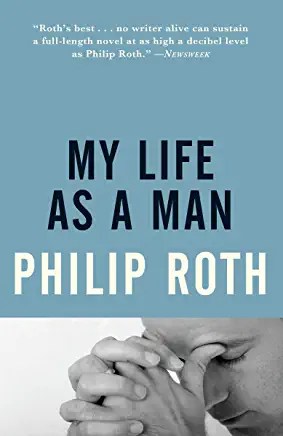
My Life as a Man

A Well-Known Seducer of College Girls

Image courtesy of Goodreads

My Life as a Man, a novel written by Philip Roth, comes from Roth’s middle period, after Goodbye Columbus and Portnoy’s Complaint, but before American Pastoral, I Married a Communist, and The Human Stain.  Roth has written some 30 odd books, not all of them odd but some pretty strange, and he is possibly America’s best writer, if not one of the most prolific. Beats me why he never won the Nobel, for he was surely deserving. 

I’ve read most of his later works and all of his earlier works and I am slowly catching up on his middle period. I don’t profess to be an expert on Roth, but I certainly like his writing I and return to him over and over again.

This book, My Life as a Man, is a story within a story, or two stories within a story, then Peter Tarnopol’s (narrator) true story. It concerns his marriage to Maureen Tarnopol who tricked him into marrying him and has become his arch-enemy. Maureen, in their divorce proceedings, described him as, “…a well-known seducer of college girls.”

Peter Tarnopol is a promising young writer who is also a college professor who teaches creative writing. He occasionally gets involved with his young students who become grist for his mill. He teaches literature and creative writing at The University of Wisconsin and Hofstra College on Long Island. He was a patient of Dr. Otto Spielvogel, a Manhattan psychoanalyst, from 1962-1967. Spielvogel considered Peter Tarnopol to be among the nation’s top young narcissists in the arts.

As usual, Roth draws from his own life and previous fiction and writes about what he knows best.

It is a rollicking satire teetering on the edge of tragedy as Roth brilliantly tells the tale of his marriage and his many peccadillos.

Roth writes in an attempt to make art out of his calamitous life and to spin gold out of straw. Is it him or his characters, or is it Memorex? You be the judge. For him, (Tarnopol), “…writing is a vain attempt to get myself to feel like something other than a foreigner being held against his will in a hostile and alien country.”

For Philip Roth, life is a Kafkaesque nightmare whereupon the dreamer ruminates on the possibility of being transformed into a gigantic cockroach. Upon awakening, he heeds the advice of Gustave Flaubert who suggests leading a regular and orderly life and being violent and original in his writing. This is a lesson Philip Roth seems to have taken to heart.

The History of the World, Part 1

According to Al

Al Mitchell, man of a thousand faces

Al: Cynthia is on her way.

Me: Cynthia is going to be late.

Al: Well, she had to…

Me: See a film at the Jewish Film Festival…Yeah, I know, I heard you say that three times already.

Al: (Laughing) Well. you know that’s what happens when you get old.

Me: Al, I’m five years older than you.

Al: (again, laughing) Well, sometimes it catches up to some of us faster than it does for everyone else!

Al Mitchell, man of impeccable taste

Another conversation with Al, including Maureen

Maureen: When I broke my foot, I had to wear a boot. I called it, the Black Boot of Death. God, I hated that thing!

Al: I know people who when they had to wear a boot on their foot, would get another one to wear on the other foot, just to balance it out.

Me: (Only half listening): Wait a minute! Who do you know that wore a second boot?

Al: (stammering) Well, I don’t remember their names….

Me: (Listening closer now): Come on Al, give me a name. Name one person you know that wore a second boot.

Al (Stammering and laughing) Hamada, hamada, hamada….Well, I might have just made that up.

Al Mitchell, never a dull moment

Me: You are damned right you made it up! Caught you, didn’t I? Because your story was preposterous!

Al and Me: (Laughing and clinking together our plastic glasses of red wine.)

Gringo Land

Photo by the author

I was sitting at a sidewalk table at a café in front of a large window, sipping my whisky and soda. I could watch the passersby on their way home. It was late and everyone had left the café except for me. A tree sat a few feet from me in a large round pot casting a shadow over the empty table sitting next to it. There was enough light to read by. I liked to sit late at night in this café and read and drink my whiskey and soda in peace. It was quiet now that all the other customers had left. There only remained two waiters, one old like me and the other young. The younger one seemed impatient to go home. Probably had a wife to go home to. That was not the case for me nor I suspect for the other waiter.

I noticed out in the street a young man and a pretty girl walking briskly by. I was entranced by the beauty of the girl and I was envious of the young man who was with her.

I signaled the waiter for another drink.

The younger waiter sauntered over.

“What will you have?”

“Another whisky and soda.”

“Don’t you think you’ve had enough, senor?”

I just looked at him. He went away to fetch the drink.

The two waiters were huddled together at a table near the door. They were whispering. Probably talking about me I thought. Probably want me to go. Well, I’m not ready to go.

The waiter went to the bar and poured a shot of bourbon into a tumbler of ice and spritzed it with soda water. He carried the drink outside to where I was sitting. He placed the drink in front of me and said, “Why don’t you just fuck off, old man?”

He probably thought I couldn’t hear what he was saying as I am practically deaf. But I hear well enough in a quiet environment.

The waiter went back into the café and sat down with his workmate. They began whispering again. Probably think I’m drunk and need to leave, I thought. Oh, well, I’ll stay a little longer and have one more for the road. 

I like this place. It is clean, well-lighted, and quiet.

I motioned to the waiters for another drink.

“Another whiskey and soda, amigo.”

“No,” the young waiter said. “You’re done. Time to go.”

“Another!” I insisted.

“We are closing now.” He began to wipe the table clean with his towel.

I slowly stood up, looked at the bill he had unceremoniously laid on the table.  I pulled some cash from my pocket and paid the bill, leaving a modest tip.

I walked down the street away from the café slowly, a bit unsteady on my feet. I could feel the eyes of the two waiters burning a hole in my back. I wasn’t ready to go home yet. I didn’t want to face my dark room and the empty bed. One more drink, I thought. There must be someplace open tonight. Only thing was, they would unlikely be as clean and well-lighted or as nice as this last one was. I didn’t want any music. No, I really wasn’t in much of a mood to listen to any music. And I didn’t really want to stand in front of a bar. What was it I wanted? Not much. Just a clean, quiet, well-lighted place.

I came to a bar that was open. It had red and white walls on the outside with an American flag hanging on one side of the entrance and a Mexican flag hanging on the other. There was music pouring out the door from a sound system hidden somewhere within the recesses of the tiny bar. Not really my kind of place, but I was thirsty, so I stumbled there inside.

There was a gentleman sitting on a barstool in the middle of the bar. A couple was sitting at a table towards the back. I went in and sat a couple of stools down from the guy at the bar.

“What would you like to drink?” asked the barmaid.

“Do you have any bourbon?” I asked.

“Si, we have Jim Beam.”

“OK. I’ll have that.”

She poured the drink and marked it on the bottle then set it down in front of me and went back to her perch she was sitting on. She was talking to the other guy, but he turned around and included me in the conversation.

“Hey! Where are you from?” he asked.

“From the States,” I answered.

“Well, I figured that. Where in the States?”

“Kentucky.”

He nodded his head. “I’m from Oregon. You been here before?”

“Yeah, I live here now.”

“A lot of ex-pats here, that’s for sure! I guess that’s why they call it “Gringo Land.”

He laughed. He had a bottle of beer sitting in front of him and a shot of tequila. He downed the tequila and chased it with a slug of beer.

The barmaid looked over in my direction and said, “Do you want to play a game?”

“What kind of a game?”

“It’s called 21. You roll the dice. There are three winners. One who calls the shot. One who pays, and one who drinks the shot. Do you want to play?”

“Sure, why not? Let’s play!”

So, we took turns rolling six or seven dice out onto the bar from a leather cup. Each time the barmaid counted the tops of the dice. I won the first roll so I called the shot.

“What shot do you want?” she asked, pointing to the bottles of tequila behind the bar.

“What are you drinking?”

She pointed to a bottle.

“OK. That’s what I want.”

She poured out a shot and set it on the bar in front of us. We rolled some more. First the guy from Oregon, then the barmaid. At the end of the game, the Oregon guy drank and paid for the shot I called. We all laughed and he left.

In the meantime, the other couple had left and there were only the two of us left in the bar. The barmaid and me. She walked over to where I was sitting.

She was dark and sloe-eyed with long black hair flowing over her shoulders. She was wearing a green plaid shirt with several of the top buttons undone, exposing her ample breasts.

“What’s your name, Gringo?” She smiled broadly.

“Phil,” I answered. “What’s yours?”

“Anna. At least that’s what I put on my Facebook page. You want another shot?”

“No thanks,” I said and then I left.  Now, I will go home. I will lie in my bed and try to fall asleep.  I will think of Anna and what it would be like to be with her. I am probably not the only one in town who has trouble sleeping at night, I thought to myself. Maybe I will dream of Anna. Maybe tomorrow I will find someplace to read. Maybe a quiet, clean, well-lighted place where I can sit and read in peace.

Driving to Berea

Road Trip

Miss Maureen and Miss Scarlett

Maureen and I recently went on road trip to Berea, Kentucky. We took Miss Scarlett, our newly acquired 1984 Porshe 994.

I said, “Maureen, why do you call your car, Miss Scarlett?”

“Because, I don’t give a damn, is why!”

Well, ask a foolish question…

Berea is a small Kentucky town known for it’s arts and crafts, it’s beautiful trail ways, and of course Berea College.

Berea College is tuition free, but the students have to work to earn their tuition. The hotel where we stayed is completely run and staffed by students. As a matter of fact, my own father attended Berea College when he was a young man and he too worked at the historic Boone Tavern and Hotel.

We visited the artisan village, walked around the college campus and one day I hiked the pinnacles while Maureen stayed behind and went shopping.

A very enjoyable stay only three hours from Louisville. We would definitely go back!

The Historic Boone Tavern
Hotel Lobby
A room in the Boon Tavern Hotel
The Cabin at the artisan village
Woodworking artisan at the Cabin
A shop in the artisan village
A loom in a shop in the artisan village
On the trail to the pinnacles
On the pinnacles
Living on the Edge
On a clear day you can see forever
Way over there

Maureen was drinking while I was hiking
Daniel Boone Trail from North Carolina to Kentucky 1775, Erected by the Kentucky Daughters of the Revolution 1915

All photos by the author.

The Seven Factors of Awakening

Buddhism by the Numbers

Japanese Gardens, Birmingham, Alabama. Photo by Benn Bell

The Seven Factors of Awakening

  1. Mindfulness
  2. Investigation of phenomena
  3. Diligence
  4. Joy
  5. Ease
  6. Concentration
  7. Letting go

“At least once every 15 minutes, we need to practice letting go. Bear in your heart no hatred, utter no unkind words, remain always compassionate, with no hostility or ill will. The Seven Factors of Awakening are the practices of love.” – Thich Nhat Hahn

If Wishes Were Horses

If Wishes were horses I’d get on and ride

If trouble was money, I’d be a millionaire

If frogs had wings, they wouldn’t bump their ass so much

If you can dream and not make dreams your master

If two are dead three can keep a secret

If not now, when?

If traveling was free, you’d never see me again

If I can stop one heart from breaking, I shall not live in vain

If I was your wife, I would poison your coffee.

If I was your husband, I would drink it.