Posse Comitatus

Trump wants to mobilize active duty U.S. military to attack peaceful protestors. This action would be unconstitutional, unlawful, and unconscionable. It is the action of a dictator and tyrant and a further degradation of our democracy. What Trump really wants is a race war.

What makes this illegal is the Posse Comitatus Act which states: Whoever, except in cases and under circumstances expressly authorized by the Constitution or Act of Congress, willfully uses any part of the Army or the Air Force as a posse comitatus or otherwise to execute the laws shall be fined under this title or imprisoned not more than two years, or both. The exception to this law is the Insurrection Act. But to use this there has to be an insurrection, and what is happening is clearly not an insurrection.

The Attorney General for New York, Letitia James, has stated, “We will not allow Donald Trump to dominate New York.”

Defense Secretary Mark Esper publicly disagreed with President Trump’s threatened use of the 1807 Insurrection Act. Speaking to reports at a recent Pentagon briefing Esper said, “The option to use active duty forces in a law enforcement role should only be used as a matter of last resort, and only in the most urgent and dire of situations. We are not in one of those situations now. I do not support invoking the Insurrection Act.”

In my view, any soldier asked to deploy to an American city to fight protestors and enforce the law has a duty to disobey this unlawful order.

LOVE KILLS

Instruments of death that fit snugly into the palm of your hand were gleaming dully in their showcases lovingly caressed by blue velvet. Oiled wooden handles jutted from solid blue-black bodies. There was a faint odor of oil and metal lingering on the air-conditioned atmosphere of the room. The soft sound of creaking leather reverberated through the reverential quiet as the clerk tenderly, ever so gently, eased a delicately balanced, but heavily weighted .357 magnum pistol out of its holster.  Firmly, but gently, he gripped the butt of the gun in his right hand. He placed the web of his thumb over the hammer of the awesome black revolver and slowly began to exert pressure on it. The man’s hands trembled slightly and he closed his eyes. Small beads of perspiration began popping over his upper lip. A little metal clicking noise emerged from the gun as the hammer went through it first cocking phase. A slight smile appeared on the lips of the clerk as he continued to pull back on the heavy hammer and another click emerged – the gun was half-cocked – the clerk began breathing heavily now and rapidly and his face grew flush. He slid his thumb to the edge of the hammer and applied the tip of it to the ridges cut deeply into the top edge. He pushed down hard and fully cocked the revolver. A tiny teardrop appeared in the corner of the clerk’s eye. The gap between the ridged head of the steel hammer and the body of the gun was a chasm. It looked like the jaws of a primordial reptile. It was powerful and it was frightening – the stored-up energy of the hammer begged to be released. He pulled the trigger. Snap! I jumped.  The hair on the back of my neck prickled and a shiver ran down my left arm. The clerk placed the gun back into its holster. He lit a cigarette, inhaled deeply and blew clouds of tobacco smoke across the room. He had a distant look in his eyes. I turned on my boot heels and walked out of the store into the bright afternoon sunlight.

House of Games (1987)

Movie Blurb

House of Games (1987)

Written and directed by David Mamet, starring Lindsay Crouse and Joe Mantegna. This movie was pretty much universally praised when it came out in 1987. It is currently rated 7.3 on IMBD. Roger Ebert, no less, rated it four stars out of four and gave it a glowing review. I’m going to give it a six out of ten.

While I liked the film, and had a favorable impression of it when I first saw it in 1987, I don’t feel like it stands the test of time. It is well crafted, but so is a finely made piece of furniture. I can see the seams and joints and that seems to take away from my overall impression. I want to get lost in the action of the picture and not see the woof and worf.

House of Games is about a den of con artists. And while it is fascinating to see the cons work their magic, I couldn’t help but notice seeing them coming. And it is hard to imagine the central character being so gullible, after having participating in a con herself, not seeing the con being played on her. But I guess that is the beauty of the con, it’s human nature to want to believe it.

Lindsay Crouse and Joe Mantegna in House of Games

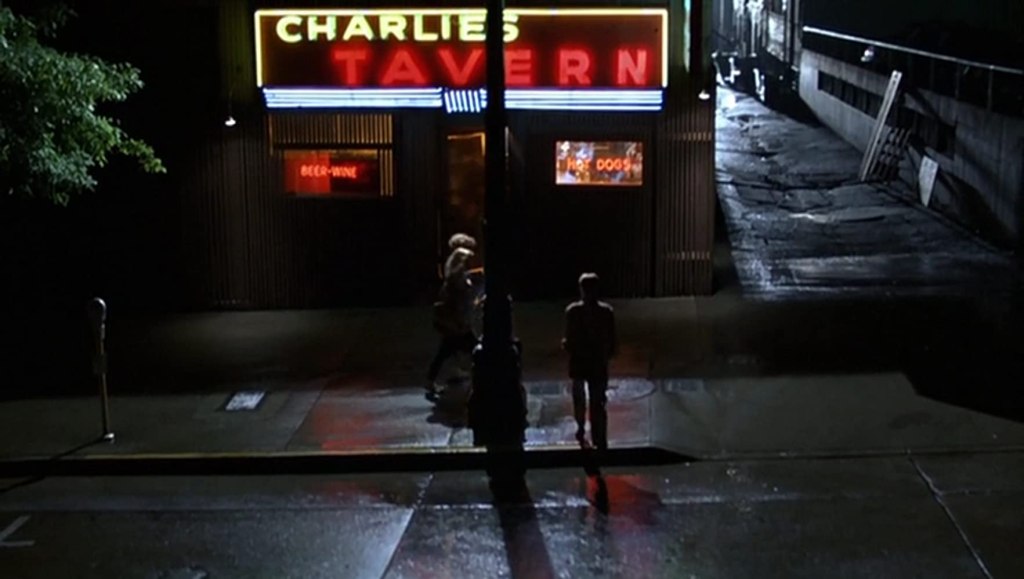
I loved how the film looked. Very noirish. Seattle at night with neon lights reflected in puddles of water and steam rising from man hole covers. Nice atmosphere!

Lots of Mamet’s patented rapid-fire dialogue, which can sound a little stilted and stagy at times.  If only Mamet had succeeded in conning me into believing what he was selling. He already conned me out of my money for the price of a ticket.

House of Games is part of the Criterion Collection and is available on Amazon.

Eugene Onegin, written by Alexander Pushkin (1799-1837)

wp-15899173769308512276441121568517.jpg

A challenge by Elisabeth from A Russian Affair

I am no literary scholar but I do like to play around the edges some. So, in the spirit of playing around the edges, I submit the following for your consideration.

First of all, I would like to thank Elisabeth for introducing me to Alexander Pushkin and this delightful verse novel, Eugene Onegin. I had of course, heard of Pushkin, but never read him. So, it was a pleasant surprise.

As I was reading, Eugene Onegin, I heard some echoes of Poe, and Shakespeare. There were of course, dozens of other literary references throughout the work, which were richly detailed in the appendix. I was put in mind of Poe’s, The Raven, and Shakespeare’s Hamlet. Although the meter was quite different, there were similarities such as the generous use of alliteration, the rhyming scheme and some of the same words rhymed. Poe and Pushkin were contemporaries and I could not help but wondering if their paths might have crossed or if one influenced the other. So, I did a little digging and found some interesting references.

There is an account of Poe and Pushkin mentioned in the novel, Time, Forward, by Soviet writer Valentin Kataev. The novel’s American character, Ray Roupe, says, “Certain of Pushkin’s poems had kinship with the stories of Edgar Poe, which is of course paradoxical, but quite explicable. When still a youth, Edgar Poe travelled to St. Petersburg on a boat. They say that in one of the taverns there he had met Pushkin. They talked all night over a bottle of wine and the great American poet made a gift of the plot, Man of the Crowd, to Pushkin.” So, I guess I wasn’t the only one who imagined that.

The Raven, by Edgar Allen Poe, has internal rhyming and a general rhyme scheme of ABCB BB. Meter is Trochaic Octameter which is one stressed syllable followed by one unstressed or Dum-da, Dum-da,  Dum-da.

Eugene Onegin consists of 366 14-line stanzas that more or less meet the definition of a sonnet but which serve as paragraphs in the verse novel. There are over 5000 lines of poetry. The meter is Iambic tetrameter. An iamb is a beat in a line of poetry where one unstressed syllable is followed by a stressed syllable, that sort of sounds like this: duh-DUH, duh-DUH, duh-DUH, duh-DUH with a rhyme scheme of ABAB; CCDD; EFFEGG

Here are some examples of similarities and references to Poe and Shakespeare:

Pushkin: “I’d seek to borrow – languid sorrow”(Chapter 3 Stanza 30)

Poe: “Vainly I had sought to borrow from my books surcease of sorrow.”

Tatyana’s letter to Onegin: “There’s no one else I adore. The heaven’s chose my destination and made me thine for evermore.”

“My life til now has been a token in pledge of meeting you, my friend, and in coming, God has spoken.

You’ll be my guardian in the end.”

Poe: “Nevermore” is used throughout The Raven. “That God we both adore,” “Leave no black plume as a token of the lie thy soul has spoken.”

Pushkin (Chapter 5 Stanza 11):

And what an awesome dream

She’s been dreaming

She walks upon a sunny vale

All around her dully gleaming.

Poe: “All the seeming of a demon’s that is dreaming.”

Pushkin: (Chapter 7 Stanza 15)

“…Of fisherman were dimly gleaming

Tatyana walked, alone and dreaming,”

Pushkin: (Chapter 8 stanza 20).

“Was this the Tanya he once scolded

In that forsaken, distant place?”


Poe: “By that Heaven that bends above us—by that God we both adore—

Tell this soul with sorrow laden if, within the distant Aidenn,”


Pushkin: “Our lives were weary, flat, and stale.” (Chapter 1 stanza 45)

Shakespeare: “The world is weary, stale, flat, and unprofitable.” (Hamlet, Act 1 scene 2)

Pushkin: “Poor Yorick!” (Chapter 2, stanza 37)

Shakespeare: “Poor Yorick!” (Hamlet, Act 5 Scene 1)


In Chapter 1 I became convinced Pushkin my have had a foot fetish:

“I love their feet-although you’ll find

That all of Russia scarcely numbers

Three pairs of shapely feet…And yet,

How long it took me to forget

Two special feet. And in my slumbers

They still assail a soul grown cold

And on my heart retain their hold.” (Chapter 1 stanza 30)

I also found it quite interesting that Pushkin foreshadowed his own death in his description of the duel with Lensky. That was a bit of a chill!

All in all a very fun read! Thank you again for this marvelous challenge!


pingback: https://wordpress.com/read/blogs/82358410/posts/967


The Juniper Tree (1990)

Movie blurb

Juniper Tree

The Juniper Tree (1990),  directed by Nietzchka Keene, starring Bjork, Bryndis Petra Bragadottir, and Valdimar Orn Flygenring.

This extraordinary film, based on a Grimm’s Fairy tale, is shot in Iceland, and takes place in medieval Iceland. The stark landscapes stand out brilliantly as photographed in delicious black and white. I see echoes of Bergman here but this is a truly unique film of women with supernatural powers.  Bjork is radiant in this her film debut as one of the sisters who has visions. Highly recommend!

Bjork

Un flic (1972)

Movie Blurb

un flic poster

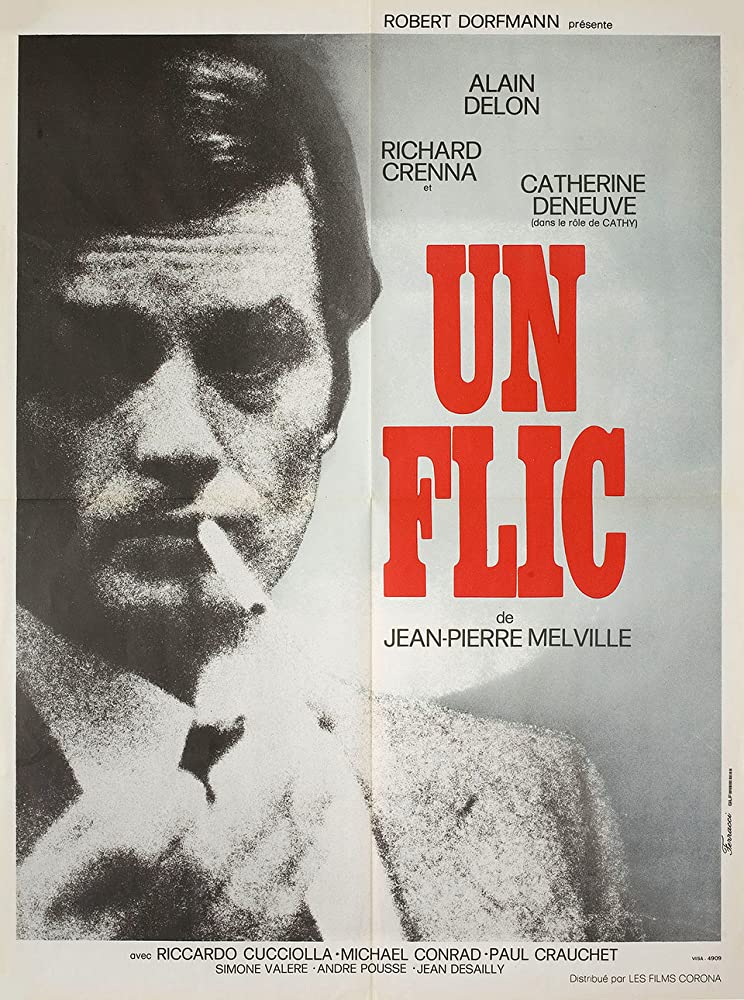
Directed by Jean- Pierre Melville, starring Alain Delon, Richard Crenna, and Catherine Deneuve.

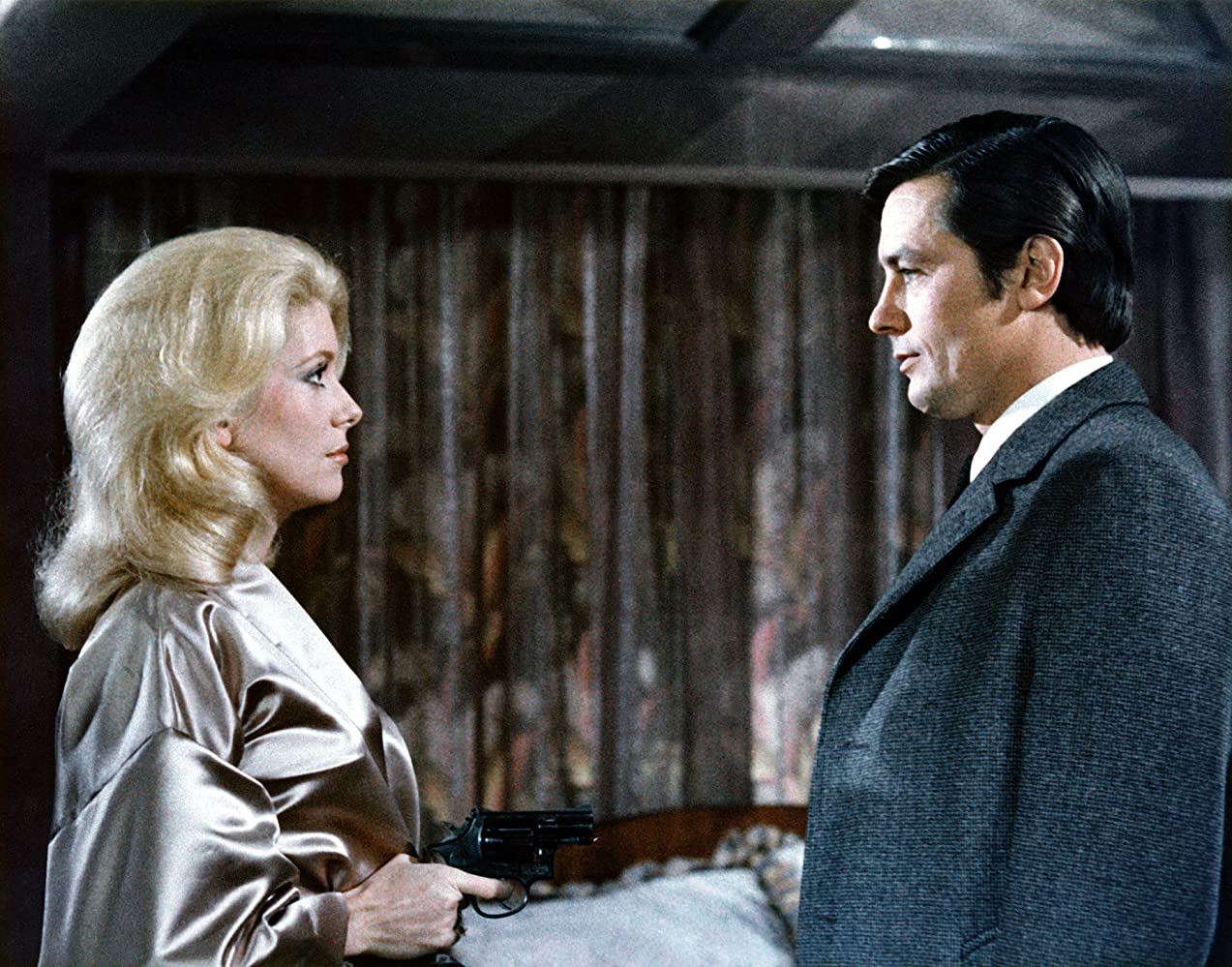
Un flic translates to “A cop,” but it is a heist movie that features the bad guys as well. Alain Delon is the icy cop who doesn’t mind issuing a slap across the face from time to time to gain cooperation. Richard Crenna is the mastermind criminal and nightclub owner. Catherine Deneuve, who is impossibly beautiful and completely vacuous in this role, is the femme fatale that each man is in love with.

Catherine

The movie starts with bank robbery in a small French town near the ocean on a foggy day. It is brilliantly conceived and executed with a minimum of dialogue.  Another set piece was a train robbery, which features lowering Richard Crenna onto a moving train and picking him up again from a flying helicopter overhead. Wow! Never saw anything like that. Models were used in the filming, but I didn’t care, it was still pretty exciting. When planning the train robbery, the gang calculated a time frame of 20 minutes. When the robbery actually takes place, the sequence is exactly 20 minutes long. Pretty impressive stuff. Not Melville’s best film, but it was his last, and definitely memorable!

un flic

Follies of God

Book Review

wp-15886835993568539113605201244016.jpg

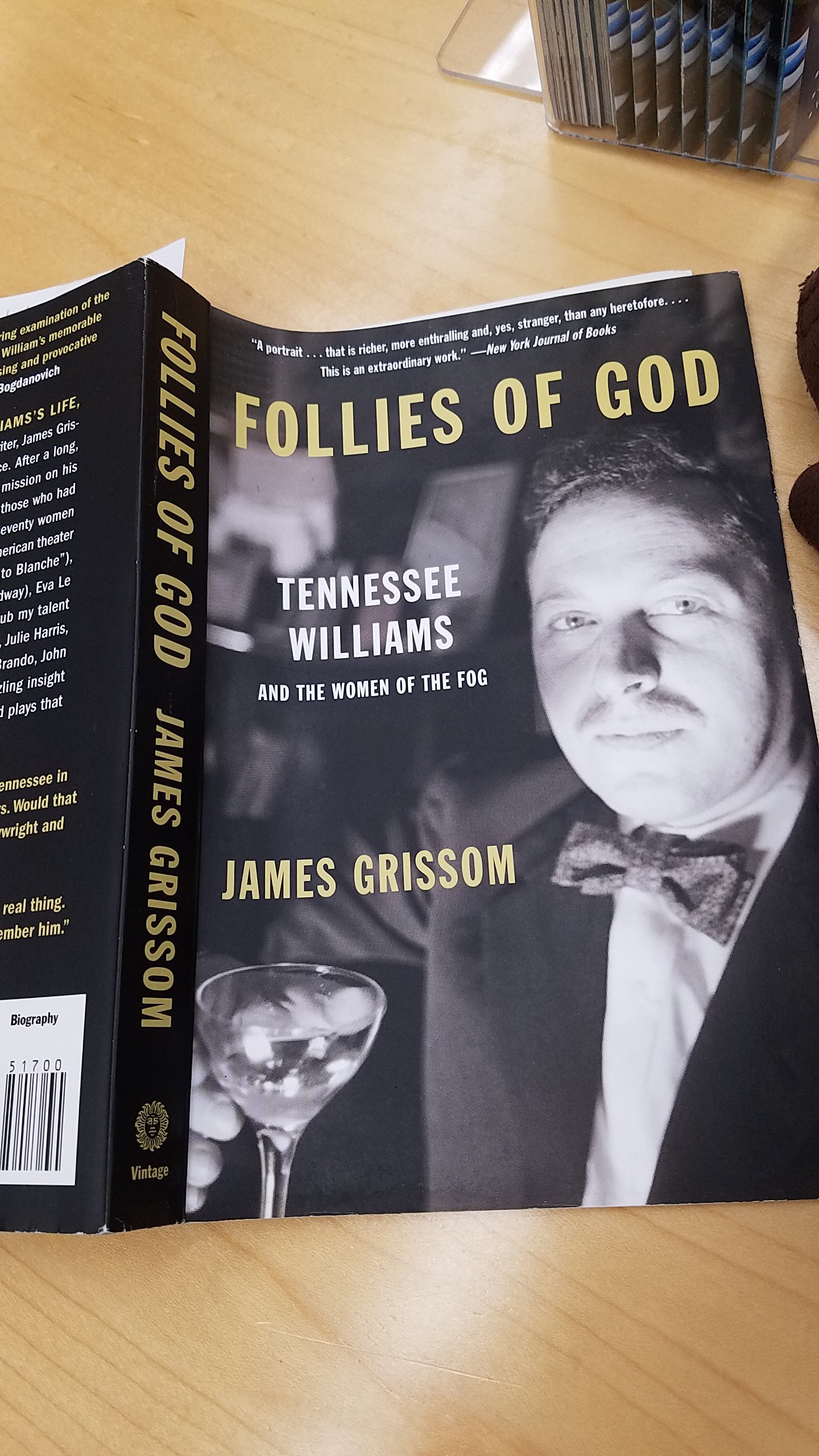
Follies of God is a book that came a long at just the right time for me. I had been thinking about Tennessee Williams for a while and had just read one of his plays. He has long been a figure that has fascinated me, both the man and his work.

I was watching YouTube videos one evening and came across an interview with a young man who told a story about meeting Tennessee Williams. It seems he got a call one morning and his mother woke him and said there was a man on the phone who says his name is Tennessee Williams. The young man realized that it must be him because he had written him a letter asking for advice on how to be a writer. He took the call. As the young man related the story, Tennessee asked him to come to have lunch with him. Where are you, he asked? I am in New Orleans, Tennessee answered. But I’m, in Baton Rouge. Well, you better hurry. So, the next day James Grissom drove to New Orleans to meet Tennessee Williams for lunch and thus began the amazing story of how this book came about. Well, I was hooked. I ordered the book that night on Amazon and it arrived very shortly thereafter.

James met with Tennessee Williams and was given a mission. To find the women that had meant so much to him, the women who appeared in his plays and movies, and some of whom were his muses and characters he modeled his characters on or wrote for. He wanted to know if he mattered to them. He called these women, The Follies of God. The characters he created for the stage he called, The Women of the Fog. Tennessee described his writing process as one of creating a mental theater in his mind. The fog rolls in across the boards and a female emerges. “I have been very lucky. I am a multi-souled man, because I have offered my soul to so many women, and they have filled it, repaired it, sent it back to me for use.”

This book is the story of that mission and how it came to be. It also gives us deep insight into the mind of one of the most creative geniuses of the American theater. Tennessee Williams needed a witness and young James Grissom was who he chose.

“Good Lord, can I get a witness? Here is the importance of bearing witness. We do not grow alone; talents do not prosper in a hothouse of ambition and neglect and hungry anger. Love does not arrive by horseback or prayer or good intentions. We need the eyes, the arms, and the witness of others to grow, to know that we have existed, that we have mattered, that we have made our mark. And each of us has a distinct mark that colors our surroundings, that flavors the recipe of every experience in which we find ourselves; but we remain blind, without identity until someone witnesses us.”

During the course of fulfilling his mission James Grissom talked to some of the most important figures on the American Theater scene: Lillian Gish, Maureen Stapleton, Marlon Brando, Elia Kazan, John Gielgud, Jessica Tandy, Kim Hunter, Geraldine Page, and Katherine Hepburn, to name a few. This book is the fascinating account of his interviewing these witnesses and the sometime startling things they had to day. And yes, Tennessee did matter, and so he still does.


Fall Guy

Cumberland Falls

wp-15883601303636660631815217202530.jpg

On the last day of my hiking trip, I tripped over some vines and fell to the ground. I had been hiking in the Cumberland Falls area for a few days taking pictures. When I fell, I had a tripod in one hand and a camera in the other.  Trying to protect the camera I fell hard on my left side jamming my left hand into the dirt as I let the tripod go flying. On my drive home my hand and wrist grew more painful and swelled. I thought I’d better see a doctor. I called my private doctor on my cell phone and made an emergency appointment.

wp-1588360088517322373070269806259.jpg

I arrived at his office about an hour later. After a thorough examination he said he didn’t think it was broken, but badly sprained and that it would heal up on its own.  Not so lucky with the camera. I had to take it to the shop to be repaired, set me back $200.

wp-15883602029843034022093312709787.jpg

 This is where I tripped

wp-15883602514555174682533563384328.jpg

Wild River (Cumberland River)

wp-15883602924943423983659927996982.jpg

Cumberland River

Cumberland Falls is located on the Cumberland River in the Daniel Boone National Forest in Southeastern Kentucky.