
It ain’t easy being green.
It ain’t easy being green.

A protester displays a placard at the Union Square in New York on April 14, 2015 during a demonstration against the recent shooting death of Walter Scott by a South Carolina police officer. Walter Scott, a 50-year-old father of four, was shot in North Charleston, South Carolina after fleeing from a routine traffic stop while a bystander caught the event on video. The shooting follows a series of similar incidents that have provoked outrage and protests across the United States, most notoriously the killing of Michael Brown in Ferguson, Missouri last August. AFP PHOTO/JEWEL SAMAD (Photo credit should read JEWEL SAMAD/AFP/Getty Images)
The killings of the five police officers in Dallas recently by lone sniper Micah Xavier Johnson was a vicious, calculated and despicable act. I condemn these killings in no uncertain terms. I also condemn the killings of black citizens Alton Sterling, age 37 of Baton Rouge and Philandro Castile, age 32 of St. Paul, Minnesota at the hands of police. Nothing justifies these killings but one cannot escape the nexus between these three events. There is no question that police overstep their bounds and brutalize and murder the citizens they are sworn to protect. With the killings in Dallas the situation is only going to get worse. I stand in solidarity with the Black Lives matter movement but I believe we are all at risk, white, black, brown, or whatever. We should not have to live in fear of those who are supposed to serve and protect. I am very concerned about the militarizing of police across this country. They have been given and allowed to purchase weapons and tools of war. Who are they going to use these weapons against? I am very concerned that the Dallas police department used a bomb carrying robot to neutralize Johnson. This sets a very dangerous precedent. I believe we are moving in the direction of a police state and a fascist nation. George Orwell said, “If you want a vision of the future, imagine a boot stamping on a human face – forever.”
I think that an armed citizenry is not necessarily the answer. The police are scared shitless out there on the streets because there are so many guns. Sterling and Castile both had guns but they were legal. What do you think is going to happen if you get stopped by a cop and you have a legal gun in your possession? This is dangerous set of circumstances to say the least. If you are driving while black and you have a taillight out it could be disastrous.
I am a gun owner and believe in the second amendment. But I believe common sense gun regulation should be in order. Backgrounds checks are necessary and should be beefed up to keep guns out of the hands of those who should not have them. Loop holes should be closed. Also, no citizen needs a military type assault weapon of the kind that killed the five officers in Dallas or the 49 patrons at the Pulse Nightclub in Dallas. This is pure insanity.
We need to change policing modelling in the country to a more community based model. Hiring practices must change. Police departments must stop hiring homicidal maniacs. If you are a policeman and you are so scared that you shoot first and ask questions later then maybe you should consider a different line of work.
I have had my share of run ins with the police. I was very nearly arrested at the Dali Lama visit here in Louisville when I was harassed by a Louisville police officer for trying to bring in a bottle of water that was sold to me but the YUM center. Sometimes discretion is the better part of valor so I let it go, but I felt threatened and intimidated. Also, the irony was not lost on me the type of event I was attending. This was not the first time I have been harassed by police. The first time being when I was eight years old walking alone along a street in Ridgecrest, California when a police car pulled up beside me and asked what I was doing there. I of course was immediately put on the defensive and felt threatened and intimidated. There have been many instances since then. And, I hasten to add, I am a law abiding citizen that has raised a family and has worked my entire life.
I will continue to speak out against police brutality and stand up for civil rights. There is no more pressing issue facing our country.
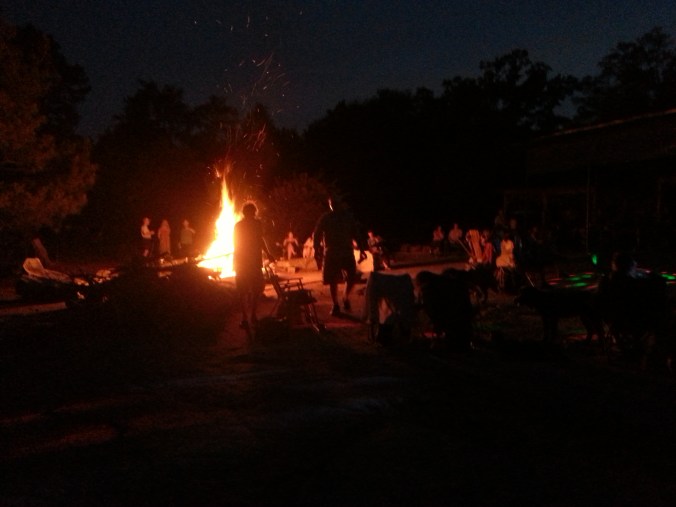
Burn Baby Burn

shared a photo with you from the Flickr app! Check it out:


Ernest Hemingways’s novel, Islands in the Stream, published posthumously, is the perfect counterpoint to his novel, For Whom the Bell Tolls, which was of course published during his lifetime. Hemingway takes his title, For Whom the Bell Tolls, from the poem of the same name by John Donne. The first line reads, “No man is an island entire of itself, every man is a piece of the continent a part of the main.”In both novels the protagonists die fighting for a cause larger than themselves that each believed in and that each felt he had a duty to fulfill. This is the Hemingway code of action that has lived with me so many years, ever since the first short story I read by him many years ago, The Short Happy Life of Francis Macomber. Hemingway comes full circle with this novel. From no man is a island to every many is an island. An island in a stream.
In the first case Robert Jordan is fighting fascism in Spain during the Spanish Civil War . In the other, Thomas Hudson is fighting fascism in Cuba during WWII. A German submarine has been damaged and the crew has come ashore and massacred a village of Indians and commandeered their turtle boat. The German crew are hiding out in the mangroves on the Cuban island. It is the duty of Thomas Hudson and his crew to hunt them down. This brilliantly written action sequence takes place in act three of the novel.
The novel is divided into three sections but the reads like three acts in a play. The first section is entitled Bimini. Here we are introduced to the isolated main character Thomas Hudson who is a painter and lives in a house on the island of Bimini which is part of the Bahamas. It is summer and his three children, two by one wife and one by his first wife, come to visit him for the summer. This is the happiest section of the book as the happy family interact and reminiscence with one another and go deep sea fishing together.
After the children leave, Hudson learns of a tragic car accident that has taken the lives of his two youngest children and their mother. This section ends with Hudson on a boat trip to Europe to attend their funeral. The tragic accident had a profound impact on Hudson driving him deeper and deeper into himself.
The next section of the book is entitled, Cuba. Most of the action in this section takes place in a bar in Havana called the Floridita. Hudson is knocking back frozen Margaritas (without sugar) and talking to a variety of motley characters who inhabit this world including an aging prostitute called Honest Lil. The conversations are often hilarious and the characters are well drawn and fascinating. Lil asks Hudson when was his happiest day? Hudson replies: “The happiest day I ever had was any when I woke in the morning when I was a boy and I did not have to go to school or work.” In this section Hudson learns of the death of his eldest son who was killed in action while flying over Germany. This was just about the last straw that does him in and he retreats further into himself. He soon receives his orders and goes once more back out to sea. He traded in his remorse for another horse that he was riding now.
The only thing Tom now has left is his duty. “Get it straight. Your boy you lose. Love you lose. Honor has been gone a long time. Duty you do. Sure and what’s your duty? What I said I’d do. And all the things you said you’d do.”
In this last section called, At Sea, Thomas Hudson does is duty. He is in pursuit of a German submarine crew whose submarine has been destroyed. They are hiding out in the mangroves of a Cuban island. The writing in this section is some of the best action writing I have ever read. At the climax there is a showdown between Hudson’s crew and the German crew. Hudson’s crew wins but Hudson gets shot it the process. As his ship cruises back to home port he realizes he is going to die. He thinks about sorrow. If it is cured by anything other than death, chances are that it was not true sorrow.

The white kanji
look like dancing skeletons
across a black screen.
In the novel Islands in the Stream by Ernest Hemingway, the main character, Thomas Hudson, is asked by the aging prostitute, Honest Lil, what was the happiest day of his life. Hudson replied as follows, “The happiest day I ever had was any when I woke in the morning when I was a boy and I did not have to go to school or work.”
Wow! Me too!

Now I have come full circle, I have worked for 50 years, I got an education, and now I am retired. My happiest days are any where I wake up in the morning and I don’t have to go to school or to work. That is why I am reluctant to go back to work. My happiest days are here now.

When one views nature’s beauty one purifies the mind….

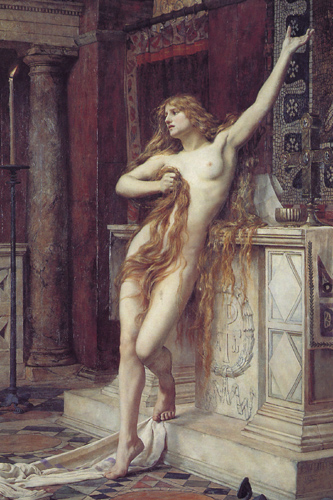
Hypatia of Alexandria (370 CE – 415 CE) was a mathematician and philosopher. She was educated at Athens. Her father was the mathematician Theon who tutored her in math, astronomy and philosophy. Around AD 400 she became head of the Platonist school at Alexandria, where she taught Plato and Aristotle. Known for her great beauty she became famous for her achievements in music, astronomy and philosophy. She was the world’s leading mathematician and astronomer, a claim no other woman has been able to make. Her philosophy was considered pagan during a time of unrest and conflict between the Jews, Christians, and pagans.
Alexandria, Egypt, was founded by Alexander the Great in 331 BC. It was a center of learning and culture. The city has been described by scholars a magnificent city. The great Library of Alexandria is said to have contained 500,000 books on its shelves on papyrus scrolls. As a professor at the university, Hypatia would have had daily access to these books. Unfortunately she lived in troubled times.
Hypatia was murdered by a Christian mob in Alexandria 415. She was stripped of her clothing and skinned alive with sharp pottery shards and her torn and mutilated body was dragged through the streets of Alexandria where it was put on a funeral pyre and burned.
The murder of Hypatia marked the end of Classical antiquity and the downfall of Alexandrian intellectual life. Hypatia is a powerful feminist symbol who sacrificed her life to the unruly and ignorant mob in the name truth and knowledge. The struggle goes on.
 Ghost Dog