Cold Day in Louisville

So, I went to Bob’s Pub in J-Town for a meeting last night. I had the Fish and Chips. They gave me a sandwich and some potato chips. Not what I was expecting but the fish was good. I ordered An Old Forester on the Rocks, but they were out of it but did have the premium label for a few dollars more, would I want that? Sure I said. When it came time to pay, I discovered I had forgotten to bring my wallet. I asked my friend Bob to cover for me which he did. How much was it? I asked. How much do you want to tip, Maggie asked. I always tip 20% I said. Bob said he always tipped 25%. Well, that’s pretty generous, I quipped, but go ahead, How much do I owe you? $50.00 he said. OK, I’ll pay you on Monday night the next time I see you. At about that time, I realized I had my wallet. It was in my left pocket instead of my right pocket where I usually keep it. Here, I say, I have my wallet after all. I’ll go ahead and pay. I already paid, said Bob. OK. I’ll pay you. Do you have a 10? So, I forked over three 20s and he gave me back a 10 and we were square. When I got home, I was telling Lula what happened, and she said you are slurring your words. How many drinks did you have? Three, I said. 100 proof? she asked. Maybe. Maybe. Then she said $50.00?!? Like I had done something wrong. Well, it must have been the drinks, I said. Anyway, another cold night in Louisville, Kentucky.  

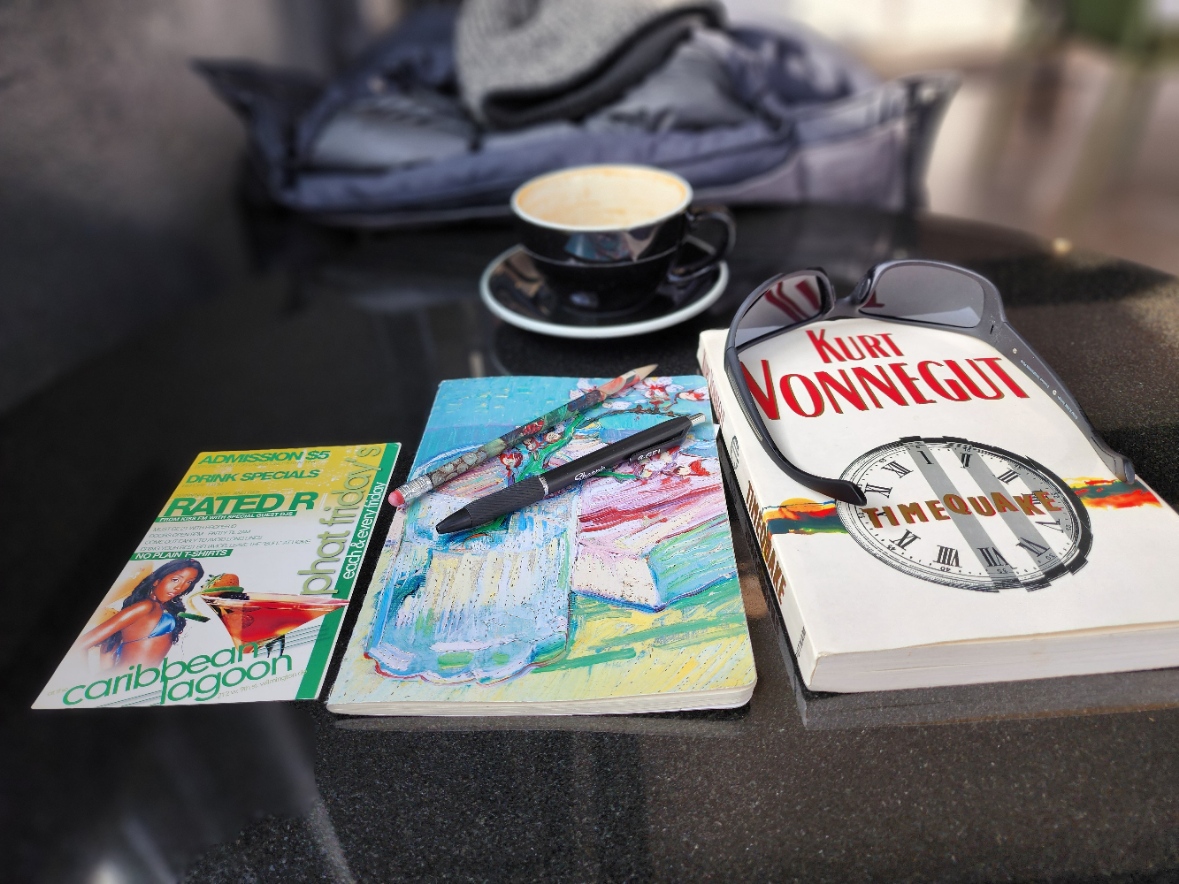
Timequake by Kurt Vonnegut

A book review

Timequake is a novel about free will. Vonnegut freely intersperses throughout the novel his own stream of consciousness. Oh, and there is also his alter ego, Kilgore Trout, who exclaims, “Oh Lordy, I am much too old experienced to start playing Russian Roulette with free will again.”

The premise of Timequake is that a Timequake, a sudden glitch in the time-space continuum, made everybody and everything do exactly what they’d done during the past decade a second time. It was déjà vu all over again for 10 years. The timeframe Vonnegut chose was February 13, 2001 – February 17, 1991. The Timequake would zapp everyone back in an instant to 1991. They had to “live” their way forward to 2001. Or you might say, back to the future again. Only when people got back to 2001 did they stop being robots of their past. Kilgore Trout would say, “Only when free will kicked in could they stop running an obstacle course of their own construction.” Free will. That is what the novel is about. Do we have it or not? That is the question. You would think that because the author mentions “when free will kicks back in” some 20-odd times he was arguing for free will. But no! Not so fast!  I’m not so sure.

Other pithy comments by Kilgore Trout would include, “If brains were dynamite, there wouldn’t be enough to blow your hat off!” and “Ting-a-ling, you son of a bitch!” which is the punch line to a variation on a joke having to do with Chinese doorbells.

So, it goes.

Vonnegut goes on to say, in his own peculiar voice, that writers of his generation had reason to be optimistic because of things like the Magna Carter, the Declaration of Independence, the Bill of Rights, The Emancipation Proclamation, and Article XIX of the Constitution giving women the right to vote. He advocated for two more amendments that he would like to add: Article XXIII: Every newborn shall be sincerely welcomed and cared for until maturity. And Article XXIX: Every adult who needs it shall be given meaningful work to do at a living wage.

Another pithy saying he was fond of throwing around was, “I never asked to be born in the first place!”

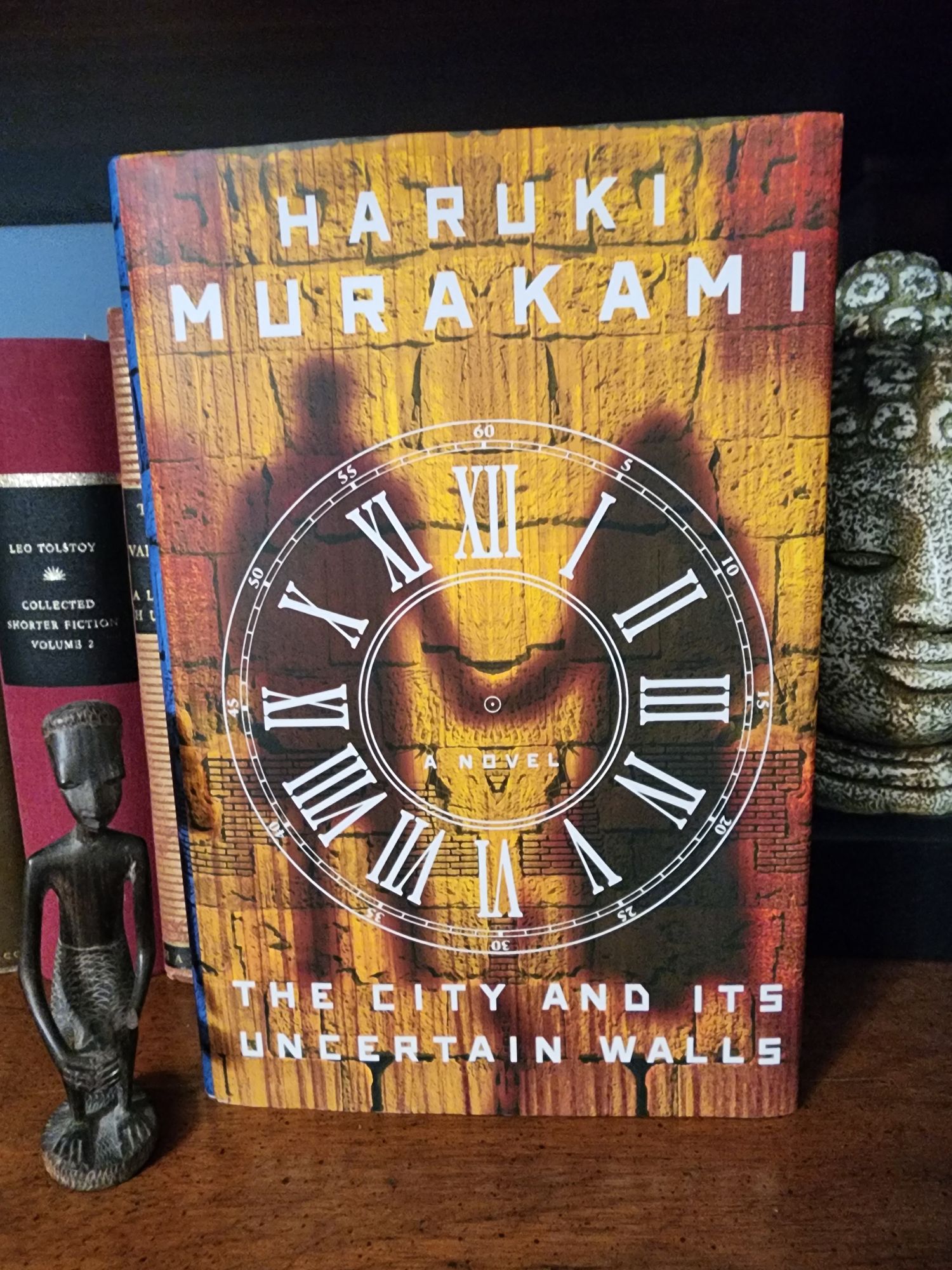
Photo by the author.

https://amzn.to/42BZP58

Top 10 Books 2024

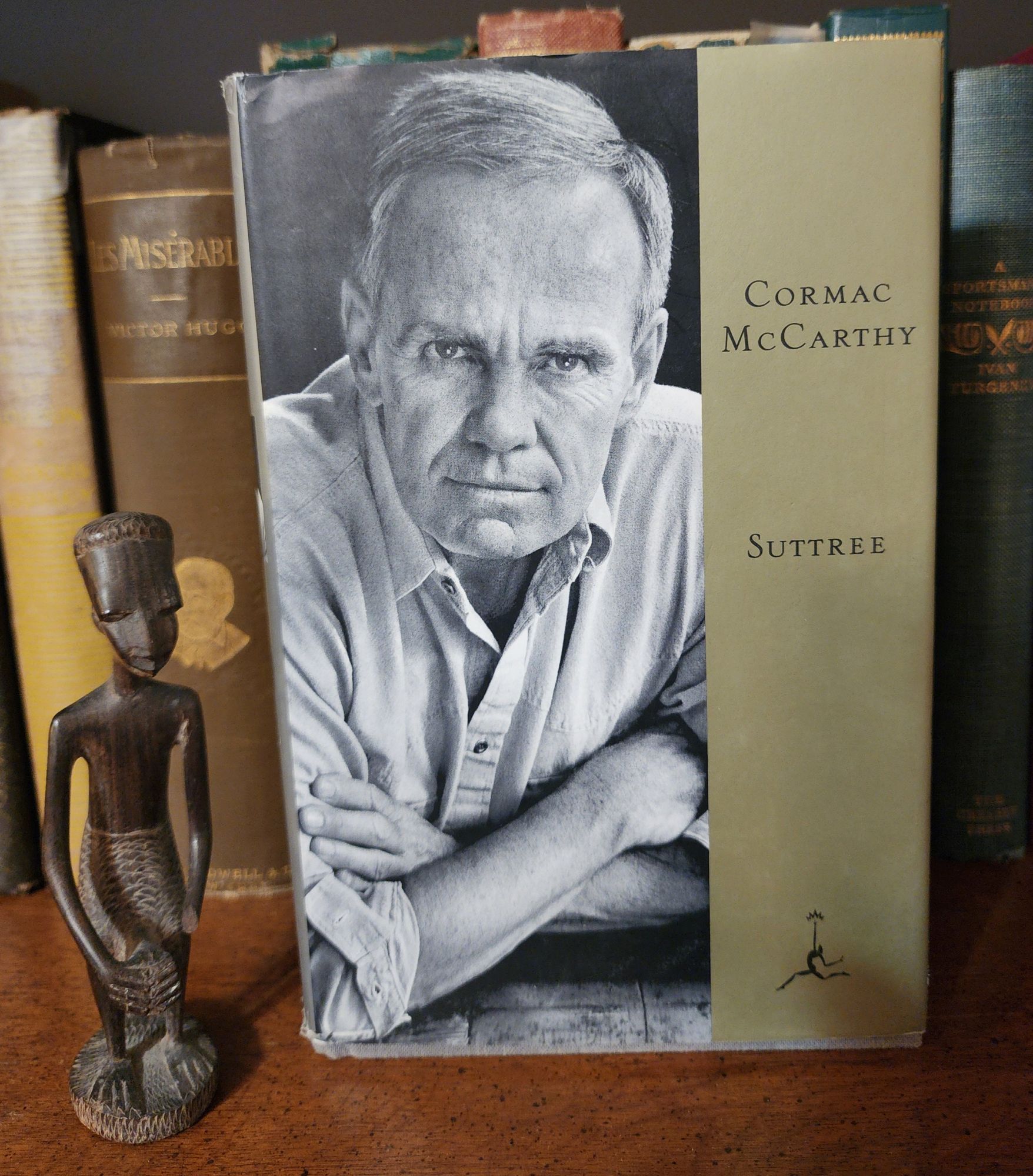
I read 34 books in 2024, some for the second time, like The Old Man and the Sea and The Lady in the Lake. I also read a lot of plays. I like to read plays because I can Imagine the actors’ actions when they play their parts upon the stage. Also, I am writing a couple of plays, and the best way to learn how to write a play is to read a lot of plays. Here is my list of my top 10 books in no special order. However, if I had to pick a favorite it would be Suttree, by Cormac McCarthy—happy reading to all who read in 2025.

  1. The Dragon Country – Tennessee Williams
  2. The Lady in the Lake – Raymond Chandler
  3. Suttree – Cormac McCarthy
  4. The Old Man and the Sea – Ernest Hemingway
  5. The Bluest Eye – Toni Morrison
  6. The Sunset Limited – Cormac McCarthy
  7. Rhinoceros – Eugene Ionesco
  8. The Savage Detectives – Roberto Bolano
  9. Hollywood – Charles Bukowski
  10. Deception – Philip Roth

Deception by Philip Roth

A Book Review

Reading Philip Roth is like eating Indian food. You have to have a taste for it, and I confess I have a passion for both. I just finished reading Deception and found it to be by turns clever and brilliant. I think the reason I like Roth so much is that sometimes I think he is writing my story. He cleverly entangles his real life with his fictional life. He mixes Nathan Zuckerman and Philip Roth in a froth of delightful storytelling.

Deception is told in all dialogue, which is not an easy feat in itself. The reader must pay close attention to who is speaking. It details his adulterous affair with a British woman while he is temporarily living in England. He is concerned that his wife might find out and take pains to keep their liaison a secret. The British woman is also married. He intertwines this story with encounters with other women including his wife who discovers his notebook and accuses him of having an affair which he denies, and therein ensues a hilarious argument about how the affair is in his imagination and the notes are for a book that he is writing. One may ask, who is he deceiving, his wife or the rest of us?  The scene reminded me of a similar incident that happened to me a while back. I also keep a notebook and one day my partner at the time happened to pick it up and read it while I was out. We had the biggest fight of our relationship over what she read in that notebook! It was over soon after that.

The novel Deception is Philip Roth at his best. Highly recommend!

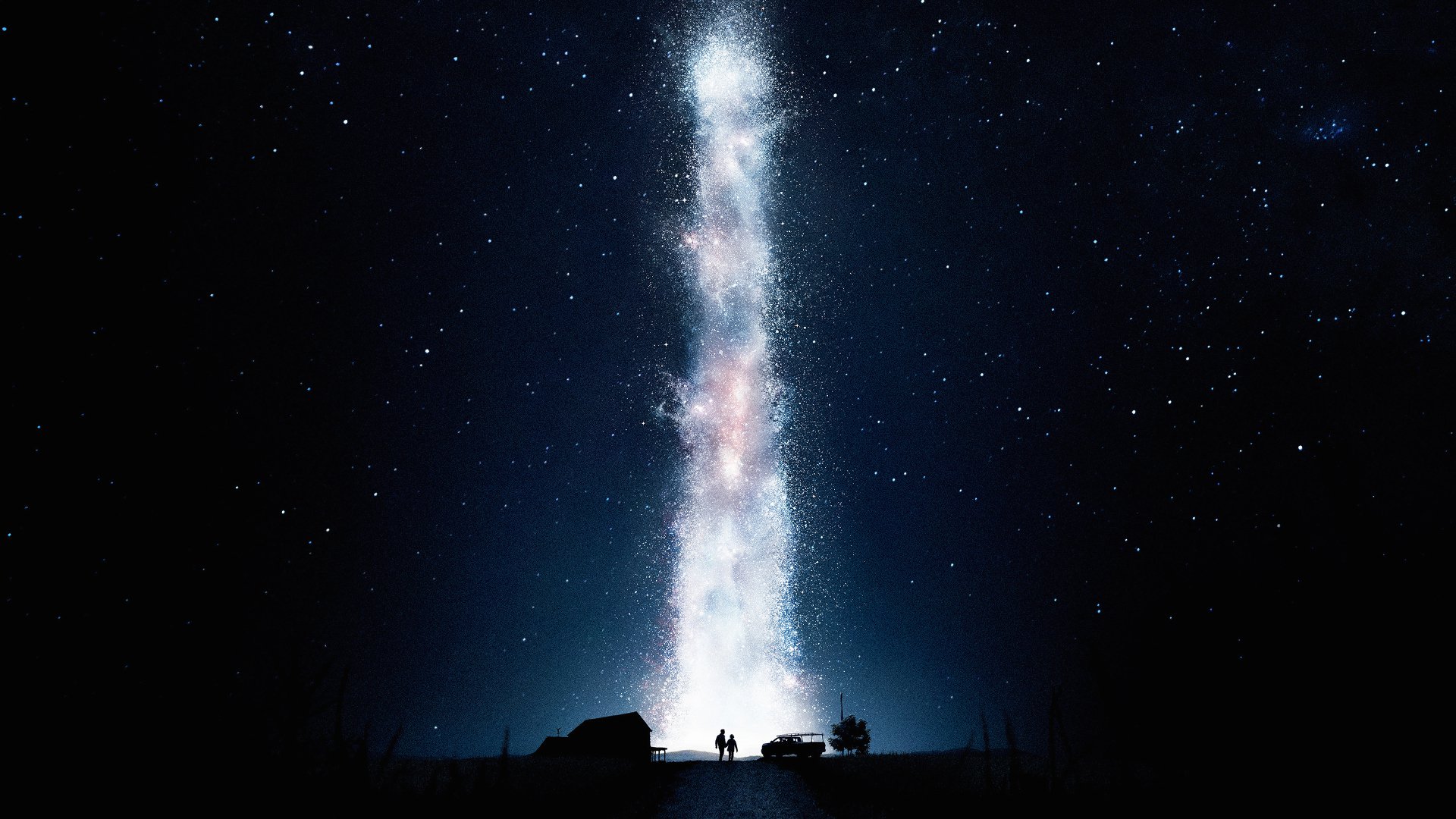
Interstellar

When I entered the black hole

I was struck by the naked singularity

And the music of the night.

Jupiter was ascending

And Scorpio was rising

The jukebox was blaring

And the sirens were screaming.

The neon wilderness showed me the way

To the star-studded brilliance of the Milky Way

I lost all consciousness as the drugs took hold

Somewhere in the depths of the hold.

When I regained my strength from my long winter’s nap

I dug deep into my jeans for a few copper pennies

To be sure I had the means to pay for my midnight sin

I strolled through the door to the daylight again

And once again became human once more.

TILTING AT WINDMILLS

I am reading Don Quixote by Cervantes. It is quite a hoot. But, it is not an easy read. It’s like reading a foreign language. As a matter of fact, it is a foreign language: Spanish. Old Spanish translated into English. If you squint your eyes and hold your nose just right, you can almost tease out the meaning. It turns out the Don is quite insane—crazy as 9 loons, as they say. He is always tilting at windmills and at every Inn he passes by on the road he thinks it is a Castle holding a damsel in distress who needs rescuing since he is a knight errant of the “ill-favored face” and that his quest is to follow that dream. Halfway through the book he meets another band of wanderers who spin quite a tale of their own about a cat named Anselmo and his friend Lothario whom he entreats to test his wife’s fidelity. What could go wrong? Sancho Panza rides along with the Don on his ass for companionship and to provide comic relief.

When I was a young man working as a factotum at the rubber factory in Rubbertown, one of my co-workers used to refer to me as, “That Don Quixote-looking motherfucker!”

“Why do you call me that, Ernie?” I asked.

“Because you wear a beard, and you sort of look like him, and you are always tilting at windmills.”

I took it as a compliment.

Musings from 30,000 Feet

Star date 09242024

In his Critique of Dialectical Reason, (1960) Jean-Paul Sartre asks the following questions: 1) Why is violence so universal a feature of human experience, especially in politics? And 2) What becomes of man’s freedom in a world where human beings are constantly threatened by what he called the “practico-inert” (alienation)?  

Example: A motorist is caught in a traffic jam created by the increased availability of cars whose original intention was to enable men to move about more freely. Human beings are increasingly and inevitably held prisoner by their own creations.

In economics, this would be an example of diminishing returns. A concept I learned in the 5th grade, which struck me like a thunderbolt and has stuck with me ever since.

Another concept I learned a couple of years later in the 7th grade, was the concept of manifest destiny. Again, this was like a thunderbolt out of the blue, but I think it might have set me on the wrong path for years to come. If you don’t think that schools were indoctrinating students in the 1950s you are sadly mistaken. But I digress….

Ten Books on Buddhism I highly recommend

  1. Zen Mind, Beginner’s Mind – Shunryu Suzuki
  2. Peace is Every Step – Thich Nhat Hanh
  3. Zen in the Art of Archery – Eugene Herrigel
  4. The Heart of the Buddha’s Teaching – Thich Nhat Hanh
  5. Introduction to Zen Buddhism – D. T. Suzuki
  6. An Open Heart – The Dali Lama
  7. The Dhammapada – (Several translations) Translated by Ananda Maitreya, Forward by Thich Nhat Hahn
  8.  The Other Shore – Thich Nhat Hanh
  9. Becoming Enlightened – Dali Lama
  10. Why Buddhism is True – Robert Wright

KAMALA HARRIS

Photo by Benn Bell

In Sanskrit, the word Kamala means Lotus Flower. The Lotus is a symbol of purity and the simultaneity of cause and effect. Out of the mud rises the fragrant Lotus Flower. This is exactly the metaphor needed at this time in this place. Kamala, the Lotus Flower, rises from the slime and muck of Donald Trump and his ilk in triumph and exaltation. Go ahead, Kamala!