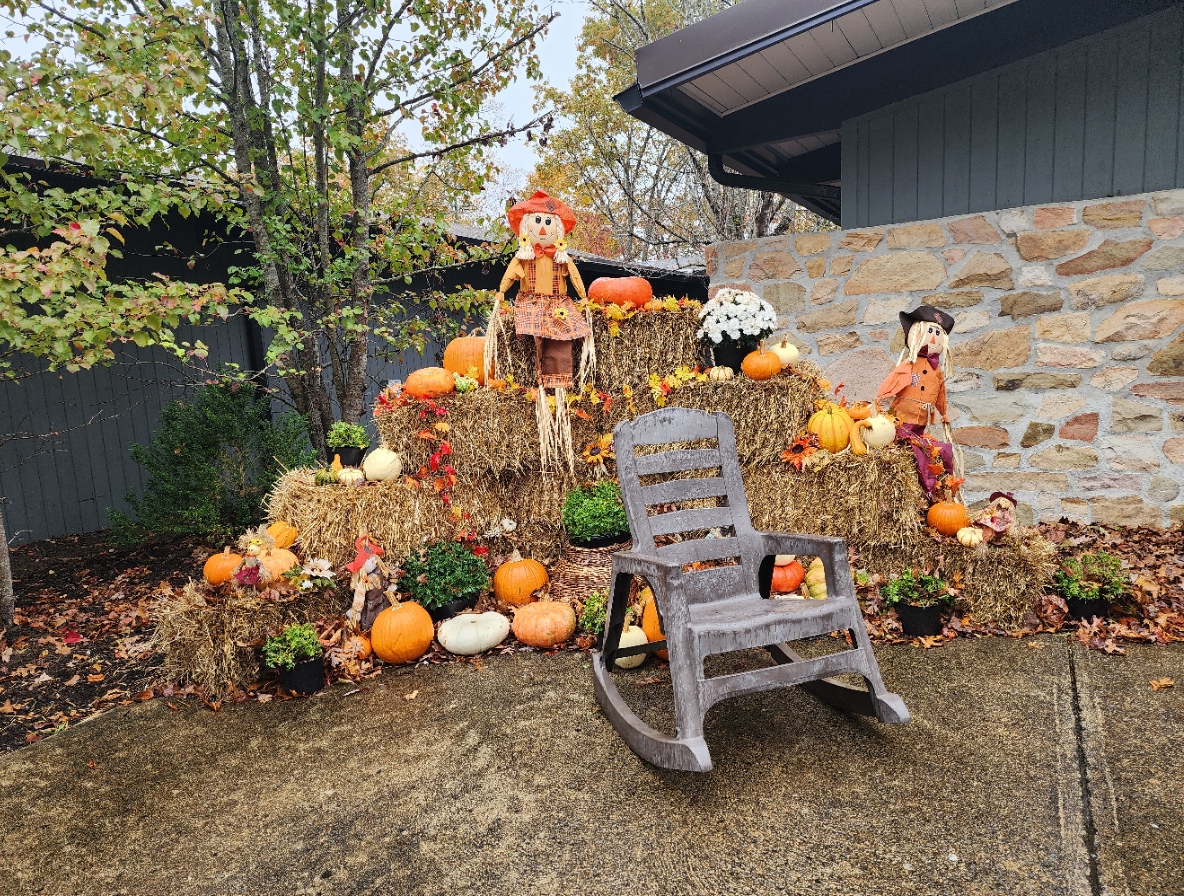
Robin and I recently made a trip to Eastern Kentucky to look at some property. We stayed two nights at the lodge at The Breaks Interstate Park, in Virginia, just across the border from Kentucky. Here are a few snaps from the trip.
The name “Breaks” was derived from the break in Pine Mountain created by the Russell Fork of the Big Sandy River as it carved a 1000-foot deep gorge on its way to join the Ohio River.
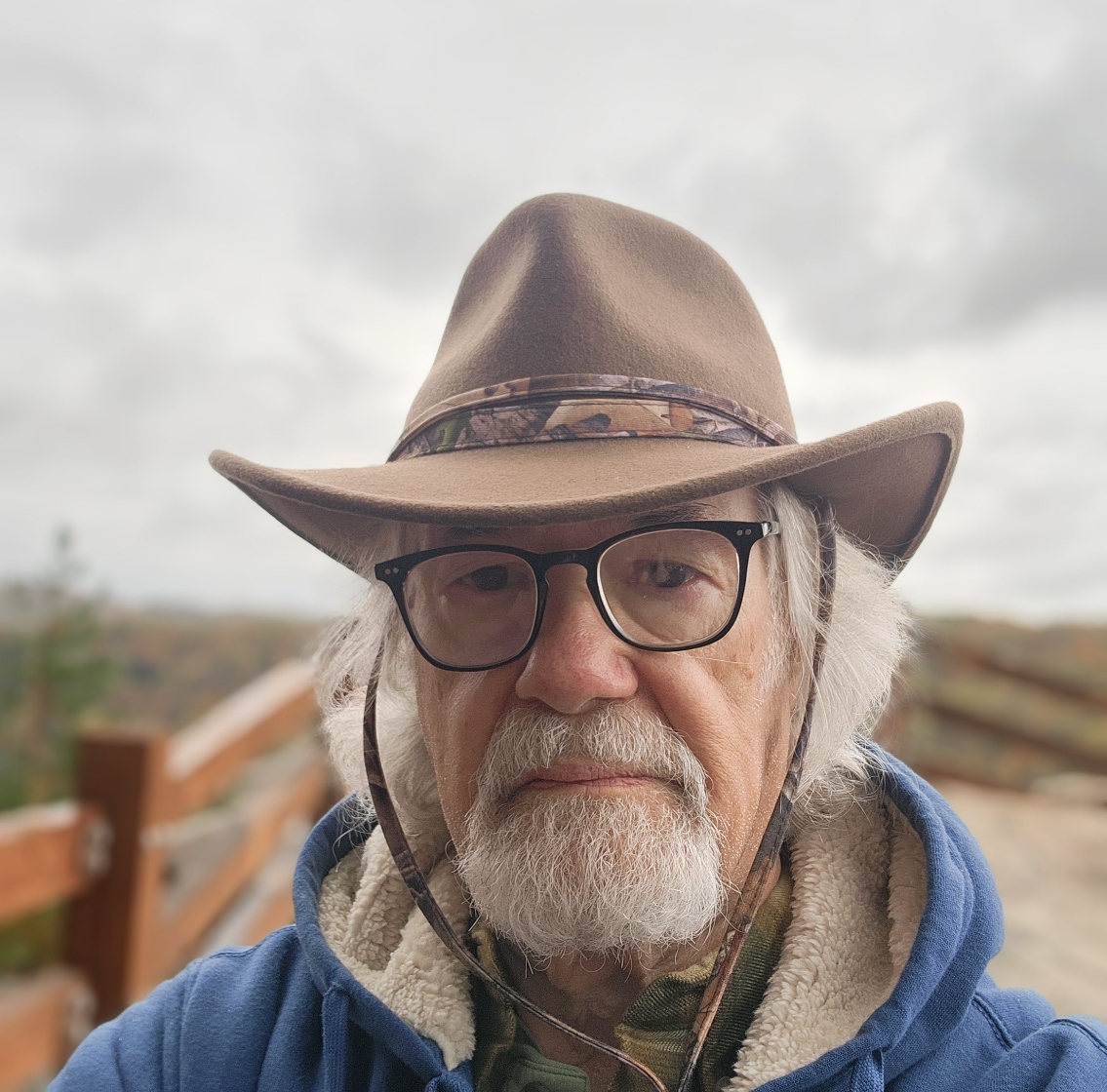
View from behind the Banquet HallYours trulyBanquet HallFront OfficeI’m climbing the stairway to heavenTis the seasonThe deer were abundantLOOK OUTPortrait of the ArtistThose are the BreaksOn the Edge
Lights up to dim. Jane Draper and Peter Steele are sitting in chairs opposite each other center stage. They are in silhouette. Lights up to full-on Fred stage right at a lectern.
FRED
Good evening, ladies, and gentlemen, and welcome to another edition of Point-Counterpoint where issues of national importance are debated on stage in front of a live audience. At the end of the show, we will take a poll to see which side was persuasive enough to earn your vote.
The topic of tonight’s show: Gun Control. It is brought to you by our sponsor Colt Manufacturing, proud manufacturer of the AR-15, when you absolutely, positively have to kill everyone in the room. Accept no substitutes.
Our guests tonight are Jane Draper, president of Mothers Against Mayhem, or MAM. Yes, Mam! Who will argue that we need stricter gun laws or gun control if you will? And on the other side of the issue is Peter Steele, vice president of the National Rifle Association.
And now, let’s meet our panel for another rousing edition of Point-Counterpoint. Leading off our debate tonight will be Peter Steele.
Lights fade on Fred and come up on Jane and Peter who are positioned center stage in chairs facing each other.
PETER
Thank you, Fred. I would just like to say at the outset that our position over at the National Rifle
Association is that the right to keep and bear arms is protected and enshrined by the Second Amendment of the United States Constitution and that every American, every American! Should own and carry a firearm. Our motto is that God created man and Samuel Colt made him equal. I will give up my gun when you pry it from my cold dead hands.
JANE
Well, that’s a good place to start, Peter, because a close reading of the Second Amendment references the right to keep and bear arms in order to maintain a well-regulated militia. Emphasis on “well regulated.” It doesn’t say a thing about arming all Americans.
PETER
Well, Jane, you are obviously not well-versed in the law because if you were you would remember the case of Heller, in District of Columbia v. Heller. In 2008, the conservative majority of the Supreme Court, in an opinion written by arch-conservative Justice Antonin Scalia, decided that “a well-regulated Militia” was merely “prefatory” language.
JANE
Yes, I am familiar with that case. Justice John Paul Stevens, who dissented, called it “unquestionably the most clearly incorrect decision” of his lifetime.
PETER
Well, we’re going to have to agree to disagree on that one, Janey, because in our view it was rightly decided and is the law of the land.
JANE
I could disagree with you more, but I don’t see how. The Supreme Court has made us all a little less safe with that ruling. The problem, dear Peter, is that there are too many guns in the hands of Americans. Did you know that the leading cause of death of children in this country is gun violence? Not drowning, not car accidents, but gun violence! And don’t call me Janey.
PETER
Ok, Jane, or Miss Draper, or whatever you prefer to be called. The Second Amendment not only gives Americans the right to bear arms, but it also creates equality for women! Guns are the great equalizer. What do you think about that? Why, I would dare say guns give women more equality than the entire feminist movement.
JANE
You can call me Jane, but I wish you would keep your condescension down to a dull roar. We are both adults here and I would appreciate being treated with a little respect.
PETER
I will treat you with the respect you deserve, Jane!
JANE
Well, that’s just ridiculous! The Second Amendment doesn’t make women equal. That would be the Equal Rights Amendment. That is what we need. Let’s replace the Second Amendment with the ERA. Burn bras, not bridges!
PETER
Don’t get carried away, there, Jane. Let’s put things into perspective, shall we? It’s not guns that kill people. It’s people who kill people. A gun is just an object. A tool for use. It is private property. And we all have the right to own private property, don’t we? We shouldn’t infringe on law-abiding citizens’ rights to own property. It’s a delicate balance we have to strike as we dance between safety and individual freedom. Man has a God-given right to defend himself!
JANE
Let’s get back on topic, shall we? I think it’s sad we live in a world where we have not outgrown our need for guns to settle our differences. Why haven’t we outgrown that? Why haven’t we outgrown our dependency on guns? Maybe we just need to exercise a little common sense. What we need are common-sense gun laws. Look! Nobody is talking about taking away your guns. You act as if you are being emasculated or something.
PETER
There you go again. Listen, Joe Biden’s constant efforts to gut the Second Amendment will not usher in safety for Americans. Instead, it will only embolden criminals. Criminals are not going to obey the law. That’s why they are called criminals! The NRA will continue our fight for self-defense laws. Rest assured, we will never bow down, we will never retreat, and we will never apologize for championing the selfdefense rights of law-abiding Americans.
JANE
In any given year in the United States, more than 120,000 Americans are shot in murders, assaults, suicides, and suicide attempts. Unintentional shootings, or police actions. Of these, 35,00 result in deaths. Over 17,000 of those injured or killed are children and teens. On average, 34 people in America are murdered on account of gun violence every day.
The United States is a global outlier when it comes to gun violence. The number of firearms available to Americans is estimated to be about 310 million. Americans own nearly half of the 650 million civilians owned guns in the world today. Americans own the most guns per person in the world. The number 2 country is Yemen. Yemen for Christ’s sake! They have 54 guns per 100. We are at 88 guns owned per 100. We have 5 percent of the world’s population but hold 31 percent of global mass shootings. Gun homicide rates are 25 times higher in the United States than in any other developed country. The United States has one of the highest rates of death by firearms in the developed world. Americans are 51 times more likely to be killed by gunfire than people in the United Kingdom.
PETER
Look, Jane, guns are needed for self-defense. If you took away all the guns only criminals would have guns. Criminals and the police. Lord help you if you ever needed a policeman in a life-and-death situation. When seconds count a policeman is only minutes away. We have the right to stand our ground! And having a gun is our only means of self-protection.
JANE
We love our guns more than we love our children in this country. The Second Amendment is cherished more than public safety. It makes no sense! We have 352 million guns in circulation in this country. More guns than people. More guns than common sense. Your so-called “stand your ground” laws are a license to kill. What happened to due process? What gives you the right to be a judge, jury, and executioner?
PETER
When seconds count you don’t have time for the due process. If I feel threatened, if my life is on the line or that of my family, I am going to stand my ground!
JANE
Don’t you realize your hostile, loudmouth, hyperventilating, knuckle-dragging posturing only reinforces negative stereotypes about gun owners? Can’t we reason together to come up with common-sense gun laws that will satisfy both sides?
PETER
Well, what do you have in mind, Jane? Do you have a proposal we can maybe talk about? Something we sink our teeth into?
JANE
Yeah! What about gun shows? Why can you buy a gun at a gun show without a background check? We need to close the “gun show loophole” to keep guns out of the hands of the wrong people.
PETER
Because you’re gullible, that’s why. There is no such thing as a “gun show loophole.” The dealer you’re buying a gun from at a gun show is running the same background check as he does in his shop. He is using the same form. There is no “gun show loophole,” Jane! And anybody who says any different is a goddamn liar!
JANE
Well, that’s a red herring, Peter! We are not talking about dealers. We are talking about private owners transferring weapons to each other.
PETER
Which they have every right to do!
JANE
I know! That is what I’m trying to get changed! 97 percent of Americans support background checks for all firearms sales. 70 percent back “red flag” laws.
PETER
What’s a “red flag” law?
JANE
Don’t play dumb with me. You know perfectly well what a “red flag” law is.
PETER
I know. I just wanted to see if you knew.
JANE
Red flag laws enable authorities to confiscate guns from people found to be a threat to public safety.
PETER
And just who is supposed to decide who is a threat to public safety?
JANE Doctors, psychiatrists…the mental health community.
PETER
That’s not good enough Jane! You can’t take guns out of the hands of law-abiding citizens without due process.
JANE
Oh, now you want to talk about due process! That’s just insane! I can cite you case after case of mass shootings in America, and some very recently, where the perpetrator had a history of mental illness.
PETER
That may be so, but that just goes to prove the point that people are to blame for mass shootings, not guns! Your radical gun control agenda will do nothing to prevent attacks by demented and disturbed individuals.
JANE
There’s nothing radical about common sense gun laws, background checks, and closing loopholes. We can protect innocent Americans from senseless gun violence while still protecting the constitutional rights that citizens enjoy for hunting and self-defense.
PETER
Look! I have no problem with vigorous background checks when it comes to firearms if we do the same thing when it comes to immigration, Voter ID, and candidates running for office.
JANE
At last! Some common ground! And speaking of mass shootings, most are committed with a militarystyle assault rifle. We are talking about the AR-15, which we, The Mothers Against Mayhem are against. We want these weapons of mass destruction banned. No one needs a military assault rifle to defend themselves on the streets of America. It is absurd! You can’t hunt with them. Their only purpose is to kill human beings in the quickest most efficient and destructive way possible.
PETER
What ho! Now just hold on there a dog gone minute little missy! I beg to differ! I think that is a little bit small-minded of you.
JANE
Small minded?
PETER
Yes. Because without them ranchers would be completely defenseless against varmints. Blaming the gun for what’s happening in America is small-minded. In rural Colorado for instance an AR-15 is the gun of choice for killing raccoons before they get to our chickens. It is the gun of choice for killing a fox, it is a gun that you use to control predators on your ranch, on your farm, on your property. Preventing chicken deaths…That’s what I’m talking about!
JANE
Chicken deaths? What about the deaths of over 11,000 humans last year alone, including 400 teenagers and 71 children? Americans have the right to feel safe in their homes, on the street, in theaters, and at the grocery store. Children should be safe at school, which should be the safest place of all instead of having to participate in active shooter drills. In Dayton Ohio, 10 people were killed in a bar while in Texas a shooter killed 22 in a Walmart store. This is insanity and it must stop! We need stricter gun laws!
PETER
The number one city in America with the strictest gun laws is Chicago. And number one in murder and gang violence. If gun control actually worked, Chicago would look like Mayberry RFD. Democrats should ask themselves why every major city they’ve run for decades is plagued by violence despite having some of the most draconian gun laws in the nation.
JANE
Please learn some of the stats on Chicago before coming in here and just repeating your prepared talking points. Chicago’s massive gun violence is because all the guns are purchased legally in red states like Indiana and then brought across the border illegally into Chicago.
PETER
Please! That is a myth! The origin of most guns is untraceable.
JANE
Republicans are the first to pounce on crime spikes while never acknowledging that the dismantling of reasonable regulations is responsible for the spiraling spikes in the first fucking place. And hundreds of millions of gun sales later, gun deaths have reached an all-time high.
The Supreme Court decided long ago that your right to free expression stops at the tip of the other guy’s nose. You have the right to own a car but you don’t have the right to drive it a hundred miles an hour on the wrong side of the road. You have the right to own a gun, but just as the state requires you to have a license to drive a car, to be of a certain age, and to demonstrate competency with driving skills and regard for public safety, the state can place reasonable limits on ownership of guns.
Only some kind of fascist would regard gun ownership as a higher priority than public safety. Can’t we have a reasonable conversation on what we can do to prevent the next mass shooting?
PETER
Well, yes, we could do that, but I take exception to the premise of your statement. Using the word fascist the way you did clearly shows you don’t know what you are talking about! Because in fascism, public safety outweighs the rights of the individuals. Mass shootings are caused by criminals who disregard the law. All you want to do is create more laws but offer no real solutions that will be effective legally speaking.
JANE
Gun laws alone cannot solve the problem. But gun laws will make a difference. There may be no single answer, but we must do what we can. Sitting on the sidelines is not an option when our children are being killed daily. We are facing public health crises of monumental proportions and attention must be JANE (CONT.)
paid! We need to act now to enact sensible common sense gun laws. The definition of insanity is to keep doing the same over again and expecting a different result. Failure to act will result in a failure to protect the innocent lives of countless Americans! For, God’s sake, how much more carnage are we willing to accept? How many more innocent American lives must be taken before we say, “Enough is enough!”
PETER
We already have plenty of gun laws on the books. They need to be enforced. We have mandatory minimum sentences for criminals using guns and many states allow sentencing enhancements for crimes involving firearms. These laws need to be enforced! If you want to pass a law how about one that will allow those with concealed carry permits be allowed to carry their weapons into other states? If you want to prevent school shootings why not arm teachers and give them training? The best way to stop a bad guy with a gun is with a good guy with a gun. Why do you want to trample on my rights and leave me defenseless? If I give up my guns, do you think the bloods and crips will give up theirs?
JANE
Calm down there Peter, you are liable to have a stroke.
PETER
You cannot imagine the enormity of the fucks I do not give!
JANE
You know, I’d like to challenge you to a battle of wits, but I see that you are unarmed.
PETER
Unarmed? Unarmed? Why, I’ll show you who’s unarmed.
JANE
Peter, you pathetic little man!
PETER
Jane, you ignorant slut!
PETER reaches for his firearm holstered under his arm. At the same time, JANE reaches inside her purse and pulls out a .25 automatic. They both point and shoot simultaneously. There is an explosion of sound and the acrid smell of cordite.
The film’s title is taken from a 1969 statement from the revolutionary political group The Weather Underground that was published in an issue of New Left Notes, a left-wing periodical from the Students for a Democratic Society. The statement read: “From here on out, it’s one battle after another – with white youth joining in the fight and taking the necessary risks. Pig Amerika beware. There’s an army growing in your guts and it’s going to bring you down.” The first and last sentences of this statement are both used in dialogue in the first act of the film.
This is the film we need to see now. A revolution is coming to America, and it won’t be pretty. Paul Thomas Anderson has taken a book that was written by Thomas Pynchon and created a masterpiece of the cinema. The acting, writing, and direction are all superb. The cast includes three Academy Award winners: Leonardo DiCaprio, Sean Penn, and Benicio Del Toro. The movie has a Tarantino-esque quality to it, and it pays homage to the movie Bullitt, starring Steve McQueen, featuring one of the most exciting chase scenes I’ve seen since 1968, featuring a Mustang pursuing a Charger in bright California sunlight with cinematic elevation changes.
If you care about anything about movies or America, go see this movie now!
According to Buddhism, the 10 non-virtues are: Killing, stealing, sexual misconduct, lying, divisive talk, harsh speech, senseless chatter, covetousness, harmful intent, and wrong views. Donald Trump embodies all these traits. A great evil has settled across the land, and America has lost her way. We must climb out of these lower depths and find our way again. New leaders must rise up and lead us out of the wilderness before it is too late.
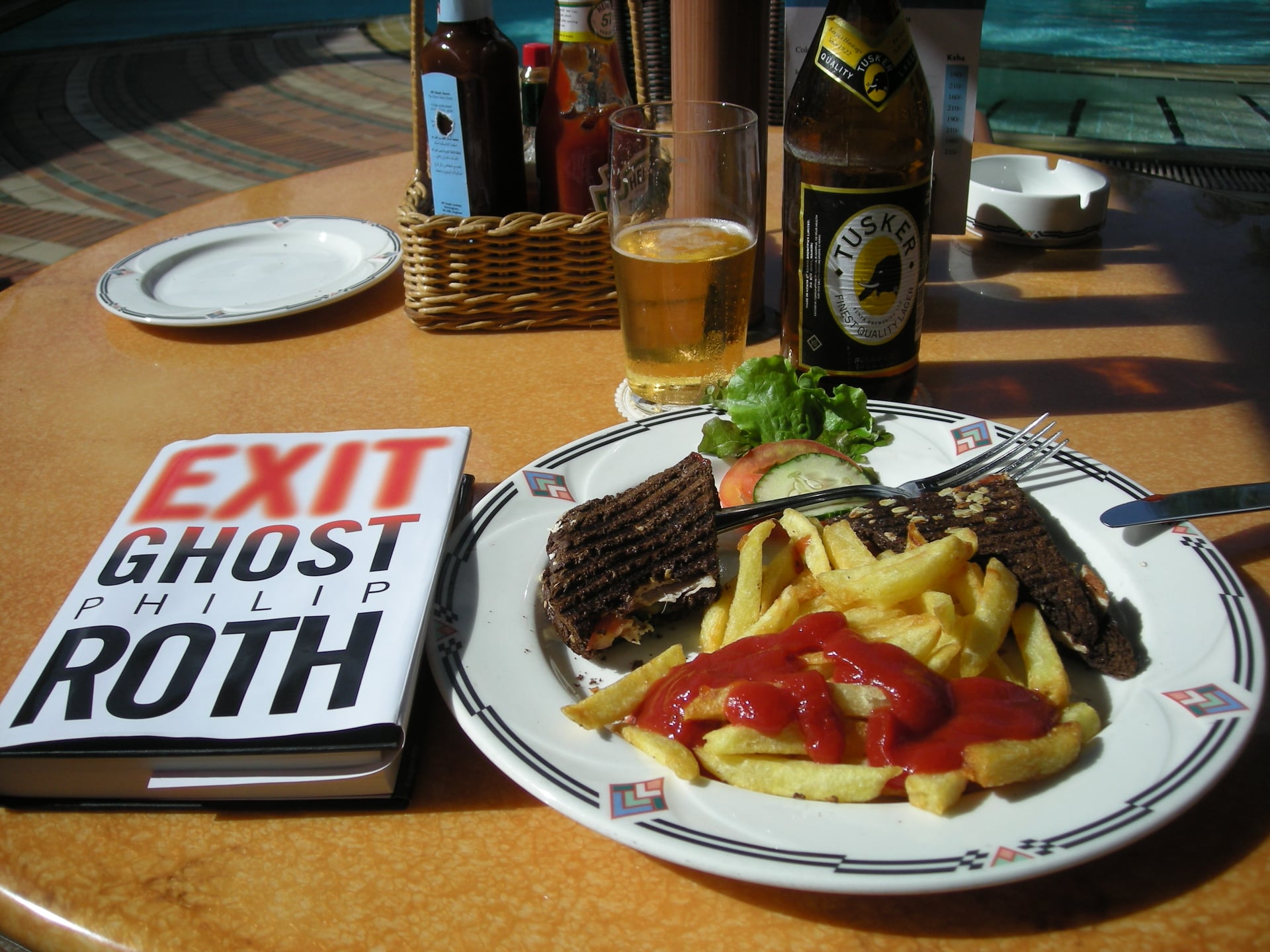
There are some uncanny similarities between the character Lonof in Philip Roth’s Ghost Writer and me. Of course, his characters are largely based on his own life, so that is to say there are some eerie similarities between Roth and me. That is why I think he resonates so strongly with me. Of course, I don’t presume to have his talent or intellect, but there are similarities, nonetheless. Here are a few.
“I crossed the river to New Jersey three days a week.” I, too, crossed the river to New Jersey every week to go to work in South Jersey when I lived in Philadelphia.
“At eight each morning, our crew was driven to some New Jersey mill town to sell magazine subscriptions door to door.” I did the same thing, but in Kentucky.
“The problem with Santa Claus.” I had a similar experience. I suppose many of us did, but it is the first time I saw it described in a novel.
“…Berkshires…Tanglewood.” I lived in the Berkshires when I was 15, and I have been to Tanglewood many times.
“I turn sentences around. That is my life.” Me too.
“I always read books with pen in hand…my attention is not n what’s in front of me.” I always read with a pencil.
“I have the evening’s reading still ahead of me. Without my reading, I am not myself.” Neither am I.
The Journey and Achievements of a Contemporary Blues Artist
Introduction
Samantha Fish, a name that has become synonymous with modern blues, is an American guitarist, singer, and songwriter who has taken the music world by storm with her electrifying performances and soul-stirring compositions. Born on January 30, 1989, in Kansas City, Missouri, Fish has carved out a niche for herself in the blues genre, blending traditional sounds with a contemporary twist.
Early Life and Musical Beginnings
Fish grew up in a musical family, with her mother playing piano and her father occasionally strumming the guitar. Her passion for music was ignited at a young age, and by the time she was 15, she had started playing the guitar seriously. Inspired by the likes of Stevie Ray Vaughan, Bonnie Raitt, and Sheryl Crow, Fish immersed herself in the blues and honed her craft through relentless practice and performances.
Career Breakthrough
Fish’s big break came in 2009 when she recorded her debut album, “Live Bait,” which showcased her raw talent and potential. Her follow-up album, “Runaway,” released in 2011, earned her the Blues Music Award for Best New Artist in 2012. This accolade was a testament to her prowess and marked the beginning of her rise to fame.
Signature Style and Musical Evolution
Fish’s music is characterized by her powerful vocals, intricate guitar work, and a unique blend of blues, rock, and Americana. She is known for her ability to convey deep emotions through her music, whether it’s the heartache of a slow blues ballad or the fierce energy of a rock-infused anthem. Over the years, Fish has continued to evolve her sound, experimenting with different genres and pushing the boundaries of traditional blues.
Notable Albums and Collaborations
Throughout her career, Fish has released several critically acclaimed albums, each showcasing her growth as an artist. Some of her notable works include:
Black Wind Howlin’ (2013)
Wild Heart (2015)
Chills & Fever (2017)
Belle of the West (2017)
Kill or Be Kind (2019)
Faster (2021)
Fish has also collaborated with various artists and bands, further enriching her musical repertoire. Her collaborations include working with Mike Zito, Ruf Records, and Buddy Guy, to name a few.
Live Performances and Tours
One of Fish’s defining aspects is her dynamic live performances. Known for her electrifying stage presence, she has captivated audiences worldwide with her energy and passion. Fish has toured extensively, performing at renowned venues and festivals such as the Montreux Jazz Festival, the Chicago Blues Festival, and the Byron Bay Bluesfest. Her live shows are a testament to her dedication to her craft and her ability to connect with her audience.
Awards and Recognition
Fish’s talent has not gone unnoticed, and she has garnered several awards and recognitions throughout her career. In addition to the Blues Music Award for Best New Artist, she has received nominations and awards for her albums and performances, solidifying her status as a leading figure in the blues genre.
Influence and Legacy
Samantha Fish’s influence extends beyond her music. She has become a role model for aspiring musicians, particularly women in the blues and rock genres. Fish’s determination, creativity, and relentless pursuit of excellence serve as an inspiration to many. Her legacy is one of innovation and passion, and she continues to shape the future of blues music.
Conclusion
Samantha Fish is a modern blues sensation whose journey from a young aspiring musician to a celebrated artist is a testament to her talent and hard work. Her contributions to the blues genre, characterized by her distinctive style and emotional depth, have earned her a special place in the hearts of music lovers. As Fish continues to evolve and create, her impact on the music world remains profound, and her future shines brightly with promise.
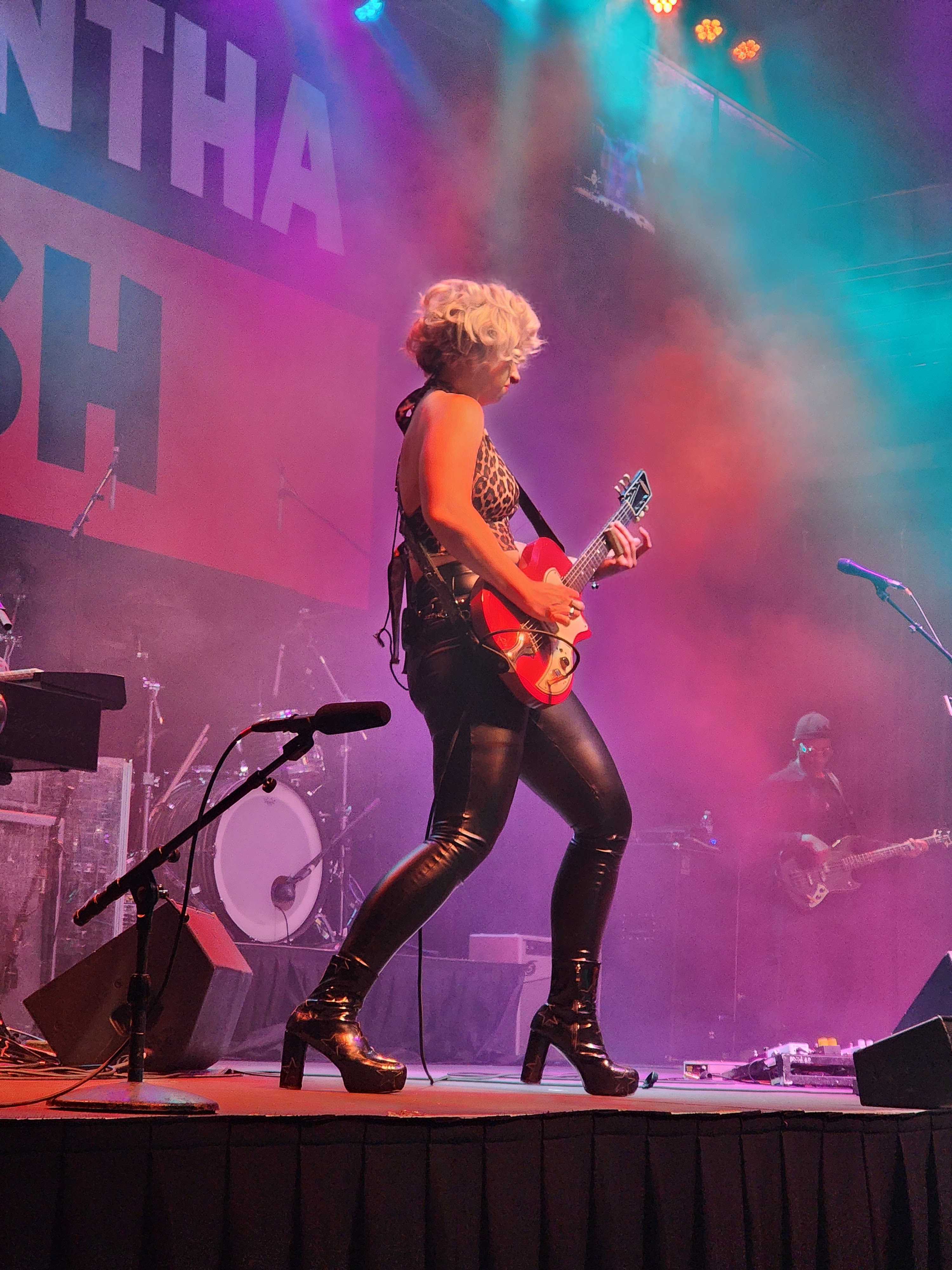
All pictures were taken by Benn Bell at the Mercury Ballroom in Louisville, Kentucky May 6, 2025.
In the quiet corners of everyday life, ordinary people often find themselves immortalized in ways they never imagined—through the viewfinder of a photographer or the ink of a writer’s pen. Whether captured candidly in a photograph or reimagined as a character in a story, these individuals unknowingly lend their lives to art. They become more than just passersby or background figures; they transform into muses, metaphors, and living echoes of human experience.
For photographers, the world is a living gallery of moments waiting to be captured. A weathered man sitting on a park bench, the way light dances across a child’s laughing face, or the tension etched into the shoulders of a woman walking alone—each scene is a potential story. Often, the subject has no idea that they have just stepped into the pages of a visual playbook. Their gestures, expressions, and the energy they radiate become a part of something greater—a reflection of mood, culture, or emotion. The photograph freezes their reality and elevates it into art.
Writers, on the other hand, weave people into narrative form. A conversation overheard on a train, a barista’s nervous smile, or an old friend’s resilience in grief—these fragments of life often become seeds of inspiration. The people we meet or merely observe become the blueprints for characters, sometimes in exact likeness, sometimes stitched together from multiple souls. Writers borrow bits of reality to create fiction that feels true. In doing so, they honor the people who left a mark, however briefly.
But this transformation from real life into art raises questions of representation and authenticity. Do we owe something to the people who unknowingly inspire us? Can we ever truly separate observation from invention? Photographers and writers alike walk this fine line, striving to capture truth while also interpreting it through their own lens of feeling and intent.
There is something sacred in this quiet transaction between life and art. Most people will never know they’ve been captured in a fleeting frame or mirrored in a fictional life. But perhaps that is part of the beauty. Their existence, however small in the context of a wider story, becomes part of a legacy—proof that the ordinary is worth remembering. They live on not as anonymous figures, but as meaningful presences in someone else’s vision.
Ultimately, art imitates life not just in grand gestures, but in the subtle details of everyday existence. The people we pass on sidewalks, sit beside in waiting rooms, or share a moment of silence with in elevators—these are the characters of our collective narrative. Photographers and writers are merely the witnesses, the translators. And through their work, these real lives continue to speak.
I have been thinking a lot lately about the hard problem, consciousness. I have been reading about it, watching videos, and listening to podcasts. Recently, I listened to a podcast with Annaka Harris and her husband, Sam Harris. First off, I didn’t know they were married. That was a pleasant surprise. I had previously watched a video with her on Big Think where she talked about consciousness as a “felt” experience. This has given me a pause. I had always thought of consciousness as an “awareness” of experience. I decided to do a little research. Turns out we were both right, as the following explanation describes it.
Consciousness is both felt and an awareness, depending on how you approach it.
Felt Consciousness (Qualia)
From a subjective, first-person perspective, consciousness is felt—we experience emotions, sensations, and thoughts directly. This is what philosophers call qualia, the raw, subjective feel of experience (e.g., the redness of red, the warmth of sunlight, the taste of coffee). This aspect of consciousness is what makes it deeply personal and difficult to explain purely in physical terms.
Consciousness as Awareness
On the other hand, consciousness is also an awareness, meaning it involves cognition, perception, and the ability to recognize oneself and the environment. This definition aligns with how many neuroscientists and cognitive scientists approach consciousness—as a state of being aware of internal and external experiences. This awareness allows us to think, reflect, and make decisions based on our perceptions.
Blending the Two
While consciousness involves feeling (subjective experience) and awareness (cognitive recognition), the two are deeply intertwined. Some theories suggest that the ability to reflect on our own experiences (metacognition) gives rise to our rich inner life. Others argue that raw feeling, without structured awareness, is still a form of consciousness (as seen in dreams or deep emotions).
So, in essence, consciousness is both felt experience and awareness—two sides of the same phenomenon.
































 Ghost Dog