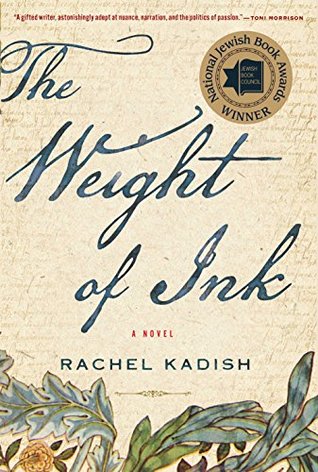
The Weight of Ink is a historical novel superbly crafted by writer Rachel Kadish. It is not the sort of book I would normally have picked out for myself, but it was gifted to me by someone special and is so well written that I honestly couldn’t put it down.
It is a story of historical sleuthing based on papers found hidden away in an old home in Richmond, Surrey. Ms. Kadish creates a handful of compelling characters to tell her tale as she weaves her story back and forth between plague-ravaged London of the mid-1600s and present-day London.
The Weight of Ink is the tale of two women of remarkable intellect: Ester Velasquez, an emigrant from Amsterdam, who through chance and circumstance becomes a scribe for a blind rabbi, and Helen Watt, an ailing historian with a love of Jewish history. It is Ester’s story Helen strives to uncover and what a story it is. Ester documents the Jewish diaspora, the horrors of the Spanish Inquisition, and the rich trade of the City of Amsterdam, all the while scribing for the rabbi in his London home. And she also lives through the Great Plague. Ester manages to communicate with some of the great philosophers of the day and express her own ideas.
There is also an appearance made by a certain bard who shall be nameless here but was named in the book. I kept waiting for him to appear as there were hints dropped along the way and I was not disappointed.
It is truly a remarkable feat to behold and a fabulous read!
Andrew Vachss writes like an avenging angel who has just been through hell.
I have long been a fan of Vachss and have read all the Burke series. He is sort of a guilty pleasure for me, not exactly literature, but a compelling read nonetheless. The man can write!
I ran across this volume in my favorite bookstore in Philadelphia, Molly Bloom’s, and I just couldn’t resist. Apparently, it is the first book in a new series featuring Dell and Dolly. Dell is an ex-legionnaire who was orphaned at a young age and has no idea where he came from. Dolly was a nurse with Doctors without Borders and their paths crossed when Dell was wounded in action on a mission somewhere in Africa. They fell in love, left their pasts behind, and moved to a small coastal town in Oregon. That is where the story begins.
The star softball player at the local high school walks into school on the last day of class and shoots to death a boy for no apparent reason. She also wounds two others. Why did she do it? Was it justified? That is largely what the book is about. But along the way, we meet some pretty onery characters inhabiting the dark underbelly of the town. We also meet some of the good guys. A small-town lawyer who rises to the occasion and puts on a masterful defense and a colorful expert witness from Kentucky.
The book culminates in a riveting courtroom scene that produces a satisfying denouement.
All in all, a good read. If you like thrillers, this is the book for you. Highly recommend!
Norwegian Wood is the second Murakami book that I have read. The first one was Kafka on the Shore. I was looking for a second book to get into when I landed on Norwegian Wood. I understand that it is a bit of a departure from his other books, but that is ok because I really loved Norwegian Wood. It was not what I was expecting, but it was perhaps better than what my expectations were. It is essentially a love story of a young man coming of age in Japan in the late 60s.
In Chapter one, Toru Watanabe hears the strains of the Beatles song, Norwegian Wood, as he lands at an airport in Hamburg, Germany. This song recalls to his mind the loves story of his youth in Tokyo when he was attending college. The rest of the novel tells that story.
In the telling, Murakami evokes the sights and sounds of the turbulent 60s, the songs of the period, the student unrest, and the pangs of falling in love. He has created some unforgettable characters, who by the end of the novel, we feel emotionally bonded to and care deeply about.
Spoiler alert!
There are five deaths in the novel, four suicides, and one illness. But the way Murakami tells it, they are played “off stage” and are referred to rather than happening on the page. This gives a little emotional distance from the deaths but never the less has a powerful impact. When Toru got word of Naoko’s suicide in the last chapter it was like a punch to the gut. I literally let out an, “Oh no!” and went on reading. I don’t usually cry at novels but this was an exceptionally gut-wrenching moment.
I started off by saying this was a love story, and so it was, but I think it was more a book about loneliness, mental illness, and suicide. But Murakami is such a beautiful writer the way he presents his story is not depressing, but quite beautiful and poignant. I truly loved this novel.
Denzel Washington and Frances McDormand in “The Tragedy of Macbeth,” Courtesy of Apple/A24
Macbeth, directed by Joel Coen and shot entirely on a sound stage, was certainly a sight to behold. It was filmed in luscious black and white giving the movie an instant classic look and taking the viewer out of the realm of reality and plunging them straight into the surreal and pathological world of the Thane of Cawdor.
This was Joel’s first foray into film without his brother Ethan at his side and what a miracle of rare device it was. With his emphasis on camera angles, close-ups, medium shots, long shots, and long and dark shadows, I was reminded of past movies of film noir and German expressionism, such as the films of F. W. Murnau, Fritz Lang, and Orson Welles. The aspect ratio of 1.37:1, almost square, recalls the classic films of old.
The performances by all the actors were uniformly excellent. Frances McDormand put in a very solid performance as Lady Macbeth. One might quarrel with her interpretation but really, I don’t see how it could be improved. I thought Denzel Washington excelled in his role as Macbeth and both actors played well together. I loved what Coen did with the weird sisters, all three played by the diminutive Kathryn Hunter.
The overall piece was visually stunning, full of sound and fury, and filled with an abundance of symbology.
A very satisfying cinematic event. Highly recommend!
Aunt Renie came to Louisville, Kentucky for a visit. It was in the spring of the year and nearing Derby Day, so I decided to take her out to Churchill Downs to watch the horses run.
We drove to south Louisville where the track is located and parked the car a few blocks away and walked the remaining distance to the track entrance. Aunt Renie is pretty spry for an old lady.
We were both able to get in for the admission price of only $1.00 as we were both senior citizens. Louisville likes to encourage its seniors to go to the track. We made our way through the throng of horseracing fans to a booth where they sell racing forms. I bought one and stuck it in my pocket. Then we walked out to the track and sat in the sun on hard benches and studied the form to make our picks.
We studied the racing form and saw that there was a field of eight horses for the next race. Aunt Renie had never been to a racetrack before so I had to teach her how to handicap the race. I am not an expert myself but here’s how I do it. The first thing I do is to study the form for the information listed about the horses for that particular race. First of all, I look for names I like. Something that clicks. Then, I look at the stats on that horse. Who is the trainer, who is the jockey, how much weight does the horse carry, how many races did the horse win this year, and last, what are the odds?
I take all these things into consideration and make a selection. I picked what looked like a winner: Psycho Blue Boots, the number 5 horse in the 3rd race. I suggested to Aunt Renie that we bet $10.00 to win on the 5 horse. If it won, we would split the winnings. She agreed.
I pushed my way through the crowd to the parimutuel window and placed my bet.
“$10.00 to win on the 5 horse in the 3rd race,” I said. The teller smiled, took my money, and punched my ticket.
The race was about to begin as was indicated by the trumpet call to the gate. I hurried back to where Aunt Renie was sitting and showed her our ticket. Just then the announcer announced, “They’re off!” And the race began.
“On the lead was Solient Green, on the outside Golden Band. On the rail was Shiftless Joe followed by Psycho Blue Boots. Royal Pain was moving up to fourth place, Psycho Blue Boots makes a sudden move…They are in the turn, Royal Pain is in third. Psycho Blue Boots moving up on the outside…now moving in…in the stretch Psycho Blue Boots takes the lead…at the wire…Psycho Blue Boots wins by nose!”
The crowd goes wild. I go wild Aunt Renie goes wild. We are winners!
We won enough on the race we were able to celebrate at one of Louisville’s most prestigious steak houses, Jack Fry’s. We had quite a day at the races and a nice meal to boot.
The next morning, I took Aunt Renie to the airport where she resumed her travels.
Sunday. 2/6/2022. 2:58 pm Riot Café. Reading August Strindberg – Miss Julie and Other Plays. Notes to follow.
Riot Café. Photo by the author
The Red Room, A satirical novel written by Strindberg in 1879. It is not a far cry to go from Red Room to Redrum to Murder. Just saying.
“Strindberg’s naturalism is not a slice of life, but rather the intense, immediate drama associated with what he called, ‘the battle of the brains.’ This is fought, not with theatrical swords or daggers, but with the equally lethal mental cut and thrust of two implacably hostile minds, bound to each other by desire and hatred. It is a battle in which one of them ultimately destroys the other’s will and commits ‘soul murder.’” One is immediately put in mind of Edward Albee’s, Who’s Afraid of Virginia Woolf?
Indeed, Translator Michael Robinson makes the very same observation writing about, The Dance of Death, a play written by August Strindberg in 1900, as a depiction of a marital inferno. He cites the numerous critics who regard it as the forerunner to Eugene O’Neill’s, Long Day’s Journe into Night and Edward Albee’s, Who’s Afraid of Virginia Wolf?
Why read Strindberg today? Because he is as relevant today as he was in 1887.
Strindberg was one of the most extreme theatrical innovators of the late 19th century and ultimately the most influential. The five plays presented here mark his transition from naturalism to modernism.
In The Father, Strindberg shifts away from social and political questions towards more psychological writing. Strindberg was more concerned with the discussion going on in Scandinavia at the time about the “woman question,” sexual morality, marriage, and the shifting psychological states of his characters (Robinson).
The Father is a three-act play with eight characters. The two principal characters are the Captain and his wife, Laura. It is a naturalistic tragedy about the struggle between parents over the future of their child.
The Captain is a scientist and freethinker whose marriage has gone south. He is engaged in a power struggle with his wife, Laura, over their daughter who wants to keep the girl home under her own influence whereas he wants to send the girl away to school. In an attempt to dominate her husband and get her way, Laura decides to drive her husband insane by first insinuating that he is not the girl’s father. The mother (Laura), uses her cunning to subdue and finally destroy the father (The Captain).
Strindberg is a great purveyor of naturalism, but in The Father, he is reaching for “greater naturalism” which is intense, immediate, and associated with a battle of the brains. (Battle of the sexes, battle of wills). The two main characters can be seen as representing the male and female principles.
Strindberg believed that life is a series of struggles between weaker and stronger wills.
What initially brought me to revisit Strindberg were the films of Ingmar Bergman. Always a big fan of Bergman I began to realize what an influence Strindberg had on the filmmaker. I began to do a little research and it turns out in his lifetime Bergman directed eleven Strindberg plays for the stage, eight for radio and two for television. He was responsible for altogether twenty-eight Strindberg productions. He often returned to the same plays, producing A Dream Play and The Ghost Sonata four times, The Pelican three times and Miss Julie, Playing with Fire and Stormy Weather twice.
My favorite Bergman movie is The Seventh Seal. It has many similarities to the play, The Saga of the Folkungs. They are both set in the 14th century, the plague is present and religion is a major component.
Sources:
Michael Robinson, Translator, Introduction and Notes to Miss Julie and Plays by August Strindberg.
Strindberg and Bergman, Egil Tornquist, November 2012
Twelve Links in the Chain of Interdependent Co-Arising
Ignorance
Volitional action
Consciousness
Mind/Body
Six sense organs (Eyes, ears, nose, tongue, body, mind)
Contact
Feeling
Craving
Grasping/attachment
Coming to be, being, becoming
Birth
Old age (decay) and death
Each link contains the other links. All teachings of Buddhism are based on interdependent co-arising. If a teaching is not in accord with interdependent co-arising it is not the teaching of the Buddha. Buddha taught that everything is both cause and effect. Interdependent co-arising goes beyond our concepts of time and space. The one contains all.
The presence of light means the absence of dark. The presence of day means the absence of night. The presence of ignorance means the absence of understanding. The Buddha said, “When ignorance comes to an end, understanding arises.”
My Life as a Man, a novel written by Philip Roth, comes from Roth’s middle period, after Goodbye Columbus and Portnoy’s Complaint, but before American Pastoral, I Married a Communist, and The Human Stain. Roth has written some 30 odd books, not all of them odd but some pretty strange, and he is possibly America’s best writer, if not one of the most prolific. Beats me why he never won the Nobel, for he was surely deserving.
I’ve read most of his later works and all of his earlier works and I am slowly catching up on his middle period. I don’t profess to be an expert on Roth, but I certainly like his writing I and return to him over and over again.
This book, My Life as a Man, is a story within a story, or two stories within a story, then Peter Tarnopol’s (narrator) true story. It concerns his marriage to Maureen Tarnopol who tricked him into marrying him and has become his arch-enemy. Maureen, in their divorce proceedings, described him as, “…a well-known seducer of college girls.”
Peter Tarnopol is a promising young writer who is also a college professor who teaches creative writing. He occasionally gets involved with his young students who become grist for his mill. He teaches literature and creative writing at The University of Wisconsin and Hofstra College on Long Island. He was a patient of Dr. Otto Spielvogel, a Manhattan psychoanalyst, from 1962-1967. Spielvogel considered Peter Tarnopol to be among the nation’s top young narcissists in the arts.
As usual, Roth draws from his own life and previous fiction and writes about what he knows best.
It is a rollicking satire teetering on the edge of tragedy as Roth brilliantly tells the tale of his marriage and his many peccadillos.
Roth writes in an attempt to make art out of his calamitous life and to spin gold out of straw. Is it him or his characters, or is it Memorex? You be the judge. For him, (Tarnopol), “…writing is a vain attempt to get myself to feel like something other than a foreigner being held against his will in a hostile and alien country.”
For Philip Roth, life is a Kafkaesque nightmare whereupon the dreamer ruminates on the possibility of being transformed into a gigantic cockroach. Upon awakening, he heeds the advice of Gustave Flaubert who suggests leading a regular and orderly life and being violent and original in his writing. This is a lesson Philip Roth seems to have taken to heart.