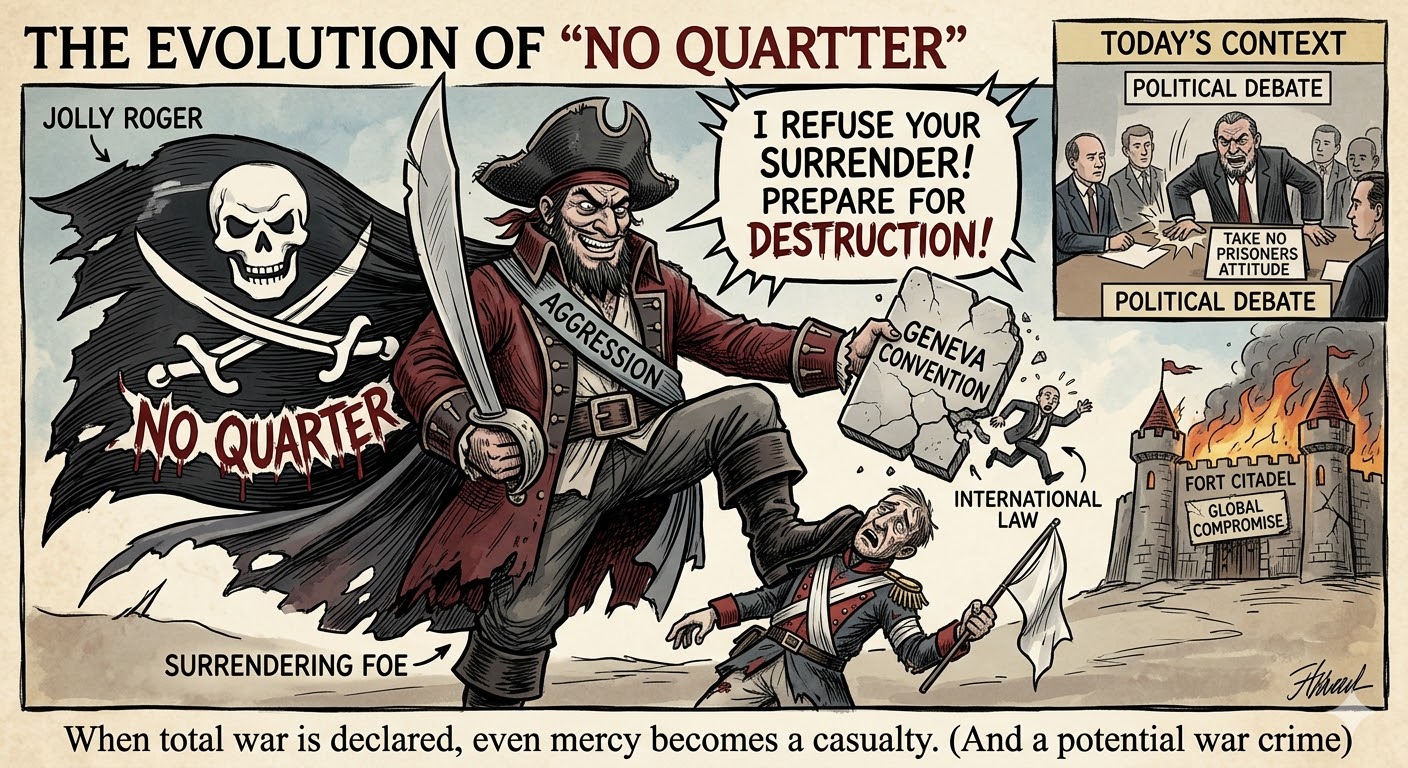
In a military context, the phrase “no quarter” means that a victor will show no mercy to a defeated enemy. Specifically, it signals that no prisoners will be taken. Anyone who attempts to surrender will be killed rather than captured. The engagement is to continue until one side is eliminated. The word “quarter” historically refers to providing shelter or exemption from being killed; therefore, “no quarter” is the refusal to grant that exemption.
The issuance of an order of “no quarter ” is a war crime under international law. Although it was common in historical warfare and piracy, it has been strictly outlawed for over a century. The prohibition isn’t just about the act of killing surrendering soldiers; the mere declaration or threat that no survivors will be taken is itself a criminal offense.
Several major international treaties and statutes explicitly forbid the denial of quarter:
- The Hague Convention (1907): Article 23(d) states that it is “especially forbidden… to declare that no quarter will be given.”
- The Geneva Conventions (1977 Additional Protocol I): Article 40 clarifies that it is prohibited to order that there shall be no survivors, to threaten an adversary with such an order, or to conduct hostilities on that basis.
- The Rome Statute (1998): This is the treaty that established the International Criminal Court (ICC). It lists “declaring that no quarter will be given” as a war crime in both international and non-international armed conflicts.
The law of armed conflict is built on the principle of military necessity. Once a combatant is out of the fight, whether because they are wounded, sick, shipwrecked, or surrendering, they no longer pose a military threat. Killing them provides no military advantage and is considered “useless cruelty.”
You don’t actually have to carry out the killings for a crime to have occurred. Legally, the act of issuing the order or making the threat is the violation. This is because such a declaration forces the enemy to fight to the death, invites immediate and equally brutal retaliation, and undermines the basic humanitarian standards that protect all service members.
In a modern military, an order to “give no quarter” is considered manifestly unlawful, meaning subordinates have a legal duty to disobey it.
Pete Hegseth, the Minister of War, has ordered our military to offer “no quarter’ to the enemy. This is a war crime. President Trump is complicit in this policy. They are both war criminals and should be held accountable. As Americans, we cannot allow these criminal acts to be undertaken on our behalf. I urge the military to refuse illegal orders and all Americans to object to these heinous, barbaric, and cruel acts of warfare carried out in our name.

 Ghost Dog