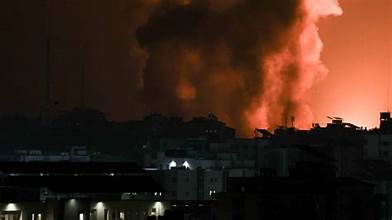
Antisemitism is on the rise in this country and around the world. I loathe bigotry of any sort, but antisemitism is particularly galling. How did we get to this place? The war between Israel and Hamas has a lot to do with it. Hamas knew exactly what it was doing when it struck on October 7. They knew Israel would unleash fury upon Gaza. As they use civilians as human shields, collateral damage is inevitable. The more carnage the more world opinion turns against Israel and sympathy rises for the Palestinians. This is exactly what Hamas wants and it is winning the propaganda war. I don’t like to see civilians killed in war, especially innocent children. It breaks my heart every time I see a small broken body being carried in a parent’s arms. There doesn’t seem to be any good solution, but I would like to see a cease-fire, the hostages released, and negotiations begin for a two-state solution. Big ask. I know Israel won’t stop until Hamas is obliterated. This is understandable as they face an existential threat, but they must do everything possible to limit civilian casualties and abide by the rules of war.
One more thing. Just because you criticize the state of Israel does not make you an anti-Semite. Every country in the world is subject to criticism. That is the very basis of free speech. It’s when that speech crosses over to hate speech is when we have a problem, and that speech could be interpreted as anti-Semitic. Let’s keep it clean. We should be able to discuss these issues without devolving into hate speech.
It took me quite a while to get around to reading Herzog. It has been sitting around in my personal library since 1985 when I purchased it in a used bookshop in Tulsa, Oklahoma. Since then, I and my books have moved around several times, but we have now finally come to rest in Louisville, Kentucky. Maybe we will be here a little bit longer. The book was published in 1964 and was awarded the National Book Award for Fiction. Bellow, himself, won the Nobel Prize for Literature in 1976.
I have been reading Bellow since the 1970s and for a long time considered him to be my favorite author. Until Philp Roth came along and then I was in this author’s thrall for many years and stopped reading Saul. Much to my detriment, I may add, but now I happily return to Saul Bellow in this wonderful book, Herzog.
Herzog is a classic novel that explores the existential crisis of a middle-aged man who is dissatisfied with his life. The protagonist, Moses Herzog, a middle-aged intellectual living in Chicago is a writer and a thinker, grappling with personal and philosophical questions and writes letters to various people, both living and dead, as a way of coping with his failures and frustrations. The novel is a rich and complex portrait of a man who is searching for meaning and identity in a chaotic and absurd world. It is also very funny.
As I read this story, I couldn’t help but relate to the main character, Moses Herzog. His story deeply resonated with me, and I felt it was a bit synchronous with my own life. For example, Moses had lived in a small town in Massachusetts near Pittsfield. I lived in a small town near Pittsfield. Moses has an affair with a woman in New York while living and teaching in Philadelphia. I lived in Philadelphia and was having an affair with a woman from New York. Like Moses, I would travel back and forth between the two cities. Moses at one time had an Asian girlfriend. I was married to a Korean woman for 14 years. Moses was going through a second divorce as he tried to sort out his life and survive a midlife crisis. Been there, done that. And finally, at lot of the action takes place in Chicago, a city I love and adore.
One of the central themes of Herzog is identity. Moses Herzog is a character deeply rooted in his own sense of self, and the novel examines how he grapples with this identity in the midst of personal and societal turmoil. Herzog’s journey is marked by his attempts to make sense of his failed marriages, his complex relationships, and his role as a father. His introspection on his own identity is similar to the search for meaning that many other individuals undertake in their lives.
Spirituality is another significant theme in Herzog. The novel raises questions about the nature of faith and belief. Herzog’s exploration of spirituality is a deeply personal one, as he grapples with the concepts of God and meaning. He is a secular man, yet he contemplates the existence of a higher power and the role of religion in human life. This internal spiritual journey is one that many people undertake in their search for purpose and transcendence.
Saul Bellow’s prose is rich and thought-provoking. He skillfully weaves together Herzog’s reflections with vivid descriptions of the world around him. Bellow’s writing captures the essence of the mid-20th century and provides a snapshot of American society at the time, with its cultural and intellectual upheavals.
The character of Moses Herzog himself is a complex and deeply human protagonist. He is flawed, struggling, and as I said earlier deeply relatable. His journey of self-discovery and reflection makes Herzog a timeless tale that continues to resonate with readers today. It did with me.
I unequivocally condemn Hamas’ brutality, and I am horrified by the bloodshed left in its wake, and deeply mourn the loss of innocent lives. The horror of these attacks beggars the imagination and can only be described as pure evil and acts of terrorism.
There is no moral equivalency between what Hamas did and what Israel is doing to defend herself. I completely support Israel’s right to defend herself, but she must do so in accordance with international law. I agree with the concerns expressed by international human rights organizations who are worried about civilian casualties in the war.
The U.S. and its allies have a moral obligation to uphold the laws of war and abide by the Geneva Conventions.
Palestinian civilians are not Hamas and had nothing to do with the shocking attacks. The United States must work to ensure innocent residents of Gaza are not indiscriminately punished for the actions of terrorists. The intentional attack on civilian populations is nothing less than a war crime.
The Zone of Interest, by Martin Amis, is a provocative and disturbing examination of one of the darkest periods in human history. I ran across this book while reading another Martin Amis book, Inside Story. Inside Inside Story, Amis discusses how he came to write and publish TheZone Of Interest. What caught my interest was the critical reaction to the book. It seems you can’t interject humor into an account of the horrors of the Holocaust. Imagine that. Well, I needed to see what the fuss was all about, so I set about to find said tome which wasn’t easy as it was out of print. Amazon didn’t have it. Half Price Books didn’t have it, and Barnes and Noble didn’t have it. I was left with having to scour the used bookstores of the nation. Finally, in a little bookshop in Chicago, I found it and sent in my order straight away. In a few days, it arrived on my doorstep in pristine condition. Needless to say, by the time it got there my interest level was elevated.
Amis tells the story of the Holocaust from the perspectives of each of the three main characters living in and operating a death camp at Auschwitz. This camp is the “Zone of Interest” from the title of the novel. Using this narrative technique Amis gives us a clear view of the atrocities occurring daily in the concentration camp. The story unfolds primarily through the viewpoints of Angelus Thomsen, a high-ranking Nazi officer; Paul Doll, the camp commandant; and Szmul, a Jewish inmate forced to work in the camp’s Sonderkommando. There is a love story attached that involves Thomsen and the commandant’s wife, Hannah Doll. It is unrequited but carries much of the weight of the novel. This story serves to illustrate the blurring of the lines between victim and perpetrator.
Jewish “evacuees” are brought by train to be used as forced labor or to be gassed, their remains incinerated and then buried in the disgusting-smelling Spring Meadow by the “sonderkommado.” Szmul is a sonder. He is Jewish and is allowed to live as long as he performs his service, but he knows his time is limited too. He describes himself and his crew as the saddest, most disgusting men in the camp. They work with the dead, with heavy scissors, pliers, and mallets. There are three reasons for them to go on living: first to bear witness, second to extract mortal revenge if possible, and third to save a life from time to time to time, mostly young Jewish males.
Amis’ writing style is both terrifying and moving as he describes the brutality and horror of the camp. There are moments of dark humor and absurdity which I found to be quite appropriate. The juxtaposition of horror and humor produces a shroud of surrealism that makes one think about the moral and ethical implications elicited from the Holocaust. Amis incorporates many German words and phrases into the narrative giving one a sense of verisimilitude. I am reminded of Anthony Burgess’ Clockwork Orange where he created an entirely new language composed of both English and Russian and combinations of the two.
Zone of Interest is an examination of what Hannah Arendt described in her book Eichman inJerusalem as the “banality of evil.” Amis portrays characters going about their daily tasks in the camp as if they were managing any other administrative task. This chilling portrayal underscores the idea that ordinary people can become complicit in unimaginable atrocities under the right circumstances.
Zone of Interest is a challenging and haunting novel that offers a unique perspective on the Holocaust. Through its complex characters, dark humor, and unflinching portrayal of life in Auschwitz, the book forces readers to confront the darkest aspects of human nature and the enduring questions of morality and complicity. This powerful book has stayed with me long after I read it and is, I think an important contribution to the literature of the Holocaust.



 Ghost Dog